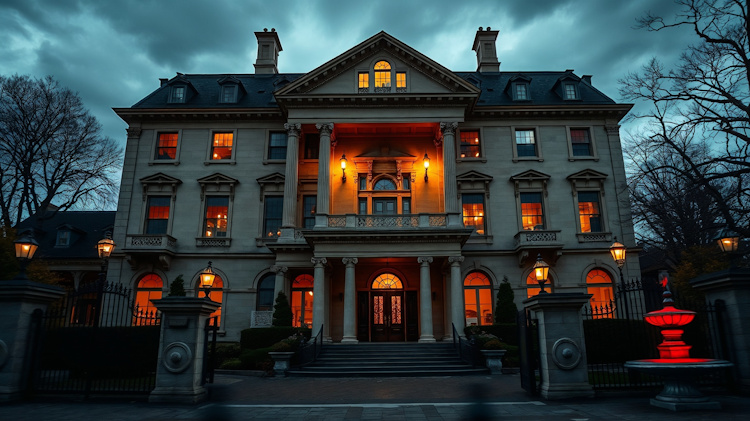
In the affluent district where Alchester's minor nobility maintain their estates, Lord Ashworth's mansion stands as a testament to expensive tastes and the careful cultivation of appearances. The estate occupies considerable grounds, surrounded by walls high enough to ensure privacy, while manicured gardens visible through the gates suggest wealth deployed for aesthetic purposes. The mansion itself rises three stories, built in the classical style favored by those who wish their homes to project both permanence and prestige. Pale stone, tall windows, and a columned entrance create an impression of established authority, though those familiar with Alchester's noble families understand that Ashworth's title carries less weight than his house's appearance might suggest.
Lord Ashworth himself occupies that uncomfortable position in society's hierarchy where wealth and ambition exceed actual power and influence. His family secured their title through service to the crown several generations past, but their current standing depends more on careful cultivation of useful connections than on any significant holdings or political authority. Lord Ashworth's expensive tastes run to collecting—not with the obsessive focus of some, but with the acquisitive eye of someone who understands that possession of rare items signals status and sophistication to those who matter.
The mansion's public areas reflect this understanding. Entrance halls display sculptures and paintings acquired through purchases that pushed the limits of prudent spending. Reception rooms contain furniture imported from neighboring fiefdoms, their exotic origins meant to impress visitors with the reach of Ashworth's commercial connections. Even the choice of which wines to serve at social functions receives careful consideration, each selection calculated to suggest refined taste and substantial means. Everything about the house's presentation has been designed to position its owner as someone of significance, someone whose opinions carry weight, someone worth knowing.
The private areas tell a somewhat different story. Behind the carefully maintained public facade, the mansion's less visible spaces reveal a man struggling to maintain appearances beyond his actual means. Some rooms remain sparsely furnished, their decoration incomplete. Bills accumulate in desk drawers, and payments are delayed as long as propriety allows. The staff, while professional in their conduct, are fewer in number than a house of this size would typically employ. Ashworth manages his financial pressures through careful juggling of obligations and strategic deployment of charm, but those close enough to observe understand that the grand estate operates closer to the edge than its owner would ever publicly acknowledge.
These financial pressures have made Lord Ashworth receptive to certain arrangements that nobles with more secure positions might decline. He has developed a reputation among particular circles as someone willing to provide his estate for uses that require both privacy and the appearance of legitimacy. A mansion belonging to a minor noble, a man known for hosting social functions and cultivating connections across Alchester's commercial and political spheres, provides exactly the sort of venue that certain parties require for transactions that would draw unwanted attention if conducted in less respectable surroundings.
The mansion has become known for its regular social gatherings. Lord Ashworth hosts galas, dinner parties, and salon evenings with practiced ease, events that draw from Alchester's merchant class and minor nobility in calculated proportion. These occasions serve dual purposes—they maintain Ashworth's social visibility and provide cover for the less conventional activities that help fund his lifestyle. The ballroom where guests dance has seen legitimate entertainment, but its true value lies in the plausible deniability it provides for a house that serves functions beyond simple hospitality.
The estate's layout facilitates these arrangements. Public areas flow into each other with architectural grace, designed to accommodate the movement of guests during social functions. But certain corridors lead to spaces that most visitors never see—studies with locks better than their appearance suggests, storage rooms that contain items unrelated to household management, and chambers whose purposes even the regular staff do not fully understand. Ashworth maintains careful control over who accesses these areas, employing guards whose discretion has been purchased along with their loyalty.
The gardens surrounding the mansion contribute to its usefulness. Carefully maintained paths wind through ornamental plantings, creating spaces for private conversation away from the main house. Fountains provide both aesthetic appeal and practical function, their sounds masking discussions that require confidentiality. The lighting throughout the grounds can be adjusted to create either a warm, welcoming glow or strategic shadows, depending on the evening's requirements. During social functions, colored lights illuminate the fountains—red and blue, the royal colors of Kallendor, a choice that demonstrates Ashworth's careful attention to appearing properly patriotic while hosting events that include activities the crown would certainly not approve.
Lord Ashworth's reputation among Alchester's elite balances on a knife-edge. To some, he is simply another minor noble with more ambition than influence, hosting unremarkable social gatherings and maintaining connections that serve his business interests. To others who move in darker circles, he represents opportunity—a man whose financial pressures and social positioning make him willing to provide services that more secure nobles would refuse. The tension between these two perceptions defines both the mansion's character and its owner's precarious position in society.
The house staff navigate this duality with practiced discretion. Servants know which rooms they may enter freely and which require explicit permission. Guards understand that certain visitors arrive through less public entrances and depart without being recorded in any ledger. The household operates according to unspoken rules, maintaining the appearance of conventional nobility while accommodating activities that would shatter that appearance if revealed. This careful performance extends to every aspect of the estate's operation, from which tradesmen are hired to which social invitations are accepted.
Among those who deal in Alchester's shadowy economies, Lord Ashworth's mansion has acquired particular significance. It represents a space where legitimacy and illegitimacy intersect, where transactions requiring both privacy and the veneer of respectability can be conducted without the complications that attend more obvious venues. The mansion's very conventionality serves as camouflage, its regular social calendar providing cover for arrangements that occur between and around those legitimate gatherings.
The financial arrangements that sustain this operation remain carefully obscured. Ashworth receives compensation for the services his estate provides, but these payments flow through channels that would be difficult to trace even for those with resources to investigate. The careful accounting extends to every transaction, every arrangement, every use of the mansion's facilities for purposes beyond simple hospitality. This financial opacity allows Ashworth to maintain his public position while privately depending on income that legitimate sources alone could not provide.
For all its grandeur, the mansion exists in constant tension between the image it projects and the reality it conceals. The pale stone facade speaks of established wealth and respectable position, while the activities within tell stories of compromise and calculation. Lord Ashworth moves between these two worlds with practiced ease, playing the role of minor nobility at social functions while quietly facilitating arrangements that serve clients whose purposes he may not fully understand but whose coin he certainly appreciates.
The estate's continued operation depends on maintaining this delicate balance. Too much visibility would invite scrutiny that Ashworth's arrangements could not withstand. Too little would eliminate the social positioning that makes the mansion valuable for those who employ its services. Ashworth navigates between these extremes with the skill of someone whose survival depends on never attracting quite enough attention to trigger serious investigation, while remaining prominent enough to maintain his usefulness to those who pay for access to his estate.
The mansion stands now much as it has for years, its doors open to guests who arrive for legitimate social functions and to others who come for purposes that remain carefully unspoken. Its gardens continue to host polite conversation and strategic negotiation in equal measure. Its ballroom sees both dancing and discussions that would scandalize the dancers if they knew what transpired there at other times. Lord Ashworth presides over it all with the careful attention of someone managing assets more complex than simple property, maintaining appearances that require constant effort to sustain.