CAVERN OF THE WELL
Overview Location & Approach The Temple Chamber The Well of Darkness The Druid Sentinels History The Watch
Overview
Deep beneath the ancient roots of the Simmaron Woods lies a place of profound evil—a testament to both the darkest ambitions of mortal zealotry and the resolve of those who stood against it. The Cavern of the Well ranks among the most dangerous sites ever created on Uhl: a temple to corruption that nearly ended all life, and which required the full strength of the druidic Order to contain.
It has never been destroyed. It cannot be. Every generation that has faced it reached the same conclusion the druids reached first—some evils will not be unmade, and must instead be shut away and watched.
Location & Approach
The entrance opens in a small clearing deep within the Simmaron, ringed by blackwood oaks that stand dead and blackened as though scorched, though no ash litters the ground. For five centuries the opening appeared as an impenetrable black void, hidden from mundane searches and mystical ones alike by the druids' final working. Only in recent years has it taken on the look of a thing men use: a vertical crack in the limestone, widened and braced with timber gone gray from weather.
Beyond the threshold, a narrow passage descends steeply into the earth. It forces a traveler sideways in places, its walls pressing close. Each step has been worn smooth by those who came before—zealots, druids, and the wardkeepers who walk it still. Fine dust covers everything, settling again within hours of any disturbance. No wind stirs the air rising from below, and no snow penetrates the dark, whatever the season above.
The Temple Chamber
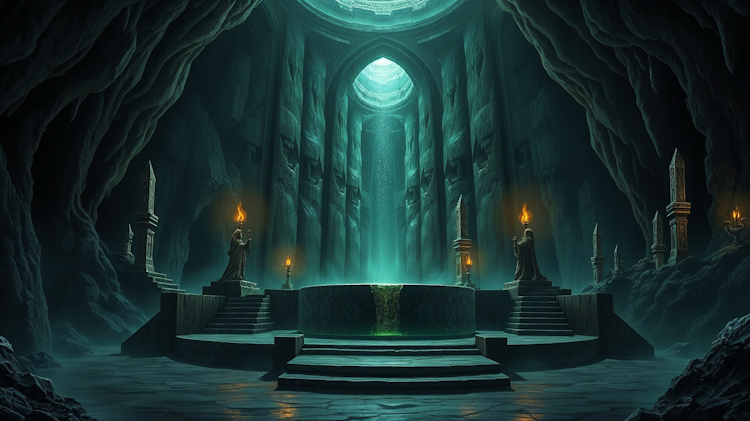
The passage levels out and opens into an enormous vault. The ceiling climbs beyond the reach of any lantern. The walls emanate a greenish iridescence—light enough to navigate by, never enough to banish the shadows clinging to the chamber's extremities. Somewhere high above, a fissure admits moonlight that falls across the center of the chamber in a pale, unhealthy column.
Stalagmites rise from the floor in formations twice the height of a man, a limestone forest dense enough to blind a traveler to whatever waits around the next turn. A winding path threads through them, marked by torches set at eye level that can be lit by those who know the way. The path meanders and doubles back in a deliberate maze until it reaches the heart of the temple: a raised dais, encircled entirely by carved stone steps that show no wear at all, as if the stone refuses the passage of time.
The air is stagnant and cool, smelling of staleness and age. Animals brought near the place react with distress. Even those with no gift for magic report a mounting physical discomfort as they climb the dais, a pressure that thickens with every step.
The Well of Darkness
At the center of the dais lies a wide pool cut into the stone, taking up most of the platform. Its contents are not water but the distilled essence of decay—a turbid, brackish liquid that seethes and boils with a vitality that belongs to nothing living. According to accountings preserved by the druids, the Well holds "the very immortal power of the Lord of Rot himself," a direct conduit to the essence of Sarrengrave, God of Disease.
To look upon it is to feel waves of nausea. To touch its contents is to invite death, or something worse. Those who have kept watch over it longest describe a whisper rising from beneath the surface—not words, not quite language, but communication nonetheless, patient and vast and wholly malevolent.
Unchecked, the Well's influence seeps outward through soil and stone, following roots and the flow of underground water. Trees wither and blacken. Clear streams turn foul. Animals sicken and rot from within. Its creators calculated that within years, perhaps months, the corruption would spread past the Simmaron and into the wider world, and that nothing could stop it—for how does one fight a poison that travels through the earth itself?
Parthen, who knew it better than any, called it the Well of Rot.
The Druid Sentinels
Four monoliths stand upon the dais in a perfect circle, one to each quarter—north toward the Ugull Mountains, east toward the heart of the Simmaron, south toward Homewood, west toward the distant coast. Each rises ten feet, gray stone carved into a hooded figure in robes, arms outstretched and palms turned outward against something unseen. The druids carved no faces. Within each cowl waits the same featureless dark that has greeted every watcher who ever climbed those steps.
Runes run along the sleeves and hems in the old tongue, their clarity undiminished by five centuries. Every fold of every robe, every angle of every outstretched finger, every degree of the palms' outward cant serves the enchantment. The druids understood that in works of true power, form and function cannot be separated.
The wards do not destroy the Well's power. They contain it, holding its taint within an invisible barrier and drawing their own strength from the earth—from the very roots of the Simmaron the zealots sought to poison. So long as the forest lives, the wards endure.
Set into each statue's breast at heart height rests a Gemstone of Morann, pulsing blue-green with a rhythm steady as a heartbeat. Warmth radiates from each gem, pushing back the chamber's cold in a small circle around every sentinel. Those trained to read that warmth treat it the way a healer treats a pulse: strong and steady means the wards hold; a cooling here, a brightening there, means something has gone wrong below.
History
The Zealots of Sarrengrave
The Well was created ages ago, during the Age of the Old Gods, when the Immortals still walked Uhl in physical form. Among the dark gods, few inspired more dread than Sarrengrave. Where others sought conquest by force of arms or domination of will, the Lord of Rot offered decay—corruption spreading unseen through flesh and earth, sickness capable of toppling kingdoms more surely than any army. His followers saw in disease and death not tragedy but a fundamental truth: that all things must return to nothingness.
A cadre of his priests gathered in the depths of the Simmaron, far from any road. They did not want conquest. They wanted annihilation—the return of the living world to the void from which it emerged. To reach it, they needed a focal point through which their god's essence could be channeled and amplified, and they chose the Simmaron for practical reasons rather than hatred. The woods were ancient and vast, their roots running deep. Power that flowed through the forest could be turned inward, and a source of life made into a wellspring of death.
They carved the cavern in secret, delving through limestone toward veins of mineral that glowed with an eerie green light—a sign, they judged, of their god's favor. They raised the dais. Then, in the dead of night, they performed a final ritual whose particulars have been mercifully lost, calling upon Sarrengrave with offerings that violated every natural law. What answered took physical form: a pool of pure corruption, their god's power concentrated until it ran like liquid.
The arch-druid's account names no leader among them. Delbin Kinkaed refused to speak the god's name aloud, and he did not speak theirs either.
The Druids' Answer
The zealots had miscalculated. For generations beyond counting the druids had guarded the Simmaron, attuned to its rhythms as a man is attuned to his own flesh, and the spreading corruption reached them as a scream. They traced it through root and stone to the hidden entrance, lit the torches along the descending passage, and found the temple.
The battle was brief and savage. The priests of Sarrengrave fought with skin that blistered at a touch, breath that carried pestilence, blood that burned like acid—they had served the Lord of Rot so long that they had become avatars of decay. But the druids fought for their home, and they were willing to spend everything. The zealots fell. Some were struck down by druidic magic and returned to the earth they had violated. Others, wounded and desperate, stumbled into the Well, where the corruption they worshipped dissolved flesh and bone until only their screams remained, and then not even those.
The druids slew every violator of the earth who stood in that chamber. Then they turned to the Well itself. Destroying it lay beyond their power—the concentration of Sarrengrave's essence ran too deep, and unmaking it might scatter the corruption more widely rather than end it. So they chose containment. They raised four obelisks upon the dais and worked into them wards of extraordinary potency, drawing on the oldest powers of the earth, each statue serving as a node in a barrier built for one purpose. These became known as the druid sentinels.
Their last act was to seal the cavern, collapsing the entrance and hiding its location from every search, mundane or mystical.
Parthen's Assault
The Old Gods destroyed themselves, and the chaos of the Age of Resilience settled over the world. Sarrengrave was long dead when a priest named Parthen gathered a host of zealots and returned to the Simmaron to finish what an earlier generation had begun.
Parthen struck during a Midwinter Rift, when the barriers between worlds thin and old magic runs at its weakest—a systematic assault on the wards timed with care by someone who understood exactly what he was undoing. He almost succeeded. What defeated him in the end was the thing he could not have changed: his god was dead, and no power answered his calling.
The defenders paid a terrible price. Restoring the wards demanded a ritual that no single tradition could complete alone, and Delbin Kinkaed—ever a renegade among his own Order—partnered with goblin shamans, with dryads, with any who shared his purpose. The working required an anchor: a willing soul, freely given, to hold the renewed protections in place. The patroller Roderick the Bold gave his existence to that purpose. Nearly five centuries later he walks the cavern still, bound by a duty that outlasted his death.
Parthen alone survived the fighting. Killing him would not have been enough—his soul, steeped in Sarrengrave's power, might have lingered as a vengeful spirit, guided others to the Well, or corrupted the earth by its mere presence. Delbin conceived a third answer, both prison and penance. Magic unmade the priest's flesh and bone, leaving consciousness, memory, and guilt. That shade the druids chained to the Well of Darkness itself, to the instrument of what should have been his greatest triumph, through links no mortal means could break. He would remain there, unable to act, unable to influence the waking world, unable to die—bearing witness forever to how completely he had failed.
The Failsafes
Delbin Kinkaed had watched the wards very nearly fall, and he did not intend to leave the next age defenseless. His Order was fading. In his final years he built a hidden tomb deep in the Simmaron's heart, and within it he secured four emeralds of extraordinary power: the Gemstones of Morann, each attuned to one of the four sentinels, each holding a reserve of druidic magic sufficient to renew a broken ward.
He did not give the gems to any keeper. He gave away the means of reaching them instead. To the dryads of Sollin-kel he entrusted a cerulean soul stone containing a portion of his own spirit, along with the location of his tomb, charging them to pass both down through the generations. Should the wards ever break and the Well threaten the forest again, the bearer of that stone was to journey to his grave and call him forth. He would answer, he promised, even from beyond death.
The Long Silence
The wards held more than four centuries. The entrance stayed hidden so completely that no searcher found it. The druids passed into legend, their Order fading as the Age of Change began, until many counted them fanciful tales told around evening fires and doubted Delbin Kinkaed had ever lived at all.
Within the sealed chamber, Parthen endured, alone in the dark with his memories and the Well he had tried to wake.
The Witch Saress
The silence broke when the sitheri witch Saress discovered the cavern and negated the wards, unleashing the Well's evil upon the Simmaron. The forest sickened from beneath. Trees blackened, streams turned foul, and the corruption crept toward Sollin-kel, killing the dryads who had kept Delbin's trust for five hundred years.
Aliah Starbough, half-dryad and last inheritor of that trust, carried the soul stone to the arch-druid's tomb and summoned him. What passed between them she has never recounted. She came away with the Gemstones of Morann and the knowledge of what they were for.
The reckoning in the temple chamber cost a great deal and did not go as anyone intended. Saress died in the Well she had come to master. Parthen, who had spent five centuries learning patience, won the freedom he had bargained for. And the Well of Darkness stood empty for the first time since the Age of the Old Gods.
By what means the Well was made whole again, and the Gemstones of Morann set into the sentinels' breasts, Aliah Starbough has never fully told. What is recorded is that she placed them there herself, and that the wards woke.
The Midwinter Crisis
Four years later the wards failed a second time, worn down by a long campaign against the sacred sites and ley lines of the Simmaron, and struck at last during another Midwinter Rift. Three of four sentinels guttered. What saved the forest was the same thing that had saved it five centuries before: a wardkeeper, a ghost, and a goblin shaman who set aside the enmity of their peoples, and a willing soul freely given to anchor the working.
The wards that stand today are woven of two traditions—the blue-green of the Gemstones of Morann and the pale blue of winter-light crystals grown in the deep caves of the Ugull Mountains.
The Watch
The Simmaron Hall learned the lesson its predecessors had learned twice already, and did not wait for a third reminder. Within a year of the witch's defeat the Hall established the wardkeepers: patrollers chosen for heightened attunement to the world around them and for the ability to draw upon their sri, or life force energy, selected out of the ranks and sworn to a duty separate from any other the Hall keeps.
A wardkeeper maintains a cabin in the clearing above the entrance and descends at regular intervals to lay hands on each sentinel and listen. It is solitary work by design, and its practitioners tend to be people who find solitude no hardship.
The druids chose containment over destruction because they understood their limits. Their successors have inherited both the choice and its consequence: the Well cannot be ended, only held, and holding it is not a task that concludes. It is a watch, kept in shifts, across ages, by whoever is standing there when the light begins to falter.