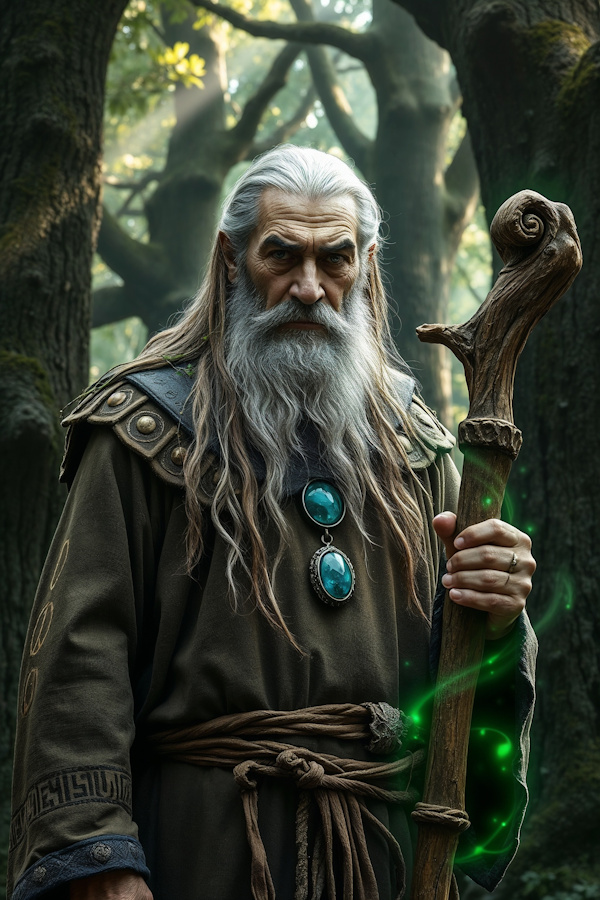
In the annals of the Simmaron Woods, few names command the reverence accorded to Delbin Kinkaed, arch-druid of the ancient Order that once stood as the forest's most stalwart guardians. Though centuries have passed since his death, his legacy endures in whispered tales and the enduring magic he left behind—safeguards against darkness that would one day be needed when the Simmaron faced its gravest peril.
Delbin came to the druidic Order as a young man, already marked by an intensity of purpose that set him apart from his peers. Where other initiates approached their training with quiet contemplation, Delbin burned with a fierce devotion to the natural world. The great blackwood oaks of the Simmaron spoke to him in ways others could not comprehend, and he spent long nights beneath their ancient boughs, listening to the whispers of Earth Power that flowed through root and branch. His masters recognized in him both extraordinary potential and a troubling tendency toward independence—traits that would define his path through the Order.
The druids of that age were the Simmaron's first and most sacred protectors, their traditions stretching back beyond recorded memory to a time when the Old Gods still walked Uhl. They had witnessed the rise and fall of the Gods of Light and Darkness, had seen zealots and dark priests attempt to harness powers beyond mortal comprehension, and had stood against such violations of the natural order. Delbin absorbed these histories with an almost obsessive fervor, understanding that the druids' sacred duty was not merely to tend the forest but to shield it—and through it, all living things—from forces that would corrupt and destroy.
As Delbin rose through the Order's ranks, his reputation grew as both a formidable practitioner of druidic magic and something of a renegade. He questioned traditions that seemed outdated, challenged his elders when he believed they acted with insufficient urgency, and pursued knowledge in places other druids feared to tread. Some whispered that his passion bordered on recklessness, that his stern conviction could blind him to the wisdom of patience. Yet none could deny his power or the depth of his commitment to the Simmaron. When he spoke of the forest, his words carried the weight of one who had communed with its deepest mysteries, who understood that the Woods were not merely trees and earth but a living tapestry of magic and life that required constant vigilance.
The defining crisis of Delbin's life came when zealots of an Old God—a deity whose name the druids refused even to speak—created a Well of Darkness deep beneath the Simmaron. These dark priests sought to harness the Well's corruptive power to destroy all life, to unmake the world itself in service to their forgotten master. The Well was an abomination, a wound in the fabric of reality that seeped poison into the earth itself, turning fertility to decay and life to death. When the druids discovered what the zealots had wrought, Delbin led the charge against them with characteristic fury.
The battle was fierce and costly. Many druids fell, their life force spent in combat against practitioners of the darkest arts. But Delbin and his brethren prevailed, slaying the violators to the last. Yet victory brought with it a terrible realization: the Well of Darkness could not be destroyed. Its power was too deeply rooted in ancient magic, too fundamentally woven into the structure of the cavern that housed it. To attempt its obliteration might tear apart the Simmaron itself, unleashing devastation far worse than what the zealots had intended.
Delbin refused to accept that such evil must be allowed to persist, even contained. For months, he labored in isolation, delving into the most obscure druidic texts and consulting with spirits of the earth that few others dared approach. His fellow druids watched with growing concern as he drove himself to exhaustion, emerging from his studies only to retreat into the depths of the forest for days at a time. Some feared he was losing himself to obsession, that his stern devotion had become something darker.
When Delbin finally emerged with a solution, even his harshest critics had to acknowledge his genius. He proposed the creation of four great sentinels—stone guardians that would stand eternal watch over the Well, their forms imbued with the most powerful druidic enchantments the Order could muster. These would not merely be statues but living wards, drawing power from the earth itself to contain and suppress the Well's corruption. The magic required was staggering, demanding contributions from every druid of sufficient power and binding their collective will into stone and spell.
The creation of the druid wards represented the pinnacle of Delbin's life work. For weeks, the druids gathered in the cursed cavern, chanting in the old tongue and channeling Earth Power through rituals that had not been performed in generations. Delbin stood at the center of it all, his voice rising above the others as he shaped the enchantments that would endure long after those who created them had returned to the earth. When the four sentinels finally stood complete—robed figures of stone with hands outstretched toward the Well—the chamber thrummed with such concentrated magic that the very air seemed to shimmer. The Well's seething corruption diminished, contained at last within the boundaries the wards established.
But Delbin was not satisfied with mere containment. He understood that the wards, powerful as they were, represented only a partial solution. Magic faded with time, and what one generation sealed, another might unknowingly unseal. The cavern had to be hidden, its location lost to all but those who might one day need to restore what the druids had built. Delbin took upon himself the task of ensuring the knowledge would survive, even as the druids themselves faded from the world.
It was during this period that Delbin forged relationships with the ancient peoples of the Simmaron—the dryads of Sollin-kel and others whose connection to the forest ran as deep as the druids' own. To them, he entrusted soul stones, vessels of cerulean crystal imbued with the power to call upon his spirit should the need arise. These were not mere trinkets but sacred instruments, created through magic that bound a portion of his essence to each stone. "Guard these well," he instructed the dryads' ancestors, his stern features softened by rare warmth. "If ever the wards fail, if ever the Well threatens to break free, use the stone at my tomb. I will answer, even from beyond death, for the Simmaron's safety transcends even the boundaries between life and what lies after."
Delbin also secured the Gemstones of Morann—powerful artifacts whose origins remained mysterious even to the arch-druid, though he recognized their potential to restore the wards should they ever be diminished. He secreted these away in his own tomb, knowing that only one who could successfully summon his spirit would be able to claim them. It was a test and a safeguard both, ensuring that the Gemstones would only come into play when the threat was grave enough to warrant disturbing his rest.
As the years passed and the crisis of the Well receded into memory, the druidic Order itself began to change. The world was transforming around them, and fewer young people felt the call to the old ways. Delbin watched with growing concern as the Order's numbers dwindled, as ancient knowledge was lost or forgotten, as the great blackwood oaks whispered warnings that fewer and fewer could hear. He spoke often and with characteristic passion about the need to preserve what they had built, to ensure that future generations would understand both the danger the druids had contained and the methods by which it could be maintained.
But even Delbin could not halt the inevitable decline. The druids had served their purpose for an age, and that age was drawing to a close. One by one, his fellow members of the Order passed beyond, returning to the earth they had served so faithfully. New protectors would arise—the King's Patrol and the Hall of the Wood that would one day stand as guardians of the Simmaron—but they would be warriors and patrollers, not druids. The deep magic would fade, and with it, much of what Delbin's generation had known.
When Delbin himself finally died, the circumstances remained shrouded in mystery. Some believed he simply chose his time, walking into the deepest part of the forest and allowing himself to return to the earth as all druids eventually must. Others whispered of a final quest, of some unknown threat he alone had perceived and moved to counter. His tomb, hidden somewhere within the Simmaron Woods, became a place of legend—a secret sanctuary known only to the dryads and perhaps to the forest itself, waiting in silence for the day when it would be needed.
For over five hundred years, that tomb lay undisturbed, its location lost to all but the most ancient memories. The Well of Darkness remained sealed, the druid wards standing eternal watch as Delbin had designed them. The Simmaron flourished, and the druids themselves passed from history into myth, their very existence questioned by those who had never known their Order.
Yet Delbin Kinkaed's greatest work was not the wards he created or the magic he mastered, but the foresight to prepare for a future he would never see. When the witch Saress discovered the hidden cavern and undid the ancient enchantments, when the Well's corruption began once more to seep into the earth and poison the great blackwood oaks, it was Delbin who provided the means to stop her. Summoned from beyond death through the soul stone his spirit inhabited, he spoke across the centuries to guide those who would stand against the darkness. The Gemstones of Morann, kept safe in his tomb for just such a crisis, became the instruments through which the wards could be restored.
Even in death, Delbin Kinkaed remained true to his nature—stern in his warnings about the threat that had been unleashed, passionate in his insistence that the Simmaron must be saved, and devoted beyond measure to the forest he had sworn to protect. His voice, echoing from within the soul stone, carried the same intensity that had defined him in life, the same unwavering commitment to duty that had sometimes made him difficult for his fellow druids but had also made him their greatest champion.
The arch-druid understood, perhaps better than any who came after, that vigilance against darkness was not a task that could be completed but a sacred duty that must be maintained across generations. He built his legacy not in monuments that would crumble with time but in safeguards that would endure, in knowledge carefully preserved, and in the faith that when the Simmaron faced its darkest hour, there would be those brave enough to seek out what he had left behind.
Delbin Kinkaed was not a gentle soul or an easy master. He was a force of nature himself, as unyielding as the ancient oaks and as fierce as the storms that swept through the Simmaron. But he was also exactly what the forest needed—a guardian whose devotion transcended death itself, whose stern resolve ensured that the druids' most important work would outlast their Order, and whose passion for protecting the natural world burned bright enough to guide those who would follow, even across the vast gulf of centuries.
FIRST APPEARANCE
Delbin first appears in The Hall of the Wood.