Introduction
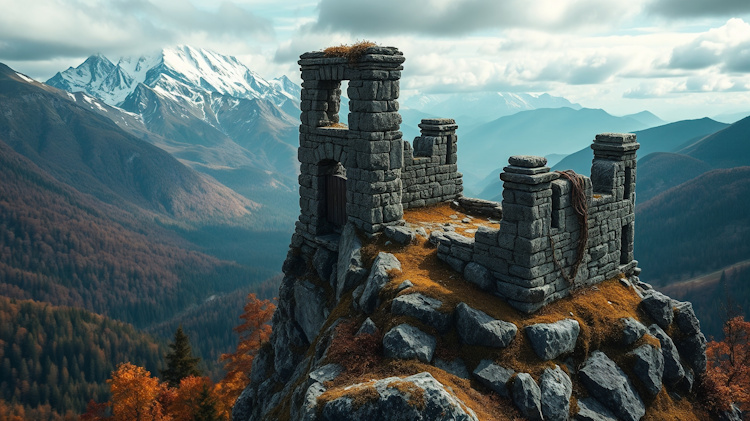
High in the Ugull Mountains, where the wind howls through narrow passes and snow threatens to close the trails for half the year, stand the remnants of what was once called Eagle's Tower. Now known simply as Eagle's Nest, these weathered ruins mark the highest point along the mountain trail connecting the Simmaron Woods to the lands beyond. What remains—uneven stone walls, a cracked and broken staircase carved from living rock, and a roofless circular chamber—offers little hint of the tower's former glory as a vital military outpost.
For nearly two centuries during the Age of Change, soldiers and patrollers stood watch from Eagle's Tower's crenellated heights, their eyes scanning in all directions for the goblins and gorgons that once infested these mountains. The tower served as both sentinel and sanctuary, warning of approaching dangers while providing refuge to travelers braving the perilous crossing. Though its duty long ago ended and its structure succumbed to time and weather, Eagle's Nest continues to serve those who traverse the Ugulls, offering the same cold shelter it has provided for centuries—a testament to the patrollers who built it and a reminder of threats that once seemed eternal but proved transient.
Origins and Construction
During the early years of the Age of Change, as the patrollers of the Simmaron Hall worked to establish their authority over the wild frontier, the Ugull Mountains presented both opportunity and danger. The mountain pass connecting the Simmaron Woods to territories eastward was vital for trade and communication, but the rugged peaks harbored goblins, gorgons, and other creatures that regularly threatened travelers.
In response to these threats, the patrollers undertook an ambitious project: the construction of Eagle's Tower. Built at the highest point in the Ugull Mountains where the trail reached its peak elevation, the tower served as both watchtower and waystation. Its crenellated top provided commanding views in all directions, allowing patrollers to spot goblin war parties and other dangers long before they could threaten the pass or descend into the Simmaron.
The tower itself was a modest but sturdy structure of mountain stone, rising perhaps three stories high. A staircase carved directly from the living rock provided access to the elevated position. Though simple in design, Eagle's Tower represented a significant investment of patroller resources and demonstrated their commitment to protecting the frontier.
The Watch Years
For nearly two centuries, Eagle's Tower fulfilled its purpose admirably. Patrollers assigned to the remote outpost endured harsh mountain conditions—bitter cold, howling winds, and months of isolation—to maintain their vigil. From their elevated position, they could spot goblin movements from the underground strongholds of Greth and Gugal, track the migration of dangerous creatures through the peaks, and provide warning to both the Hall and to travelers using the pass.
The tower also served as a refuge for those crossing the mountains. Travelers could find shelter within its walls, share a fire with the stationed patrollers, and receive current information about conditions on the trail ahead. Many a merchant, missionary, or wanderer owed their life to the warning or assistance provided by the watchers of Eagle's Tower.
During this period, the tower earned its reputation as an essential link in the network of defenses protecting the Simmaron and the settlements beyond. The goblins and gorgons that infested the mountain regions learned to avoid the areas under the tower's watchful gaze, though they never ceased their attempts to find alternative routes or overwhelm the position through sheer numbers.
The Tide Turns
As the Age of Change progressed, the nature of the threat facing the frontier began to shift. The various goblin tribes, while still dangerous, gradually withdrew deeper into their underground strongholds. Whether through patroller pressure, internal conflicts among the goblin tribes, or simple changes in goblin priorities, the frequency and scale of surface raids diminished significantly.
Similarly, the gorgons that once plagued the mountain passes became increasingly rare. Some were hunted to near extinction by determined patroller patrols. Others simply migrated to more remote regions, driven away by the growing human presence in the mountains.
With the immediate threats receding, the strategic value of maintaining a permanent garrison at Eagle's Tower came into question. The post was expensive to supply, difficult to staff, and increasingly seemed like an unnecessary luxury. Patroller resources could be better deployed elsewhere, addressing more pressing concerns closer to the Hall or in other parts of the Simmaron.
Decline and Abandonment
The decision to abandon Eagle's Tower was gradual rather than sudden. At first, the garrison was simply reduced—from a dozen patrollers to a handful, then to a rotating watch that might spend only a few months each year at the remote post. Supply runs became less frequent. Maintenance on the structure was deferred and then abandoned entirely.
Eventually, perhaps around Year 350 or 400 of the Age of Change, the last permanent patroller left Eagle's Tower. The structure was not destroyed or deliberately dismantled; it was simply left to the elements. Without regular maintenance, the harsh mountain weather took its toll. The roof collapsed under the weight of winter snows. Stone walls, no longer mortared or repaired, began to crumble. The carved staircase, subjected to centuries of freeze-thaw cycles, cracked and broke.
What remained was transformed from military outpost to something more humble but no less valuable: a wayfarer's station. The ruined walls still provided shelter from the wind. The circular interior, though roofless, could accommodate a fire. For travelers crossing the Ugulls, especially late in the year before the first snows made the pass impassable, the ruins of what locals now called simply "Eagle's Nest" remained a welcome sight.
Legacy
In the current Age of Advancement, Eagle's Nest stands as a testament to the patrollers' long history of frontier defense. Few who shelter in its ruins know its full history or remember its original name. The carved staircase, chipped and worn, hints at the ambition of its builders. The uneven stone walls speak to both the skill of ancient masons and the relentless power of mountain weather.
The trail over the Ugulls remains infrequently traveled, especially late in the year. Most times, the ruins are empty. But occasionally, smoke still rises from within those ancient walls as a merchant, missionary, patroller, or traveler finds shelter for the night—much as they have for centuries, though now without the watchful eyes of Eagle's Tower's guardians to protect them.
The tower is gone, but Eagle's Nest endures.