Evar was born in the great city of Thesia, capital of Vranna, in the year 463 of the Age of Advancement, the third son of a prosperous merchant family named Thornwald. His father, Corben Thornwald, traded in agricultural goods—grain, wool, timber, and leather—that flowed into the capital from the surrounding estates and valleys. The Thornwald family lived comfortably in a three-story timber and stone house near the Grand Market Hall, where young Evar spent his childhood surrounded by the bustle of commerce, the shouts of traders, and the constant movement of goods and gold that defined life in Vranna's beating heart.
From his earliest years, Evar felt suffocated by the city's walls and the weight of expectations that came with being a merchant's son. While his older brothers, Gareth and Willem, eagerly learned the family trade—mastering ledgers, negotiating contracts, and cultivating relationships with estate lords and guild masters—Evar's attention wandered to the stories told by travelers who passed through his father's warehouse. Patrollers stopping in Thesia for supplies spoke of the deep Simmaron Woods, of ancient trees that had witnessed the Fall of the Gods, of the delicate dance between civilization and wilderness that defined life on the frontier. Dwarven traders from the Ugull Mountains described vast forests where a man could walk for days without seeing another soul, where skill and knowledge mattered more than coin or family name.
His father dismissed these longings as boyish fancy, certain that responsibility and maturity would cure Evar of his restlessness. Corben arranged for his third son to apprentice with a master cooper, thinking that a craft might satisfy the boy's need for work with his hands. For three years, Evar learned the ancient art of barrel-making, understanding how to select wood, shape staves, and create vessels that would hold their contents for years without leaking. He proved skilled at the work, his hands finding satisfaction in coaxing oak and ash into useful forms, but the workshop's walls felt no less confining than his father's counting house. The barrels he crafted would travel to distant places—down rivers, across seas, into the deep woods—while he remained fixed in place, his future as predictable as the grain that filled the vessels he made.
The breaking point came in his eighteenth year, when his father announced plans for Evar to marry the daughter of another merchant family, a union that would strengthen trade connections and secure the Thornwald family's position for another generation. Lisara was a pleasant enough young woman, educated and well-mannered, but the prospect of spending his life managing warehouses and negotiating shipping rates while bound to a marriage arranged for commerce rather than affection filled Evar with a desperation he could no longer ignore. He saw his future stretching before him like a road with no turnings—safe, prosperous, and utterly soul-crushing.
On a cold autumn night, with the first frost settling on Thesia's rooftops, Evar took what money he had saved from his cooperage work, packed a simple traveler's kit, and left his father's house before dawn. He left a letter explaining that he sought a different path, that the city would never be his home, that he hoped his family would understand even if they could not approve. The letter was inadequate, he knew, but words had never been his strength. He hoped his actions would speak more clearly than any explanation he might offer.
Evar traveled north and east, following the trade roads toward Homewood and the Simmaron Woods beyond. He had enough coin for basic supplies but not enough for comfort, and he learned quickly that romantic notions about wilderness life crashed hard against the reality of sleeping on cold ground, rationing food, and navigating unfamiliar territory without guidance. A week into his journey, he made camp poorly and woke to find his pack ransacked by wild animals, most of his food gone. Cold, hungry, and beginning to question the wisdom of his flight, he was found by a patrol of King's Patrollers making their rounds along the forest's southern edge.
The squad leader was a weathered woman named Kareth Silvermark, forty years a patroller and seemingly carved from the same oak as the forest itself. She looked at the shivering young man trying to start a fire with damp wood and said, "City boy, are you?" When Evar admitted he was from Thesia, she laughed—not unkindly—and asked what foolishness had driven him into the woods so unprepared. He told her the truth: that he sought a life connected to something real, that he wanted to live by skill rather than inheritance, that he would rather die in honest pursuit of meaning than suffocate slowly in gilded comfort.
Kareth studied him for a long moment, then said, "The woods don't care about your pretty words or your noble intentions. They'll kill you just as dead whether you're fleeing something or seeking something." But then she offered him a choice: return to Thesia with enough provisions to reach home safely, or accompany her patrol to the Hall of the Simmaron and petition for acceptance as a patroller recruit. The training would be brutal, she warned, and most who came from soft city lives failed within the first season. But for those with true determination and the willingness to be remade by the forest, the patrollers offered exactly what he claimed to seek—a life of purpose, skill, and service to something greater than personal comfort.
Evar chose the Hall without hesitation.
The Hall of the Simmaron rose from the forest like a promise made stone and timber, its walls grown thick with age, its foundation stones laid by patrollers who had served in the Age of the Old Gods. The great building was neither grand nor ornate—it possessed the same practical solidity that characterized all of Vranna's best architecture—but to Evar it represented everything he had hungered for in Thesia's merchant quarters. Here, rank was earned through competence rather than inherited through bloodline. Here, the work was real and immediate, not abstract negotiations over quantities of grain he would never see. Here, a man was measured by his tracking skill, his knowledge of the forest, his courage when facing goblin raiders in the deep woods.
The first year nearly broke him. His cooperage skills meant nothing when learning to move silently through underbrush, to read the subtle signs that revealed a trail hours old, to survive on foraged food when supplies ran short. His city-bred body, soft despite his craftsman's hands, protested the endless miles of patrol routes, the cold camps in autumn rain, the sudden violence of combat training. He made every mistake a recruit could make—got lost on supposedly simple navigation exercises, let his fire go out on a freezing night, froze in terror during his first encounter with a haurek scouting party.
But Evar possessed something that compensated for his lack of wilderness experience: an absolute determination not to return to the life he had fled. When other recruits quit after brutal weeks of training, Evar endured. When his body screamed for rest, he pushed harder. When instructors told him he lacked natural aptitude for tracking or woodcraft, he practiced obsessively during what should have been rest periods. Kareth, who had sponsored his petition to join the patrollers, watched his progress with approval tempered by concern that he might push himself to injury in his desperation to prove he belonged.
Slowly, painfully, the forest began to teach him. He learned to move not against the woods but with them, to let the natural rhythms of the place flow through his awareness rather than fighting to impose his will upon the wilderness. His cooperage training proved unexpectedly valuable—the same patience and attention to detail that shaped barrel staves helped him read the subtle language of bent grass and disturbed earth that revealed where goblins had passed. The merchant's son who had memorized ledgers discovered he could memorize terrain with the same facility, building mental maps of the forest that grew more detailed with each patrol.
By his second year, Evar had not only survived but begun to excel. His tracking skills, built on relentless practice rather than natural talent, made him reliable if not brilliant. His cooperage background gave him practical skills that proved valuable around the Hall—he could repair equipment, craft wooden tools, and jury-rig solutions to problems that might stump patrollers who had never worked a trade. More importantly, he demonstrated the kind of steady dependability that defined the best patrollers, the ones who might not achieve legendary status but who formed the backbone of the organization through consistent competence and unwavering commitment.
In his fourth year as a patroller, during a routine patrol of the forest's northern reaches, Evar's squad encountered a goblin raiding party that had penetrated dangerously close to Homewood. The patrol was outnumbered—five patrollers against perhaps a dozen imps and three haureks—but Kareth judged that letting the raiders pass would put the town at risk. She ordered an ambush, using the terrain and the forest itself as weapons. The fight was brutal and chaotic, and during the melee, Kareth took a grievous wound from a haurek's axe. Evar, positioned to provide covering fire with his crossbow, found himself the closest to his fallen squad leader as the haurek moved in for the killing blow.
Everything Evar had learned in four years of training collapsed into a single moment of terrible clarity. He dropped his crossbow, drew his sword, and charged. He had no illusions about his martial prowess—he was a competent fighter but not exceptional—yet in that moment, hesitation would mean Kareth's death. The haurek, surprised by the sudden assault, turned its attention from the wounded woman to this new threat. Evar fought with desperate efficiency, using every trick his instructors had drilled into him, exploiting every opening the creature gave him. When his sword lodged in the haurek's shoulder, he seized the goblin's own weapon and used it to deliver the killing stroke.
Kareth survived because of Evar's intervention, though her wounds ended her active service as a patroller. She recovered enough to join the Council of Elders at the Hall, where her experience and wisdom would guide the organization for decades to come. She never forgot that she owed her life to the city boy she had found shivering in the woods years before, and when votes were cast for promotions and responsibilities, Kareth became Evar's most consistent advocate.
Evar's rise through the patroller ranks followed the Vrannan pattern—steady, earned through demonstrated competence rather than dramatic heroics. He became a squad leader at twenty-six, leading routine patrols and training new recruits with the same patient determination he had once applied to his own education. At thirty-two, he was promoted to company commander, coordinating multiple squads in complex operations against increasingly organized goblin forces. His leadership style emphasized thorough preparation, attention to detail, and the same practical competence that had always characterized his approach to challenges. Flashier commanders might achieve more spectacular successes, but Evar's units suffered fewer casualties and completed their missions with reliable consistency.
It was during his tenure as company commander that Evar met Mirael.
She came to the Hall as a healer and herbalist, a woman from Homewood who possessed knowledge of forest plants and their medicinal properties that had been passed down through her family for generations. Mirael was perhaps five years older than Evar, a widow whose first husband had died in a logging accident, leaving her with no children and a choice about how to spend the remainder of her life. She chose to bring her skills to the Hall, where the patrollers' dangerous work created constant need for healing knowledge.
Evar first noticed her when she treated a wound he had taken during a skirmish with goblin scouts—nothing serious, merely a gash along his forearm that required cleaning and bandaging. Mirael worked with quiet competence, her hands gentle but sure as she cleaned the wound and applied a poultice that smelled of honey and strange herbs. She asked how he had gotten injured, and when he explained the circumstances of the fight, she listened with genuine interest rather than the mixture of fear and fascination that many civilians displayed when hearing about patroller work.
"You're fortunate the blade was clean," she said as she wrapped his arm in linen bandages. "Goblins sometimes poison their weapons with filth from the Underland. The wound itself might be minor, but the corruption that follows can kill."
Evar found himself returning to the healer's quarters more often than medical necessity strictly required—a minor complaint here, a question about treating common injuries in the field there. Mirael seemed amused by his transparent excuses but never turned him away. They began taking meals together, their conversations ranging from practical matters of wound care and herbal remedies to deeper discussions about why they had each chosen the paths they walked. She told him about her late husband, about the grief that had nearly consumed her, about how she had found purpose again through helping others heal. He told her about Thesia, about the merchant life he had fled, about finding in the forest something he could never articulate but that felt more real than anything he had known in the city.
"You're a romantic," she said one evening as they sat outside the Hall, watching the sun set through the ancient trees. "Most people who come to the woods seeking 'meaning' or 'authenticity' discover that the reality is simply different work in a different place. But you found what you were looking for, didn't you?"
Evar considered the question seriously before answering. "I found where I belong. Whether that's the same thing, I'm not certain."
Mirael smiled. "Close enough, I think."
They married in the spring of the year 498, with Kareth presiding over the simple ceremony that joined them before witnesses from both the Hall and Homewood. Mirael moved into Evar's quarters at the Hall, bringing with her an extraordinary collection of herbs, tinctures, and medical supplies that transformed his spartan rooms into something that felt remarkably like a home. She continued her work as healer, her knowledge growing more comprehensive with each passing year as she experimented with new combinations of forest plants and learned from both successes and failures in treating various ailments and injuries.
Their life together fell into comfortable rhythms shaped by the demands of patroller service and the cycles of the forest. Evar would lead patrols into the deep woods, sometimes gone for weeks at a time, while Mirael maintained her healing practice at the Hall and occasionally traveled to Homewood to treat townspeople or gather rare herbs from locations she had learned about through decades of careful study. When he returned from patrol, she would question him about what he had seen—not out of idle curiosity but from genuine interest in the forest's condition, in unusual plants or animals he might have noticed, in changes to familiar areas that might indicate problems developing.
They never had children. This was not from lack of desire but simply how fate arranged their lives, and after the first few years of disappointment, they accepted their situation and found meaning in other forms of legacy. Evar poured his energy into training new patrollers, trying to give them the guidance and patience that Kareth had shown him years before. Mirael taught her healing knowledge to anyone willing to learn, ensuring that her accumulated wisdom would not die with her but would continue serving the Hall and Homewood for generations.
In the year 515, when Evar was fifty-two, the Council of Elders voted to admit him to their number. The position of Elder was not purely honorary—the Council provided strategic guidance to the Hall, made decisions about resource allocation and recruitment, and served as the repository of institutional knowledge spanning centuries of patroller operations. Evar brought to the Council his characteristic thoroughness and practical wisdom, his deep knowledge of forest operations tempered by awareness of larger strategic concerns. He specialized in logistics and training, ensuring that patrols were properly supplied and that new recruits received comprehensive education in both practical skills and the philosophical principles that defined the King's Patrollers.
The true test came three years later, in 518, when the long-serving Eldest of the Elders died peacefully in his sleep at the remarkable age of eighty-seven. The position of Eldest was chosen by vote of the Council, with each Elder considering not just competence but wisdom, temperament, and the indefinable quality of judgment that separated good leaders from merely adequate ones. The vote was not unanimous—it rarely was—but Evar emerged as the choice, supported by Kareth and enough others to form a clear majority.
Taking up the role of Eldest at age fifty-five, Evar found himself responsible not just for his own actions or those of his company, but for the entire Hall of the Simmaron and its crucial mission of frontier defense. The role weighed heavily on him, particularly as goblin activity in the Ugull Mountains had begun increasing under the leadership of a cunning new lord named Gral. This goblin possessed strategic brilliance rare among his kind, organizing raids with unprecedented sophistication and probing Vrannan defenses as if looking for weaknesses to exploit in some future campaign.
Evar approached the challenge as he approached everything—with patient thoroughness and attention to detail. He strengthened patrol schedules, improved coordination with Homewood's defense forces, and maintained the careful diplomatic relationship with the dryads of Sollin-kel that allowed patrollers to operate effectively in the deep forest. He expanded the Hall's library of tactical knowledge, ensuring that lessons learned from encounters with Gral's forces were documented and incorporated into training. His leadership lacked the charisma of some previous Eldests, but it provided steady guidance during a period when steady guidance was precisely what the Hall required.
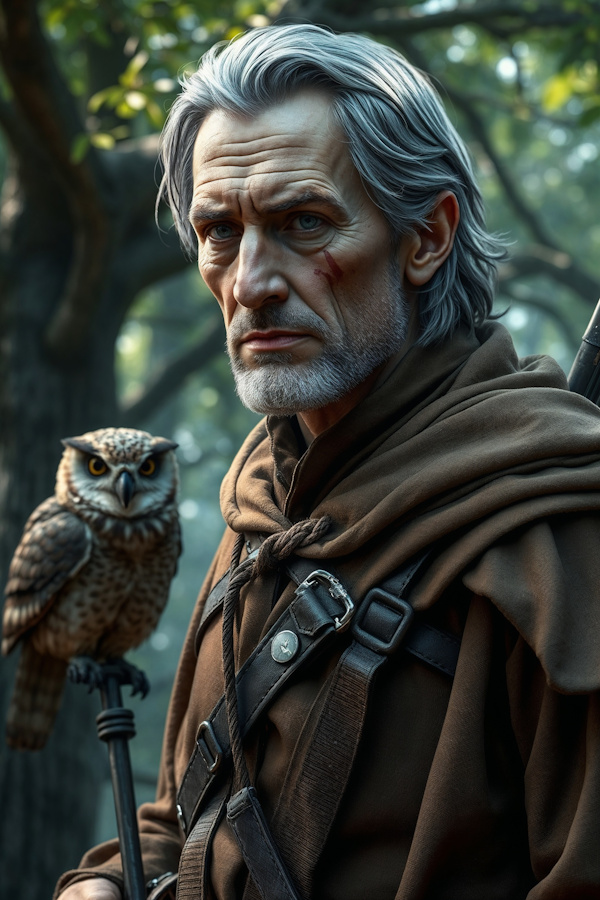
For nearly two decades, Evar served as Eldest while Mirael continued her healing work beside him. They grew old together in the way that long-married couples do, their individual identities blending until neither could imagine life without the other. Mirael's hair turned silver while Evar's dark brown hair showed increasing streaks of grey. The patroller's life had kept him physically fit despite advancing years—his frame remained lean and strong, his movements still possessing the woodsman's economy of motion—but his face showed the weathering of decades spent in the forest, with lines carved around his eyes from squinting against sun and snow, and a scar along his left cheekbone from a goblin blade that had come too close during a patrol in his younger years.
Then, in the autumn of 536, Mirael grew ill.
It began subtly—a persistent tiredness that didn't respond to rest, a loss of appetite that concerned Evar but that Mirael dismissed as perhaps a minor imbalance she would correct with her herbs. But as autumn deepened toward winter, her condition worsened. The fatigue became debilitating, her skin took on an unhealthy pallor, and she began experiencing pains in her joints that made even simple movements difficult. She tried every treatment she knew, consulted with other healers from Homewood and even from Thesia when Evar sent urgent messages requesting help, but nothing provided more than temporary relief.
By midwinter, Mirael could barely leave their quarters. Evar, desperate and increasingly frantic, brought in physicians from the capital, promising them whatever payment they demanded if they could identify and cure his wife's illness. They examined her, consulted their texts, prescribed various treatments—bloodletting, special diets, compounds of rare ingredients—but nothing worked. Some said her humors were unbalanced. Others suggested a corruption of the blood. One honest practitioner admitted that he simply didn't know what afflicted her, that some illnesses defied all knowledge and treatments.
Evar watched his wife fade through that terrible winter, her strength ebbing like water from a cracked vessel. She remained lucid, her mind sharp even as her body failed, and in their private moments, she tried to prepare him for what both knew was coming. "You've been a good husband," she told him one night as he sat beside their bed, holding her hand. "You gave me years I never expected after losing Willem. Years of purpose and companionship. That's more than most people receive."
"I can't lose you," he said, the words inadequate but honest.
"You don't have a choice in that," she replied gently. "None of us do. Death comes for everyone, Evar. The only question is whether we meet it with grace or rage."
But Evar was not prepared for grace. He had found Mirael late in life, had built with her something precious that he had never imagined possessing during his years as a lonely patroller. The thought of returning to that isolation, of losing the one person who understood him completely, filled him with a desperation that overwhelmed his usual careful judgment.
It was in this state—grief-stricken and desperate—that Evar heard about the witch.
She had appeared in the Simmaron Woods perhaps a year earlier, one of those solitary woodswomen who occasionally made their homes in the deep forest, living by herb-lore and offering minor magical services to those brave or foolish enough to seek them out. The patrollers had noted her presence but deemed her harmless—she had caused no trouble, violated no laws, simply established herself in a remote grove and kept to herself. Saress, she called herself when anyone asked, though few bothered to make the journey to her dwelling.
Evar had dismissed her as irrelevant to patroller concerns. But now, with Mirael dying and conventional medicine powerless to help her, he remembered stories about witches and their power over life and death, their ability to brew potions and work magics that defied normal understanding. It was a desperate hope, probably foolish, but he was a desperate man.
He rode out alone in early spring, as Mirael's condition deteriorated to the point where she could no longer rise from bed. He told no one where he was going—not the other Elders, not his patrollers, not even Mirael herself, who he feared would forbid him from pursuing such a dangerous path. He took his companion S'nar, the keen-eyed owl who had bonded with him years ago and who served as both scout and comfort during lonely patrols, but otherwise traveled without company into the deep forest where few patrollers ventured without good cause.
He found Saress in a grove that made his skin crawl, a place where the trees grew twisted and the normal sounds of the forest seemed muted and wrong. She was a sitheri—a female of that reptilian race that most humans found unsettling—and she regarded him with eyes that reflected too much intelligence and too little compassion. When he explained what he needed, offering every worldly possession he controlled in exchange for a cure for his wife's illness, Saress laughed.
"What use have I for the coin or goods of men?" she asked. "I seek knowledge, Eldest of the Patrollers. I seek secrets that cannot be purchased in markets or extracted from books. Give me something valuable—truly valuable—and perhaps I will consider your request."
Evar, thinking desperately, remembered a discovery he had made as a boy, years before he had fled Thesia to become a patroller. During a rare family trip into the countryside when he was perhaps twelve years old, he had wandered away from his father's business meetings and found, revealed by a recent mudslide, the entrance to a cave. Curiosity had driven him inside despite a crawling sense of wrongness that made his skin prickle with instinctive fear. He had followed a long passage to a vast chamber where an ancient temple stood, built around a well of seething black liquid that had filled him with such profound dread that he had fled back to the surface and never spoken of what he had found.
He had spent years trying to forget that place, had eventually convinced himself it had been a childhood nightmare rather than reality. But the memory remained, precise in its details, and now—desperate and grasping for anything that might save Mirael—he told the witch about the cave and how to find it.
Saress listened with growing interest, her reptilian eyes glittering with something Evar recognized too late as hunger. "The Well of Darkness," she breathed. "It truly exists. The ancient accountings spoke truth." She turned her full attention on Evar, and he felt pinned by that predatory gaze. "You have given me something of value, patroller. Very well. I will brew a potion that will cure your wife's illness. But you must swear a witch's oath that you will not interfere with my own investigations of this cave, that you will not attempt to prevent me from accessing the temple you discovered."
Evar hesitated. Every instinct screamed warning, but the image of Mirael dying in their quarters overwhelmed his caution. He agreed, swearing the oath the witch dictated, binding himself with words of power he didn't fully understand. Saress produced a vial of dark liquid that smelled of herbs and something else, something wrong that made him want to drop it and flee. But he took it, promised not to interfere with her activities, and rode back to the Hall as if pursued by demons.
The potion worked. Within days of taking it, Mirael's color returned, her strength began rebuilding, the mysterious illness that had been killing her simply... stopped. The physicians marveled at her recovery, attributing it to the resilience of her constitution or perhaps some natural remission of whatever had afflicted her. Mirael herself questioned Evar about what he had done, seeing in his eyes the guilt of terrible decisions made in desperate moments, but he deflected her concerns with reassurances that all that mattered was her recovery.
She lived another six months. Then, in the autumn of 537, she died in her sleep, peacefully and without warning. The physicians said her heart had simply stopped—not from illness but from the natural wearing out that came with age. She was seventy-three. They had been married for thirty-nine years.
Evar buried her in the grove near Homewood where they had often walked together, planting a young oak over her grave and carving her name into a simple stone marker. He stood alone at the grave for hours after the funeral, S'nar perched silent on his shoulder, while he tried to comprehend that the bargain he had struck, the terrible oath he had sworn, had purchased only six months more of Mirael's life. Six months, then death from natural causes that no magic could have prevented.
The witch had not lied—she had cured the illness as promised. But she had given him false hope, letting him believe he could cheat death when death had never been the true threat. Mirael would have died from heart failure whether or not she had recovered from the mysterious illness. The potion had cured her so that age could kill her instead.
By the time Evar understood the full scope of his mistake, it was too late. Saress had found the Well of Darkness in the Cavern deep in the northern reaches of the Simmaron Woods. She had begun working magic that corrupted the forest, drawing on the ancient evil that druids and dryads had sealed away centuries ago. The witch's oath bound Evar from interfering directly, and the clever wording she had used prevented him from warning others or organizing opposition to her activities. When he tried to circumvent the oath's restrictions, speaking carefully to other Elders about "concerns" in the northern forest, he felt the magic tightening around him like chains, making it difficult to breathe, impossible to say what needed saying.
The corruption spread. The forest sickened. And then, in a final betrayal, Saress worked magic on the patrollers themselves, transforming them into mindless beasts—twisted creatures neither fully animal nor fully human, driven by primal instincts to hunt and kill. Evar felt the transformation beginning in himself, fought against it with every ounce of will he possessed, but the magic was too strong. His last clear memory was of standing in the Hall, trying desperately to warn someone, anyone, about what was happening, before his mind shattered and animal consciousness overwhelmed everything he had been.
He existed for weeks or perhaps months as one of these creatures, hunted former friends, killed with claws and teeth and savage strength. Some fragment of his consciousness remained trapped beneath the beast's awareness, screaming silently while his transformed body committed horrors he would never be able to forget. When the witch's curse was finally broken—when Jerrick and his unlikely allies confronted Saress and destroyed her—Evar returned to himself to discover the full scope of the devastation his bargain had wrought.
The Simmaron Woods had been corrupted. The dryads of Sollin-kel had been murdered. Fellow patrollers had been transformed into monsters, many killed before the curse could be broken. The Hall itself had been abandoned, its defenses shattered, leaving the way open for Lord Gral's goblin forces to march on both the Hall and Homewood. And Evar himself—Eldest of the Elders, guardian of frontier defense, keeper of ancient traditions—had been the architect of the disaster, the one whose desperate bargain had unleashed catastrophe upon everything he had sworn to protect.
When he faced his former student Jerrick after being restored to human form, Evar could barely meet the younger man's eyes. The shame was too great, the betrayal too complete. He had condemned the patrollers, endangered the forest, brought death to innocents, all because he had been unable to accept the natural death of his beloved wife. In trying to save Mirael, he had destroyed everything else he cared about.
Jerrick forgave him—or at least, Jerrick placed a hand on his shoulder in a gesture that spoke of understanding if not quite absolution. But Evar knew he could never forgive himself. The other Elders, when they learned the truth, agreed that he would step down once the immediate crisis passed, once Gral's invasion had been repelled and the Hall could function normally again. He would resign as Eldest, would face whatever judgment the patrollers deemed appropriate for his catastrophic failure of leadership and betrayal of trust.
But first, there was work to do. The witch might be dead, but her corruption lingered. The goblins marched on the Hall and Homewood. The patrollers, restored to themselves but traumatized by their experience as beasts, needed guidance and leadership to mount an effective defense. Evar, the man who had destroyed so much through his desperate bargain, would spend whatever time remained to him trying to repair even a fraction of the damage he had caused.
He was sixty-three years old, his hair gone mostly grey, his face lined with weathering and now with guilt that carved deeper than any goblin blade. He had been a patroller for forty-five years, had served as Eldest for nearly two decades, had built a reputation for steady competence and reliable judgment. All of that was ashes now, burned away by his single catastrophic failure.
But he was still a patroller. That core identity remained, even if everything else had been stripped away. And patrollers served, even when—especially when—they had failed. They protected, even when they had been the source of danger. They stood their ground, even when they deserved to fall.
Evar would stand his ground. He would face Lord Gral's forces alongside the patrollers he had betrayed. He would fight to defend the Hall and Homewood, even knowing that his service could never balance the ledger of his failures. And when the battle was done, if he survived, he would face whatever judgment was deemed appropriate and accept it without protest or excuse.
It was all he could do. It would have to be enough.
FIRST APPEARANCE
Evar first appears in The Hall of the Wood.