In the darkness of the Underland, where haurek blood clans rule through ruthlessness and cunning, Gral was born into the lowest stratum of his tribe. His mother died bringing him into the world, and his father—a warrior of no particular distinction—perished in a border skirmish before Gral reached his second year. The young haurek grew up among the refuse and unwanted, scavenging for scraps in the deepest warrens beneath what would one day become his fortress. Other young haureks mocked his parentless state, calling him "Gralkek" which in the crude goblin tongue meant "nothing-spawn." They beat him when the mood struck them, stole what little food he managed to find, and ensured he understood his place at the bottom of their brutal hierarchy.
But Gral possessed something his tormentors lacked: patience wedded to hatred. He did not lash out in futile rage as other low-born haureks did. Instead, he watched. He learned. He waited. The haurek discovered early that while he would never match the largest warriors in raw strength, his mind could be honed into a weapon far more dangerous. Gral observed how the clan's witch mothers commanded respect through fear and mysticism. He studied how the war-chiefs maintained control through displays of brutal dominance. Most importantly, he noticed the small cracks in their authority—the moments of weakness, the whispered dissent, the barely concealed ambitions of those beneath them.
Gral's fortunes changed when he reached his fifteenth year. A rival blood clan launched a surprise assault on his tribe's warren, overwhelming the outer defenses and pushing deep into the residential tunnels. In the chaos, Gral found himself cornered by three enemy haureks who saw easy sport in the scrawny young goblin. What they did not see was the sharpened stake Gral had been concealing for months, waiting for the right moment to use it on one of his childhood tormentors. He drove it through the first attacker's throat before the haurek could react. The second fell when Gral collapsed a poorly supported section of ceiling onto him—the young goblin had noticed the structural weakness weeks earlier and filed the knowledge away. The third fled when Gral emerged from the dust cloud covered in his victims' blood, laughing with a sound that promised madness and death in equal measure.
That laugh became Gral's signature. It is not the cackle of true insanity, but rather the calculated performance of a haurek who understands that fear is the most effective weapon in the goblin arsenal. When the war-chief learned of Gral's actions during the raid, he elevated the young haurek to the rank of warrior—not out of gratitude, but because even haurek leaders recognized that a fighter who could kill three enemies alone deserved a place in the shield wall. Gral accepted the promotion with appropriate humility, but inside he was already planning his next move.
Over the following years, Gral cultivated a reputation for viciousness that exceeded even haurek norms. He volunteered for the most dangerous raids to the surface, led ambushes against rival clans, and never showed mercy to those who fell into his hands. But it was his treatment of prisoners that earned him the name that would echo through the Underland and beyond: the Meat Peddler. After one particularly successful raid on a human settlement near the Alzion Mountains, Gral returned with several captives. Rather than simply killing or enslaving them as was customary, he did something that both horrified and fascinated his fellow haureks.
Gral set up a crude stall in the central warren, where he proceeded to butcher his prisoners piece by piece, "selling" the portions to other goblins as if he were a merchant at market. The display was not born of hunger—haureks, unlike their smaller cousins, did not eat humanoids—but rather from Gral's understanding that spectacle bred fear, and fear bred power. He kept his victims alive as long as possible through the process, their screams echoing through the warren as Gral called out his "wares" with the enthusiasm of a legitimate trader. "Fresh meat! Tender cuts! Who'll trade for this fine selection?" The performance was grotesque theater, but it achieved its purpose. Within weeks, every goblin in the Underland knew the name "Meat Peddler," and most feared it.
The war-chief who had promoted Gral recognized his mistake too late. By the time he understood that the Meat Peddler's growing reputation posed a threat to his own authority, Gral had already cultivated allies among the warriors who saw opportunity in following a rising power. The challenge, when it came, was not the traditional single combat between haurek leaders. Gral had learned that tradition was a chain that bound the ambitious to predictable paths. Instead, he orchestrated a scenario that left the war-chief no choice but to fight on Gral's terms. During a feast celebrating a successful raid, Gral publicly accused the war-chief of cowardice—specifically, of sending other haureks to die while he remained safe in the warren. The accusation was false, but Gral had spent months planting seeds of this narrative among the warriors who had lost companions on the chief's orders.
The war-chief had to respond or lose all authority. But Gral's challenge was not to single combat, but to lead the next raid personally, with Gral at his side. The chief agreed, confident that whatever Gral planned, he could survive it. He did not anticipate that Gral had already negotiated with their ostensible target—a rival haurek clan—to turn the raid into an ambush. When the war-chief's war band walked into the trap, Gral made sure he was positioned where he could strike at the chief during the chaos. His blow was not immediately fatal; that would have been too obvious. Instead, he wounded the chief's leg, crippling him just enough that when the rival haureks pressed their attack, the war-chief fell beneath their axes. Gral fought savagely to "save" his leader, killing three of the attackers and rallying the survivors to fight their way free. He returned to the warren carrying the war-chief's body, lamenting loudly the tragedy of losing such a magnificent leader. No one questioned his grief. Few suspected his involvement. Those who did kept their suspicions to themselves.
Gral ascended to leadership of his blood clan through acclamation of the warriors, who saw in him both strength and cunning. But leadership of a single clan was never his true goal. The haurek had spent years studying the geography of the Underland beneath the Alzion Mountains, and he recognized what his predecessors had not: the strategic value of a particular nexus of tunnels that connected multiple clan territories and provided access routes to the surface. This location, known to the locals as the Empty Halls because of its unstable reputation, had been avoided by most goblin clans due to periodic collapses and the whispered claims of hauntings by the spirits of dwarves who had once worked the area.
Gral saw opportunity where others saw danger. He led his clan in a systematic occupation of the Empty Halls, shoring up the most critical tunnels with stolen timber and impressed slaves from surface raids. Within three years, he had transformed the Empty Halls into a fortress he named Greth—a haurek word meaning "the grip" or "the clenched fist." From Greth's defensible position, Gral began extending his influence over neighboring clans. Some he conquered through direct assault. Others he absorbed through careful manipulation, offering alliances that slowly transformed into vassalage. A few he eliminated entirely when they proved too proud or stubborn to bend knee.
The fortress of Greth grew as Gral's power expanded. The haurek understood that ruling other goblins required more than martial prowess—it demanded the appearance of invincibility and the reality of overwhelming force. He organized the disparate goblin breeds into a coherent military structure, something rare in goblin society. The numerous imps served as infantry and laborers. The clever grekkels became scouts and spies, their teleportation ability invaluable for reconnaissance. The brutal gaugaths, summoned from their mountain peaks through a combination of threats and promises of violence, formed shock troops that could break through any defense. And the haureks, Gral's own kind, served as officers and elite warriors—the spine of his growing army.
But Gral understands that external enemies are necessary to maintain internal unity. Goblins by nature fight among themselves without a common foe to focus their aggression. He found that enemy in the Simmaron forest and its defenders—the King's Patrol based at the Hall of the Wood. For generations, the patrollers have stood as a barrier preventing goblin raids into the settled lands of the Four Fiefdoms. They are skilled warriors who know the forest as well as any goblin knows the Underland. They have repelled countless assaults from Greth and other goblin strongholds. They represent everything Gral despises: order, tradition, and the presumption that humans and other surface dwellers have the right to deny goblins their rightful prey.
Gral's hatred of the patrollers is not merely strategic—it is personal. In his younger years, before he became Lord of Greth, Gral led a raiding party that ventured deep into the Simmaron. The raid had been going well until a patroller squad discovered them. In the running battle that followed, Gral watched as his companions were cut down one by one by warriors who moved through the forest like ghosts. He escaped only by abandoning his fellows to their fate, teleporting away using a grekkel's ability he had bargained for in advance. The shame of that flight never left him. Not because haurek culture values loyalty to comrades—it does not—but because the patrollers made him feel powerless, and Gral swore never to feel that way again.
Over the decades, Gral has launched numerous assaults against the Hall and the patrollers. Each one has failed, repelled by warriors who have trained for generations to defend the Simmaron. The fortress known as the Hall has proved impregnable, built as it is with both physical defenses and the forest's own natural advantages working in concert. The patrollers know every path, every ambush point, every approach. They have early warning systems that allow them to detect goblin movements before raids can achieve surprise. Most frustrating to Gral is that the patrollers fight not for glory or conquest, but for protection of their home—a motivation that breeds resilience he cannot match with mere promises of plunder.
The Meat Peddler has become obsessed with destroying the Hall. It represents the greatest challenge to his authority, the one enemy he cannot cow into submission or trick into defeat. His subordinates have learned not to speak carelessly about the patrollers in his presence, as such talk inevitably triggers rages where Gral demonstrates on some unfortunate slave exactly what he plans to do to the patrollers once he finally breaches their defenses. These performances reinforce his terrible reputation while also revealing the depth of his obsession. Some of his more perceptive lieutenants recognize that Gral's fixation on the Hall might eventually prove his undoing, but none dare suggest he abandon the goal.
Gral's rule over Greth is maintained through a combination of tactical brilliance, psychological manipulation, and strategic brutality. He understands that haureks respect strength above all, but also respond to displays of cunning. He allows ambitious subordinates to rise to positions of authority, giving them enough rope to either prove their worth or hang themselves through overreach. Those who succeed in their appointed tasks earn rewards and greater responsibilities. Those who fail meet ends that serve as object lessons to others. Gral makes sure his "examples" are public and memorable—the origin of his "Meat Peddler" performances, which he continues to stage periodically to remind his followers of the price of failure.
Yet Gral is not mindlessly cruel. He recognizes that effective leadership requires balancing fear with opportunity. Warriors who distinguish themselves in battle earn recognition and favor. Shamans and witch mothers who prove their power receive protection and resources for their work. Even the lowliest imps know that competent service can lead to better rations and safer duties. This system creates a military hierarchy more sophisticated than most goblin strongholds can maintain, making Greth's forces more dangerous than the sum of their individual warriors. The Meat Peddler has built not just an army, but an engine of conquest that waits only for the right opportunity to unleash its full power.
That opportunity seemed to arrive when a sitheri witch named Saress appeared at Greth's gates, claiming to have driven the patrollers from the Hall through her sorcery. Gral was immediately suspicious—such claims were too convenient to be believed without verification. But he also recognized that if the witch spoke truth, this represented the opening he had sought for decades. The Hall unmanned, its defenses weakened, its warriors scattered—such conditions would never come again. He dispatched his most trusted lieutenants, the haurek Skave and the gaugath Nohr, to verify the witch's claims while he began mustering his forces. If the Hall truly stood undefended, Gral intended to bring every warrior Greth could spare to ensure its complete destruction.
The Meat Peddler did not simply want to conquer the Hall—he wanted to erase it. He envisioned razing the structure to its foundations, salting the earth where it stood, and displaying the skulls of every patroller on pikes along the forest paths as warnings to any who might think to rebuild. After the Hall fell, Homewood would follow—the frontier town that supplied and supported the patrollers would burn, its people dragged back to Greth for sport and slavery. Then, with the Simmaron firmly under his control, Gral could turn his attention to greater prizes. The settled lands beyond the forest held riches and victims beyond counting. The Four Fiefdoms themselves might tremble before the armies of Greth once he demonstrated that even their famed defenders could fall.
Gral's ambitions extend beyond simple conquest. He has spent years observing how the surface dwellers organize their societies, and he recognizes that their strength comes from coordination across large territories. In the goblin tradition, each stronghold operates independently, sometimes cooperating but more often competing. Gral envisions a different future—a network of goblin fortresses all answering to Greth, all following his strategic direction, all working in concert toward shared goals of expansion and domination. He would become not just Lord of Greth, but the undisputed master of the goblin peoples, the one who finally unites the fractious breeds into an unstoppable force.
But first, the Hall must fall. Every other goal depends on eliminating the patrollers and proving that the barriers they maintain can be breached. Gral has assembled an army that represents the full might of Greth—over a thousand imps, hundreds of haureks, scores of gaugaths, and a scattering of grekkels for reconnaissance. He has brought siege weapons crafted specifically to destroy the Hall's fortifications, artillery pieces that took years to build and require teams of slaves to haul through the mountain passes. He has mobilized shamans to counter any magic the defenders might employ. He has prepared supply trains to sustain a prolonged campaign if necessary, though he expects the assault to be swift once his forces reach the undefended Hall.
As his army marches toward the Simmaron, Gral allows himself to envision the moment of victory. He will personally lead the final assault, will be the first to set foot in the Hall's great room, will claim the seat of the eldest patroller as his own before ordering the entire structure set ablaze. The Meat Peddler will carve his name across the forest in blood and ash, will create a legend that will echo through the Underland for generations. The patrollers who have haunted his dreams since his youthful defeat will be avenged, their Hall reduced to a cautionary tale about the folly of standing against the Lord of Greth.
Gral's haurek nature shapes his approach to leadership and warfare. Like all haureks, he is superstitious, consulting with shamans before major decisions and reading omens in everything from the flight of bats to the patterns of fungus growth in the deep tunnels. He brews his own particular blend of thick ale, a recipe he guards jealously and shares only with his most trusted advisors as a mark of favor. His humor is crude and cruel, finding amusement in the suffering of others and the dark ironies of existence. He maintains a collection of skulls from particularly noteworthy victims, each one carefully preserved and displayed in his private chambers as trophies and reminders of past victories.
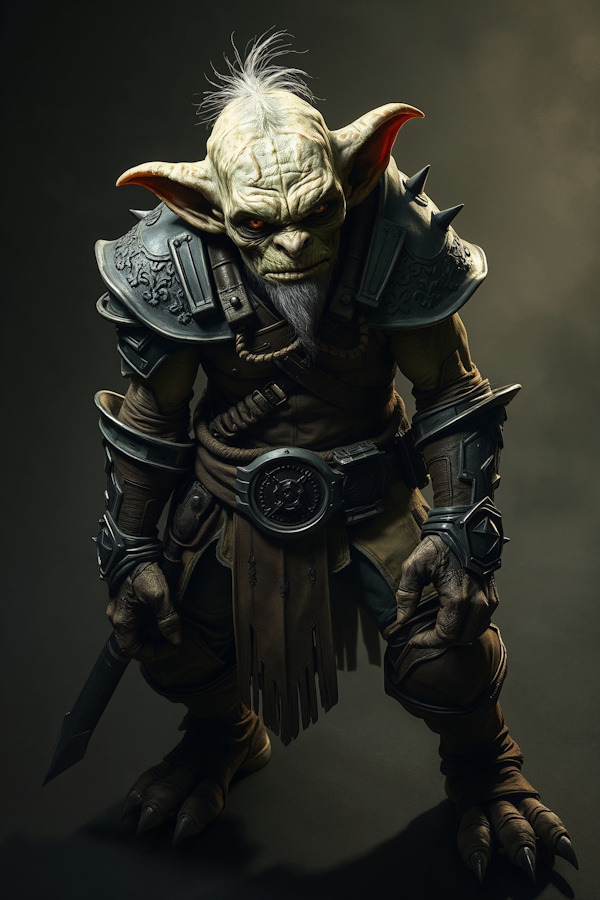
The Meat Peddler's physical presence matches his reputation. Tall even for a haurek, he stands head and shoulders above most of his warriors. His parched, dark tan skin bears the scars of countless battles, each one a mark of survival and strength. His yellow eyes, set beneath a heavy brow ridge, miss nothing in the chambers and tunnels of Greth. He covers his muscular frame with armor scavenged and improved from defeated enemies—dwarven plate reinforced with haurek craftsmanship, lighter than it appears but strong enough to turn aside all but the most powerful blows. He wields a massive cleaver that serves both as weapon and butcher's tool, its blade stained dark from the blood of victims too numerous to count.
Yet for all his power and reputation, Gral harbors doubts he shares with no one. He knows that his rule depends on continued success, on maintaining the appearance of invincibility. Any significant defeat could embolden rivals within Greth to challenge his authority. The longer he pursues the Hall without achieving victory, the more his obsession appears as weakness rather than determination. His decision to commit the full strength of Greth to this assault is not merely strategic—it is desperate. He must win decisively, must prove that his decades of preparation and planning have purpose. Failure would mean more than a military setback; it would crack the foundation of fear and respect upon which his entire regime rests.
As Lord of Greth, as the Meat Peddler, as the haurek who clawed his way from the lowest warrens to command the most powerful goblin fortress in the Alzion Mountains, Gral stands ready for either his greatest triumph or his ultimate defeat. The assembled army represents years of careful planning, resource accumulation, and political maneuvering. The alliance with the witch, however uneasy, provides the opening he needs. The patrollers' apparent absence removes the greatest obstacle to his success. Everything Gral has worked toward, every sacrifice he has made, every enemy he has destroyed—all of it leads to this moment.
The Meat Peddler marches toward the Simmaron with his army at his back and vengeance in his heart. The Hall of the Wood awaits, and with it, the destiny Gral has been forging since the day he first understood that in the brutal world of goblin-kind, only the ruthless survive and only the cunning prosper. He is both, and he intends to prove it to the patrollers, to his own warriors, and to history itself. The Lord of Greth is coming, and he will not be denied.
FIRST APPEARANCE
Gral first appears in The Hall of the Wood.