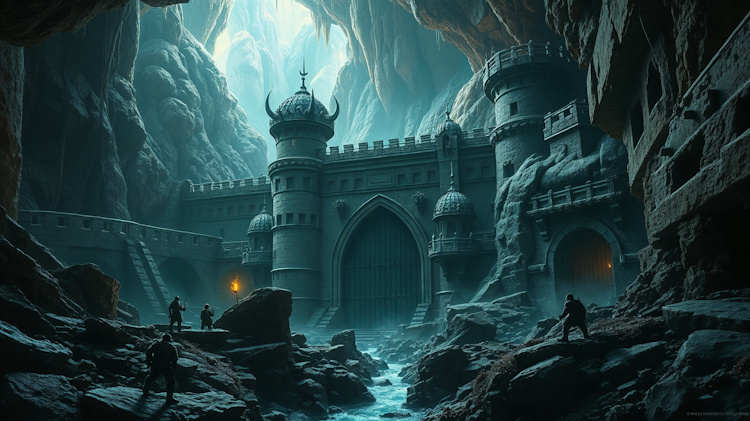
"From the depths they watch, and in the darkness they wait. Greth has stood since before the gods fell, and it will stand long after the last patroller draws breath."
— Ancient warning carved at Brakken Pass
Introduction
Greth stands as the most notorious goblin fortress in the Ugull Mountains, a subterranean stronghold whose very name evokes dread among the frontier settlements of the Four Fiefdoms. For over five centuries—and likely far longer—this ancient fortress has served as the staging ground for countless raids, the prison of thousands of captured slaves, and the seat of power for a succession of brutal warlords whose names are remembered with equal parts fear and hatred.
Built within what the goblins call the Empty Halls, Greth occupies a strategic nexus deep beneath the mountains where multiple tunnel networks converge. This position grants its masters control over vast regions of the Underland, the sprawling subterranean realm whose true extent remains unknown to surface dwellers. From these dark depths, goblin armies have emerged generation after generation, threatening the stability of human civilization and testing the resolve of those who guard the frontiers.
The fortress's history is written in blood and stone. Each of its rulers has left their mark through conquest, construction, or memorable cruelty. Some expanded its physical boundaries, transforming natural caverns into fortified halls. Others perfected its military organization, uniting the fractious goblin breeds into more effective fighting forces. Still others became legends of terror, their methods so brutal that their reputations alone could break the will of enemies. Through all these transformations, Greth has remained constant in its threat to the surface world and its rivalry with other goblin strongholds, particularly Mount Kroom in the distant Ugull Mountains.
The current lord of Greth is Gral, known throughout the Underland and beyond as the Meat Peddler—a title earned through acts so grotesque they shock even other goblins. His rise from the lowest depths of haurek society to absolute mastery of the fortress represents one of the most remarkable and terrifying ascensions in goblin history. Under his rule, Greth has achieved perhaps its greatest strength, assembling an army capable of challenging even the legendary King's Patrol and threatening the Hall of the Wood itself.
This history traces Greth's existence from its mysterious origins through the present day, examining the warlords who shaped it, the battles that defined it, and the dark culture that sustains it. It is a chronicle of persistence and brutality, of a fortress that has weathered internal strife and external assault alike, always emerging to threaten once more. For those who dwell on the surface, Greth represents an eternal nightmare—the clenched fist that grips from below, never fully releasing its hold on the lands above.
The Ancient Origins
Greth's origins predate written history, lost in the murky depths of the Underland where time itself seems to twist and darken. The fortress occupies what the goblins call the Empty Halls, a nexus of natural caverns and ancient passages that connect multiple regions of the subterranean world beneath the Ugull Mountains. Long before goblin-kind claimed these halls, they bore the marks of an older presence—carved passages too regular to be natural, chambers whose dimensions suggested purpose, and the lingering sense of abandonment that pervades places once inhabited by those now gone.
Legends whisper of dwarven miners who first delved these depths, seeking the rich veins of iron and silver that thread through the mountain's heart. Whether they abandoned their work or met darker fates remains unknown. What is certain is that when the first goblin tribes descended from the high peaks in search of shelter from the surface world's hostility, they found the Empty Halls waiting—a labyrinth of stone that would become the foundation of their greatest stronghold.
The name "Greth" comes from the ancient haurek tongue, meaning "the grip" or "the clenched fist." It speaks to the fortress's strategic value, positioned at the convergence of multiple tunnel networks that extend throughout the Ugull range and beyond. From Greth, goblin warlords could control access to vast regions of the Underland, squeezing tight their grip on trade routes, migration paths, and the flow of power through the subterranean world.
Through the Ages
The Age of the Old Gods
During the Age of the Old Gods, when Darshavon stood unified under a high king and divine powers walked the earth, Greth existed as a refuge for goblin-kind fleeing the expansion of surface civilizations. The haurek blood clans who first established dominance in the Empty Halls were driven underground by human expansion and dwarven territorial claims. What began as scattered tribes coalescing for survival gradually transformed into something more organized and dangerous.
The first recorded lord of Greth was Vrakk the Bone-Gnawer, a haurek warlord whose name appears in fragmentary human records from the final century before the Fall. Vrakk unified multiple blood clans through a combination of brutal dominance and strategic marriages between clan leaders' offspring. His greatest achievement was the fortification of Greth's upper approaches, transforming natural choke points into defendable positions that could withstand assault from both surface dwellers and rival goblin strongholds.
During this era, Greth's relationship with Mount Kroom—another goblin fortress deep in the Ugull Mountains—was primarily hostile. The two strongholds competed for control of the richest mining territories and the most advantageous routes to the surface. Skirmishes between raiding parties from both fortresses were common, with neither side able to achieve lasting dominance. This rivalry would wax and wane throughout the ages, sometimes erupting into open warfare, other times cooling into uneasy coexistence when external threats demanded attention.
Vrakk's rule ended during the chaos of the Third Great War, when the battle between the Old Gods sent shockwaves through the very foundations of the world. Massive cave-ins throughout the Underland killed thousands of goblins and sealed off entire sections of tunnel networks. Vrakk himself was crushed when the ceiling of his throne chamber collapsed during a particularly violent tremor. The succession that followed was bloody even by goblin standards, as multiple claimants fought for control of a fortress that seemed on the verge of complete collapse.
The Age of Resilience and Expansion
The Fall of the Old Gods paradoxically strengthened Greth's position. While the fortress itself suffered damage, the collapse of Darshavon and the chaos that engulfed the surface world created unprecedented opportunities for goblin expansion. The shattered human kingdoms could no longer maintain their border defenses. Dwarven thanes withdrew to secure their own holds. The frontier settlements that had once stood as bulwarks against goblin raids were abandoned or left vulnerable.
From the ruins of the succession war emerged Throk Iron-Fang, a haurek who had served as one of Vrakk's war captains. Throk recognized that Greth's survival depended on adaptability. He organized the reconstruction of the fortress using slave labor captured from surface raids, and he implemented a military structure that incorporated all four goblin breeds into a cohesive fighting force. The massive gaugaths served as shock troops, the clever grekkels as scouts and infiltrators, the numerous imps as infantry, and the haureks as officers and elite warriors.
Under Throk's rule, Greth's raiders ranged farther than ever before, striking deep into what would eventually become Seacea and the other emerging fiefdoms. These were not mere plunder expeditions but systematic campaigns designed to capture skilled slaves—smiths, masons, engineers—whose knowledge could be exploited to improve Greth's fortifications and weapons. Throk also established the first lasting trade agreements with other Underland settlements, including a brief period of cooperation with Mount Kroom when both fortresses faced pressure from a dwarven military campaign.
The slave pens of Greth expanded dramatically during this era, becoming a defining feature of the fortress. Captured humans, dwarves, and others were put to work in the mines, in the forges, and in the endless expansion of Greth's tunnel network. Those who proved useful might survive for years, even decades. Those who faltered or resisted faced fates that served as object lessons to the others. The haurek tradition of keeping skull collections began during this period, with Throk himself maintaining a chamber lined with the remains of those he deemed particularly noteworthy victims.
The Age of Change
As the Four Fiefdoms solidified their borders and rebuilt their strength during the Age of Change, Greth faced new challenges. The organized kingdoms proved more resilient than the scattered settlements of the previous age. Norwynne Keep, in particular, emerged as a formidable obstacle, its warriors learning to anticipate goblin tactics and defend effectively against raids. The King's Patrol was established specifically to counter the goblin threat, and their presence in the Simmaron Forest created a barrier between Greth and some of its richest raiding grounds.
This era saw a succession of increasingly brutal warlords, each rising through treachery and falling to the same. Throk Iron-Fang was assassinated by his own son, Throk the Younger, who ruled for barely three years before being overthrown by a coalition of war captains who resented his incompetence. The coalition fractured almost immediately, plunging Greth into a decade of internal warfare that weakened the fortress significantly.
From this chaos emerged Shakka the Witch-Blessed, one of the few female haurek to rule Greth. Her rise was unprecedented—haureks typically relegated females to subordinate roles—but Shakka commanded respect through her alliance with the goblin witch mothers and shamans. She claimed to receive visions of future victories and could read omens in the most mundane occurrences, skills that resonated deeply with the superstitious goblin culture. Under her rule, Greth became as much a spiritual center as a military one, with shamans from across the Underland traveling to seek the wisdom of the witch mothers under Shakka's protection.
Shakka's reign coincided with a period of relative cooperation with Mount Kroom. The two fortresses formed an alliance against the expanding dwarven thanes, coordinating their raids and sharing intelligence about surface defenses. This alliance proved profitable for both sides, but it dissolved acrimoniously after Shakka's death when her successor accused Kroom's lord of withholding promised reinforcements during a crucial battle. The betrayal—real or imagined—reignited the ancient rivalry between the two strongholds.
The Deep Hollow Connection
During the middle centuries of the Age of Change, Greth established formal ties with Deep Hollow, the legendary stalker refuge buried in the deepest reaches of the Underland. This connection proved invaluable, as Deep Hollow's masters of stealth and assassination shared their techniques with Greth's most promising warriors. The stalker tradition that would eventually produce figures like Skave traces its lineage to this partnership, which continues in some form to the present day.
The Succession of Warlords
The centuries following Shakka's death saw Greth ruled by a succession of warlords whose reigns ranged from mere months to several decades. Each left their mark on the fortress through expansion projects, military innovations, or particularly memorable atrocities. Gruk the Builder transformed the upper halls into the labyrinthine death trap they remain today, with hidden passages, collapsing floors, and concealed murder holes that have claimed countless would-be invaders. Zrath the Cruel perfected the art of psychological warfare, sending the mutilated corpses of captured enemies back to their homes as warnings, often keeping them alive just long enough to deliver messages of Greth's inevitable victory.
Hakkor Iron-Gut established Greth's brewing traditions, importing gaugath brewmasters from the high peaks to create the fortress's distinctive thick ales and stouts. What began as a luxury for the ruling elite gradually became central to goblin culture within Greth, with brewing competitions and seasonal festivals marking the calendar. The quality of Greth's beer became a point of pride, and haurek warriors would sometimes resolve disputes through brewing contests rather than combat—though such peaceful resolutions remained the exception rather than the rule.
Perhaps the most significant ruler before Gral was Vorgash the Uniter, who ruled Greth for nearly forty years during the late Age of Change. Vorgash expanded Greth's influence over neighboring goblin settlements, absorbing some through conquest and others through strategic alliances. He established a rudimentary system of governance that extended beyond Greth's immediate territory, with subordinate chiefs paying tribute and providing warriors for major campaigns. This network of vassals gave Greth unprecedented military strength and made it the preeminent power among the Ugull Mountain goblins.
Vorgash's ambitions extended to Mount Kroom, which he saw as the last obstacle to total dominance of the region. He launched three major campaigns against Kroom, each ending in stalemate. The fortress's defenses proved as formidable as Greth's own, and neither side could achieve the decisive victory needed to break their rival. The third campaign ended when Vorgash was killed by a Kroom assassin who had infiltrated his war camp. His death triggered another succession crisis, undoing much of the unity he had built.
The Battle of Brakken Pass
The Battle of Brakken Pass occurred approximately sixty years before the present day, during one of Greth's periodic attempts to break through the defensive lines that confined goblin raids to the frontier regions. The warlord Kragg Skull-Splitter, who had recently seized control of Greth, assembled what was then the largest goblin army in living memory—over two thousand warriors drawn from Greth and its vassals, supplemented by mercenary bands from other Underland settlements.
Brakken Pass, a narrow defile that provided one of the few accessible routes from the Ugull Mountains into the settled lands beyond, seemed the perfect target. Kragg believed that if he could seize and hold the pass, he could strangle trade routes and force the humans to negotiate from weakness. What he had not anticipated was the coordinated response from the King's Patrol and the garrison of Norwynne Keep, who joined forces to defend the strategic position.
The battle lasted three days. The goblins initially held the advantage, their numbers overwhelming the defenders' first positions. But the narrow confines of the pass negated much of their numerical superiority, and the disciplined patroller formations proved devastatingly effective. Haurek berserkers hurled themselves against shield walls that refused to break. Gaugath shock troops found themselves trapped in killing zones where they could not bring their strength to bear. The grekkels' teleportation abilities, so effective in raids and ambushes, provided little advantage in a pitched battle where there was nowhere to teleport except into enemy blades.
By the third day, Kragg recognized that victory was impossible, but goblin culture provided no tradition of ordered retreat. The army broke apart as different units fled back toward the mountains, harried by patroller cavalry that pursued them for miles. Kragg himself died in the rearguard, his skull added to the patrollers' trophy hall. Of the two thousand goblins who entered the battle, fewer than eight hundred returned to Greth. The defeat was total, humiliating, and unforgettable.
The battle's aftermath shaped goblin attitudes toward the patrollers for generations. Where before they had been seen as merely another obstacle, they now represented something that burned in the goblin psyche—the memory of undeniable defeat. The patrollers became both the enemy most feared and the foe whose destruction was most desired. Young goblins grew up hearing tales of Brakken Pass, each retelling adding new layers of bitterness and resentment. The few survivors who returned to Greth were simultaneously celebrated for their courage and scorned for their failure, living reminders of the fortress's greatest shame.
The Age of Advancement
The Age of Advancement brought new challenges to Greth as the surface kingdoms developed technologies and military innovations that further tilted the balance against traditional goblin tactics. The airships of Alchester, in particular, revolutionized reconnaissance and rapid response, making it harder for goblin raiders to strike and withdraw before organized resistance arrived. The King's Patrol expanded its presence and improved its coordination with the fiefdoms' regular military forces.
For several decades following Brakken Pass, Greth operated under a succession of cautious leaders who focused on consolidation rather than expansion. They rebuilt the fortress's strength through careful raids, strategic slave-taking, and the continued expansion of the Underland tunnel network. Relations with Mount Kroom remained tense, occasionally flaring into open conflict over disputed territories or perceived slights, but neither fortress possessed the strength to definitively defeat the other.
The period immediately before Gral's rise saw Greth weakened by internal divisions. The blood clans that comprised the fortress's haurek population increasingly chafed under centralized authority, preferring to pursue their own agendas. Without a strong warlord to impose order, Greth risked fragmenting into competing factions. The fortress remained formidable in its defenses, but its ability to project power had diminished significantly.
The Rise of Gral the Meat Peddler
Gral's ascension to power marked a turning point in Greth's history. Born into the lowest stratum of haurek society, orphaned young, and subjected to constant abuse and humiliation, Gral possessed neither the advantages of noble bloodline nor the raw physical dominance of the greatest warriors. What he had was patience, cunning, and a willingness to embrace cruelty that shocked even other haureks.
His rise through the ranks was methodical and calculated. Where other ambitious haureks challenged their superiors directly, Gral orchestrated scenarios that made his enemies destroy themselves. His signature tactic—arranging for rivals to fall during raids or battles that appeared entirely legitimate—became so refined that few suspected his involvement until it was far too late. The title "Meat Peddler" emerged from his grotesque practice of publicly butchering prisoners, "selling" their parts to other goblins in performances that were equal parts spectacle and psychological warfare.
When Gral finally claimed leadership of his blood clan, he immediately began consolidating power beyond traditional boundaries. He recognized what previous warlords had not—that Greth's true strength lay not in the dominance of a single clan, but in the systematic organization of all goblin breeds working in concert. He restructured Greth's military along more rigid lines, assigning specific roles to each breed based on their natural capabilities. Imps became disciplined infantry rather than mere cannon fodder. Grekkels were organized into scout networks. Gaugaths were brought down from their mountain peaks through a combination of threats and promises. And haureks like Skave, who possessed specialized skills, were given positions that maximized their value.
Gral's strategic vision extended beyond military organization. He improved Greth's fortifications, reinforcing the unstable sections that had plagued the Empty Halls since the fortress's founding. He established more systematic exploitation of slave labor, ensuring that captured enemies contributed maximum value before their inevitable deaths. He cultivated relationships with goblin witches and shamans, recognizing the power of supernatural fear in controlling both his own warriors and his enemies. Most significantly, he never forgot the humiliation of Brakken Pass, making the destruction of the King's Patrol and the Hall of the Wood his singular obsession.
The Current Fortress
Under Gral's rule, Greth has reached perhaps its greatest strength in recorded history. The fortress now commands the allegiance of dozens of smaller goblin settlements throughout the Ugull Mountains. Its standing army numbers over a thousand warriors, with the ability to call upon thousands more from vassal territories when needed. The slave pens are full, the forges burn continuously, and the brewing halls produce enough ale to keep the warriors content between campaigns.
Yet Gral's obsession with the Hall of the Wood colors every strategic decision. Where previous warlords might have pursued multiple objectives or sought to expand in different directions, Gral has focused Greth's entire strength on this single goal. His subordinates recognize that their lord's fixation borders on madness, but none dare suggest alternative strategies. The Meat Peddler's reputation ensures obedience through fear, and his tactical successes—until now—have validated his approach.
Greth in the Present Day
As of year 539, Greth stands at a crossroads. The appearance of the sitheri witch Saress and her claims of having driven the patrollers from the Hall of the Wood represents either the greatest opportunity in the fortress's history or a trap that could lead to its destruction. Gral has committed Greth's full military strength to the invasion of the Simmaron Forest, assembling an army that includes not only his best warriors but also siege weapons, supply trains, and specialist units that took years to prepare.
The fortress's relationship with Mount Kroom remains antagonistic, with both strongholds viewing the other as a potential rival for dominance should the current campaign succeed. Kroom's lords watch Gral's expedition with interest, preparing to exploit any weakness that might result from either victory or defeat. Other goblin settlements throughout the Underland similarly observe events, calculating how Greth's fate might affect their own positions.
Within Greth itself, the atmosphere mixes anticipation with apprehension. The warriors relish the prospect of finally destroying their ancient enemy, but some recognize that failure would be catastrophic. If Gral's army is destroyed in the Simmaron, the fortress would be vulnerable to both external attack and internal rebellion. The blood clans that Gral has unified through force of personality might fracture once again, undoing decades of careful consolidation.
The fortress's physical structure reflects its history—ancient dwarven passages overlaid with centuries of goblin construction, defensive modifications, and brutal functionality. The upper halls remain a labyrinth designed to channel invaders into kill zones. The middle levels house the warrior barracks, brewing halls, and communal spaces where goblin culture thrives in all its crude vitality. The lower depths contain the slave pens, the forges, and the older tunnels that extend far into the Underland, connecting Greth to the broader subterranean world.
Greth's legacy is one of persistence and brutality. For over five centuries—potentially much longer—it has stood as the preeminent goblin stronghold in the Ugull Mountains. It has survived internal strife, external assault, natural disasters, and the rise and fall of dozens of warlords. It has sent countless raiders to the surface, captured thousands of slaves, and served as the nightmare that haunts frontier settlements. Whether it will survive Gral's current gambit remains to be seen, but the fortress's history suggests that whatever happens, Greth will endure in some form, as it always has—watching from the depths, waiting in the darkness, ready to grip its enemies in a fist that never fully loosens.