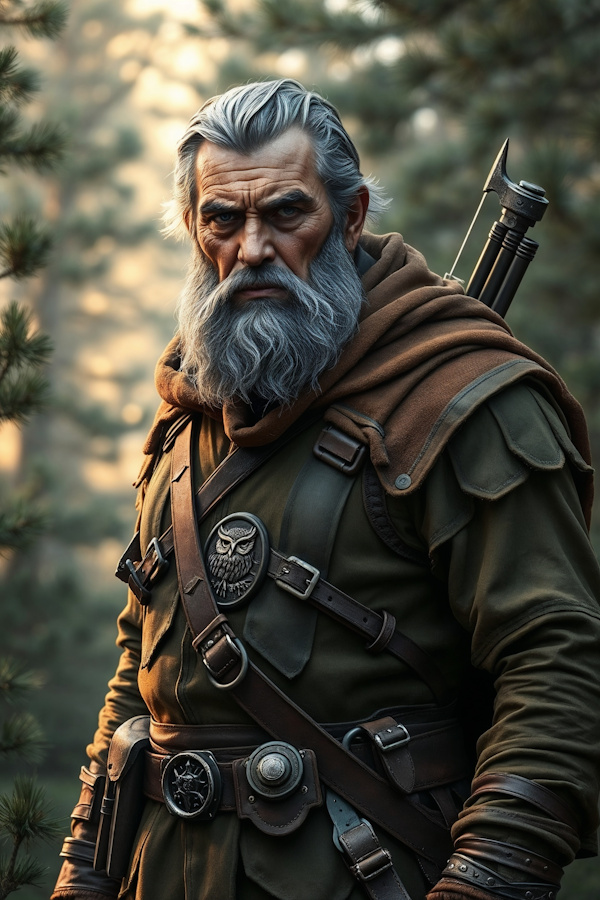
Holtz Merritown was born in a nameless crossroads settlement along the northern edge of the Freelands, where the wind carried the scent of pine from the Simmaron Forest and the threat of goblin raids kept farmers vigilant. His parents were transplants from the Four Fiefdoms—his father a blacksmith from Vranna who'd sought cheaper land and fewer questions, his mother a seamstress who'd followed her husband into what she called "the frontier madness." They raised Holtz and his two younger sisters in a drafty timber house that leaked when it rained and groaned in winter storms.
The settlement had no name because it barely qualified as one—a dozen families clustered around a crossroads, a trading post that doubled as a tavern, and a shared well. What it did have was proximity to danger. Goblin raiding parties from the mountains struck with enough regularity that every able-bodied man kept a weapon close and knew how to use it. Holtz learned to shoot a bow before he learned his letters, and by twelve he'd already helped drive off two raids, standing shoulder-to-shoulder with his father and the other men behind hastily erected barricades.
It was during one of these raids that Holtz first saw the King's Patrol in action. A squad of patrollers appeared seemingly from nowhere, their arrows finding targets with lethal precision, their coordination transforming chaos into calculated efficiency. They killed half the goblin band before the creatures even realized they were under attack, then pursued the survivors into the forest. The entire engagement lasted less than ten minutes. Young Holtz stood slack-jawed, his own unused bow dangling from his hand, and knew he'd witnessed something extraordinary.
The next morning, before the patrol moved on, Holtz approached their squad leader—a weathered woman named Carrick who had a scar running from temple to jaw. He asked what it took to join the King's Patrol. She looked him over with eyes that missed nothing, then told him the truth: it took skill, discipline, and the willingness to spend your life protecting people who'd never know your name. "Most wash out in the first year," she said. "But if you make it through training, you'll never wonder if your life meant something."
Holtz was sixteen when he left home. His father understood, even if his mother wept. The Freelands were no place for those who wanted more than subsistence and survival, and Holtz wanted to return to the land of his family's origin—to serve something larger than himself. He made the journey south to Vranna alone, carrying little more than his bow, a bedroll, and his father's parting gift: a well-forged hunting knife.
The Simmaron Hall accepted him as a recruit, and the training nearly broke him. Not the physical demands—Holtz was strong and capable—but the precision, the discipline, the expectation of excellence in every task. He'd thought himself competent with a bow; the trainers showed him he was barely adequate. He'd believed he understood the forest; his instructors taught him he'd been stumbling through it like a blind ox. More than once, Holtz considered quitting. Each time, he remembered that ten-minute engagement at his home settlement, the way Carrick and her squad had moved with purpose and certainty, and he pushed through.
He graduated after two years, not at the top of his class but solid, reliable, and determined. His first posting was routine patrol work—walking the boundaries, checking on frontier settlements, investigating reports of unusual activity. Holtz proved himself steady if unspectacular, the kind of patroller commanders wanted on every squad because he followed orders, kept his head in a crisis, and never left a job half-finished.
His first real taste of leadership came during the Autumn Incursion, when a coordinated series of goblin raids struck multiple settlements simultaneously. The squad leader took an arrow through the throat in the first engagement, and Holtz found himself suddenly in command of nine other patrollers, most as green and terrified as he felt. He didn't have time to question or doubt. He fell back on training, on the book of regulations he'd memorized, on the procedures drilled into him until they were instinct. His squad held their position, protected the settlers, and when reinforcements arrived twelve hours later, every patroller under his command was still alive.
That night, spitting a wad of chewing leaf into the fire, the company commander told Holtz he had a knack for keeping people alive. "Not flashy," the man said, "but flashy gets you killed out here. Competence keeps you breathing."
Holtz's rise through the ranks was methodical. He became a squad leader, then a senior squad leader, then a squadron captain. He earned a reputation for being by-the-book, for following regulations and expecting his subordinates to do the same. But those who served under him also learned that Holtz understood the difference between the regulation and the situation. When the book said one thing but reality demanded another, Holtz bent the rules just enough to get results—then documented everything meticulously so no one could question his decisions after the fact.
One incident became legend among the patrol: a goblin raiding party had taken hostages from a logging camp and retreated into a cave system. Regulations said to request reinforcements and wait for a coordinated assault. Holtz assessed the situation, saw that waiting would likely mean dead hostages, and led his squadron into the caves immediately. They rescued all six prisoners and eliminated the goblin band, but Holtz took an arrow through the shoulder in the process. When called before the company commander to explain his violation of procedure, Holtz simply presented his meticulously documented report showing that by the book's own definitions of "imminent threat" and "acceptable risk," his decision was justified. The commander promoted him.
By the time Holtz earned his company command, he was in his forties—a grizzled veteran with a weathered face, hands scarred from decades of bow work, and a perpetual wad of chewing leaf tucked behind his lower lip. His hair had more gray than brown, his knees ached in cold weather, and he'd accumulated enough scars that he'd stopped counting them. But he could still outshoot most of his younger patrollers, still outmarch recruits half his age, and still make tactical decisions that saved lives.
His command style was gruff, direct, and demanding. He expected his squadrons to follow orders precisely, maintain their equipment properly, and conduct themselves according to regulations. He had no patience for sloppiness, excuses, or heroes looking for glory. But his subordinates learned that beneath the rough exterior was a commander who cared deeply about their survival, who studied every after-action report to learn from mistakes, and who would bend or break rules when it meant bringing his people home alive.
During the goblin invasion led by Gral, Lord of Greth, Holtz volunteered his company for what everyone knew was the most dangerous assignment: harrying the bulk of the goblin army and drawing them away from the siege engines. It was a suicide mission dressed up in tactical language, and Holtz took it without hesitation. Not because he was fearless—he'd been afraid plenty of times in his career—but because someone had to do it, and he trusted himself to give his people the best chance of survival.
He led his squadrons into the Simmaron with the same methodical precision that had defined his entire career. They struck hard, fell back, struck again from a different angle. They made the goblins chase them deeper into the forest, away from the siege engines and the Hall. Holtz lost good people in that running battle, and each death sat heavy on his conscience. But the mission succeeded. The siege engines were destroyed, the Hall survived, and enough of his company made it out that Holtz could still look himself in the mirror.
These days, Holtz commands his company with the same gruff competence that's defined him for over twenty years. He still chews leaf, still spits when he's thinking, still follows regulations while knowing when to bend them. He's trained two generations of patrollers, turned raw recruits into competent soldiers, and earned the grudging respect of everyone who's served under him.
He knows he's not the most inspiring leader, not the most brilliant tactician, not the hero of songs and stories. But he's steady, reliable, and committed to the simple principle that kept him going through all those years: protect the people, follow the mission, bring your subordinates home alive. In the King's Patrol, where death lurks behind every tree and glory is measured in sunrises you live to see, that's more than enough.
FIRST APPEARANCE
Holtz first appears in The Hall of the Wood.