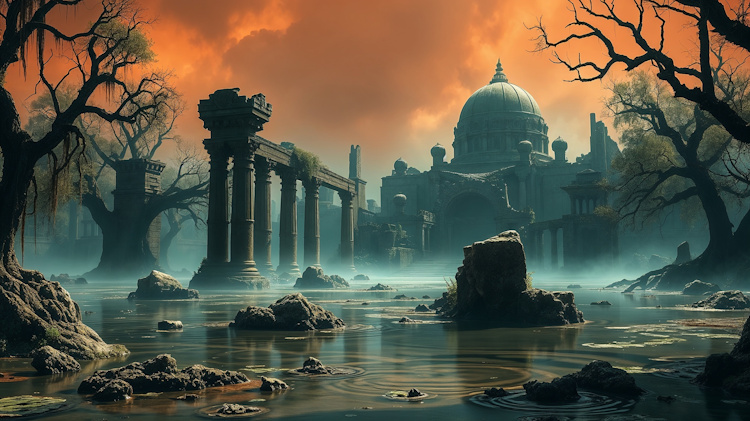
Deep within the pestilent heart of the Grimmere swamp, where humid mists cling to ancient stone and serpentine sitheri broods patrol their territorial waters, lie the ruins of Il'kell—a testament to a civilization that flourished millennia before the Age of the Old Gods and whose grandeur now serves only to haunt those brave or foolish enough to venture into its vine-choked remains.
Four thousand years before the present day, during an age when the world of Uhl was young and wild magic flowed freely through the land, the empyreans built Il'kell upon what was then fertile ground blessed by natural springs and surrounded by lush forests. The empyreans were a sophisticated people, neither human nor eslar, but a race unto themselves—beings attuned to the fundamental forces that governed the natural world.
They were master architects who crafted structures of perfect symmetry, their stone columns rising like prayers to the sky, their domes achieving mathematical precision that spoke of deep understanding of geometry and natural law. The empyreans built not merely for function but for harmony, seeking to create a city that existed in balance with the world around it. Their cobbled paths wound through neighborhoods where families lived for generations, their flat-roofed homes designed to capture rainwater and channel cooling breezes through carefully positioned windows and doorways.
Il'kell grew into a sprawling metropolis that extended for miles, home to perhaps fifty thousand souls at its height. The city was renowned throughout the ancient world as a center of natural philosophy and arcane study. Empyrean savants conducted experiments in laboratories protected by intricate spell traps, seeking to understand and harness the mysterious energies that permeated their land. Some claimed that Il'kell itself sat upon a "place of power"—a geographic location where the boundaries between the material and magical realms grew thin, where forces gathered like an underlying current waiting to be channeled by those with the knowledge and will to do so.
The empyreans were not conquerors or empire-builders. They valued knowledge above dominion, understanding above accumulation. Their society was structured around scholarly pursuits, with savants—their wisest philosophers and practitioners of the arcane arts—serving as both teachers and leaders. These savants maintained great libraries filled with texts on natural law, alchemical processes, and the manipulation of elemental forces.
Trade routes connected Il'kell to distant lands, bringing exotic materials and ideas that the empyreans eagerly incorporated into their studies. The city's markets bustled with merchants from every known race, though the empyreans themselves rarely ventured far from their beloved home. They created artifacts of remarkable craftsmanship and power, objects that would become legendary treasures sought by adventurers in ages to come—though most of these wonders would be lost, buried, or claimed by the swamp.
The empyreans were a peaceful people, but not naive. They understood that knowledge could be dangerous in the wrong hands. Their savants protected their most sensitive research behind locked doors, magical wards, and spell traps designed to deter thieves and the unworthy. Keys of intricate design—long brass implements marked with many teeth—secured their most precious secrets.
The fall of Il'kell did not come through war or cataclysm, but through a gradual transformation so insidious that the empyreans barely noticed it until too late. Over the course of several centuries, the climate shifted. What had once been moderate rainfall became torrential flooding. The forests that surrounded the city grew darker, denser, twisted by wild magic. The ground itself seemed to sour, becoming waterlogged and unstable.
The springs that had provided clean water became brackish. The air grew thick with humidity and the smell of decay. Strange fungi bloomed in places where none had grown before. Trees began to die, their trunks rotting while still standing, creating a skeletal forest that trapped the moisture and heat. What had been paradise was slowly, inexorably becoming swamp.
Some empyrean scholars theorized that their own experiments had contributed to this transformation—that drawing too heavily upon the place of power had weakened the natural barriers that kept wild magic in check. Others blamed shifting ley lines or the machinations of forces beyond their understanding. The truth was likely more mundane: the world was changing, as it had always changed, and Il'kell happened to sit in the path of that change.
The empyreans tried to adapt. They built channels to divert flood waters. They raised their foundations and reinforced their structures. They researched spells to purify water and ward off the encroaching decay. But each solution proved temporary. The swamp was patient and implacable.
As conditions worsened, the younger empyreans began to leave, seeking more hospitable lands. The old remained, bound by tradition and the belief that Il'kell could be saved. They maintained their laboratories, continued their studies, and held fast to the hope that knowledge would provide deliverance.
By three thousand years ago, Il'kell was already more swamp than city. Only a fraction of its original population remained—perhaps five thousand elderly scholars and stubborn traditionalists who refused to abandon their ancestral home. They moved through streets where moss grew thick on stone, where tree roots cracked foundations that had stood for a millennium, where the sound of dripping water was constant and maddening.
The last empyreans of Il'kell grew increasingly isolated from the outside world. Trade routes that had once brought prosperity now brought only occasional desperate treasure hunters or lost travelers. The savants sealed their laboratories, protecting their life's work behind locks and spells, perhaps hoping that future generations might return and reclaim what was being lost.
Disease came with the swamp. Fevers and wasting sicknesses that the empyreans' healing arts could not cure. Their numbers dwindled. The living moved from the outer districts into the city center, abandoning whole neighborhoods to nature's reclamation. Eventually, even the center was too much to maintain.
The exact fate of the last empyreans remains unknown. Some believe they simply died out, their bodies claimed by the swamp that had consumed their city. Others whisper of desperate final experiments—attempts to harness the place of power one last time, to transform themselves into something that could survive in this new environment. Perhaps this is mere legend. Or perhaps it explains certain oddities reported by those few who have explored Il'kell's deepest ruins.
In the centuries after the empyreans' disappearance, the Grimmere fully claimed what had once been Il'kell. The swamp became impenetrable, its waters home to venomous serpents, its air thick with disease, its depths concealing dangers both natural and unnatural. The city that had once housed fifty thousand living souls became a haunted place of crumbling stone and gathering shadows.
Then came the sitheri.
The serpentine race, organized into territorial broods led by their brood mothers, discovered the ruins approximately fifteen hundred years ago. To the sitheri, who thrived in swamp environments, the Grimmere was paradise. And within that paradise, they found Il'kell—a ready-made city of stone structures that, despite centuries of decay, still stood against the elements.
The sitheri did not rebuild Il'kell. They had no interest in restoring empyrean architecture or reclaiming the city's former glory. Instead, they claimed the ruins as sacred territory, a place of power recognized even by their primitive understanding. Different sitheri broods staked claims to different sections of the ruins, creating a patchwork of perpetually contested territories. The ruins became both holy ground and battleground, a place where brood mothers sent their warriors to prove themselves and where ancient empyrean magic occasionally flared to terrible effect.
The sitheri discovered that the ruins held secrets and treasures—locked laboratories containing strange artifacts, spell traps that could kill the unwary, and plants that grew nowhere else in the world. Among these was the silver lotus, a flower that bloomed year-round in certain places within the ruins, its petals possessed of remarkable alchemical properties. The sitheri considered these plants sacred, and killing an outsider who dared harvest them became a rite of honor.
In the current Age of Advancement, year 539, Il'kell remains a place of mystery and danger. The ruins extend for miles through the Grimmere, their true extent unknown even to the sitheri who claim dominion over them. Vine-wrapped columns stand at odd angles, cracked and upheaved by tree roots and the shifting of the swampy ground. Moss-covered stone rises everywhere—remnants of foundations, walls, entire structures that somehow still stand despite centuries of decay. The outlines of doorways and windows can still be seen, though the wood has long since rotted away, leaving only stone frames that stare like empty eye sockets across the ruined cityscape.
The ruins feature a central area of relatively flat, featureless ground—likely once a great plaza or ceremonial space—which serves as a landing site for the rare airship crews brave enough to fly into the Grimmere. From there, old cobbled paths lead deeper into the ruined city, their stones slick with moisture and treacherous with age. The paths wind between structures in various states of collapse, from those that are nothing but the last vestiges of foundations to others that remain almost entirely intact, their stability questionable but their stone having lasted this long through empyrean craftsmanship.
The place retains an aura of power that sensitive individuals can feel—an underlying current, a force different from normal magic, as if the very ground remembers what it once was. The humidity is oppressive, the air thick with the smell of rotting loam, fungus, and brackish water. Pools of stagnant swamp water collect in low places. Gray swamp trees grow among and through the ruins, their roots slowly tearing apart what time has not already claimed.
The sitheri patrol the ruins constantly, their broods in perpetual conflict over territory and resources. They view outsiders as either intruders to be killed or potential sacrifices for their dark rituals. Only the most desperate treasure hunters, or those with specific needs that can only be met within Il'kell, dare to enter the Grimmere and navigate its dangers.
Yet people still come. Scholars seeking lost empyrean knowledge. Alchemists hunting for the silver lotus. Mercenaries paid to retrieve specific artifacts from sealed laboratories. Each believes they can succeed where others have failed, that they can take what they need from Il'kell and escape the swamp alive.
Few do. The ruins keep their secrets well, protected by time, terrain, sitheri, and perhaps by the lingering will of the empyreans who once called this place home.
Il'kell represents a cautionary tale about the impermanence of civilization, a reminder that even the greatest works of architecture and the most profound accumulations of knowledge can be reclaimed by nature. The empyreans built a city of perfect symmetry and mathematical precision, a place of learning that drew scholars from across the world. They unlocked secrets of the natural world and created artifacts of remarkable power.
Yet none of it saved them when their environment turned hostile. Their knowledge could not prevent the transformation of their land into swamp. Their magic could not halt the advance of decay. Their architectural genius could not stop roots from cracking foundations or water from seeping into sealed chambers.
What remains is not a city but a ruin. Not a center of learning but a graveyard. Not a place of harmony but a battleground for savage sitheri broods who neither understand nor care about the civilization they have inherited.
The treasure hunters who risk the Grimmere seeking empyrean artifacts rarely find what they seek. Most return empty-handed, if they return at all. Those few who do recover relics or knowledge speak of Il'kell with a mixture of awe and horror—awe at what the empyreans achieved, horror at how completely it has been lost.
Perhaps that is Il'kell's true legacy: not the artifacts or knowledge it once contained, but the lesson it teaches. That no matter how advanced a civilization becomes, no matter how secure it believes itself to be, nature remains patient and implacable. Given enough time, the swamp always wins.
And in the ruins of Il'kell, where vine-wrapped columns lean at impossible angles and shadows gather in doorways that once welcomed families home, that lesson is carved in slowly crumbling stone for anyone with the courage—or foolishness—to venture deep enough into the Grimmere to read it.