Parthen is one of the most tragic and corrupted figures in the history of the Simmaron Woods, a priest whose devotion to the God of Disease led him to commit atrocities that would echo through the centuries. Once a man of flesh and blood, he became a shade—a disembodied spirit bound eternally to the very instrument of his greatest ambition, condemned to exist as a ghostly witness to his own failure for over five hundred years.
Little is known of Parthen's origins before he entered the service of Sarrengrave. Like many who were drawn to the darker Immortals during the Age of the Gods, he likely came from desperate circumstances or harbored ambitions that the Gods of Light could not fulfill. What drove him to pledge his soul to the Lord of Rot—whether it was a desire for power, a twisted sense of purpose, or something darker still—remains a mystery lost to time. What is certain is that Parthen rose through the ranks of Sarrengrave's priesthood to become one of the god's most devoted servants. In an age when the Immortals walked Uhl and their followers waged wars of ideology and conquest, Parthen distinguished himself among the zealots who served the God of Disease. He embraced the teachings of rot and decay, seeing in them not merely destruction but a fundamental truth about the cycle of existence.
Parthen was among a cadre of dark priests who sought to harness Sarrengrave's power for a purpose so terrible that its full scope defied comprehension: the destruction of all life on Uhl. These zealots believed that by creating a focal point for their god's essence—a Well of Darkness that would channel Sarrengrave's corruptive power—they could spread disease and decay across the world like a cleansing fire. In their twisted theology, this was not murder but purification, a return of all living things to the primordial state of nothingness from which they had emerged. Parthen was instrumental in the creation of the Well of Darkness. Through dark rituals and sacrifices that scarred both land and soul, he and his fellow priests carved out a temple deep beneath the Simmaron Woods. There, in a vast cavern lit by the eerie glow of corrupted minerals, they constructed their instrument of apocalypse. The Well itself became a pool of seething, bubbling darkness—a concentrate of Sarrengrave's power so potent that merely approaching it filled even the most stalwart hearts with waves of nausea and dread.
The zealots' work did not go unnoticed. The druids of the Simmaron, guardians of the natural order and protectors of the great forest, sensed the corruption spreading beneath their feet. As the Well's influence began to seep into the earth, poisoning root and stream, the druids mobilized. What followed was a confrontation between two opposing philosophies: the druids' reverence for life and balance against the zealots' nihilistic vision of universal decay. The battle was fierce and costly. The zealots, empowered by their proximity to the Well and armed with diseases that could kill with a touch, were formidable adversaries. But the druids were fighting for their homeland, for every tree and creature that called the Simmaron home. One by one, the dark priests fell, their bodies consumed by the very corruption they had sought to wield. The druids showed no mercy, for they understood that any who survived would simply rebuild and begin anew. Parthen was the last to face the druids' judgment. Whether through skill or cowardice, he had survived when his brethren had not, and he stood alone before the arch-druid Delbin Kinkaed and his circle of protectors.
The druids faced a terrible dilemma. Simply killing Parthen would be insufficient—his soul might find its way back to Sarrengrave or, worse, linger as a vengeful spirit that could guide others to the Well. Yet they could not allow him to live, not after the horrors he had committed and the world-ending catastrophe he had nearly unleashed. Delbin Kinkaed, in consultation with the greatest minds of his order, conceived of a punishment that was both prison and penance. Using ancient magic and soul-binding rituals that would themselves be lost to time, the druids stripped Parthen of his physical form. His corporeal body was destroyed utterly, leaving only his spirit—a shade, a ghost bound to the waking world but unable to touch it or influence it in any meaningful way. But the druids went further. They chained his disembodied soul to the very Well he had helped create, the instrument of what should have been his greatest triumph. This was to be Parthen's eternal torment: to exist forever in the cavern where he had committed his darkest deeds, unable to act, unable to die, unable to escape. He would bear witness to the victory of his enemies, forced to watch as the druids sealed the cavern and negated the Well's power. He would remember, always remember, what he had done and how completely it had failed. The druids meant for him to exist in this state for all eternity, a shade haunted by his own memories and the weight of his crimes.
For over five hundred years, Parthen endured his punishment. Trapped in the sealed cavern, he existed in a twilight state between life and death, consciousness and oblivion. The world above moved on—the Immortals destroyed themselves in their final war, the druids themselves faded into legend, and the very memory of what had transpired beneath the Simmaron was forgotten by all but a few. Yet Parthen remained, unchanged and unchanging. The cavern became his entire universe, its limestone walls and the sealed Well the only things he could perceive. He had no body to feel hunger or thirst, no flesh to grow weary, no mortality to provide the mercy of an ending. He was consciousness without form, awareness without agency, memory without release. Over the long centuries, something within Parthen shifted. Whether it was genuine remorse, the erosion of his zealotry by endless isolation, or simply a desperate desire for any change to his existence, the priest who had once sought to destroy all life began to wish for something different. He could not undo what he had done, could not restore the lives he had taken or repair the damage he had caused. But perhaps, if given the chance, he could act differently. Perhaps he could help rather than harm. Or perhaps this was simply another lie he told himself to pass the endless years.
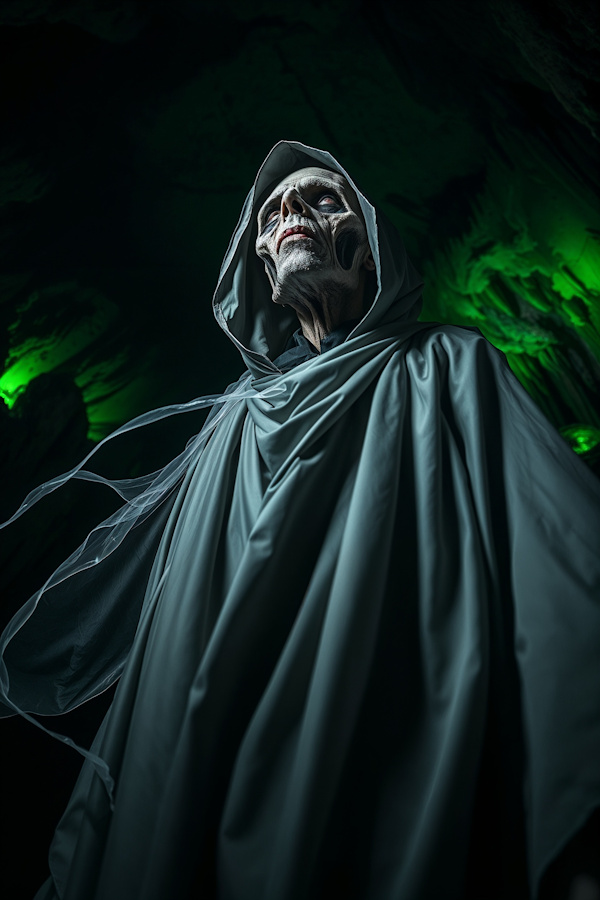
When Parthen manifests to those rare individuals who enter his domain, he appears as a robed figure shrouded in gray, silken vestments. He typically keeps his hood drawn, concealing features that bear the unmistakable marks of Sarrengrave's touch. When revealed, his face is a horror: hairless and scarred, with skin pockmarked by disease. His nose is sharp and pointed, his eyes gray like steel, devoid of the warmth of living flesh. His lips are swollen and slug-like, bearing the same terrible scarring that covers his cheeks. These are not the features Parthen wore in life but rather a manifestation of his spiritual state—marked forever by the god he served and the corruption he embraced. They serve as a constant reminder of what he was and what he can never escape. Parthen possesses the ability to draw living minds into an illusory space, a limbo between the waking world and the realm of dreams and nightmares. In this mental landscape, he can converse with the living, pulling images from their memories to create familiar settings. His touch in this realm does not harm, though the mere sight of him often inspires revulsion and fear. He claims he cannot lie in this space, though whether this is truth or simply another deception remains uncertain.
After five centuries of imprisonment, Parthen is an enigma—neither wholly evil nor entirely redeemed. He claims to wish for freedom, not to wreak havoc but simply to be released from his eternal torment. He offers guidance and assistance to those who might help him, providing information and steering them away from the darkest impulses that the Well's corruption might inspire. Yet his motivations remain suspect, for he was once a priest who sought to end all life, and such fundamental corruption of purpose is not easily shed, if it can be shed at all. The sorcerer Murik Alon Rin'kres, one of the few scholars to study the aftermath of the Well's reawakening, described Parthen's imprisonment as "an effective prison." Whether the priest's offer of help to Holly and her companions was genuine redemption, calculated self-interest, or something more complex remains a matter of debate among those who survived the ordeal. What is certain is that Parthen represents a unique punishment in the history of Uhl—a soul bound not to oblivion or torment in the afterlife but to perpetual awareness of its own failure, trapped forever at the scene of its greatest crime. Whether the druids' judgment was justice or cruelty, mercy or revenge, is a question that can never be fully answered.
Parthen's story serves as a cautionary tale about the dangers of zealotry and the corrupting influence of the darker Immortals. His fate demonstrates the lengths to which the ancient druids would go to protect the Simmaron and prevent world-ending catastrophes. It also raises uncomfortable questions about the nature of punishment, redemption, and whether any soul, no matter how corrupted, deserves an eternity of torment. The priest's binding to the Well of Darkness remained unbroken for over five hundred years, until the events surrounding the witch Saress's discovery and exploitation of the cavern. Whether Parthen finally achieved his freedom, what he did with it if he did, and whether his assistance to those who opposed Saress represented genuine change or mere self-preservation are mysteries that may never be fully resolved. What remains is the memory of a priest who served the Lord of Rot, who sought to unmake the world, and who paid a price that exceeded even death itself—a shade trapped in shadow, a voice echoing through centuries, a reminder that some crimes transcend even the grave.
FIRST APPEARANCE
Parthen first appears in The Hall of the Wood.