Relk drew his first breath in the small settlement of Thornbridge, a collection of timber houses clinging to the southern edge of the Simmaron Forest like moss to ancient bark. His father worked as a woodcutter, bringing down the great oaks at the forest's periphery, while his mother tended a small garden plot that struggled against the shade of those same towering trees. Three older brothers filled the cramped house with noise and competition, leaving little room for a fourth son who arrived unbidden and unwanted into an already strained household. From his earliest memories, Relk understood he was the extra mouth that stretched the family's meager resources too thin, the child whose portion came from someone else's plate.
The forest became his sanctuary before he could count ten winters. While his brothers apprenticed to their father or hired themselves out to neighboring farms, young Relk slipped between the trees, finding in the quiet depths of the Simmaron what he could never find at home. The woods did not judge him for being the youngest or the least wanted. The creatures that moved through shadow and dappled light asked nothing of him save respect for their domain. He learned to move silently across carpets of fallen leaves, to read the stories written in disturbed earth and broken twigs, to sense the rhythms of life that pulsed through the forest like blood through veins. The Simmaron accepted him without question, and he returned that acceptance with devotion.
Relk's education came not from books or masters but from observation and necessity. He watched how the red foxes hunted voles in the meadows, how the ravens communicated danger to their flocks, how the deer moved through the undergrowth without leaving trails that predators could follow. He studied the trappers who worked the forest, noting which men returned with full packs and which came back empty-handed, discerning the difference between skill and mere luck. Old Gareth, a grizzled trapper who worked a territory east of Thornbridge, occasionally shared his fire with the quiet boy who appeared like a ghost from the trees. Gareth spoke little, but his weathered hands showed Relk how to set snares that animals would walk into without suspicion, how to prepare pelts so they fetched better prices, how to read the forest's moods and know when storms approached or when game had moved to different grounds.
By the time Relk reached his fifteenth year, he had already spent more nights under the stars than beneath his family's roof. His father barely noticed his absences. His mother worried in the way mothers do, but she also recognized that her youngest son had found something in the wilderness that the town could never provide. His brothers regarded him as strange, this silent sibling who preferred the company of trees to people, but they were not unkind about it. They simply accepted that Relk had chosen a different path, one that led away from Thornbridge and deeper into the green shadows of the Simmaron.
The transition from boy to man happened gradually for Relk, marked not by any single event but by the accumulation of skills and confidence. He fashioned his first bow from yew wood, spending weeks selecting the right branch, curing it properly, testing the draw until it felt like an extension of his own arm. His arrows flew true not because of natural talent but because of countless hours spent practicing on stumps and branches, learning how wind and distance affected their flight. He became adept at reading animal behavior, understanding when a deer sensed danger or when a rabbit would bolt from cover. Hunting with a bow demanded patience and stillness, qualities Relk possessed in abundance. Where other hunters might grow restless waiting for the perfect shot, Relk could become as motionless as stone, his breathing shallow, his presence so diminished that even the forest's most cautious inhabitants forgot he was there.
Trapping became his primary trade, though hunting supplemented his income during lean seasons. Relk developed his own techniques, combining what Old Gareth had taught him with innovations born from his intimate knowledge of the Simmaron. He learned which animals moved through which corridors of the forest, where they denned and where they hunted, what attracted them and what made them wary. His traps were clever without being cruel, efficient without being wasteful. He took only what he needed, always leaving enough breeding stock to ensure the populations remained healthy. This was not altruism but practicality. A trapper who depleted his territory would soon have no territory worth working.
The Simmaron was vast, and Relk came to know vast portions of it with the intimacy that others reserved for their own homes. He could navigate by the stars when the canopy opened enough to reveal them, or by the moss that grew thicker on the northern sides of the great oaks. He knew which streams ran year-round and which dried to trickles in summer, where the best fishing holes hid beneath overhanging banks, which caves provided shelter during storms and which were claimed by bears or other creatures best left undisturbed. He learned the forest's sounds so thoroughly that silence itself became a warning, the absence of birdsong or the sudden stillness of insects alerting him to danger long before his eyes could confirm it.
It was during one of his ranging trips eastward, following a promising line of beaver dams along a tributary of the Simmaron's main waterways, that Relk first encountered the patrollers of the Hall of the Wood. He had heard of them, of course. Every woodsman knew stories of the King's Patrol, those sworn protectors who maintained order in the vast wilderness and stood as a bulwark against the goblin threat from the north. But knowing of them and meeting them were different things entirely. The patroller who stepped from the trees wore the forest like a second skin, moving with a confidence and purpose that marked him as someone who belonged to this place as deeply as Relk himself did. His name was Jerrick Bur, and though their first meeting lasted only long enough to exchange names and establish that neither posed a threat to the other, it planted the seed of mutual recognition. Here was another man who understood what it meant to choose the forest over the false comforts of civilization.
Over the years that followed, Relk and Jerrick crossed paths with increasing frequency, their separate wanderings through the Simmaron creating occasional intersections that both men came to appreciate. They were not friends in the conventional sense. They did not seek each other out or make plans to meet. But when their trails converged, they shared fires and food, trading information about game movements, discussing changes in the forest's character, sometimes sitting in companionable silence that needed no words to bridge. Jerrick spoke occasionally of the Hall, of his fellow patrollers, of the duty that bound him to these woods. Relk listened without judgment, understanding that men needed different things from life. Jerrick had found his purpose in service and protection. Relk had found his in solitude and self-sufficiency. Neither path was better than the other. They were simply different, and both men respected that difference.
The patrollers came to know Relk as a reliable presence in the eastern reaches of the Simmaron, a woodsman whose knowledge could be trusted and whose word carried weight. When they encountered signs of unusual animal behavior or evidence of human passage through remote areas, they sometimes sought him out for his interpretation. Relk provided what information he could, never involving himself in patrol business but willing to share observations that might prove useful. This arrangement suited him perfectly. He maintained his independence while contributing to the protection of the forest he loved. The patrollers, in turn, left him to his trapping and never questioned his right to work territories that technically fell under the Hall's jurisdiction.
Relk's reputation grew slowly but steadily among those who made their living from the Simmaron. He was known as a man who kept his word, who could be counted on to honor territorial boundaries, who traded fairly and never cheated on quality. His pelts commanded good prices in Homewood and other settlements around the forest's edges because merchants knew they were properly prepared and honestly represented. He developed regular customers who specifically requested his furs, knowing they would last and wear well. The money he earned was modest by town standards but more than sufficient for his needs. Relk owned little beyond his traps, his bow, his knife, and the clothes on his back. He needed nothing more.
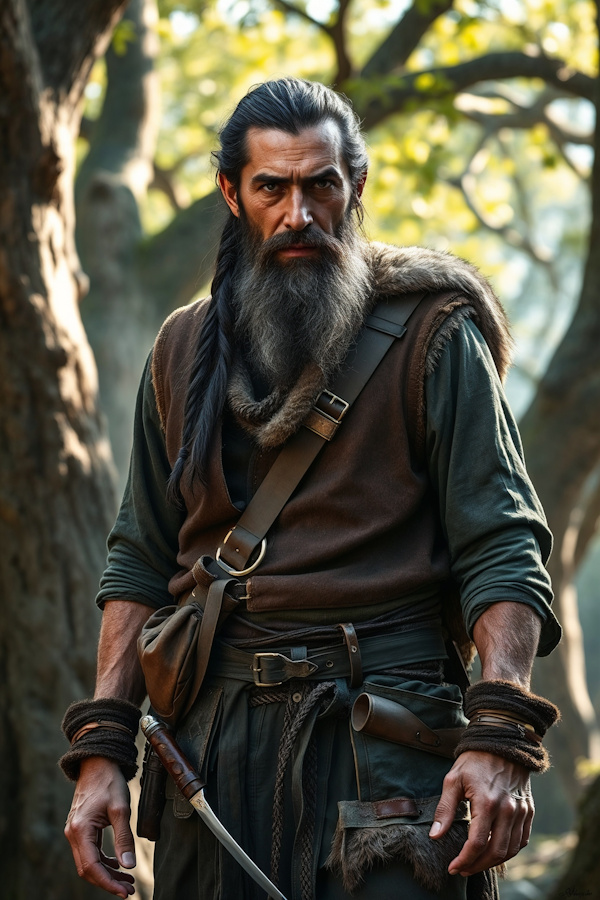
The forest shaped him as surely as a river shapes the stones in its bed. His skin grew rough and weathered from constant exposure to sun and wind, marked by small scars that told stories of close encounters with thorns, brambles, and the occasional animal that took exception to being trapped. His hands became calloused and strong, capable of delicate work when setting snares but equally able to wield an axe for hours without tiring. His dark hair grew long because cutting it seemed unnecessary, and he gathered it back with whatever cord was handy. His beard grew thick and untamed, a practical barrier against cold and insects that he trimmed only when it grew inconvenient. His lean frame carried not an ounce of excess weight, maintained by the constant physical demands of his life and a diet that consisted primarily of what he caught or gathered.
Relk learned the superstitions that woodsmen carried like talismans against the unknown. He marked certain trees as boundaries that should not be crossed without permission from whatever spirits might dwell beyond. He left offerings at old standing stones whose origins predated memory, not because he necessarily believed in the old gods but because the forest was vast and ancient, and wisdom suggested humility in the face of such antiquity. He noted the days when the forest felt wrong, when the normal sounds fell silent and the air itself seemed to hold its breath, and on those days he returned to familiar ground and avoided venturing into new territories. Some called these superstitions mere fancy, but Relk had lived too long in the Simmaron to dismiss them entirely. The forest held mysteries that defied easy explanation, and he had learned that skepticism could be as dangerous as credulity.
The years accumulated like rings in a tree's heartwood, marking Relk's passage from young man to middle age without dramatic incidents or sudden changes. His life followed the rhythms of the seasons—setting trap lines in autumn, checking them through winter, processing pelts in early spring, hunting and fishing through summer. He returned to Homewood only when his packs were full or his supplies exhausted, spending as little time as possible within walls that felt confining after the forest's freedom. The townsfolk knew him as a quiet man who conducted his business efficiently and then disappeared back into the trees as if the settlement's very air was poison to him. They were not wrong. Towns meant noise and crowds, petty disputes and social obligations that grated against his nature. The forest offered clarity and purpose without demanding constant interaction or explanation.
Relk witnessed the slow changes that crept through the Simmaron like shadows lengthening at day's end. The patrollers he once encountered regularly began appearing less frequently, then hardly at all. The forest's character shifted in ways he could not quite articulate but definitely felt. Certain areas that had once seemed welcoming now carried an oppressive quality, as if something malevolent had taken up residence and was slowly spreading its influence. The animals behaved strangely, migrating from traditional territories or avoiding areas they had inhabited for generations. Trees that should have been healthy showed signs of disease or decay that had no natural explanation. Relk altered his trap lines accordingly, avoiding the troubled regions and working territories that still felt right, but the changes disturbed him more than he cared to admit.
When the darkness became impossible to ignore, when his usual route north toward the Hall filled him with the unmistakable sensation of being watched by hostile eyes, Relk finally abandoned his customary reticence and made for Homewood with information that needed sharing. The town was gripped by fear when he arrived, its people speaking in hushed tones about missing patrollers and the Call of Heroes that had gone out seeking aid. Relk took a room at Jay's Tavern, an unprecedented decision that spoke to the severity of the situation. He who normally slept beneath stars and trees found himself trapped within walls by a mayor's decree that no one could leave after nightfall, a rule that chafed like ill-fitting boots but which he endured because the circumstances demanded it.
It was during this enforced stay that Jerrick returned to Homewood, appearing with companions who had answered the Call. Relk shared what he knew, describing the wrongness that had infected the northern reaches of the Simmaron, the sensation of malevolent observation, the way the forest itself seemed to have sickened. He spoke of the patrollers' disappearance and the failed expeditions that had preceded the Call. He provided the information as factually as he could, though he knew his account would sound superstitious to outsiders who did not understand how the forest communicated its moods to those who truly listened. Jerrick understood, though. Jerrick always understood. That mutual comprehension, born from years of parallel existences in the Simmaron, needed no elaboration or justification.
After sharing what he knew, Relk excused himself from the company. He had done his part, provided his testimony. What came next was not his concern. The patrollers and the heroes would venture north to discover the Hall's fate, and Relk would return to his trap lines when the gate finally opened at dawn. He had lived through troubles before by staying out of conflicts that were not his own, by trusting his instincts about when to advance and when to withdraw. The Simmaron had taught him that survival often depended on knowing when to act and when to simply endure. He chose endurance now, retreating to the relative safety of his eastern territories while others marched toward whatever darkness had claimed the north. It was not cowardice that guided his decision but the hard-earned wisdom of a man who understood his limitations and stayed within them.
Relk remained what he had always been—a solitary woodsman who knew the Simmaron's eastern reaches better than any man alive, who could move through the forest like smoke through trees, who asked nothing from the world except to be left alone with his traps and his bow and the quiet that fed his soul. The troubles at the Hall were beyond his scope, meant for heroes and patrollers who had sworn oaths and accepted duties that Relk had never claimed for himself. He wished them well in his own silent way, hoped they would restore whatever balance had been upset, and planned to continue his work when the dust settled and the forest returned to normalcy. Until then, he would endure, survive, and trust in the lessons the Simmaron had spent decades teaching him. The forest had always provided for those who respected it and understood its ways. Relk had faith that it would continue to do so, even in these darkening times.
FIRST APPEARANCE
Relk first appears in The Hall of the Wood.