S’SARREN-KULL
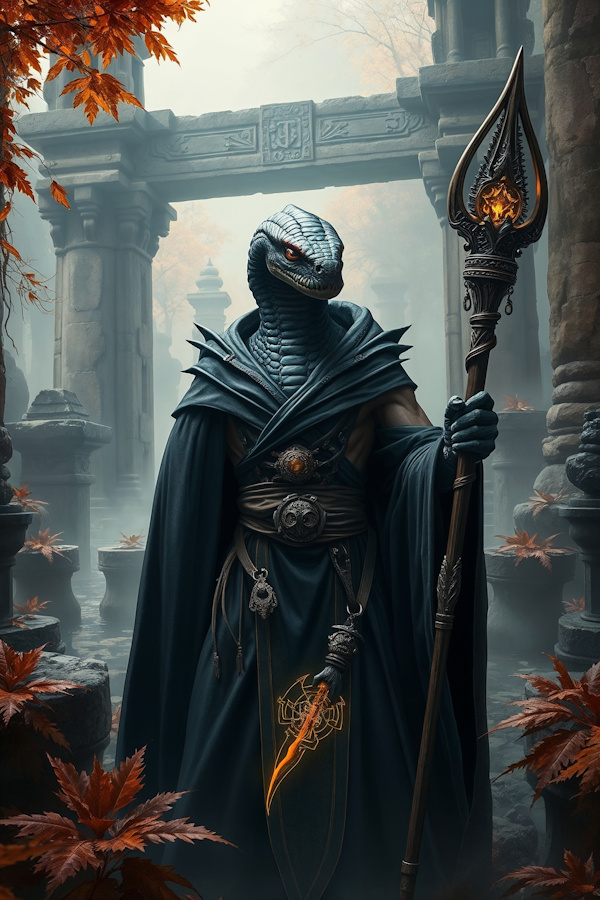
Overview
Like all sitheri, S’Sarren-kull was born into violence. The Grimmere swamp knows no gentle births, no peaceful childhoods. From his first moments, he fought for survival in the murky waters and tangled roots of Death’s Head Swamp, where the weak become food and only the cunning live to see their second season.
His natal brood belonged to one of the ten major sitheri tribes—the Scaled Throne, they called themselves, a tribe distinguished by the deep crimson and brown patterns that marked their warriors’ scales. His brood mother, Iss’thara, ruled her territory with absolute authority, as all brood mothers do, commanding loyalty through spiritual mysticism and brutal enforcement. Young S’Sarren learned early that power in sitheri society flows from two sources: physical might and spiritual insight. He possessed both.
Unlike his clutch-mates who dreamed only of the Hundred Scalps ritual and the warrior’s path, S’Sarren showed an unusual fascination with the spirits that the tribe’s shamans claimed to speak with. While other young males practiced with spears and learned the art of the ambush, he watched the shamans perform their rituals, memorizing their words, studying their methods. The shamans noticed. One in particular—an ancient male named Thresh’kul who had survived the Hundred Scalps and returned to spiritual service—took interest in the young sitheri’s keen observations.
“You see more than others,” Thresh’kul told him during one of their early conversations. “Your eyes look past the present moment. This is rare. This is dangerous.”
Dangerous indeed. The visions began when S’Sarren reached adolescence, when most young sitheri males prepare for their Hundred Scalps journey. He would fall into trances, seeing images of events that had not yet occurred—a raiding party ambushed at a river crossing that had not yet been planned, a brood mother’s assassination before any plot had been hatched, his own reflection standing atop a mound of skulls while warriors from multiple tribes bowed before him. The visions came unbidden at first, overwhelming his senses, leaving him dazed and vulnerable.
When S’Sarren shared a vision of his own brood mother’s death—poison administered by her most trusted lieutenant—Iss’thara faced a choice. She could kill the young prophet to prevent any possibility of his words becoming self-fulfilling, or she could trust his sight and act on his warning. The brood mother chose pragmatism. She had the lieutenant killed, and when her spies discovered the poison hidden exactly where S’Sarren said it would be, his reputation was sealed.
She kept him close after that, using his visions to navigate the treacherous politics of inter-tribal warfare and to plan successful raids against surface-dwelling settlements. S’Sarren’s predictions proved accurate far more often than not, though he learned quickly that the future was not fixed. The visions showed possibilities, not certainties. Sometimes multiple futures would present themselves, branching paths that depended on choices not yet made. This understanding set him apart from simple fortune-tellers and tribal prophets. S’Sarren did not merely see the future—he learned to read it, interpret it, and eventually, manipulate it.
His Hundred Scalps ritual, when it finally came, was unlike any other. Most young sitheri warriors leave their tribes for months or years, wandering the borderlands and attacking isolated travelers to gradually accumulate their required kills. S’Sarren completed his ritual in a single, coordinated campaign. Using his visions to predict troop movements, supply routes, and vulnerable targets, he orchestrated a series of raids against human settlements with such precision that he collected his hundred scalps in barely three months. More remarkably, he survived encounters that should have killed him, always seeming to know when to strike and when to fade back into the swamp.
He returned changed. The visions had grown stronger during his time in the surface world, and what they showed him troubled him—a future where the sitheri remained fractured, endlessly fighting amongst themselves while the warm-blooded races above grew stronger, developed new weapons, built flying machines that could bypass the swamp’s natural defenses. He saw sitheri tribes crushed by human armies, their territories burned, their broods exterminated. But he had also seen another path.
“The future holds two paths for our people,” he told Thresh’kul upon his return. “In one, we continue as we are—ten tribes eternally at war, growing weaker as the surface dwellers grow stronger. In the other, we become something the warm-bloods have never faced: a unified force with singular purpose.”
“The tribes will never unite,” Thresh’kul said, though his tone suggested less certainty than his words. “It goes against our nature. Even the greatest warriors cannot command the loyalty of multiple brood mothers.”
“Warriors, no,” S’Sarren agreed. “But a magi might. One who offers not just conquest, but destiny.”
Then S’Sarren began his true education in the mystical arts. Thresh’kul taught him everything the old shaman knew—how to commune with the spirits of the swamp, how to channel the natural energies that flowed through the Grimmere, how to read signs in the movement of water and the behavior of animals. But S’Sarren’s curiosity extended beyond traditional sitheri magic. He sought out forbidden knowledge, venturing into the ruins of Il’kell where the ancient empyreans had once practiced their arts. In those vine-choked laboratories and crumbling temples, he discovered texts and artifacts that spoke of necromancy—the manipulation of death itself.
He studied these texts with obsessive intensity, learning how necromantic magic inverted the natural flow of life energy and drew power from suffering and death. He found references to artifacts of terrible potency—a grimoire containing the spells of the ancient necromancers Ill Sigith and Jux Jeorn, a scepter capable of channeling the life force of countless souls, monoliths that could broadcast necromantic energy across vast distances. They had used such powers once before, millennia ago, to create the Dead Lands. The artifacts had supposedly been destroyed or lost after that region’s fall, but S’Sarren’s visions suggested otherwise.
The true breakthrough came when he uncovered a partially intact empyrean artifact in the deepest levels of Il’kell—a staff carved from darkwood and inlaid with symbols that seemed to shift and writhe when viewed directly. The moment S’Sarren touched it, his visions exploded in clarity and power. He saw not just possible futures but the intricate web of cause and effect connecting them, and how small actions in the present could cascade into massive changes years hence. The staff was a necromantic focus, a tool designed to channel death magic with devastating efficiency. Joined to his prophetic gift, it created something unprecedented: a sitheri magi who could see the future and possessed the magical might to shape it.
Armed with staff and visions, S’Sarren began the delicate work of unification. He started with the Scaled Throne, using his foresight to ensure their raids succeeded overwhelmingly. Under his guidance, they defeated rival tribes, claimed resource-rich territories, and grew powerful enough to attract the attention of other broods. But he did not conquer through force alone. He shared his visions with the brood mothers who came to him, offering a future in which serpentine warriors marched as one rather than wasting their strength on each other.
Those who rejected him he dealt with by other means—arranging for their warriors to walk into ambushes, for their raids to fail spectacularly, for internal dissent to fracture their leadership. When a weakened tribe finally crumbled, S’Sarren would be there to offer the survivors a choice: join his coalition or face extinction. One tribe became three, then five, then seven, each addition bringing fresh challenges as brood mothers jockeyed for position and warriors from rival broods struggled to work alongside those they had hated for generations.
“I am not asking you to follow me out of love,” he told his coalition. “I ask you to follow because I have seen victory, and I know the path to reach it.”
Appearance
S’Sarren-kull carries the coloring of the Scaled Throne in his very face—a mask of dark reds and darker browns, the crimson-and-brown patterning that marks his tribe’s warriors. His eyes are yellow and slitted, his mouth wide, his lips the same red-brown as his scales. A black tongue darts in and out between them, tasting the air, and it moves most when he is interested in something.
When his lips pull back in what passes for a grin, they reveal twin venomous fangs. He speaks in a hiss, the sibilance never entirely absent from his words no matter how measured his tone.
He goes robed rather than armored, his form distinct even in mist and gloom, and he is never without the darkwood staff. Those with the sensitivity to perceive such things register a radiance surrounding him as they would around any sorcerer—but wrong somehow, different in a way that resists identification. It unsettles practitioners far more than the fangs do.
Abilities & Necromancy
S’Sarren’s foundational gift is prophecy, and it is genuine. He falls into trances and sees events that have not yet occurred—not with the vague theatrics of a fortune-teller but with specificity enough to name where a poison lies hidden. He is careful to distinguish himself from soothsayers, whom he considers mundane. What he sees are possibilities rather than certainties, branching paths contingent on choices not yet made, and his real skill lies in reading that web of cause and effect and identifying where a small pressure applied now will produce a large result years hence.
His necromancy came later and from outside sitheri tradition, salvaged from empyrean ruins and ancient texts. Channeled through the darkwood staff, it manifests as violet death magic capable of striking down entire war parties or withering living flesh at a touch. He continues to push at the limits of what the staff can accomplish, preparing for a working larger than any single being has attempted since the ancient necromancers raised the Dead Lands.
Alongside these, he retains the traditional arts Thresh’kul taught him—communion with the swamp’s spirits, channeling the natural energies that run through the Grimmere, reading signs in the movement of water and the behavior of animals. He is also, less dramatically, an extraordinary planner. The Hundred Scalps campaign that took other warriors years he completed in three months by treating it as a logistics problem, and he has run every operation since on the same principle.
Personality & Demeanor
S’Sarren is patient in a way that unnerves those accustomed to sitheri aggression. He plays for outcomes years distant, positions his pieces well in advance, and shows no interest in the immediate gratification that drives most of his kind. Where another magi might rage, he calculates.
He does not see himself as a villain. In his own accounting, he is a visionary, one who has glimpsed the true potential of his people and works to make it real. The sitheri have always been apex predators, perfectly adapted to their environment yet limited by an inability to organize beyond the tribe. He is changing that. The necromancy is a tool, no more—the ancient necromancers used death magic for selfish immortality and petty tyranny, and he intends it for something he considers greater. That his realm would be populated chiefly by the undead, that it would require the death and transformation of countless living beings, that it would threaten the existence of every warm-blooded race in the region: these are acceptable costs in his calculation. He has seen the alternative, and in that alternative his people go extinct.
His certainty is his defining quality and, increasingly, his vulnerability. The visions have grown less reliable as events approach their culmination. New variables keep appearing—individuals and events he did not foresee, figures who seem to exist outside the normal flow of fate entirely. He would never admit that this troubles him. It does.
Notable Relationships
Thresh’kul, the ancient shaman who recognized his gift when he was still a youth, was the first to name what S’Sarren was and the one who gave him his grounding in the mystical arts. Their exchanges shaped the ambition that followed, and the old shaman’s skepticism about unification became the argument S’Sarren has spent his life disproving.
Iss’thara, his brood mother, made the pragmatic choice to trust his sight rather than eliminate him, and in doing so established his reputation and set his course. She used his visions to guide the Scaled Throne’s wars and politics, and he learned the mechanics of power at her side.
The brood mothers of his coalition follow him without affection, and he prefers it that way—he has said outright that he does not ask for love. Some came willingly, persuaded by his vision of a unified future. Others he broke first, then recruited. His warriors call him the Snake Lord and the Great Magi who sees all, and they fear him considerably more than they trust him.
Among surface dwellers he cultivates instruments rather than allies, working through intermediaries and carefully worded correspondence. One such is a savant named Erlek Abn Nee, a brilliant and amoral researcher whose experiments in alchemical transformation and forbidden magic S’Sarren means to turn toward necromantic ends.
Role & Affiliations
By the year 539, S’Sarren-kull has achieved what no sitheri leader has managed in recorded history. He commands a coalition he grandly titles the Twenty Tribes, though the number of fully integrated tribes remains closer to seven or eight, with others operating as reluctant vassals or temporary allies. His influence extends throughout the Grimmere and into the borderlands beyond. His warriors patrol the swamp in organized units rather than scattered war bands, and his network of spies and informants reaches deep into human settlements, feeding intelligence back into his prophetic understanding of unfolding events.
He rules from a fortified compound raised among the ruins of Il’kell, deep in the Grimmere, where he studies his visions, refines his necromantic arts, and issues instructions to agents scattered across the surface world. To those few outsiders who have encountered him and lived to report it, he is the greatest threat to emerge from the Grimmere in generations—perhaps in centuries.