SENNA
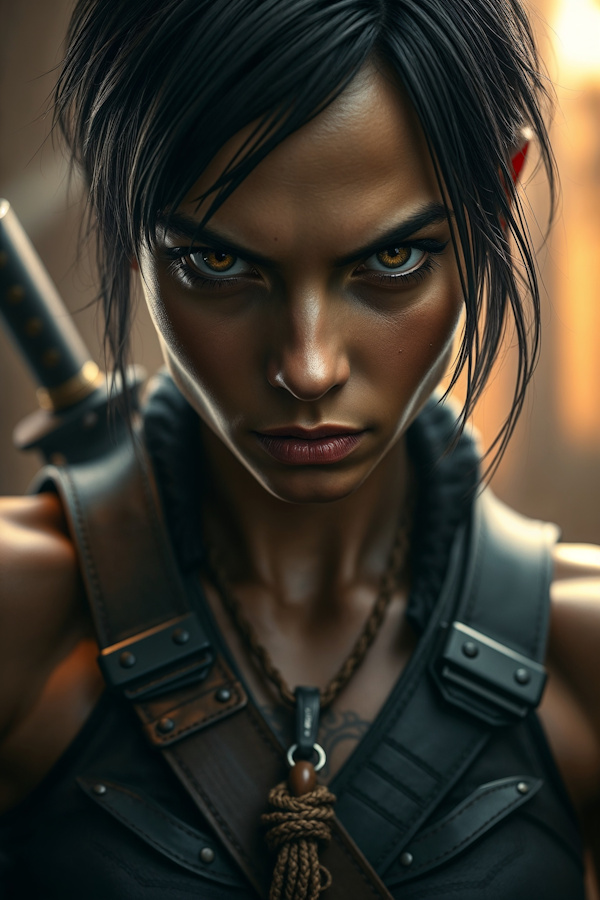
Senna is the kind of woman people underestimate—usually once. Small of stature and plain of face, she doesn't draw attention when she enters a room, doesn't turn heads or inspire second glances. This suits her perfectly. By the time her targets realize the unassuming woman in flexible leather is a threat, she's already inside their guard with a knife at their throat. A former circus acrobat turned bounty hunter turned professional problem-solver, Senna has made a career of being overlooked and has left a trail of bodies from those who made that mistake.
Physical Description
Senna is a small woman, compact and wiry, her frame built for speed and agility rather than power. Years of acrobatic training have given her a body that moves with liquid grace, every muscle toned for tumbling, climbing, and the quick, darting strikes that define her fighting style. She is not physically imposing—standing well below average height and weighing little enough that larger opponents assume they can simply overpower her. These assumptions tend to be fatal.
Her complexion is dark, her features plain and unremarkable—a face that blends into crowds and slides from memory moments after seeing it. She has never been beautiful and knows it, a fact that has long since settled into bitterness. Her dark hair is kept short and practical, cropped close to her head where it can't be grabbed in a fight or catch on obstacles during a climb. Her eyes are a deep brown, almost black, sharp and watchful beneath heavy brows.
She dresses for function over fashion: light armor that doesn't restrict movement, flexible clothing in dark colors that allows her to tumble and leap without hindrance, soft boots that grip surfaces and make little sound. Her twin knives ride at her hips, positioned for quick draws, and various other tools of her trade are concealed about her person. The only ornament she wears is an amulet on a leather cord around her neck—a gift she values more than anything else she owns.
From Circus to Killing
Senna's early life was spent traveling with a circus troupe that wound through the Four Fiefdoms, performing in towns and cities that welcomed its entertainment and spectacle. She learned acrobatics young, her small size and natural flexibility making her ideal for the aerial acts that drew gasps from crowds. She learned to tumble, to leap, to twist her body through spaces that seemed impossibly small, to trust that her hands would find the next grip and her feet would land true.
She also learned that circus life was precarious, that performers were disposable when they aged or injured, and that the skills she possessed had applications beyond entertaining provincial audiences. When she left the troupe—the circumstances of her departure are not something she discusses—she took with her a body trained for impossible movement and a growing understanding that people would pay well for someone who could go where others couldn't.
Bounty hunting came next, a natural progression for someone with her talents. She tracked targets who thought they had disappeared, infiltrated hiding places that seemed impenetrable, and collected payments from grateful clients who didn't ask how she did it. Some bounties she brought back alive. Others she didn't. The work taught her that she had no particular aversion to killing, that a throat cut in the dark troubled her sleep no more than a target delivered in chains.
The transition from bounty hunter to Varen Crost's regular contractor was simply a matter of economics. Crost paid better than most clients, offered steady work, and didn't waste her time with jobs beneath her abilities. She proved herself useful—more than useful—and their professional relationship solidified into something approaching mutual respect. He knows she gets things done. She knows he pays on time and doesn't ask her to work for free.
The Amulet
The amulet Senna wears is more than jewelry—it's a weapon, and it's changed the way she fights. A gift from Crost after a particularly difficult job, the amulet grants her bursts of exceptional speed, allowing her to move faster than the eye can follow for brief, crucial moments. In a fight, those moments are often the difference between victory and death.
She doesn't know the amulet's history or the nature of the magic that powers it. She doesn't particularly care. What matters is that it works, that when she triggers its power, she becomes a blur of motion that opponents cannot track or counter. The effect is temporary—seconds at most—and leaves her momentarily drained afterward, so she uses it sparingly and strategically. But in the right moment, at the right time, it makes her nearly untouchable.
The gift also bound her more closely to Crost than any contract could. He gave her something valuable, something that makes her better at what she does, and that kind of investment isn't easily forgotten. Their relationship remains professional, but Senna's loyalty to Crost runs deeper than a simple employment relationship. He saw her worth and rewarded it. In her world, that counts for something.
A Dirty Fighter
Senna fights without honor, without rules, and without hesitation. Her style combines the acrobatic mobility of her circus training with the brutal pragmatism of someone who has learned that fairness is a luxury reserved for people who can afford to lose. She tumbles and leaps, using her environment as a weapon, bouncing off walls and furniture to attack from unexpected angles, staying in constant motion so opponents can never pin her down.
Her twin knives are her preferred weapons—short, quick, and suited to the close-quarters fighting where her size becomes an advantage rather than a liability. She targets vulnerable areas without compunction: throats, eyes, tendons, anywhere that a small blade can do disproportionate damage. She uses her speed amulet to create openings, striking in bursts that overwhelm her opponents' defenses before they can react.
And she talks. Constantly. A stream of chatter flows from her during combat—taunts, observations, dark jokes, personal comments designed to distract and unnerve. She comments on her opponents' technique, their appearance, their obvious fear, anything that might break their concentration or provoke them into mistakes. The habit started as a deliberate tactic and has become so ingrained that she barely notices she's doing it anymore. Some find it unnerving. Others find it infuriating. Either reaction serves her purposes.
She isn't above fighting dirty in ways that go beyond mere pragmatism. The pretty ones, especially, draw her ire—the beautiful women who move through life with advantages Senna never had, who attract attention and open doors simply by existing. When she faces such an opponent, something personal enters her fighting, a desire not just to win but to leave marks, to mess up those pretty faces and take something that can never be returned.