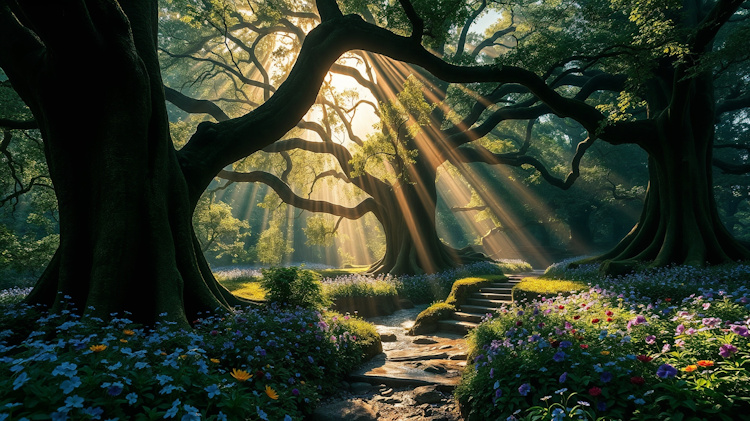
Deep within the ancient Simmaron Forest, far from the paths traveled by hunters and woodsmen, lies a place of such transcendent beauty that those fortunate enough to glimpse it carry the memory for the rest of their lives. Sollin-kel, known to the patrollers of the Simmaron Hall as "grove of beauty," stands as one of the oldest and most sacred dryad sanctuaries in all of Uhl. The grove's origins stretch back beyond recorded history, predating even the establishment of the Hall itself, existing as a place of concentrated fey magic when the world was younger and the forests covered far more of the land than they do in these current days.
The location of Sollin-kel was not chosen arbitrarily but rather emerged organically from the convergence of multiple factors that made this particular section of the Simmaron ideal for dryad habitation. The grove sits in a natural depression surrounded by gentle hills that provide shelter from the worst of winter storms while allowing summer breezes to flow freely through the canopy. A clear stream, fed by springs that never run dry even in the driest years, meanders through the heart of the grove, its waters possessing unusual purity that speaks to the deep magic saturating the earth. The soil itself is extraordinarily fertile, dark and rich with centuries of accumulated leaf matter and infused with Earth Power that encourages robust growth in everything that takes root there.
The oaks of Sollin-kel are magnificent specimens, many of them having stood for five or six centuries, their massive trunks requiring several people linking hands to encircle them. These ancient trees form the foundation of the grove, their root systems intertwined beneath the earth in a vast network that facilitates communication and the sharing of resources. The canopy they create is dense but not impenetrable, allowing shafts of sunlight to penetrate to the forest floor where they create ever-shifting patterns of light and shadow. In spring, wildflowers bloom in profusion wherever the light reaches, creating carpets of color that change with the seasons. In summer, the shade provides cool respite from the heat, while autumn transforms the grove into a tapestry of golds and ambers before winter strips the deciduous trees bare and blankets everything in pristine snow.
The first dryads to emerge in this blessed location did so during the Age of the Old Gods, when the world was fundamentally different than it would become after the Fall. These ancient mothers established the patterns and traditions that would define Sollin-kel for millennia to come, creating a community based on mutual support, shared responsibility for the grove's protection, and cautious isolation from the mortal world beyond their boundaries. They learned to work with the forest rather than attempting to dominate it, encouraging certain plant species while allowing others to flourish according to their nature, creating clearings where moonlight could reach the ground for their sacred dances, and fostering relationships with the birds and animals that made the grove their home.
The grove's relationship with the outside world has always been carefully managed and deliberately limited. During the Age of the Old Gods, the primary contact came through the ancient druid orders who understood and respected the fey nature of the dryads. These druids, who served as bridges between the mortal and fey realms, visited Sollin-kel with some regularity, bringing news of the wider world while seeking wisdom, healing, and occasionally the magical acorns that only dryads could create. The relationship was mutually beneficial—the druids provided the dryads with information about threats developing beyond their immediate territory, while the dryads shared knowledge of herbs, forest lore, and the subtle workings of natural magic. Some of the most powerful druidic traditions trace their origins to knowledge shared by the dryads of Sollin-kel during this ancient period, though the specifics of what was taught remain secrets guarded by those few druid lineages that survived the chaos following the Fall.
The Fall of the Old Gods and the collapse of human civilization that followed brought significant changes to Sollin-kel, though the grove itself survived relatively intact compared to many other places. The disappearance of the druid orders represented perhaps the most significant loss, as these intermediaries had provided the dryads with crucial information about the broader world while helping to maintain the delicate balance between fey isolation and necessary awareness of external threats. Without the druids, Sollin-kel became more isolated than ever, relying primarily on information gathered through the forest's tree network and the occasional interactions with refugees who fled into the deep woods seeking safety from the chaos consuming the surface world.
Some of these refugees stumbled upon Sollin-kel by accident, drawn by the oasis of life and beauty it represented amidst the dying forest. The dryads' response to these desperate mortals varied depending on the circumstances and the character of those who approached. Those who came with respect, who demonstrated genuine appreciation for the natural world and who posed no obvious threat, sometimes received assistance—food, healing, guidance back to safer areas. Those who attempted to take what they wanted by force or who showed disrespect for the grove's sanctity learned painful lessons about the dangers of angering beings who commanded the very forest around them. Stories of foolish men who entered the grove unbidden and found themselves hanging upside down from trees or fleeing with thorns in uncomfortable places became part of the oral tradition in the scattered human communities that survived the Age of Resilience.
The establishment of the Simmaron Hall during the early years of the Age of Change marked the beginning of a new relationship for Sollin-kel. The patrollers, dedicated to protecting the great forest and maintaining some semblance of order in the wilderness, represented a type of human the dryads could at least cautiously respect. These were not the typical woodsmen who saw the forest primarily as a source of timber and game, nor were they the bandits and desperate folk who fled into the wilderness to escape justice. The patrollers understood, perhaps better than most mortals, that the Simmaron was not merely a collection of trees but a living ecosystem requiring protection and careful management.
The protocols governing Sollin-kel's relationship with the Hall developed gradually over decades and eventually centuries, evolving through trial, error, and occasional misunderstandings into a stable arrangement that served both parties reasonably well. The dryads established clear boundaries: patrollers were welcome to pass through the forest around the grove but were not to enter its boundaries without explicit invitation. They were to announce themselves at the grove's edge if they needed to communicate with the dryads, to wait patiently for acknowledgment, and to understand that such invitations would be rare and conditional. Most patrollers learned to respect these boundaries, recognizing that the dryads asked only to be left alone and that their presence in the forest represented no threat to the Hall's mission.
However, the nature of young recruits being what it is, nearly every generation of patrollers produced a few foolish souls who viewed entering Sollin-kel unbidden as a test of courage or a rite of passage. These trespassers invariably discovered that the dryads, while generally peaceful, possessed both the power and the will to defend their territory. The punishments delivered were designed to be memorable rather than truly harmful—thorns that found their way into the most embarrassing locations, hours spent hanging upside down from branches while contemplating one's foolishness, sudden entanglement in vines that held fast until the dryads chose to release their captive. These experiences became legendary among the patrollers, serving as cautionary tales that prevented most recruits from making similar mistakes while also contributing to Sollin-kel's mystique.
Beyond these defensive actions, the grove occasionally provided more positive assistance to the Hall. When forest fires threatened to consume vast swaths of the Simmaron, dryads emerged to share information about wind patterns, areas of particularly dry undergrowth, and natural firebreaks that could be exploited to contain the blaze. When diseases threatened wildlife populations, the grove's herbalists shared knowledge of plants that might help, contributing to efforts that eventually brought plagues under control. When bandits or worse things took refuge in the deep forest, the dryads sometimes provided information about their movements, recognizing that such threats endangered not just human settlements but the forest itself.
These interactions were always conducted on the dryads' terms, at the grove's edge or in neutral meeting locations they designated, never allowing the patrollers to assume too much familiarity or to expect unrestricted access. The careful management of this relationship reflected a fundamental truth about Sollin-kel: it existed as a sanctuary not merely from physical threats but from the constant demands and complications that characterized life in the mortal world. The grove represented a place apart, where time moved according to the slow rhythms of trees rather than the frantic pace of human existence, where beauty and peace could be cultivated without constant compromise, where the ancient ways of the fey could continue relatively undisturbed by the changes sweeping across the rest of Darshavon.
The physical enhancement of the grove beyond its natural advantages came through centuries of patient cultivation by successive generations of dryads. They encouraged the growth of particularly beautiful flowering plants, transplanting specimens from other parts of the forest and nurturing them until they became established. They created small clearings in strategic locations where moonlight could reach the forest floor, providing spaces for their seasonal dances and ceremonies. They shaped the stream's course subtly over decades, creating small pools where fish could thrive and sandy shores where animals could drink safely. They fostered relationships with birds, encouraging certain species to nest within the grove by ensuring abundant food sources and safe nesting sites.
The result of this patient work was a grove that transcended ordinary forest beauty, becoming something approaching a natural paradise. Visitors fortunate enough to be invited into Sollin-kel consistently described the experience in similar terms: it was as if they had stepped from the ordinary world into a dream, a place where every element worked in perfect harmony, where even the quality of light seemed different, softer and more welcoming than in the forest beyond. The air itself felt different within the grove's boundaries—cleaner, sweeter, carrying scents of flowers and growing things that seemed to awaken something deep in the soul. The constant gentle sounds of bird song, rustling leaves, and flowing water combined into a natural symphony that brought peace to troubled minds and healing to weary bodies.
The protective magic surrounding Sollin-kel operated on multiple levels simultaneously, creating a barrier that repelled threats while remaining invisible and intangible to those approaching with good intentions. The outermost layer consisted of subtle misdirection that made the grove difficult to find for those who sought it with malicious intent. Hunters tracking game would find their prey leading them in circles that never quite reached the grove's boundaries. Bandits searching for a hideout would feel inexplicable unease that intensified the closer they came, usually convincing them to seek shelter elsewhere. This misdirection was not absolute—determined individuals could overcome it—but it provided a first line of defense that turned away the merely curious or casually malicious.
Those who penetrated the outer defenses encountered more direct magical resistance. The grove's wards created a barrier that actively repelled corruption, malice, and harmful intent, operating through a combination of physical discomfort and psychological pressure. Evil-hearted individuals attempting to enter experienced mounting sense of wrongness, a feeling that they were trespassing in a place fundamentally opposed to their nature. This sensation intensified with proximity, growing from mild unease to overwhelming dread that typically convinced even the most determined villains to turn back before actually breaching the boundary. Those few who pushed through despite this resistance found themselves confronting the dryads themselves, tree-bound guardians who wielded the full power of their ancient grove against those who would violate its sanctity.
The concentrated presence of multiple dryads living together created environmental effects that permeated every aspect of Sollin-kel. Plants grew faster and healthier within the grove than in the surrounding forest, recovering quickly from damage and displaying unusual vigor. The stream's water possessed healing properties beyond its natural purity, providing relief from minor ailments and accelerating recovery from injuries. Animals that spent time within the grove's influence healed more rapidly from wounds, recovered from illnesses, and often lived longer than members of their species typically survived. Even the weather seemed to moderate somewhat within Sollin-kel's boundaries, with summer heat less oppressive and winter cold less biting than in the forest beyond.
The social structure of Sollin-kel's dryad community evolved over centuries into patterns that balanced individual autonomy with collective responsibility. Each dryad possessed her own oak, her own territory extending roughly 360 yards from that symbiotic tree, and her own personality and preferences. But they lived together as sisters, supporting each other through the challenges of existence, celebrating together during seasonal festivals, mourning together when one of their number approached the end of her life cycle. Leadership emerged naturally based on age, wisdom, and strength of character rather than through formal selection or hereditary succession. The eldest dryad typically held particular influence due to her accumulated knowledge and longer perspective, but her authority was moral rather than coercive, based on respect earned over centuries rather than any power to compel obedience.
Decision-making within the grove typically occurred through consensus after discussion among all members, with each dryad having opportunity to voice her opinion and concerns. This process could be time-consuming, as beings who measured time in centuries had little need for haste, but it ensured that all members felt heard and that final decisions reflected genuine collective agreement. Only in emergencies requiring immediate action did leadership make unilateral decisions, and even then explanation and justification were expected once the crisis had passed. This approach to governance created a community characterized by genuine harmony rather than merely enforced peace, with conflicts resolved through patient discussion rather than imposition of authority.
The seasonal celebrations held within Sollin-kel served multiple purposes beyond mere festivity, functioning as markers of time's passage, opportunities for renewing bonds between grove members, and occasions for teaching younger dryads about their heritage and responsibilities. Spring celebrations honored the renewal of life and welcomed any new dryads who had emerged from maturing oaks during the winter. Summer festivals celebrated abundance and featured competitions in dancing, singing, and displays of magical skill that showcased individual talents while reinforcing cultural values. Autumn gatherings focused on preparation for winter's challenges and the creation of enchanted acorns with various properties, with elder dryads teaching younger ones techniques for shaping and directing magic. Winter ceremonies emphasized patience, endurance, and reflection, with dryads spending more time blended within their trees and sharing stories that preserved cultural knowledge across generations.
The grove's relationship with the broader forest ecosystem extended far beyond its physical boundaries. Sollin-kel functioned as a refuge for animals fleeing danger, a sanctuary where predators rarely hunted and where the constant presence of the dryads provided protection from many threats. Birds nested in the grove's ancient oaks in numbers far exceeding what similar areas of forest supported, drawn by the safety and abundant food sources. Deer and other prey animals grazed in the clearings, knowing instinctively that they were protected within the grove's influence. Even predators like foxes and occasional wolves passed through without hunting, somehow understanding or compelled to recognize that this was sacred ground where the normal rules of survival did not fully apply.
The influence Sollin-kel exerted on the surrounding forest extended outward in gradually diminishing strength, creating a buffer zone where life flourished more vigorously than in areas farther removed from the grove's magic. Trees within a mile of the grove grew taller and stronger than their counterparts elsewhere, their roots tapping into networks that ultimately connected to the ancient oaks at Sollin-kel's heart. Animal populations remained healthier and more stable in this buffer zone, able to withstand pressures that decimated populations in more distant areas. Even the frequency and severity of natural disasters seemed reduced near the grove, with storms somehow less violent and diseases less virulent when they reached this blessed section of the Simmaron.
Throughout the centuries, Sollin-kel endured numerous challenges and threats while maintaining its essential character. Goblin raids probing south from the fortress of Greth occasionally brought hostile forces uncomfortably close to the grove's boundaries, but the combination of protective wards and active defense by the dryads prevented any successful penetration of their sanctuary. Periodic droughts that devastated other parts of the forest left Sollin-kel relatively unscathed thanks to its spring-fed stream and the moisture-retaining properties of its rich soil. Forest fires that consumed vast swaths of the Simmaron were turned aside or contained before they could reach the grove, through a combination of the dryads' efforts and the natural firebreaks formed by the stream and areas of sparse undergrowth the dryads maintained precisely for this purpose.
The grove's population fluctuated over the centuries as dryads emerged from maturing oaks and others made their final blendings with dying trees, but it typically maintained between five and ten residents at any given time. This number proved ideal for the grove's size and resources, large enough to create the concentrated magical effects that made Sollin-kel special while small enough that each dryad could maintain meaningful relationships with all her sisters. The emergence of a new dryad was always cause for celebration, bringing fresh perspective and energy to the community while ensuring the continuity of their culture. The death of an elder, while sorrowful, was accepted as natural and inevitable, the final blending transforming both dryad and tree into rich soil that would nourish new growth for centuries to come.
Among the patrollers of the Simmaron Hall, Sollin-kel occupied a unique place in their collective consciousness. Most patrollers knew of the grove's existence and general location, this knowledge being shared during training as both practical information and cautionary tale. They understood that the dryads residing there were powerful beings deserving of respect, that the grove was protected by magic as well as by its guardians, and that unauthorized entry would result in consequences ranging from humiliating to genuinely dangerous depending on the transgressor's intentions and behavior. Yet despite these warnings, or perhaps because of them, Sollin-kel also held a certain fascination for the patrollers, representing a mystery just beyond their normal experience, a glimpse into the fey realm that existed alongside but fundamentally separate from the mortal world they inhabited.
The name "Sollin-kel" itself, meaning "grove of beauty" in the old tongue, perfectly captured what the place represented not just to those who lived there but to all who knew of its existence. It stood as a reminder that beauty, peace, and harmony with nature were possible even in a world that often seemed characterized by conflict, destruction, and the constant pressure to exploit resources rather than nurture them. The grove represented an ideal, a demonstration of what forests might become if allowed to develop without human interference yet also benefiting from careful, loving stewardship by beings who understood and respected the natural world. For the dryads who called it home, Sollin-kel was not merely a dwelling place but an extension of themselves, a physical manifestation of their values and their dedication to preserving a fragment of the world as it had been in earlier, simpler times before the Fall changed everything.
The enduring legacy of Sollin-kel lay not in any great deeds or dramatic events but in its quiet persistence, its patient cultivation of beauty and life across centuries while the world around it changed and often deteriorated. Generation after generation of dryads had devoted their long lives to maintaining this sanctuary, to protecting it from threats both obvious and subtle, to ensuring that at least this one place remained unspoiled and sacred. They asked little from the outside world beyond being left alone to continue their stewardship, offering in return the occasional assistance to neighbors who respected their boundaries and the simple existence of a place of transcendent beauty in a forest that sometimes seemed to be dying. As long as the ancient oaks stood and dryads continued to emerge from their bark, Sollin-kel would endure as a testament to the possibility of harmony between the fey and mortal realms, a living jewel hidden deep within the Simmaron's shadowed embrace.