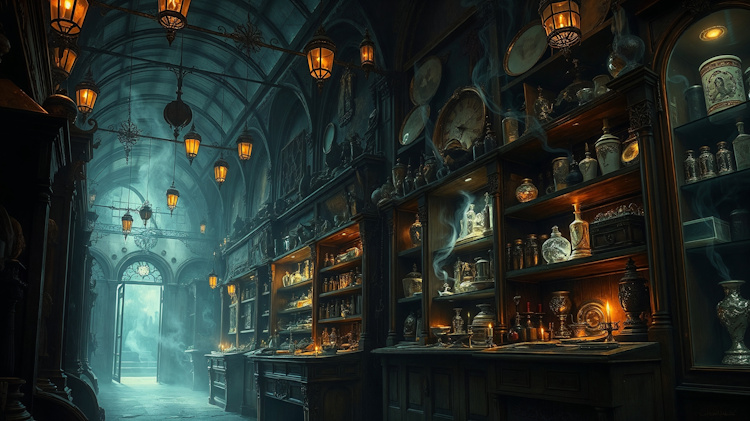
You don't find Solvain's Curios & Antiquities. It finds you. This fundamental truth about Mordecai Solvain's wandering shop has been understood in Alchester's underworld for as long as anyone can remember—which, given the wizard's apparent longevity, is quite a long time indeed. Each night, the shop appears in a different location throughout the city, a narrow storefront that wedges itself between buildings that somehow make room for its presence. The street around it seems to bend and accommodate this new arrival, as if the city itself recognizes Mordecai's claim to whatever space he has chosen for that particular evening.
A weathered sign bearing the shop's name hangs above the door, creaking in breezes that don't seem to touch anything else on the street. The wood is old, the paint faded, but the letters remain legible through some quality that has nothing to do with maintenance and everything to do with magic. Those who receive an invitation to the shop—delivered by page or appearing mysteriously in their possession—find their way without difficulty. The shop is simply there, waiting for them at the appointed crossroads. Those who seek it uninvited rarely find anything but empty streets and the uncomfortable sense that something watches them from just beyond the edge of sight.
Little is known of Mordecai's origins, and the wizard prefers it that way. What is understood among those who deal in Alchester's shadows is that he has operated his wandering shop for longer than most of the city's current residents have been alive. Some claim he arrived during the reign of the previous king, back when Alchester was smaller, and the airship docks were merely ambitious plans rather than towering realities. Others insist he predates even that, dealing in forbidden relics when the city was little more than a trading post. The truth, like so many things about Mordecai Solvain, remains his closely guarded secret.
The shop's interior defies the laws that govern ordinary spaces. From the outside, it appears cramped and narrow, a sliver of storefront barely wide enough for a door and a single window. Inside, it stretches impossibly. Shelves reach toward shadows that shouldn't exist given the building's apparent dimensions, aisles twist in directions that make no geometric sense, and corners seem to lead to other corners in defiance of basic spatial logic. The air inside smells of old paper and incense, with an underlying metallic scent that those familiar with magic recognize as the residue of spells long settled into wood and stone.
The contents of those impossible shelves represent acquisitions from across the known world and beyond. Items whisper in languages no living scholar recognizes. Objects glow with faint phosphorescence that has nothing to do with alchemical compounds. Some artifacts seem to watch visitors as they pass, following their movements with an attention that suggests awareness, despite having no obvious eyes. Each piece represents a transaction, a favor called in, or a contract fulfilled. The collection grows with each passing year, expanding to fill spaces that appear when needed and disappear when not, obeying rules that make sense only to the wizard who commands them.
Mordecai himself typically awaits visitors at the back of the shop, seated behind a cluttered desk piled with scrolls, ledgers, and objects in various states of examination. He is a man in his seventies, though decades of arcane study have aged him beyond his years. His face is a map of deep lines, weathered like ancient parchment, framed by long gray hair that hangs unkempt and wispy. His beard reaches to his chest, as gray as his hair, and equally neglected in its grooming. But his eyes remain his most striking feature—an unusually bright green that seems to see far more than they should, sharp and calculating despite his apparent age.
Years spent hunched over books and artifacts have left him stooped, shuffling when he moves, peering up at visitors from beneath bushy gray brows with those unsettling green eyes that assess worth with uncomfortable accuracy. His hands are long-fingered and elegant despite his age, adorned with multiple rings of various metals and stones—each likely holding some magical significance known only to the wizard. An amulet of unknown purpose hangs around his neck on a leather cord, resting against robes that might once have been fine. The deep burgundy fabric has faded over the years to something duller and more worn, patched in places but still carrying hints of former grandeur.
What drives Mordecai is singular and consuming: acquisition. He is a collector in the truest sense, obsessed with obtaining rare and powerful artifacts regardless of their origin, purpose, or the methods required to secure them. His shop fills with curiosities precisely because he cannot resist adding to it, cannot pass up opportunities to possess items of power or historical significance. Each artifact represents not merely an object but a piece of knowledge, a fragment of power, a connection to forces and ages that most prefer to leave undisturbed.
But Mordecai does not dirty his own hands with the actual procurement. He hires others to steal on his behalf, to kill when necessary, to handle the messy details that he can ignore from the safety of his wandering shop. His network extends throughout Alchester's criminal underworld and beyond. The thieves' guild has done work for him in the past, and his reputation among those who deal in shadows is one of mysterious power and deep pockets. He pays fairly for services rendered, but expects them to be provided exactly as specified. Failure is not tolerated, though his punishments tend toward the subtle rather than the violent—a failed contractor might simply find that Solvain's Curios & Antiquities never appears for them again, and in Alchester's underworld, losing access to Mordecai's resources and information can be a death sentence of its own kind.
In conversation, Mordecai is grumpy, impatient, and dismissive. He does not suffer fools, does not waste words on pleasantries, and makes clear through tone and manner that his time is valuable and those who waste it are not welcome to return. He views every relationship through the lens of transaction—what can this person provide, and what must he offer in return? Loyalty, sentiment, and gratitude mean nothing compared to the acquisition of that which he desires. His assessment of visitors begins the moment they enter his shop, those green eyes cataloging their worth, their potential usefulness, their probable price.
The wizard's motivations remain his own closely guarded secret. He claims to be merely a collector, a connoisseur of the rare and dangerous. But those who have dealt with him sense something deeper, a purpose behind the accumulation that Mordecai has never revealed. Madam Nadira, the fortune-teller whose sight extends beyond ordinary perception, has warned that whatever Mordecai intends with the artifacts he gathers, it is nothing good. Whether he pursues power, knowledge, revenge, or something else entirely remains unclear, but the scale and scope of his collection suggest aims beyond simple acquisition.
His rivalry with Marek Volarin had simmered for years, a quiet war fought through competing bids, intercepted shipments, and occasional theft of items one had acquired before the other could reach them. Volarin considers Mordecai an eccentric nuisance, an ancient wizard playing at collector without the resources or connections to compete seriously. He has no idea how badly he has underestimated his opponent. For Mordecai, patience is a virtue cultivated over decades. He's watched Volarin interfere with his acquisitions one too many times, snatching artifacts the wizard wanted for his own collection, outbidding him through intermediaries, and generally making himself a persistent obstacle to Mordecai's goals.
The shop itself serves Mordecai's purposes more than most realize, expanding and contracting as needed, appearing where required, and offering passages that lead to storage areas in dimensions not quite aligned with Alchester's ordinary geography. Those who have ventured deeper into the shop speak of rooms behind rooms, halls that stretch beyond reason, spaces that contain more artifacts than could possibly fit within the building's exterior dimensions. The magic that sustains this impossible architecture is old, woven into the very structure through methods Mordecai has never shared and no one has successfully replicated.
Each night when Solvain's Curios & Antiquities appears in a new location, the city makes room for it. The street bends slightly, the buildings shift almost imperceptibly, and space that did not exist moments before suddenly contains a narrow storefront with a creaking sign and a door that opens onto impossibilities. Those who have business with Mordecai find their way as if guided by invisible threads, while those who stumble upon it by accident often cannot find the door again, even if they remember exactly where the shop had been. The magic serves its master's purposes, ensuring that only those Mordecai wishes to see ever cross his threshold.
Inside, surrounded by whispers and glows and watchful artifacts, Mordecai Solvain pursues his singular obsession. Each new acquisition feeds the collection, each completed transaction brings him closer to whatever goal drives this endless accumulation. The shop grows heavier with power, denser with magical residue, more dangerous with each passing year. And somewhere in those impossible spaces, buried among artifacts from across ages and worlds, the true purpose behind Mordecai's collecting waits to be revealed.