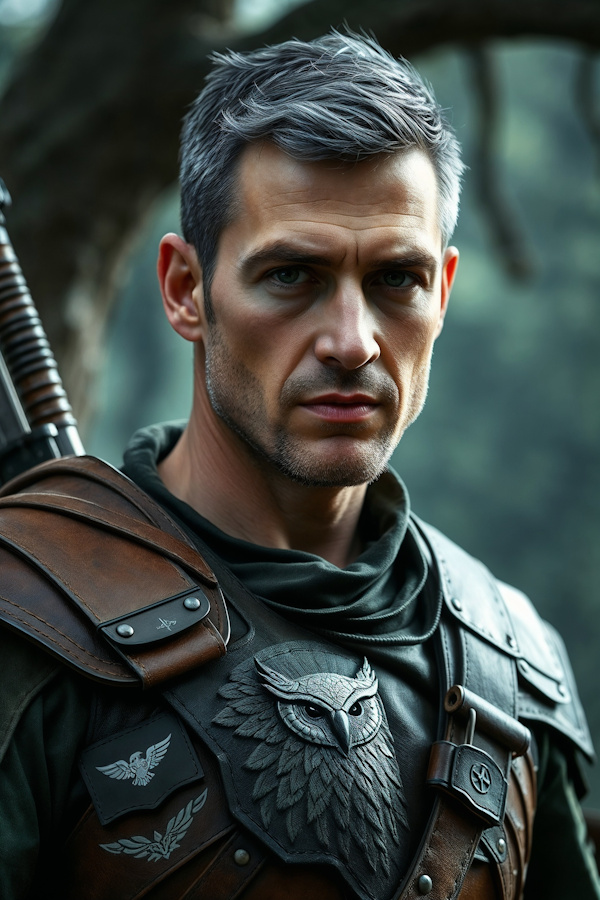
Thomas Drake was born in the frontier town of Millbrook during the early years of the Age of Advancement, a settlement precariously situated between the relative safety of Vranna's interior and the dangerous wilderness beyond. His parents, both merchants who supplied the King's Patrol with provisions, instilled in him from an early age an understanding of the delicate balance between civilization and the wild frontier. While other children played at being knights or adventurers, young Thomas spent his days watching patrollers come and go from his parents' trading post, observing how they carried themselves, how they spoke, and most importantly, how they thought. He saw in them not just warriors, but guardians who stood between order and chaos, and he knew with absolute certainty that he would join their ranks.
At eighteen, Thomas arrived at the Simmaron Hall of the Wood, one of the youngest recruits in that year's intake. Unlike many who came with romantic notions of glory and adventure, Thomas approached his training with a methodical practicality that would define his entire career. He understood that the King's Patrol wasn't about heroics but about duty, discipline, and the unglamorous work of protecting those who could not protect themselves. During his early training, he met Jerrick Bur, a fellow recruit who was perhaps a year or two his junior. The two formed a friendship based on mutual respect, though their personalities differed markedly. Where Jerrick was introspective and sometimes prone to self-doubt, Thomas possessed an unwavering confidence in his assessments and decisions. Yet he recognized in Jerrick a natural tactical mind and a depth of character that would serve the patrol well, even if Jerrick himself couldn't always see it.
Thomas excelled in every aspect of his training, mastering not just the physical skills of combat and woodcraft, but also the strategic thinking that separated adequate patrollers from exceptional ones. His instructors noted his ability to assess situations quickly, to see patterns where others saw only chaos, and to make decisions without the paralysis of overthinking. These qualities marked him for leadership from the beginning. After completing his basic training, Thomas served first as a regular squad member, then quickly advanced to squad leader. His squads developed a reputation for efficiency and effectiveness, completing their missions with minimal casualties and maximum results. He never asked his men to take risks he wouldn't take himself, and he never made a decision without considering all available information, but once he made that decision, he committed to it absolutely.
The pragmatic commander's rise through the ranks was neither meteoric nor plodding, but steady and earned. He became known for his directness, a quality that some found abrasive but which his troops came to appreciate. Thomas never wasted words on pleasantries when clarity was needed, never softened bad news with false comfort, and never gave praise that wasn't deserved. Yet when he did offer encouragement or acknowledgment, his words carried weight precisely because they were rare and genuine. His assessment of situations cut through emotion and wishful thinking to focus on what was real and what was necessary. This made him an invaluable asset during crisis situations when others might hesitate or equivocate.
When Jerrick left the patrol to marry and settle in Rell, Thomas understood the decision even if he privately believed his friend was making a mistake. He knew Jerrick's solitary nature suited the patrol, that the structure and purpose it provided gave Jerrick direction in a way civilian life never could. But Thomas also understood that love made fools of even the wisest men, and he respected Jerrick's choice. Over the years that followed, Thomas continued his own advancement, eventually achieving the rank of company commander. This promotion came roughly twenty years younger than the other current company commanders, Holtz Merritown and Bostan the Quick, both grizzled veterans who had seen decades of service. Some questioned whether Thomas had the experience necessary for such responsibility, but he quickly proved that age and experience were not synonymous. His company operated with a precision and effectiveness that matched or exceeded their more veteran counterparts.
As a company commander, Thomas developed a leadership philosophy built on three fundamental principles: know your people, trust your subordinates, and make decisions based on reality rather than hope. He made it his business to understand every squadron captain, sergeant, and soldier under his command, not through casual friendship but through careful observation of how they performed under pressure. He knew which leaders could be trusted with independent operations and which needed closer oversight. He understood who had tactical brilliance and who excelled at execution. Most importantly, he knew how to use each person's strengths while compensating for their weaknesses. This attention to the human element of command separated him from commanders who treated their troops as interchangeable resources.
Thomas commanded his company through numerous engagements with goblin forces from Greth, each conflict reinforcing his tactical acumen and leadership skills. He learned to think like his enemies, to anticipate how different goblin breeds would react to various situations. He understood that gaugaths would charge headlong into combat, that haureks would look for tactical advantages, that imps would panic and scatter under sustained pressure, and that grekkels required constant vigilance due to their teleportation abilities. This knowledge informed every battle plan he developed, allowing him to position his forces for maximum effectiveness. His casualty rates were consistently lower than other companies because he never sent his troops into situations without thoroughly considering the tactical reality they would face.
The commander's relationship with the Council of Elders was respectful but not deferential. Thomas understood the value of experience and wisdom, but he also recognized when tradition or politics interfered with military necessity. He never hesitated to speak his mind in council meetings, presenting his assessments with the same directness he showed his subordinates. Some elders appreciated this candor, while others found it presumptuous from one so young. Thomas didn't particularly care either way. His concern was the safety and effectiveness of his company, and he refused to compromise on matters of military readiness for the sake of political niceties. This occasionally created friction, but it also earned him a grudging respect from those who valued honesty over flattery.
When Jerrick returned to the Simmaron following the deaths of his wife and daughter, Thomas recognized immediately that his old friend had changed. The grief had carved something out of Jerrick, leaving him harder but also more focused. Thomas knew better than to offer empty condolences or try to discuss what had happened. Instead, he simply welcomed Jerrick back and ensured he was given appropriate assignments. Over time, as Jerrick worked through his grief in his own way, Thomas observed how he had matured as a patroller. The solitary rover who had left years ago had returned with a depth of character and judgment that came only from experiencing profound loss and surviving it. Thomas filed this observation away, knowing it might prove relevant in the future.
The crisis that struck the Simmaron Hall tested every leader to their core. When the witch Saress unleashed the power of the Well of Darkness and transformed patrollers into mindless creatures, the entire structure of command and defense collapsed overnight. Thomas found himself commanding a drastically reduced force while facing an imminent invasion from Lord Gral's goblin armies. Lesser commanders might have despaired or made desperate decisions born of panic. Thomas instead focused on what could be controlled: organizing the remaining unaffected patrollers, assessing the tactical situation with brutal honesty, and preparing contingency plans for multiple scenarios. He worked closely with the Council of Elders, providing them with clear assessments of their military situation and the options available to them, no matter how grim those options appeared.
When Jerrick returned having broken the witch's curse and freed the transformed patrollers, Thomas immediately recognized the strategic opportunity this presented. The returned patrollers needed leadership, organization, and a clear mission. More than that, they needed confidence that could only come from leaders they trusted. Thomas understood that Jerrick's role in breaking the curse had elevated him to hero status, whether Jerrick wanted that elevation or not. Rather than see this as a threat to command structure or feel jealous of his friend's newfound reputation, Thomas pragmatically recognized how to use it. The returned patrollers would follow Jerrick into the darkest pit if he asked them to, and that loyalty was a tactical asset that couldn't be wasted.
The defensive plan that emerged from the crisis council was ambitious and risky, requiring precise coordination between three separate forces, each with distinct missions. Bostan the Quick's company would destroy Lord Gral's siege artillery with the help of the eslar sorcerer Murik. Holtz Merritown's squadrons would harry the main goblin force and draw them deeper into the woods, away from their objective. Thomas's company would intercept and destroy the advanced goblin contingent already marching toward Homewood. Each mission was critical, and failure in any one area could lead to catastrophe. Thomas approached the planning with his characteristic directness, identifying potential problems and working through solutions without wasting time on what-ifs or worst-case scenarios that served no practical purpose.
The decision to offer Jerrick command of the Fighting Foxes squadron was not sentimentality but calculated judgment. Thomas knew his friend better than perhaps anyone else in the patrol. He knew Jerrick's tactical instincts were exceptional, that his years as a rover had taught him to think independently and adapt to changing situations. He also knew that Jerrick's self-doubt was his greatest weakness, the one thing that held him back from achieving his full potential as a leader. By offering him the squadron command and refusing to accept his protestations about inexperience, Thomas was forcing his friend to step into a role he was ready for, even if he didn't believe it himself. Thomas's assessment was characteristically blunt and direct: Jerrick's problem had always been that he didn't give himself enough credit, and the current crisis had no room for false modesty or self-doubt.
When Jerrick questioned whether he was suited for squadron command, Thomas's response was immediate and unequivocal. This wasn't encouragement or motivational speech-making. It was a commander making a tactical decision about personnel deployment. Thomas had assessed Jerrick's capabilities, compared them against the mission requirements and the available alternatives, and reached a conclusion. The Third Squadron would be most effective under Jerrick's command. If circumstances were different, Thomas might consider Jerrick's hesitancy. But circumstances demanded that every patroller make their best contribution, and Jerrick's best contribution was leading this squadron. The matter was settled, not through debate or persuasion, but through clear-eyed assessment of what the situation required. Thomas's confidence in his judgment gave Jerrick something to lean on when his own confidence faltered.
The tactical briefing Thomas conducted with his squadron captains demonstrated his command philosophy in action. He laid out each unit's objectives with clarity and precision, leaving no room for misunderstanding about what was expected. When Jerrick suggested the ambush site at Potter's Grove over Arrow Sweep, Thomas evaluated the recommendation on its merits, recognizing the superior tactical position immediately. He didn't need to assert his authority by overruling a good idea simply because it came from a subordinate. Instead, he acknowledged Jerrick's assessment, confirmed its validity, and moved forward with implementation. This ability to recognize good thinking regardless of its source and incorporate it into his plans made Thomas an effective commander who earned genuine loyalty rather than mere obedience.
Throughout the crisis, Thomas maintained his characteristic directness and pragmatism. When hard decisions needed to be made, he made them without hesitation or second-guessing. When orders needed to be given, he gave them clearly and expected them to be followed. When subordinates needed support, he provided it in practical ways that enhanced their ability to complete their missions. He never wasted energy on worry about things he couldn't control, never allowed emotion to cloud his tactical judgment, and never let personal feelings interfere with military necessity. Yet for all his pragmatism, Thomas genuinely cared about his troops. He simply expressed that care through effective leadership and sound decision-making rather than through emotional displays or false camaraderie.
The successful defense of the Simmaron Hall and Homewood vindicated Thomas's tactical approach and leadership decisions. His company accomplished its mission of destroying the advanced goblin contingent while taking minimal casualties. The coordination between the three companies worked precisely as planned, demonstrating that sound tactical thinking and clear communication could overcome even significant numerical disadvantages. Most importantly, the squadron captains Thomas had selected, including Jerrick, proved equal to the trust he had placed in them. This confirmed Thomas's belief that understanding people and matching them to appropriate roles was as important as any tactical formation or strategic plan. Wars were ultimately won by people, and commanders who forgot that fact did so at their peril.
In the aftermath of the crisis, Thomas resumed his duties as company commander with the same steady competence he had always shown. There was no celebration of personal achievement, no seeking of recognition for his role in the victory. He simply moved on to the next challenge, the next threat, the next mission that required completion. This was the essence of Thomas Drake's character: a profound commitment to duty expressed through practical action rather than grand gestures or inspiring speeches. He was a man who understood that the King's Patrol existed to protect the frontier, and that everything else was secondary to that fundamental purpose. His pragmatism, directness, and unwavering focus on what was real and necessary made him an exceptional commander and a leader his troops could rely on in even the darkest circumstances.
Thomas Drake continues to serve as company commander at the Simmaron Hall, maintaining the same standards of excellence and practical leadership that have defined his career. He remains roughly twenty years younger than his fellow company commanders, but his effectiveness has long since silenced any questions about his qualifications. His friendship with Jerrick Bur endures, built not on sentimentality but on mutual respect and shared understanding of what the patrol requires from those who serve it. As threats continue to emerge from the goblin strongholds and other dangers that lurk in the wilderness, Thomas approaches each challenge with the same methodical assessment and practical decision-making that have served him and his company so well. He represents the best traditions of the King's Patrol: competent, dedicated, and absolutely committed to the mission of protecting the frontier, regardless of personal cost or recognition.
FIRST APPEARANCE
Thomas first appears in The Hall of the Wood.