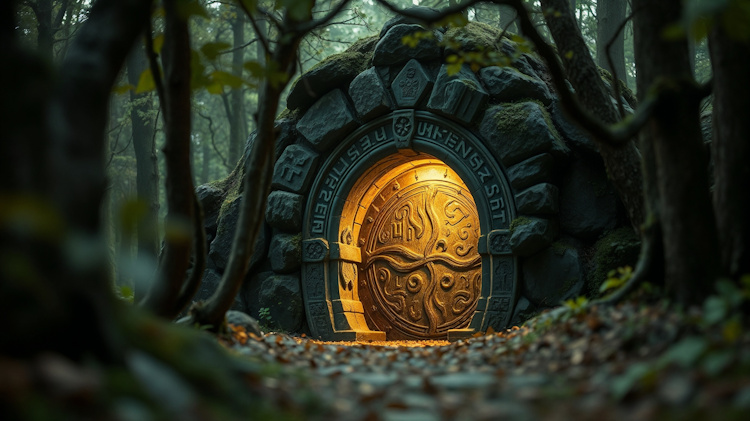
Deep within the Simmaron Woods, hidden from the eyes of all but the most trusted guardians of the forest, lies the Tomb of Delbin Kinkaed—a sanctuary that serves as both burial place and failsafe, crafted by the arch-druid himself in preparation for a day he knew would inevitably come. For over five centuries, this secret place has waited in silence, its location known only to the dryads of Sollin-kel, passed down through generations as a sacred trust that transcends even death itself.
The tomb's creation dates to the waning years of the druidic Order, sometime in the early to middle centuries of the Age of Change, when Delbin Kinkaed looked upon the world and understood with terrible clarity that his Order would not endure forever. The druids who had stood against the zealots of the Old Gods, who had sealed the Well of Darkness beneath the Simmaron, were fading from the world. Their numbers dwindled with each passing year, their ancient knowledge slipping away as fewer answered the call to their sacred duty. Delbin, ever the visionary despite—or perhaps because of—his reputation as something of a renegade, refused to accept that the protections they had built would simply fade with them.
The arch-druid spent his final years preparing not for death but for the possibility of being needed beyond it. He understood that the druid wards containing the Well of Darkness, powerful as they were, might one day fail or be undone by forces the Order could no longer prevent. When that day came, there would be no druids left to restore what had been built, no practitioners of the old magic who remembered the rituals and enchantments that held corruption at bay. Unless, Delbin reasoned with characteristic stern determination, he made arrangements that would transcend the boundaries between life and death.
The tomb itself was constructed in absolute secrecy, its location chosen with meticulous care. Only Delbin knew the exact site, somewhere deep within the Simmaron's heart where the great blackwood oaks grew oldest and most powerful, where Earth Power flowed strongest through root and stone. The arch-druid labored alone on his final work, drawing upon every reserve of druidic magic he had mastered over his long life. What he created was far more than a simple burial chamber—it was a nexus of carefully woven enchantments, a place where the veil between the living world and what lay beyond grew thin by deliberate design.
The tomb was built to house not merely Delbin's mortal remains but the instruments through which his spirit could be called upon in the Simmaron's hour of greatest need. Chief among these were the Gemstones of Morann, powerful artifacts whose origins remained mysterious even to the arch-druid but whose potential he recognized with absolute clarity. These emerald stones contained enchantments potent enough to restore the druid wards should they ever fail, and Delbin secreted them within his tomb as a test and safeguard both. Only one who successfully summoned his spirit—only one deemed worthy by the very act of calling him forth—would gain access to these precious gems.
The tomb's construction incorporated residual energies and mechanisms that would serve a crucial purpose: they would facilitate the summoning process when combined with the soul stones Delbin created. These cerulean crystals, imbued with a portion of the arch-druid's own essence through magic that bound his spirit to each stone, were never meant to be kept within the tomb itself. Instead, Delbin entrusted them to the most ancient and enduring guardians of the Simmaron—the dryads of Sollin-kel, whose roots ran as deep as the forest itself and whose connection to the Woods would outlast any mortal stewardship.
The arrangement Delbin made with Vadeya Dawnoak's ancestors represented a covenant that transcended the normal boundaries between druid and dryad. Though the dryads had always maintained their distance from the druidic Order, valuing their solitude and independence, they recognized in Delbin's request something worthy of exception. The arch-druid came to Sollin-kel in his final days, carrying with him a soul stone whose cerulean facets gleamed with captured sunlight. His words to the dryads were characteristically stern yet touched with rare warmth: this stone and the knowledge of his tomb's location were sacred trusts, to be guarded with the same devotion they showed to their grove. If ever the Simmaron faced darkness that threatened to consume it, if ever the Well's corruption broke free of the druid wards, the bearer of this stone must journey to his tomb and call upon his spirit. He would answer, Delbin promised, even from beyond death, for the forest's safety transcended all other considerations.
The dryads accepted this charge, weaving the secret of the tomb's location into their most carefully guarded knowledge, passed down from one generation to the next through methods known only to their kind. The soul stone was kept safe within Sollin-kel, protected by the grove's ancient magic and the vigilance of its inhabitants. For over five hundred years, this arrangement held. The tomb remained undisturbed, its location forgotten by all save the dryads, while the soul stone waited in readiness for a crisis that might never come.
The tomb itself became the subject of legend among those few who even knew of its existence. Patrollers of the Simmaron Hall whispered stories of the arch-druid's final resting place, though none knew where it lay and fewer still believed the tales held any truth. To most, Delbin Kinkaed had become myth, a figure from an age so distant that his very existence was questioned. The druids themselves had passed from history into legend, their Order faded so completely that many considered them nothing more than fanciful stories told around evening fires.
Yet the tomb endured through the centuries, hidden and waiting. The enchantments Delbin wove into its structure did not fade with time as lesser magic might have done. The arch-druid had crafted his final work with the same passionate devotion he brought to the creation of the druid wards themselves, building not for years or decades but for ages. The residual energies contained within the tomb's confines remained potent, ready to facilitate the communion between living and dead should the need arise. The Gemstones of Morann rested in their appointed place, their emerald brilliance undimmed by the passage of centuries.
The nature of these residual energies and the mechanisms Delbin employed remain subjects of mystery. Those who study such matters speculate that the tomb must incorporate elements of the most profound druidic magic—enchantments that draw upon the fundamental forces of Earth Power that flow through the Simmaron itself. The very stones of the tomb might be carved with runes in the old tongue, each symbol a conduit for energies that bridge the gap between the material world and the realm of spirits. Others suggest that Delbin may have woven aspects of his own life force into the tomb's structure, creating a permanent anchor for his spirit that would endure long after his physical death.
Whatever the specifics of its construction, the tomb served its purpose exactly as Delbin intended when, over five centuries after his death, the crisis he had foreseen finally came to pass. When the witch Saress discovered the hidden cavern containing the Well of Darkness and undid the ancient wards, when the Simmaron began to sicken and die from corruption seeping into its very earth, it was the dryads' knowledge and the soul stone they protected that provided the means to counter her. Aliah Starbough, last of her line and inheritor of the sacred trust her ancestors had accepted from Delbin himself, journeyed to the secret place her family had guarded for generations.
What transpired within that tomb when Aliah used the soul stone to summon the arch-druid's spirit remains known only to her. The price Delbin demanded for his aid, the nature of their communion across the vast gulf separating life from death, the appearance of the tomb itself after so many centuries of silence—these details she kept to herself, speaking only of the results. Delbin's spirit, called forth through the combined power of soul stone and tomb's residual energies, provided the knowledge needed to restore the druid wards and stop the Well's corruption. The Gemstones of Morann, secured within the tomb all those long years, passed into Aliah's keeping to serve the purpose for which Delbin had preserved them.
In the aftermath of the crisis, the tomb returned to its silence and secrecy. Aliah, respecting the sacred trust her family had maintained for over five hundred years, revealed nothing of its precise location. The arch-druid's final resting place remains hidden somewhere in the Simmaron's depths, its exact site a mystery that even the patrollers of the Hall cannot penetrate. Whether Aliah passed this knowledge to others before the death of her mother and the other dryads of Sollin-kel, or whether she alone now carries the secret, remains unknown.
The Tomb of Delbin Kinkaed stands as a monument to foresight and devotion that transcends mortality itself. It represents the arch-druid's greatest work not as a demonstration of power but as an act of faith—faith that there would be those who came after him worthy of bearing the burden he once carried, faith that the Simmaron would find protectors in each generation, faith that the sacred duty of guarding against darkness was not bound to any single age or Order but was a responsibility that would endure as long as the great blackwood oaks themselves stood tall.
The tomb's greatest significance lies not in its physical structure, whatever mysteries that may hold, but in what it represents: a bridge between ages, a covenant that outlasted the very civilization that created it, and proof that vigilance against evil is not a task that ends with death but a sacred charge that can be maintained across centuries through careful preparation and unwavering commitment. Delbin Kinkaed built his tomb not as a monument to himself but as a tool for those who would come after, a failsafe against the possibility that his greatest work—the containment of the Well of Darkness—might one day be undone.
Somewhere in the Simmaron Woods, beneath the shadow of ancient oaks that were already old when Delbin walked among them, the tomb waits still. The soul stone has served its purpose once, but who can say whether the arch-druid's spirit might be called upon again? The Gemstones of Morann have been retrieved, but the tomb itself remains, its enchantments enduring, its secrets intact. It stands as a reminder that the wisest guardians prepare not merely for the dangers they can foresee but for the crises that will come long after they themselves have passed beyond, and that true devotion to a sacred duty knows no boundaries—not of time, not of death, not even of the vast gulf between the living and the dead.
The location of the Tomb of Delbin Kinkaed is now known only to Aliah Starbough, if indeed she still lives. Whether this knowledge will be passed to another generation of guardians, whether the dryads of Sollin-kel might somehow be restored to carry on their ancient trust, or whether the secret will die with the last heir of Vadeya Dawnoak, only time will tell. But the tomb itself will endure, waiting in its hidden sanctuary, a testament to one druid's determination that the Simmaron would never lack for protection, even when all other safeguards had failed.