UGULL MOUNTAINS
Introduction
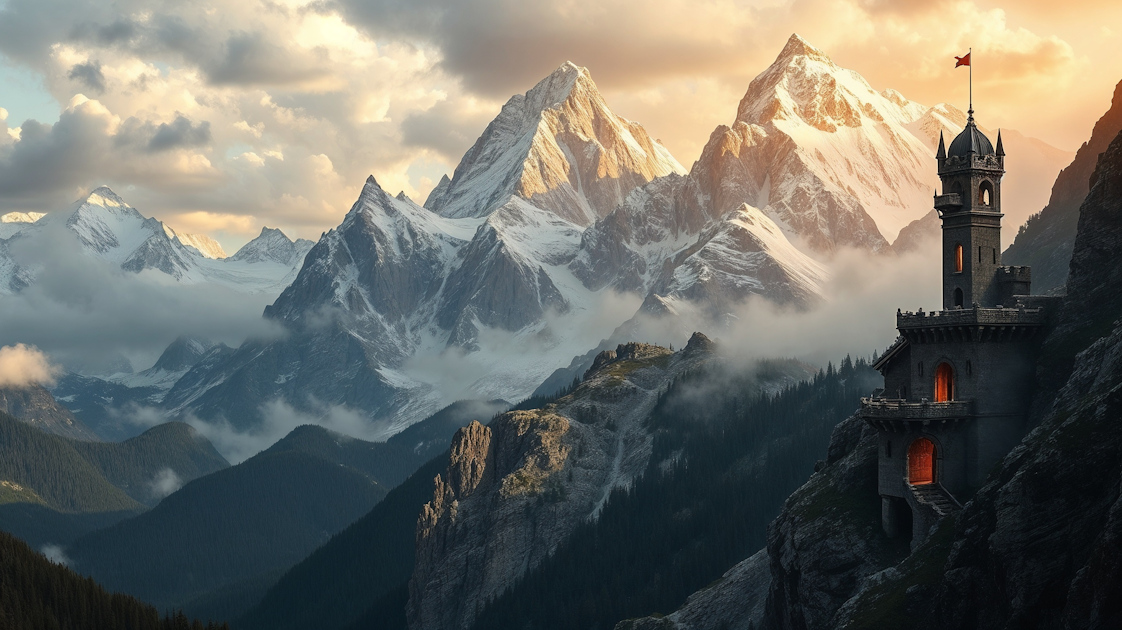
The Ugull Mountains stand as one of Uhl's most formidable geographic barriers, a towering range of jagged peaks, treacherous passes, and windswept heights that have shaped the history of civilizations for millennia. Extending from the depths of the Simmaron Woods in the west to the shores of the Miradathia Sea in the east, with the Merrow Woods marking their southern boundary, the Ugulls have long served as both sanctuary and fortress for those who dare make their homes in these unforgiving heights.
Within these mountains dwell two of Uhl's most distinctive peoples: the industrious dwarves, who have carved magnificent strongholds into the living rock, and the goblins, whose ancient fortresses command strategic positions throughout the range. The mountains themselves are a place of extremes, where bitter winds scream across barren slopes, where snow-capped peaks pierce the clouds, and where hidden valleys shelter unexpected beauty. It is a land where only the hardy survive, where territorial disputes simmer for generations, and where the thin mountain air carries the weight of countless ages.
For travelers, merchants, and patrollers who must cross the Ugulls, the journey is never taken lightly. The passes become impassable with the first heavy snowfall, and even in summer, the trail demands respect. Those who venture into these heights must contend not only with the elements but with the ever-present threat of goblin raids and the isolationist tendencies of the dwarven thanes who guard their territories jealously.
Geography and Terrain
The Ugull Mountains form a vast arc that dominates the landscape of northern Uhl. Rising abruptly from the eastern reaches of the Simmaron Woods, the range extends hundreds of miles eastward toward the Miradathia Sea, its peaks gradually diminishing in height as they approach the coast. To the south, the mountains descend into the dense expanse of the Merrow Woods, home to the reclusive tribes of the krill, while to the north, the foothills give way to the territories that would eventually become the Four Fiefdoms.
The Ugulls are characterized by their dramatic elevation changes and rugged terrain. Great snowy peaks tower above the clouds, their slopes barren and windswept above the tree line. Below this desolate zone, thick stands of evergreens cling to the mountainsides, providing shelter and forage for mountain goats, elk, moose, and the creatures that hunt them. Still lower, in the foothills and protected valleys, the trees give way to hardy brush and alpine meadows where whitebark pines produce their precious nuts and cold mountain streams carve paths through ancient stone.
The mountains are riddled with caves, both natural and carved by dwarf or goblin hands. Some of these connect to the vast network of the Underland, the subterranean realm that extends beneath much of Uhl's surface. Travelers who know the secret ways speak of passages that wind deep beneath the peaks, emerging miles away in unexpected locations. But most of these tunnels remain the jealously guarded secrets of their inhabitants, and outsiders who stumble into them rarely emerge to tell the tale.
The primary route across the Ugulls follows a treacherous path between the highest peaks, a trail that requires several days to traverse even in favorable conditions. The journey takes travelers through zones of dense forest, across barren boulder fields, and past precipitous drops where a single misstep means death. Landmarks along this route include the ruins of Eagle's Nest, ancient cave systems that provide shelter from sudden storms, and strategic vantage points that have witnessed countless battles throughout the ages.
Through the Ages
The Age of the Old Gods
Long before the Fall, the Ugull Mountains stood as silent witnesses to the rise and fall of empires. During the Age of the Old Gods, when Darshavon reigned as the One Kingdom under the rule of the high king, the mountains served as both barrier and highway between the eastern and western reaches of that vast realm.
It was in these ancient times that Mount Kroom first gained prominence. The goblin fortress, already ancient beyond reckoning, controlled crucial passes through the eastern Ugulls. Mount Kroom housed all manner of goblin-kind within its sprawling complex of caverns and fortifications: the massive gaugaths in their high mountain strongholds, the cunning haureks in their blood clan warrens, the prolific imps in their mining tunnels, and the devious grekkels in their shadowed lairs. Under the command of powerful goblin lords, Mount Kroom launched periodic raids against human settlements, though the strength of unified Darshavon kept such incursions from becoming existential threats.
The fortress of Greth, too, claimed its place in the mountains during this era, commanding the western approaches where the Ugulls met the Simmaron Woods. While not as ancient as Mount Kroom, Greth grew in significance as goblin numbers swelled and territorial disputes drove competing tribes to seek new strongholds.
The dwarven thanes had long made their homes in these mountains, their strongholds of Brokken-Tor and Dwathenmoore representing but two of the seven great dwarven fortresses scattered throughout Uhl. These magnificent halls, carved deep into the living rock, served as centers of dwarven craftsmanship and culture. The dwarves maintained tenuous trade relationships with Darshavon, exchanging their famed metalwork and gemcraft for goods from the surface world, all while defending their territories against the ever-present goblin threat.
During the Three Great Wars, the Ugulls saw their share of conflict. Human forces marched through the mountain passes to engage enemies on distant battlefields, while dwarven warriors emerged from their strongholds to honor ancient alliances. The mountains themselves bore witness to skirmishes between goblin raiders and defending forces, leaving behind battlefields that would become landmarks for future generations.
In the final days before the Fall, as the Old Gods waged their catastrophic war, the mountains trembled with the violence unleashed upon the world. Avalanches reshaped familiar valleys, earthquakes opened new crevasses, and the very stone seemed to weep at the destruction wrought by divine fury.
The Age of Resilience
The Fall of the Old Gods brought devastation to all corners of Uhl, and the Ugull Mountains proved no exception. The cataclysm that destroyed the gods and shattered Darshavon sent shockwaves through the range, triggering avalanches, collapsing tunnels, and fundamentally altering the landscape that so many called home.
For the dwarven thanes, the Age of Resilience became a time of survival and consolidation. With trade routes disrupted and the human kingdoms in chaos, the strongholds of Brokken-Tor and Dwathenmoore turned inward, focusing on maintaining their halls and supporting their own people. The loss of contact with other dwarven thanes, some of whom had suffered catastrophic damage in the Fall, left each stronghold increasingly isolated. Resources became precious, and the dwarves devoted themselves to rebuilding damaged sections of their fortresses while carefully managing their stores against an uncertain future.
The goblins, less dependent on external trade and more accustomed to hardship, adapted more quickly to the new reality. In the chaos following the Fall, goblin activity surged throughout the Ugulls. With human patrols disrupted and defenses weakened, raiders from Mount Kroom and Greth struck at vulnerable settlements with increasing boldness. The breakdown of centralized authority in what had been Darshavon meant that isolated communities now faced goblin incursions with minimal support.
During this century, the fortress of Greth grew significantly in power and population. Goblin tribes displaced from other regions sought refuge in the western Ugulls, swelling Greth's numbers and extending its network of tunnels deeper into the mountains. The fortress became a launching point for raids into the emerging territories that would become the Four Fiefdoms, earning itself a fearsome reputation that would persist for centuries.
Mount Kroom, older and more established, maintained its dominance over the eastern approaches. The various goblin breeds within its walls continued their age-old hierarchies and blood feuds, occasionally uniting under a strong leader to launch devastating attacks on coastal settlements or dwarven positions. The gaugath tribes in the highest peaks hibernated through the harsh winters, emerging in spring to hunt and brew their notorious stouts while remaining largely aloof from the broader conflicts below.
The mountain passes themselves became increasingly dangerous during this age. The old waystations, built and maintained during Darshavon's height, fell into disrepair. Eagle's Tower, once a proud watchtower staffed by soldiers and patrollers, suffered damage in the cataclysm that left it partially collapsed. With no centralized authority to maintain it, the tower was abandoned, its remaining walls serving only as shelter for occasional travelers brave or desperate enough to cross the Ugulls.
Yet even in this dark century, signs of resilience emerged. The Hall of the Wood, deep in the Simmaron, began training its patrollers to defend the forest and its borders. These hardy men and women learned the mountain trails, establishing routes and protocols that would persist for generations. Small human communities at the mountain's edges, including the settlement of Rell, stubbornly refused to abandon their homes despite the increased goblin threat, instead developing their own defenses and warning systems.
The Age of Change
As the Four Fiefdoms emerged and consolidated their power during the Age of Change, the Ugull Mountains entered a new period of strategic importance. No longer merely a barrier to cross or a source of mineral wealth, the mountains became a frontier zone where the interests of humans, dwarves, and goblins collided with increasing frequency.
The establishment of formal patrol routes marked one of the most significant developments of this era. The Hall of the Wood instituted regular patrols across the Ugulls, with lone patrollers or small squads maintaining watch over the mountain passes and keeping tabs on goblin activity. The Regdale Keep patrol, running from the Hall west over the mountains through Rell to Regdale Keep south of Thesia, became one of the most important of these routes. Patrollers who walked these trails became intimately familiar with every cave, every vantage point, and every hidden danger the mountains concealed.
The fortress of Greth reached its peak as a threat during the early part of this age. Emboldened by their success in the Age of Resilience, the goblins of Greth launched increasingly ambitious raids against human settlements. This aggression culminated in the Battle of Brakken Pass, a decisive engagement where the combined forces of the newly established King's Patrol met a massive goblin army emerging from the mountains. The battle raged for three days before the goblins broke and fled back to Greth, their numbers devastated and their confidence shattered.
Following this defeat, Greth adopted a more cautious posture. Rather than launch open attacks, the fortress turned to subterfuge and smaller raids, maintaining pressure on the borderlands without risking another catastrophic confrontation. The King's Patrol established permanent watch posts near Greth, monitoring the fortress from a distance and intercepting raiding parties before they could reach populated areas. This uneasy standoff would persist for centuries, with both sides probing for weakness without committing to full-scale war.
Mount Kroom, meanwhile, maintained its ancient pattern of periodic aggression followed by long periods of quiescence. The fortress's raids were less frequent but often more devastating than those from Greth, striking coastal settlements or isolated dwarven outposts with overwhelming force before retreating into the mountains. The various goblin breeds within Mount Kroom maintained their own complex political structures, occasionally erupting into internal conflicts that temporarily reduced the external threat.
For the dwarven thanes, the Age of Change brought renewed contact with the surface world. As the Four Fiefdoms established stable governments and trade networks, Brokken-Tor and Dwathenmoore gradually emerged from their isolation. Dwarven merchants began appearing in human markets again, exchanging masterwork weapons, intricate jewelry, and precisely crafted tools for food, textiles, and other goods their mountain fortresses could not produce.
However, this renewed engagement did not extend to cooperation between the two dwarven strongholds. Brokken-Tor and Dwathenmoore remained independent entities, each governed by its own thane and following its own counsel. While they maintained loose alliances based on shared culture and mutual self-interest, they rarely coordinated their efforts or shared resources. This independence meant that threats to one stronghold did not automatically trigger support from the other, a reality that the goblins occasionally exploited.
The relationship between the dwarven strongholds and the goblin fortresses during this era was complex. Open warfare was rare, as both sides recognized the costs of sustained conflict in the treacherous mountain terrain. Instead, an uneasy coexistence developed, punctuated by border skirmishes, raids on mining expeditions, and occasional acts of sabotage. The dwarves fortified their territories, collapsed known goblin tunnels near their borders, and maintained constant vigilance against infiltration. The goblins, for their part, generally avoided direct assaults on the dwarven strongholds, recognizing that breaching those ancient fortifications would require resources and unity they rarely possessed.
The infrastructure of the mountain passes improved somewhat during this age. While Eagle's Tower was never fully rebuilt, the ruins came to be known as Eagle's Nest, serving as a wayfarers' station where travelers could find shelter from the wind and cold. Other stopping points along the main route received similar attention, with simple structures or improved natural shelters making the crossing marginally less perilous. Yet the trail remained dangerous, becoming completely impassable with the first heavy snowfall and requiring several days of hard travel even in the best conditions.
The Age of Kings
The current age finds the Ugull Mountains in a state of tense equilibrium. The great powers that have made these heights their home have settled into patterns of behavior shaped by centuries of conflict and coexistence, yet none can claim absolute dominance over the range.
The fortress of Greth remains the most immediate threat to human settlements in the region. Despite its defeat at Brakken Pass centuries ago, the fortress has rebuilt its strength through patient accumulation of goblin-kind from throughout the mountains and the Underland. The King's Patrol maintains its watch from afar, noting the comings and goings of raiders and occasionally intercepting war parties before they can reach their targets. The people of Homewood and other border communities live with the constant awareness that Greth lurks in the mountains above them, waiting and watching for any sign of weakness in the patroller presence that keeps them in check.
Mount Kroom, ancient and enigmatic, continues to pose a threat to the eastern reaches of the Ugulls. The fortress's raids remain unpredictable, sometimes absent for years before suddenly erupting in violent assaults on coastal settlements or dwarven outposts. The various goblin breeds within its walls maintain their complex internal politics, occasionally producing strong leaders who unite the fortress for major campaigns. The gaugath tribes in the highest peaks around Mount Kroom continue their seasonal patterns, hibernating through winter and emerging in spring to tend their mountain goat herds and brew their prized (if unpalatable to others) stouts.
Brokken-Tor and Dwathenmoore endure as they have for millennia, bastions of dwarven culture and craftsmanship deep within the mountains. Both strongholds maintain selective trade relationships with human kingdoms and occasionally with each other, but they remain fundamentally independent and self-reliant. The thanes who rule these halls make their own decisions about when to engage with the outside world and when to seal their gates and rely on their own resources. This independence has allowed both strongholds to weather crises that might have overwhelmed more interdependent communities, but it has also limited their ability to respond to threats that require coordinated action.
The relationship between the dwarven strongholds and their goblin neighbors continues to be characterized by caution and occasional conflict. Both sides have learned to read the signs of impending raids or expansion, and both maintain defensive measures designed to deter aggression. The goblins occasionally probe dwarven defenses or attempt to infiltrate the strongholds through forgotten tunnels, while the dwarves periodically collapse suspected goblin passages and reinforce vulnerable sections of their territories. Open warfare remains rare, as neither side sees sufficient advantage in the enormous costs such conflict would entail.
The Goblin Fortresses
Mount Kroom
Mount Kroom stands as one of the most ancient goblin fortresses in all of Uhl, its origins lost in the mists of time before the Age of the Old Gods. Built around and within one of the tallest peaks in the eastern Ugulls, the fortress comprises a vast network of caverns, tunnels, and surface fortifications that house thousands of goblins of all four breeds.
The fortress's structure reflects the hierarchical nature of goblin society. The highest elevations belong to the gaugath tribes, who claim the windswept peaks and alpine valleys where they cultivate their lands, tend their mountain goat herds, and brew their seasonal beers. These massive warriors, the largest and strongest of goblin-kind, prefer the open air and cold breezes of the heights, disdaining the underground warrens that other goblins favor. Their territories around Mount Kroom include several semi-independent tribal settlements, each led by its own chieftain but loosely affiliated with the main fortress.
Below the gaugath domains, the fortress proper begins. Here, the haureks maintain their blood clan warrens, complex networks of tunnels and chambers where they practice their crafts, brew their notorious ales, and plot their strategies. The haureks, with their greater cunning and intelligence, often serve as the fortress's de facto leadership, though they must always be mindful of the gaugaths' physical superiority and the other breeds' numbers.
The imps, most prolific of the goblin breeds, occupy vast sections of the fortress's middle levels. Here they labor in mines extracting iron and other metals, craft weapons and armor, and train for raids. The imps' communal areas buzz with activity even when the fortress is not actively preparing for war, as they maintain the infrastructure that keeps Mount Kroom functional.
Finally, in the deepest and darkest corners of the fortress, the grekkels make their lairs. These devious creatures, smallest and most magical of goblin-kind, serve as scouts, spies, and occasional saboteurs. Their ability to teleport makes them invaluable for reconnaissance, and their inherent magical nature allows them to weave nightmares and commune with vermin in ways that other goblins find useful if disturbing.
Mount Kroom's connection to the Underland provides it with resources and escape routes unavailable to surface-only fortifications. Tunnels extend deep beneath the mountains, connecting to the vast subterranean network that spreads throughout Uhl. These passages allow goblins to emerge in unexpected locations, making raids on distant targets possible without the need to travel exposed surface routes.
The fortress's relationship with neighboring powers has been defined by periodic aggression punctuated by long stretches of relative calm. When strong leaders arise within Mount Kroom, capable of uniting the various goblin breeds under a single banner, the fortress becomes capable of launching devastating campaigns. But more often, internal politics and the natural independence of the different breeds keeps Mount Kroom's attention focused inward, making it a potential threat rather than an active one.
Greth
While younger than Mount Kroom, the fortress of Greth has earned a fearsome reputation through centuries of conflict with the human kingdoms. Located in the western Ugulls where the mountains meet the Simmaron Woods, Greth commands the passes that lead toward the territories of the Four Fiefdoms, making it a constant threat to human settlements in the region.
Greth's structure shares many characteristics with Mount Kroom, housing all four goblin breeds in a complex of surface fortifications and underground warrens. However, Greth has been shaped by its proximity to human civilization and its history of sustained conflict. The fortress's defenses are more elaborate than those of Mount Kroom, designed to withstand siege by organized military forces rather than merely deterring opportunistic attacks.
The fortress gained particular notoriety during the Age of Change, when its goblin population swelled with refugees from other regions. This period saw Greth launch increasingly ambitious raids against human settlements, culminating in the disastrous Battle of Brakken Pass. The defeat in that engagement devastated Greth's military strength and taught its inhabitants a harsh lesson about the limits of goblin power when faced with organized human resistance.
Since Brakken Pass, Greth has adopted a more cautious strategy. Rather than launch open attacks that might provoke another coordinated response, the fortress now favors smaller raids, ambushes, and attacks on isolated targets. This approach allows Greth to maintain pressure on human settlements while avoiding the kind of catastrophic losses that nearly destroyed it in the past.
The King's Patrol maintains constant surveillance of Greth from positions in the foothills and forest edges. Patrollers track the movements of goblin raiding parties, note changes in the fortress's activity levels, and occasionally intercept attacks before they can reach their intended targets. This vigilance has been successful in containing Greth's threat, but it requires constant dedication and has not eliminated the danger entirely. The fortress remains active, its inhabitants waiting and watching for any lapse in the patrollers' attention that might provide an opportunity for a major strike.
Greth's connection to the Underland, like Mount Kroom's, provides it with strategic advantages. Goblin raiding parties can emerge from hidden tunnels miles from the fortress itself, appearing suddenly in the midst of populated areas before retreating back underground. This capability makes completely defending against Greth's raids nearly impossible, as there is no way to guard every potential emergence point across the vast territory the Underland encompasses.
The Dwarven Strongholds
Brokken-Tor
Brokken-Tor stands as one of the seven great dwarven thanes scattered throughout Uhl, a magnificent fortress carved deep into the living rock of the Ugull Mountains. The stronghold represents the pinnacle of dwarven engineering and craftsmanship, with grand halls supported by pillars of stone carved to resemble ancient trees, intricate frescoes depicting the history of the dwarven people, and workshops where master artisans create works of legendary quality.
The fortress extends through multiple levels within the mountain, with the uppermost chambers serving as trade halls and guest quarters where surface-dwelling merchants can conduct business without penetrating the stronghold's deeper secrets. Below these public spaces lie the residential quarters, where dwarven families make their homes in comfortable chambers lit by clever arrangements of mirrors and light wells that bring daylight deep underground. Deeper still are the workshops where smiths forge weapons and armor, jewelers cut gemstones with precision measured in fractions of a hair's width, and stonemasons practice their ancient craft.
The lowest levels of Brokken-Tor house the mines, the forges that never cool, and the vaults where the stronghold's accumulated wealth and most precious creations are stored. These depths connect to the Underland through carefully guarded passages, providing the dwarves with access to the vast mineral wealth beneath the mountains while also requiring constant vigilance against potential goblin infiltration.
Brokken-Tor is ruled by a thane selected by the stronghold's clan leaders based on a combination of lineage, achievement, and demonstrated wisdom. The current thane maintains the stronghold's independence jealously, making trade agreements with surface kingdoms when advantageous but never subordinating dwarven interests to human concerns. The stronghold's relationship with Dwathenmoore remains cordial but distant, with occasional exchanges of craftsmen or resources but no permanent alliance or coordination of policy.
The dwarves of Brokken-Tor maintain a defensive posture toward the goblin fortresses in the mountains. They have learned through bitter experience that vigilance is the price of survival in the Ugulls, and they maintain extensive fortifications, trap systems, and sealed passages designed to prevent goblin incursions. The stronghold's warriors train constantly in the art of underground combat, preparing for the day when diplomacy fails and steel must speak.
Dwathenmoore
Dwathenmoore, like its sister stronghold Brokken-Tor, represents centuries of dwarven determination and skill. Located in a different region of the Ugulls, the fortress maintains its own character and traditions while sharing the fundamental dwarven values of craftsmanship, clan loyalty, and resilience.
The stronghold's layout follows principles similar to those of Brokken-Tor, with public spaces near the surface giving way to residential areas, workshops, and finally the deep mines and vaults. However, Dwathenmoore has developed its own specialties over the centuries, with particular expertise in certain forms of metalwork or gemcutting that distinguish its products from those of other thanes.
Dwathenmoore's thane, like that of Brokken-Tor, rules independently and makes decisions based solely on the stronghold's own interests. While the two fortresses recognize their shared heritage and maintain friendly relations, they do not automatically support each other in times of crisis. This independence has occasionally left one or the other vulnerable when faced with threats that coordinated action might have defeated more easily, but it has also preserved each stronghold's autonomy and allowed them to adapt to local conditions without being constrained by alliance obligations.
The relationship between Dwathenmoore and the goblin fortresses mirrors that of Brokken-Tor: wary coexistence punctuated by occasional conflict. The dwarves maintain their defenses, monitor goblin movements, and respond to provocations with measured force designed to deter future aggression without triggering escalation to full-scale war.
Eagle's Nest and the Mountain Passes
The ruins known as Eagle's Nest stand as a monument to both Darshavon's former glory and the harsh realities of the present age. Once called Eagle's Tower, the structure was built during the Age of the Old Gods as a watchtower where soldiers and patrollers could observe the mountain passes in all directions, watching for goblins, gorgons, and other threats that once infested the Ugulls in greater numbers.
The tower stood tall and proud for centuries, its crenellated top providing an unobstructed view of the surrounding mountains. Soldiers stationed there maintained signal fires to warn of approaching dangers, while patrols used it as a staging point for expeditions deeper into the range. A sturdy door secured the entrance, and stairs carved from the living rock led up to the fortified structure.
The Fall of the Old Gods dealt Eagle's Tower a devastating blow. The cataclysm that shook the world collapsed portions of the structure, leaving only the lower walls standing. The roof disappeared entirely, and the once-proud tower became an exposed ruin open to the elements. In the chaos of the Age of Resilience, with Darshavon shattered and resources desperately scarce, no one had the means or motivation to rebuild it.
Yet even in its diminished state, Eagle's Tower remained useful. As order slowly returned during the Age of Change, travelers crossing the Ugulls began using the ruins as a wayfarers' station. The remaining walls provided shelter from the worst of the mountain winds, and the central chamber could accommodate a small fire without too much smoke. The structure gained its new name, Eagle's Nest, and became an expected stopping point for anyone crossing the mountains.
The ruins serve this function still in the present age. Most times Eagle's Nest stands empty, as the trail over the Ugulls sees infrequent traffic, especially late in the year when the first snowfall threatens to make the passes impassable. But when travelers do use the ruins, they follow certain customs: announcing their presence loudly before entering, maintaining the fire carefully, and leaving the space in good condition for the next visitors. The alternative, after all, is to face the mountain night without shelter, a prospect that has claimed more than one life over the centuries.
The main pass through the Ugulls follows a route refined over millennia of use. Starting from the Hall of the Wood in the depths of the Simmaron, the trail climbs steadily through zones of dense evergreens, past the tree line into barren boulder fields, and finally between the great peaks themselves. Eagle's Nest marks roughly the midpoint of the journey, where the trail reaches its highest elevation. From there, the path descends toward the western side of the range, passing through Rell and eventually reaching Regdale Keep south of Thesia.
The journey across the Ugulls requires several days even for experienced travelers in good weather. The trail is treacherous, with steep drop-offs, unstable slopes prone to avalanche, and sections where a single misstep means death. Cave systems along the route provide emergency shelter, but travelers must carefully weigh the risks of taking refuge in caves that might house goblins, wild animals, or other dangers.
Weather poses one of the greatest threats to those crossing the mountains. Storms can strike with little warning, bringing driving rain, sleet, or snow that reduces visibility to nothing and makes the trail nearly impossible to follow. More than one traveler has become trapped by weather, forced to shelter in whatever protection they can find for days until the storm passes. The wise watch the sky carefully and turn back if conditions threaten to deteriorate, even if it means abandoning their attempt to cross.
Other hazards include rockslides, flash floods from sudden mountain storms, ice on the trail in early or late season, and the ever-present cold. The temperature at higher elevations remains frigid even in summer, and travelers must pack accordingly. Those who underestimate the mountains' severity rarely get a second chance to correct their mistake.
Despite these dangers, the trail sees steady use from those who have legitimate business crossing the Ugulls. Patrollers from the Hall of the Wood make regular crossings to maintain their routes and gather intelligence on goblin activity. Merchants occasionally brave the journey when the potential profits justify the risks. Missionaries and travelers with their own reasons for crossing appear from time to time, though never in great numbers.
Present Day Challenges
The Ugull Mountains in the present day remain much as they have been for centuries: a beautiful, dangerous, and strategically vital range that shapes the lives of all who dwell in or near them. The great powers that have made these heights their home continue their ancient patterns of behavior, each pursuing their own interests while remaining warily aware of their neighbors.
The patrollers from the Hall of the Wood maintain their vigil over the mountain passes, watching for signs of goblin activity and ensuring that the trails remain passable for legitimate travelers. These hardy men and women know every rock and tree along their routes, can read the mountains' moods in the clouds and wind, and possess the skills necessary to survive in this unforgiving environment. Their presence provides a measure of security to those who must cross the Ugulls, though they cannot eliminate all dangers or prevent every raid.
The fortress of Greth continues to pose a threat to human settlements in the western foothills and beyond. Despite the constant watch maintained by the King's Patrol, goblin raiding parties occasionally slip through to strike at isolated farms, small villages, or travelers caught away from protection. These attacks keep the borderlands in a state of perpetual alertness, with communities maintaining their defenses and refugees from goblin raids appearing periodically with tales of loss and terror.
Mount Kroom, ancient and enigmatic as ever, remains a concern for those who dwell in the eastern reaches of the mountains. The fortress's unpredictable nature makes planning for its threat difficult, as years of quiet can give way suddenly to devastating campaigns. The various goblin breeds within its walls pursue their own agendas, sometimes cooperating and sometimes fighting among themselves, their internal politics as complex and opaque to outsiders as they have always been.
Brokken-Tor and Dwathenmoore endure within their mountain fastnesses, producing works of legendary craftsmanship and maintaining the ancient traditions of their people. Both strongholds continue their selective engagement with the surface world, trading when advantageous but never compromising their independence or security. The dwarves watch the goblins, the goblins watch the dwarves, and both watch the humans, each side seeking advantage while avoiding the costs of open warfare.
The mountains themselves stand unchanged, their peaks still scraping the sky, their passes still treacherous, their beauty still capable of taking the breath away from those who see them. They remain a constant in a changing world, a reminder that some things endure no matter what empires rise and fall in the valleys below.
For those who live in sight of the Ugulls, the mountains represent different things. To the settlers of Rell and other border communities, they are both barrier and threat, separating them from the dangers beyond while harboring dangers of their own. To the patrollers who walk their trails, they are workplace and home, familiar despite their hazards. To the merchants who occasionally cross them, they are obstacle and opportunity, the price that must be paid to reach markets on the other side. To the goblins who lair in their fortresses, they are sanctuary and stronghold, providing protection and resources. To the dwarves in their deep halls, they are inheritance and responsibility, the ancestral home that must be maintained and defended.
Conclusion
The Ugull Mountains stand as one of Uhl's defining features, a range whose history is written in stone and whose future remains as unpredictable as a mountain storm. From the Age of the Old Gods to the present day, these peaks have witnessed the rise and fall of civilizations, the clash of armies, and the quiet persistence of those who refuse to abandon their mountain homes despite all hardships.
Within the Ugulls dwell peoples as diverse as the terrain itself: the dwarven thanes in their magnificent halls, masters of craft and stone; the goblins in their fortresses, eternal threats to those who dwell in the lowlands; the hardy human settlers who eke out existence on the margins; and the patrollers who walk the dangerous trails that bind it all together. Each has shaped the mountains, and the mountains have shaped them in return.
The fortresses of Mount Kroom and Greth remain symbols of goblin power and persistence, ancient strongholds that have weathered every storm and outlasted every attempt to destroy them. Brokken-Tor and Dwathenmoore stand as testaments to dwarven endurance, their halls echoing with the sounds of hammer on anvil as they have for untold centuries. Eagle's Nest, though diminished from its former glory, continues to shelter travelers as it has for generations.
And to all who see them rising against the sky, the Ugull Mountains remain a symbol of nature's power and permanence, a force that commands respect and occasionally claims lives, but that ultimately makes the world more diverse, more challenging, and more magnificent than it would be without them. They are barrier and bridge, sanctuary and battlefield, home and grave. They are, and will remain, the Ugulls—eternal, unchanging, and utterly indifferent to the brief lives that play out in their shadows.