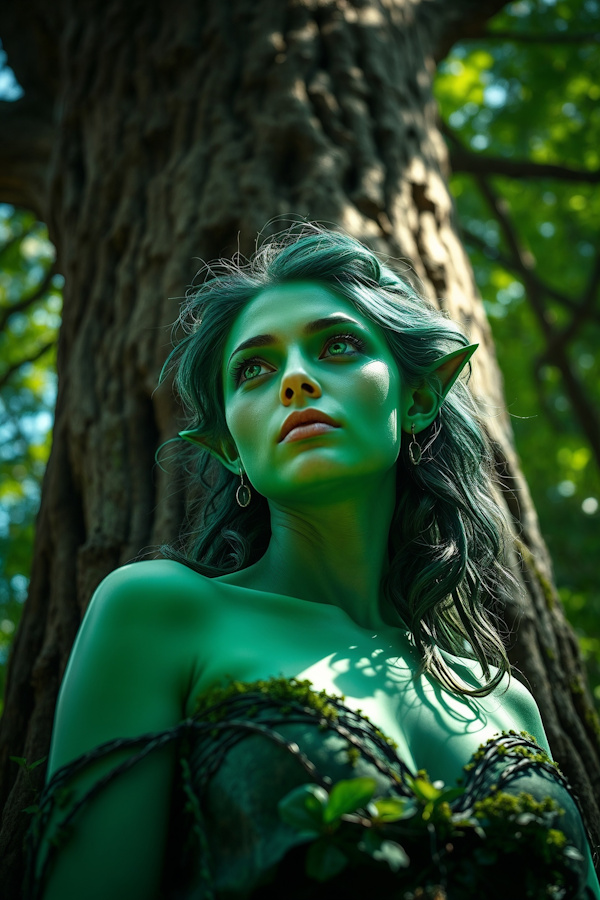
Vadeya Dawnoak emerged from her oak in the heart of Sollin-kel approximately three hundred years before the present day, during the waning years of the Age of Change. Three elder dryads awaited her emergence—Thessaly, Mirwen, and Laurelin—who would guide her through her first decades of existence. Under their patient tutelage, she learned to blend with her oak, to forestwalk between trees, and to master the songs and dances that carried power.
The grove of Sollin-kel existed as a true commune during these early years, home to seven dryads who lived together in harmony. Young Vadeya absorbed not merely skills and knowledge but the very essence of what it meant to be dryad—the patient acceptance of seasonal cycles, the fierce protection of their oaks and grove, and the cautious relationship with the world beyond their boundaries.
By her first century, Vadeya had developed into a dryad of considerable skill and deepening wisdom. She possessed particular talent for animal empathy, able to read and influence the emotions of forest creatures with subtlety that impressed even her elders. During this period, she formed a friendship with an aging druid named Caradoc, who visited Sollin-kel several times each year and through whom she learned of the Hall of the Simmaron and its patrollers.
When Thessaly's oak reached the end of its life cycle, the ancient dryad made her final blending during a misty autumn dawn. The death shook Vadeya deeply, forcing her to confront mortality even among the long-lived. Later, when Mirwen died suddenly in a lightning strike, leadership of the grove fell clearly to Vadeya. Though not the eldest, she was the one the others looked to for guidance, whose judgment they trusted, whose connection to both the forest and practical realities made her the natural leader.
Under Vadeya's leadership, Sollin-kel maintained carefully managed relations with the patrollers of the Simmaron Hall. She established clear protocols: patrollers were to announce themselves at the grove's edge if they needed to communicate, never to enter without explicit invitation, and to respect that such invitations would be rare and conditional. Most patrollers understood and honored these boundaries, though every few years another foolish recruit would test them and receive swift, harmless, but humiliating correction—thorns in embarrassing places or hours hanging upside down from trees.
The relationship was cautious but not hostile. When forest fires threatened the Simmaron, Vadeya emerged to meet with patrol commanders, providing information that helped contain the blaze. When disease threatened the deer population, she shared herbal knowledge that aided recovery efforts. But these interactions were always conducted on Vadeya's terms, never allowing the patrollers to assume too much familiarity or expect unrestricted access to the grove. The patrollers came to know her name, though few ever saw her directly. She became something of a legend among them—the dryad of Sollin-kel, guardian of the grove of beauty, whose judgment was both fair and absolute.
During a period of unexpected loneliness, despite dwelling within a thriving grove of sister dryads, Vadeya experienced a yearning for something different—a curiosity about what it might mean to connect with mortal consciousness in ways that transcended her carefully maintained boundaries. She observed the patrollers who passed through the Simmaron until one caught her attention: a young man who moved through the forest with unusual grace and genuine appreciation for its beauty.
Using her charm carefully and subtly, she created a series of encounters that seemed like coincidence, drawing him toward the grove's edge over several weeks. The charm was gentle enough that he retained his essential self, his desires merely amplified rather than supplanted. When she felt the change beginning within her that indicated conception, she released him from the charm's influence gradually, leaving him with pleasant but dreamlike memories. He returned to his duties at the Hall, never fully understanding what had transpired.
The pregnancy was unlike anything documented in dryad oral traditions. Vadeya carried the child within her body but also, mystically, within her oak. When the child was born on a spring morning, it was through conventional birth rather than emergence from the tree. The infant arrived already aware, her eyes open and alert, her mixed heritage immediately apparent in features that combined human bone structure with dryad coloration and grace.
Vadeya named her Aliah Starbough—"branch of the starlight"—a name signifying a bridge between the rooted dryads and the wider world beyond. The other dryads of Sollin-kel welcomed the child without reservation, accepting her as they would any daughter born to their community.
Raising Aliah presented challenges no dryad mother in the grove's memory had fully documented. The girl was dryad enough to communicate with trees and animals, to understand forest rhythms, to possess fey grace. But she was also human enough to require food beyond sunlight and water, to need more sleep than pure dryads, to experience the world with an intensity that sometimes overwhelmed her placid dryad kin.
The most profound challenge—and greatest blessing—came from Aliah's lack of a tree-bond. Unlike her mother and aunts, she was not bound to a specific oak, not limited to a 360-yard radius. This freedom troubled Vadeya deeply, who worried constantly that her daughter might wander too far without understanding the dangers. Yet it also meant Aliah could experience things no pure dryad could, could explore beyond the grove's boundaries, could even visit human settlements.
Vadeya taught Aliah everything she knew of dryad lore and forest wisdom. The girl learned to speak with birds, to read weather patterns, to identify every plant and understand its properties. She learned the dances and songs that carried power, though her half-mortal nature meant her performances lacked the pure magical potency of her mother's. She learned to create enchanted acorns, discovering she could work with nuts from any oak tree rather than being limited to a single symbiotic partner.
Vadeya told her daughter about the patrollers of the Simmaron Hall, describing them as different from ordinary humans—people who understood and respected the forest, who could be trusted within carefully defined boundaries. This teaching would prove important as Aliah grew older and began forming her own relationships beyond the grove.
The day Aliah brought Jerrick Bur into the grove for the first time, Vadeya knew something significant had shifted in her daughter's life. Her initial impression of Jerrick was mixed. He seemed earnest and respectful, demonstrating genuine wonder at the grove's beauty without entitled attitude. But he also displayed the impulsiveness and emotional intensity characteristic of young humans, traits that made Vadeya cautious.
She maintained careful distance from Jerrick during his visits, speaking little and observing much. This coolness was deliberate, designed to make clear that while he was permitted in the grove as Aliah's guest, he should not assume too much familiarity. Jerrick sensed her reserve and interpreted it, not entirely inaccurately, as a mother's protective wariness. What he could not fully understand was the deeper layer of Vadeya's concern: that his friendship with Aliah was merely the first of many connections her daughter would form with beings who would age and die while she endured, that each such connection would bring inevitable grief.
Despite her reservations, Vadeya permitted the friendship to continue. She recognized that Aliah needed connections beyond the grove, that her daughter's half-mortal nature created needs the dryads could not fully satisfy. She watched with mixed feelings as their bond deepened over the years, seeing both the beauty of genuine affection and the seeds of future pain.
When Aliah announced her intention to leave the Simmaron and explore the wider world, the words hit Vadeya like a physical blow. "You are not ready," she said. "You do not understand the dangers that wait in the human world, the cruelty and chaos that govern life beyond the forest's protection."
"Then help me understand," Aliah replied. "But do not ask me to remain here forever without experiencing what lies beyond. Half of me is human, Mother. I need to know that half."
What followed was perhaps the most difficult period in Vadeya's long life. The argument between mother and daughter lasted for days, neither willing to yield. In the end, Vadeya yielded not because her fears had been allayed but because she recognized that preventing Aliah's departure would destroy their relationship. If she truly loved her daughter, she needed to let Aliah make her own choices, even if that path led into dangers Vadeya could not protect her from.
The preparation for departure became an act of love despite the pain. Vadeya taught additional skills useful in human lands, created enchanted acorns with protective properties, provided guidance about navigating mortal society. On the morning of Aliah's departure, the entire grove gathered to say farewell.
"Remember that you always have a home here," Vadeya whispered, her voice thick with tears she refused to let fall until Aliah had gone. "Remember that the forest loves you as I love you, and that you can return whenever you choose."
As Vadeya watched her daughter walk away, she could not shake the terrible premonition that forces beyond their control were already moving, that this parting might prove more final than either of them imagined.
The years following Aliah's departure were difficult in ways Vadeya struggled to articulate. Life continued its rhythms, but there existed within her now a constant anxiety, a perpetual wondering about where Aliah was and whether she was safe. She threw herself into her duties as grove leader with renewed intensity, perhaps seeking to fill the emptiness.
She never stopped looking for Aliah. She watched paths leading to the grove with attention beyond normal vigilance, questioned every traveler, sought any news of a half-dryad woman wandering human lands. Occasionally she received fragments of information, but nothing definite, nothing that told her whether her daughter thrived or suffered.
The forest itself began showing signs of change during this period. Lord Gral's forces increased their probing expeditions into the Simmaron. The patrollers, stretched thin, struggled to maintain coverage. Skirmishes became more frequent, and the sense of security that had characterized the forest for decades began to erode. Vadeya noticed these changes with concern but initially saw them as human problems, threats the patrollers would handle without expecting grove assistance.
The corruption announced itself so subtly that Vadeya initially dismissed the signs. A few trees showed less vigorous spring growth. Mushrooms appeared paler than normal. Animals avoided certain areas without obvious cause. Individually, these observations meant little. Collectively, they formed a pattern that deeply disturbed her.
Vadeya began experiencing episodes of weakness in certain parts of the grove's territory, a sensation she had never felt except when pushing against her tree-binding boundaries. Other dryads reported similar episodes with increasing frequency. The oaks themselves seemed restless, their consciousness disturbed by something none could identify.
Working with the grove's most skilled magic-users, Vadeya discovered that soil in affected areas tested wrong somehow, lacking vitality. Water carried a faint taint. The corruption was real, growing, and seeping into their territory from the north.
The realization that something was poisoning the forest from which they drew life sent ripples of fear through the grove. Pure dryads could not flee—their bonds to their oaks meant that if the trees died, they died with them. They were trapped, bound to ground being slowly poisoned.
The trees spoke of a woman who had come to the Simmaron, one who walked the forest with apparent innocence but left wrongness in her wake. The corruption spread through root networks in ways that bypassed the grove's protective wards because it mimicked natural decay rather than attacking as obvious threat. The witch had been working her subtle evil for months or years, and the accumulated poison would take decades to purge even if its source were immediately eliminated.
Vadeya attempted to warn the patrollers, but the corruption was too subtle for them to detect initially. She tried to create magical barriers, attempted to forestwalk to investigate directly, sent desperate calls through the tree network seeking help. Every defense proved inadequate, every protection ultimately failed, and her calls received only silence in response.
As weeks turned to months, Vadeya watched helplessly as her grove and her sisters began to die. The process was agonizingly slow, giving them time to fully understand what was happening but no opportunity to prevent it. Physical symptoms began subtly but grew progressively worse. Vadeya's normally vibrant jade skin took on grayish undertones. Her emerald hair dulled and became brittle. Episodes of weakness became more frequent and severe.
The grove itself began showing corruption's touch. Flowers wilted and died. Bird song diminished as creatures fled. Streams slowed to trickles, their water taking on an off-color that made the dryads gag. Vadeya drove herself to exhaustion seeking solutions that did not exist, every attempt proving futile against corruption that flowed through channels too numerous to block.
Elara was the first to die, her oak succumbing to poison more quickly than the others. Vadeya held her sister as she made her final blending, feeling through their connection the agony of a dryad whose tree was dying from unnatural poison rather than natural causes. After Elara passed, they knew with certainty that the same fate awaited them all.
Vadeya called a final gathering of Sollin-kel's remaining dryads—six souls including herself. They met under a full moon and spoke honestly of their situation, acknowledging that death was inevitable and discussing what, if anything, they might do to give their ending meaning.
Rowan suggested the sacrifice: if they were going to die regardless, perhaps they could choose to return their remaining life force to the grove itself rather than allowing corruption to simply claim it. A deliberate sacrifice, freely given, might preserve some sanctuary within the dying forest, might maintain enough vitality to provide refuge for other creatures even after the dryads themselves were gone.
Vadeya immediately recognized the wisdom and rightness of this proposal. It would not save them, but it would give their deaths purpose, would ensure that Sollin-kel's beauty did not entirely vanish from the world. The other dryads agreed, and they began preparations for a ritual none had performed before but understood instinctively.
They spent their final days in strange peace, having accepted what was to come and finding comfort in the choice they had made. They said farewells to the forest they had protected, danced one last time beneath the stars, sang the old songs one final time.
Vadeya's thoughts during these days turned frequently to Aliah. She felt profound regret that she would not see her daughter again, that she could not warn her personally or offer comfort for the grief Aliah would feel. She attempted one final message, sending her consciousness through the tree network as far as she could reach, calling Aliah's name and begging her daughter to remember that she was loved, that she should not blame herself for being absent when the grove fell.
On the morning they chose for their sacrifice, the six dryads made their final blendings with their oaks. But instead of simply merging and waiting for death passively, they consciously pulled their life force from their dying trees, gathering it together through the root network. They wove their combined essence into the earth itself, into the streams, into the remaining healthy vegetation, creating a reservoir of vitality that would persist after their individual consciousness ceased.
Vadeya was the last to complete the sacrifice, maintaining her awareness longest to guide and coordinate the working. She felt her sister dryads' presences fade one by one. When her turn came, she had a final moment of crystalline clarity in which she experienced her oak's consciousness with perfect intimacy.
And then she let go, releasing her hold on individual existence and allowing herself to dissolve into the grove's collective essence. Her final thought was a prayer that Aliah would find peace and purpose beyond the grief, that her daughter would understand the sacrifice was made from love, and that Sollin-kel's beauty would endure long enough to provide sanctuary one last time.
Vadeya Dawnoak's death marked the end of an era for Sollin-kel and the Simmaron Forest itself. The grove she had led for over two centuries survived her sacrifice, maintaining a pocket of beauty and life amidst spreading corruption, exactly as she had intended. The vitality she and her sisters wove into that sacred earth sustained it long enough to shelter desperate travelers, long enough to serve as staging ground for the final confrontation with the evil that had destroyed it.
Her daughter returned to find her mother gone, exactly as Vadeya had feared. But through the trees and the lingering essence of the sacrifice, Aliah learned what had happened and understood the choice her mother had made. That understanding would shape Aliah's own choices in the trials ahead, would help her find strength to forgive rather than merely seek revenge, would remind her of the values her mother had embodied throughout her long life.
The patrollers who had known Vadeya only at a distance would remember her as a figure of mystery and power. Jerrick would always carry the sense that she had not entirely approved of him, but he would come to understand that her coolness had reflected not dislike but rather a mother's protective instinct and a dryad's clear-eyed recognition of the pain that mortal-fey friendships inevitably brought.
Her legacy survived in the grove itself, in the beauty and magic that persisted there for precious additional time thanks to her sacrifice. It survived in her daughter, who carried forward the wisdom and values Vadeya had instilled. It survived in the memory of what Sollin-kel had been—a sanctuary of timeless beauty, a place where magic and nature intertwined so completely that even brief glimpses of it remained etched in memory forever.
Vadeya Dawnoak had lived for over three centuries, had led her grove through times of peace and growing danger, had raised a daughter who belonged to two worlds, and had died protecting the home she loved. And in the end, when death came not as natural ending but as murder by poison, she had chosen to meet it with grace and purpose, transforming inevitable tragedy into meaningful sacrifice. That choice, perhaps more than any other single act of her long life, defined who Vadeya Dawnoak truly was: a dryad who understood that protection sometimes required sacrifice, that leadership meant bearing burdens others could not, and that love was worth any price, even her own existence.
FIRST APPEARANCE
Vadeya first appears in The Hall of the Wood.