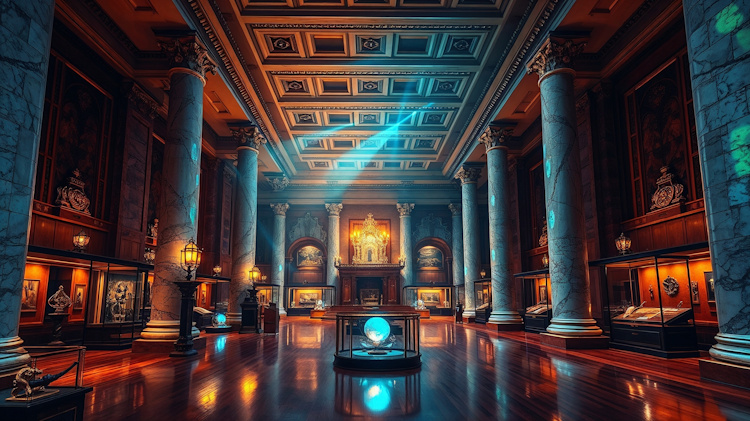
In one of Alchester's better districts, where cobblestone streets wind between buildings of substantial wealth and respectability, stands a grand structure that draws visitors from across the Four Fiefdoms. Volarin's Museum of Antiquities occupies a building whose classical facade speaks to the ambitions of its proprietor—columns of pale marble frame the entrance, while tall windows allow natural light to illuminate the treasures within. The architecture itself represents a later addition to the neighborhood, built when Marek Volarin's obsession with antiquities had outgrown the family's private collection rooms and demanded a more public display.
The Volarin family made their fortune generations ago through mineral investments and trade, accumulating wealth as Alchester rose to prominence as Kallendor's capital. What began as a modest collection assembled for social prestige transformed under Marek's stewardship into something far more consuming. Where his father had collected a few choice pieces to demonstrate cultured taste, Marek developed an appetite that bordered on obsession. The museum became not merely a repository for artifacts but a monument to his expertise, a physical manifestation of the knowledge and authority he claimed over relics from the age before the Fall of the Old Gods.
Inside, visitors walk through halls where gas lamps cast long shadows across display cases meticulously arranged. Each artifact rests in its designated space, labeled with careful notation of its supposed origin and purpose. Religious implements stand behind glass beside ceremonial weapons whose edges have not drawn blood in centuries. Jewelry of forgotten significance gleams under lamplight, while stranger objects occupy their own cases—items whose purposes have been lost to time, leaving only speculation and Marek's confident assertions about their function.
The museum draws scholars who study remnants of civilizations that predate current kingdoms, collectors who appreciate the scope of its acquisitions on display, and curious visitors who marvel at tangible connections to ages past. Marek himself can often be found moving among the exhibits, ready to lecture anyone who will listen about the provenance of particular pieces, the significance of certain symbols, or the historical context of religious practices long abandoned. His lectures carry the tone of absolute authority, the voice of a man who considers himself the foremost expert on such matters in all of Alchester.
What the public does not know—or chooses not to acknowledge—is how many of these artifacts came into Volarin's possession through channels that would not survive close examination. While some pieces were acquired through legitimate purchases at auction or from established dealers, others arrived through more circuitous routes. The museum's collection has been built as much through transactions with thieves and intermediaries as through respectable acquisitions. Marek maintains careful distance from the unsavory details, employing a network of agents who handle the actual procurement while allowing him to claim ignorance of exactly how certain items found their way into his vault.
The museum's private areas tell a different story from the public galleries. Behind locked doors accessible only to Marek and his most trusted staff, additional artifacts await authentication, cleaning, or simple storage until the curator decides whether they merit display. A vault beneath the main building houses the most valuable or controversial pieces, items whose acquisition involved complications Marek prefers to keep private. The chief of security oversees guards stationed throughout the museum, their presence a constant reminder that these treasures require protection from those who might covet them.
The museum has become more than a collection of artifacts. It serves as theater for Marek's ego, a stage where he performs expertise and authority before audiences willing to accept his self-appointed role as Alchester's foremost authority on antiquities. The building itself contributes to this performance, its grand halls and careful lighting transforming even mundane objects into items of significance simply through presentation. Every artifact, every label, every arrangement of display cases serves the larger purpose of establishing Volarin as scholar, expert, and guardian of history.
But beneath this carefully constructed image lies the truth that those in Alchester's underworld have long understood. The museum operates as a front for transactions that blur the line between collecting and trafficking in stolen goods. The same halls that draw scholars and curious visitors also serve as a marketplace for those willing to pay premium prices for items whose ownership histories would not survive scrutiny. Marek has built his reputation on acquisitions that demonstrate his willingness to pursue treasures others cannot or will not obtain, and that willingness has made him both wealthy and vulnerable.
The museum stands now much as it has for years, its doors open to visitors who marvel at displays of ancient wonders. But those who understand Alchester's deeper currents know that Volarin's Museum of Antiquities represents something beyond simple preservation of history. It stands as a monument to one man's consuming obsession, built on foundations of dubious acquisitions and maintained through networks of thieves and dealers who operate in shadows the gas lamps cannot reach. The artifacts behind glass may be ancient, but the methods used to acquire them are thoroughly modern, and thoroughly ruthless.