ALCHESTER
Introduction
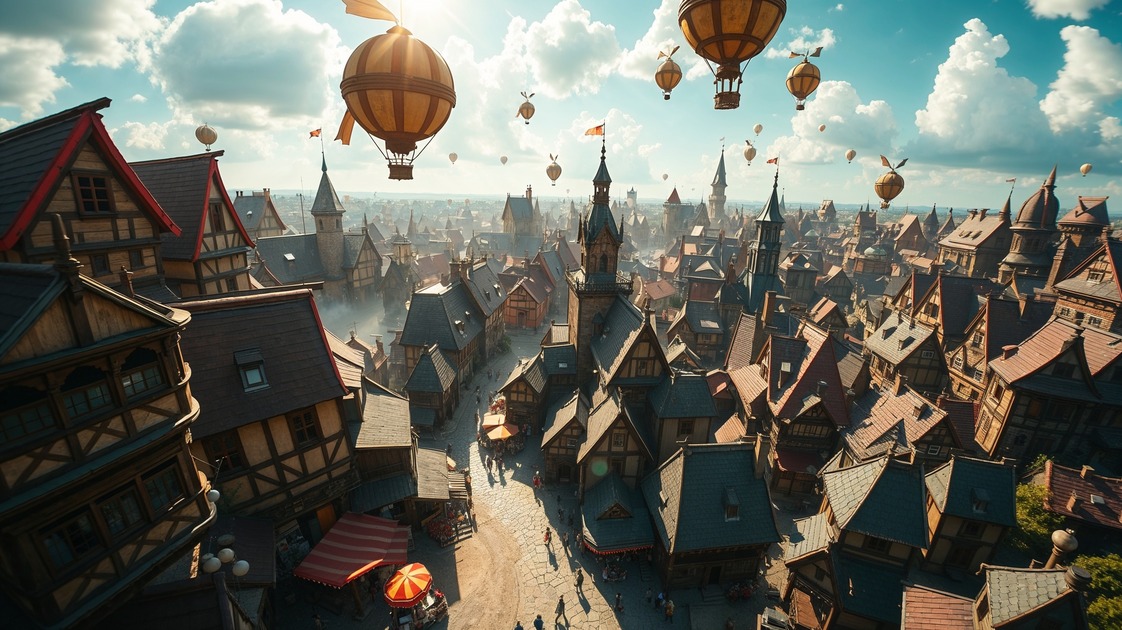
Alchester is the capital of Kallendor and the jewel of the fiefdom — a city of wide trading streets and elevated skylines, of alchemical lamps burning amber through winter fog and airship towers rising above the eastern roofline like the fingers of a reaching hand. It sits at the crossroads of the major overland trade routes connecting the Four Fiefdoms, a position that has made it the center of commerce, innovation, and political ambition for as long as any charter in the city's archives can attest. What began as a trading post has become something that trading posts rarely become: a city that shapes the future of the world around it, one invention at a time.
Originally established to serve the merchants who moved goods along the inland routes, Alchester grew with the speed that strategic location and mineral wealth together produce. The discovery of rich ore deposits in the nearby hills gave the city's craftsmen superior raw materials at a moment when the rest of the Four Fiefdoms were still rebuilding from catastrophe, and that early advantage compounded across generations into the technological lead that Kallendor holds today. The King's Airship Docks stretching across the eastern skyline are the most visible expression of that lead — engineering marvels that have changed the way people think about distance, commerce, and military reach across the entire known world.
Alchester has weathered considerable hardship alongside its triumphs. The Great Plague reduced its population by a third three centuries ago. The Fall of the Old Gods left its magnificent temple district silent and crumbling. Periodic wars with neighboring fiefdoms have tested its walls and its resolve. It has absorbed each of these in turn, rebuilding on the foundation of the same practical ingenuity that built it in the first place. The city does not sentimentalize its scars. It puts them to work.
Through the Ages
Before the Fall (Before Year 0)
The site of present-day Alchester was already a significant waypoint on the overland trade routes of Darshavon's interior before the first permanent structures were built there. The convergence of roads connecting the northern and southern provinces with the kingdom's eastern frontier made the location a natural stopping point for merchants, and the modest collection of inns and storage facilities that served them gradually acquired the character of a permanent settlement. When the rich ore deposits in the surrounding hills were formally documented by Darshavon's mining surveys, royal investment followed quickly. The One Kingdom understood that mineral wealth required infrastructure to extract it, and infrastructure required a city to support it.
During the age of the Old Gods, Alchester was a prosperous but unremarkable provincial center — important to the kingdom's interior commerce, dominated by the magnificent temples that rose along its central avenue, and governed by noble families whose fortunes derived from the horse breeding and trade that had characterized the region for generations. The city's equestrian traditions ran deep even then, with the annual horse fair drawing buyers from every corner of Darshavon and the cavalry units raised from local stock holding a well-earned reputation for quality throughout the royal army.
The Age of Resilience (Year 0–100)
The Fall of the Old Gods struck Alchester hard in ways that were not immediately obvious. The city's walls held and its population survived largely intact, but the institutions that had organized its life — the temple hierarchies, the royal trading charters, the noble houses' relationship with distant Oslo — collapsed simultaneously, leaving a prosperous city without a coherent framework for governance or commerce. The temples fell silent within a generation as the faith that had sustained them evaporated along with the gods it honored. The trade routes that had made the city wealthy were disrupted as the other fiefdoms collapsed inward, and the merchant class that had dominated Alchester's public life found itself managing a shrinking economy with increasingly local horizons.
What saved Alchester was the mineral wealth in its hills and the craftsmen who knew how to work it. Even as long-distance trade contracted, the city's smiths and engineers found new applications for the ore their mines continued to produce, developing tools and machinery that improved local productivity and began attracting attention from the recovering communities around them. The noble families who had survived the Fall consolidated their authority through control of the mines and the roads, establishing the tripartite power structure of crown, guild, and noble house that would define Alchester's politics for centuries.
The Age of Change (Year 101–450)
As Kallendor emerged as one of the Four Fiefdoms, Alchester's position as its natural capital was never seriously contested. The city's central location, commercial infrastructure, and mineral resources made it the indispensable hub of the emerging fiefdom's economy, and successive rulers invested in its development with the understanding that Kallendor's prosperity and Alchester's were effectively the same thing. The guilds grew into significant political forces during this era, their control over the skilled trades that drove the city's economy translating directly into influence over policy and personnel in the ducal administration.
The Great Plague arrived midway through this period and came close to breaking the city entirely. A third of the population died within three years, including a disproportionate share of the skilled craftsmen whose knowledge was not written down and could not be quickly replaced. The recovery took decades and required deliberate investment in education and apprenticeship systems that would eventually produce the Technology Academy — a response to the plague's lesson that knowledge stored only in living minds is permanently vulnerable.
The Rise of the Four Fiefdoms (Year 100–300)
Alchester's commercial dominance among the fiefdoms' interior cities was established during this era through the same combination of geographic advantage and technological edge that had characterized the city since its founding. The overland trade routes that converged here gave Kallendorian merchants access to goods from all four fiefdoms simultaneously, while the engineering capabilities of the city's craftsmen produced manufactured goods that commanded premium prices regardless of destination. The League of Merchants, founded during this period to coordinate commercial interests and negotiate trading terms with other fiefdoms, established its headquarters in Alchester and rapidly became one of the most powerful non-governmental institutions in the city.
The relationship with the krill of the Merrow Woods to the east was formalized during this era as well. The krill's reclusive hostility toward human intrusion had closed the traditional Freelands trade route following the Fall, and restoring even limited access required the kind of patient, long-term diplomatic investment that the commerce-minded rulers of Kallendor eventually concluded was worth making. The resulting arrangements were imperfect and never entirely stable, but they kept the eastern approaches open enough to sustain the trade relationships that Alchester's merchants depended upon.
The Age of Advancement (Year 451–Present)
The current age belongs to Alchester in a way that no previous era quite has. The development of practical airship technology — the product of generations of incremental engineering advances at the Technology Academy, finally synthesized into operational designs during the reign of the current monarch — transformed the city from a prosperous trade hub into the center of a technological revolution whose implications are still working themselves through the other fiefdoms' military and commercial calculations. The King's Airship Docks on the eastern edge of the city stand as the most dramatic physical expression of this transformation: twenty berthing towers constructed in an era of optimistic projection, ten of them still dark and sealed as the commercial demand that justified their construction catches up to the infrastructure built in anticipation of it.
The political dimension of this technological lead has grown more fraught in recent years. Classus IV, who ruled as duke before declaring himself king — a title the other fiefdoms do not recognize and that carries dangerous implications for regional stability — has invested heavily in the airship fleet as both a commercial and military asset. The declaration of kingship has massed troops at borders and tested the diplomatic arrangements that have kept the Four Fiefdoms from open war, while within the city, the disruptions caused by the shift toward aerial commerce have created economic winners and losers whose competing interests play out in guild politics, street-level unrest, and the complex maneuvers of factions seeking to direct or redirect the crown's priorities.
Geography and Layout
Alchester sits on gently rolling terrain at the convergence of the major overland roads that cross Kallendor's interior, its position chosen for accessibility rather than defensibility — a choice that reflects the city's commercial origins and that subsequent rulers have compensated for through the construction of walls and fortifications that nature did not provide. The surrounding hills that supply the city's mines are visible from the higher ground near the citadel, their slopes crossed by the roads and cart tracks that carry ore down to the city's processing facilities. The cold winds that sweep south from the Ugull Mountains across the Vernesse Steppes make Alchester's winters harsh, its streets empty on the worst nights, and the alchemical lamps that line the main thoroughfares more than merely decorative for several months of the year.
The city's layout reflects its history more than any planner's vision. The oldest neighborhoods cluster around the central avenue where the temple district stands, their narrow streets predating the road grid that more deliberate expansion imposed on the newer quarters. The commercial districts spread outward from the old center along the converging trade roads, their widths calibrated for the wagon traffic that has flowed through them for centuries. The King's Airship Docks occupy the entire eastern quarter, their twenty towers dominating the skyline in a way that makes the city's prevailing wind direction — the towers are oriented to face it — legible from any elevated vantage point.
The Beggars' Quarter occupies the city's southwestern reaches, its streets narrowing and its buildings darkening as the distance from the commercial center increases. The Shambles, a labyrinthine tenement district within the Quarter, houses the city's poorest residents in conditions that the King's Watch monitors with the minimum attention required to prevent outright rebellion and no more. Beyond the city walls, the horse-breeding estates that sustain Kallendor's cavalry traditions stretch across the surrounding plains, their paddocks and training grounds visible from the wall walks in every direction except east, where the airship towers block the view.
Governance
Power in Alchester operates on three levels that interact constantly and cooperate only when their interests align. At the apex sits the royal court, where Classus IV governs from the citadel with a vision of technological progress and political elevation that his more cautious predecessors would not have recognized as Kallendorian. The guilds that control the city's skilled trades and commercial infrastructure form the second tier, their influence embedded in every economic decision the crown makes and their cooperation essential for any policy that requires the participation of the craftsmen and merchants who built the city's prosperity. The noble houses with their ancestral land claims and cavalry traditions form the third, their influence diminished by the shift toward aerial commerce but not eliminated, and their resentment of that diminishment a source of ongoing political friction.
The King's Watch maintains order in the streets and the citadel's authority over public life, though the Watch's presence thins noticeably in the outer districts and disappears almost entirely in the Beggars' Quarter, where different arrangements prevail. The League of Merchants, headquartered in the commercial district's most impressive private building, operates as a fourth power that is formally subordinate to the crown but practically capable of frustrating royal policy through commercial means when its interests are threatened. The relationship between Classus and the League has grown complicated since the Grand Administrator's recent appointment — a figure whose connections extend into areas of the city's life that the League's commercial charter does not formally cover.
The city's spymaster, who operates from an unmarked building near the citadel's service entrance, represents the crown's attempt to maintain visibility into the competing interests that governance in Alchester requires managing simultaneously. The spymaster's network extends through every district of the city and reportedly beyond its walls, though the precise reach of that network is, by design, unknown to anyone outside the office itself and to the king who receives its reports.
Districts and Landmarks
The King's Airship Docks
The eastern quarter of Alchester is defined by the twenty berthing towers of the King's Airship Docks, each multi-bayed structure rising high enough to accommodate the largest commercial dirigibles in service. The towers were constructed in an era of ambitious projection, built to meet a demand for aerial commerce that city planners and the League of Merchants together believed was imminent and inevitable. They were not wrong about the direction, only the timing — commercial airship traffic has grown substantially but not yet to the scale the towers were designed for, leaving ten of them dark and sealed while the active ten handle a traffic level that continues to increase year over year. The unused towers have found unofficial purposes: vagrants shelter in the lower floors, and those who require private meeting space beyond the Watch's notice have discovered that an officially sealed building is not the same as a locked one.
The docks operate continuously, their activity visible from across the city by day and announced after dark by the glow of gas lamps illuminating the loading platforms and the silhouettes of vessels moving against the sky. Cargo nets swing from bronze-hulled merchant ships, military transports sit in reinforced moorings designed for their weight, and the constant background noise of maintenance work — hammering, the hiss of steam from engine compartments, the creak of mooring cables under tension — provides the eastern quarter with a soundtrack that residents either find reassuring or maddening depending on their distance from it.
The Temple District
The central avenue of Alchester is flanked by the silent ruins of the temples that once made this the spiritual heart of the city. These structures were magnificent once — their columns still stand, their carved facades still display the iconography of gods who no longer answer prayers — but centuries of neglect and the depredations of scavengers who stripped the most valuable materials long ago have left them in a state that registers as eerie rather than grand. Most Alchestrians pass them daily without looking up, the way people learn not to look at things that unsettle them. Visitors look, and then often wish they had not, because the temples at dusk have a quality of attention that the rationally-minded prefer not to think about too carefully.
Beneath the temples, the catacombs extend for miles through the bedrock beneath the city's central districts, housing the remains of the faithful from an era of genuine religious devotion. The catacombs are officially closed to the public and genuinely dangerous in the sections where the architecture has degraded beyond safe navigation, but they are also genuinely extensive and connected to the city's sewer system in ways that make complete closure practically impossible. Scholars, thrill-seekers, and those with professional reasons to move through the city without surface-level observation all use them, and the things that some visitors report experiencing in the deeper sections have generated a body of first-hand accounts that the city's rationalists dismiss and its superstitious residents take very seriously.
The Commercial District
The broad streets radiating outward from the old city center along the converging trade roads house Alchester's commercial life in its most legitimate and prosperous form. The League of Merchants building — a substantial stone structure whose facade features the carved likenesses of notable commercial figures from the city's past — anchors the district's most prestigious block, surrounded by trading halls, commodity exchanges, banking houses, and the offices of the guild administrators who oversee the skilled trades. The King's Stockyards, the largest livestock market in the fiefdom, occupy a dedicated section of the commercial district where the northern trade road enters the city, their scale sufficient to handle the volume of the annual horse fair that draws buyers from all four fiefdoms.
The Technology Academy sits at the commercial district's eastern edge, a complex of buildings where Kallendor's brightest minds work on the innovations that sustain the kingdom's technological lead. The Academy trains students in both theoretical and applied sciences, its curriculum producing artificers, engineers, and alchemists whose work blurs the boundary between technology and what less practically-minded observers call magic. Royal patronage ensures funding and access to materials that independent scholarship could not afford, and royal expectations ensure that the Academy's output remains oriented toward applications with commercial or military value rather than purely theoretical pursuits.
The Beggars' Quarter
The southwestern reaches of Alchester operate under governance of a distinctly informal kind. The Beggars' Quarter is the city's poorest district and its most self-organizing, its residents having long since concluded that the King's Watch's interest in their welfare was insufficient to justify waiting for it. The quarter's internal order is maintained through arrangements that the Watch officially does not acknowledge and practically does not challenge, centered on the Thieves' Guild whose operations extend from the Quarter outward into the legitimate businesses of every other district in the city. Guild House, the administrative center of this enterprise, sits in one of the quarter's older neighborhoods, its ivy-covered wall and well-maintained grounds a deliberate contrast to its surroundings — a statement about the kind of organization that occupies the building and the kind of respect it expects.
The Shambles, within the Quarter, houses the city's most desperate population in conditions that the gap between Alchester's technological ambitions and its social investment makes starkly visible. The contrast between the alchemical lamp-lit splendor of the commercial district and the Shambles' untreated tenements is the source of the periodic protests and occasional riots that the King's Guard suppresses with the efficiency of long practice. Reformers within the progressive factions argue publicly that a city capable of building airship docks is capable of managing its poverty. The crown's response has been to invest in the docks.
Aikon Cemetery
At the city's edge, Aikon Cemetery has accumulated a reputation over the centuries that goes well beyond what most burial grounds manage. The cemetery is old — old enough that some of the monuments near its center mark graves whose inscriptions weathered smooth generations ago — and extensive, its marble statues of gods and gargoyles standing sentinel over family crypts that have been sealed for so long the families that built them have themselves been forgotten. Under certain lunar alignments, the cemetery earns the persistent rumors that circulate about it in every tavern in the city: that things move among the headstones after dark, that the caretakers occasionally report finding arrangements in the morning that no living person left there. Most citizens avoid the place after nightfall. Some seek it out for precisely this reason, though those who have gone looking with scientific intent have rarely published findings that fully satisfy either the skeptics or the credulous.
Economy and Innovation
Alchester's economy runs on the intersection of mineral wealth, skilled manufacturing, and the commercial traffic that its geographic position generates regardless of what any particular ruler prioritizes. The ore from the surrounding hills feeds the processing facilities that power the city's advanced machinery, the machinery produces the goods that command premium prices throughout the fiefdoms, and the premium prices attract the merchants whose presence sustains the financial houses, inns, and service industries that employ much of the city's permanent population. This cycle has been turning long enough that it is largely self-sustaining, though each component depends on the others in ways that make the whole more fragile than its apparent prosperity suggests.
King Classus's aerial commerce initiative has added a new layer to this economy while disrupting existing ones. The airship trade generates revenue from cargo fees, maintenance contracts, and the manufacturing of vessels and components at the Technology Academy's affiliated workshops. It has also reduced demand for the traditional wagon-freight industries that employed generations of Alchester's working population, and the resulting displacement is visible in the Beggars' Quarter's population growth and the League of Merchants' more contentious internal politics as established commercial interests find their positions threatened by aerial competitors who operate under different cost structures.
The financial sector has grown substantially in the current era, its services required by the complex transactions that aerial commerce and multi-fiefdom trade generate. Banking houses headquartered in Alchester maintain branches in Sirron, Drakemoor, and the major Freelands cities, and the instruments they issue — letters of credit, cargo insurance, investment notes in airship ventures — have made Alchester a financial center whose reach substantially exceeds its physical size. The League of Merchants remains the most powerful commercial organization in this system, its relationships with the crown's commercial apparatus and its network of guild affiliations giving it leverage over economic conditions that no competitor has yet successfully challenged.
Military and Defense
Kallendor's military reputation rests on its cavalry, and that reputation was built in Alchester's surrounding plains, where the horse-breeding estates that supply the fiefdom's mounted forces have operated for as long as the city has existed. The noble houses whose ancestral identity is bound up in the equestrian tradition maintain these estates and the cavalry units raised from them, and the King's Stockyards in the commercial district serve as the logistical hub for the horse trade that keeps them supplied. Alchester's cavalry garrison — quartered in the stables complex inside the western wall — represents the most visible conventional military force in the city and the most traditional one, its soldiers maintaining practices that predate the airship era and that the old noble families consider the authentic expression of Kallendorian military identity.
The airship fleet represents the military dimension that Classus has prioritized, and the King's Airship Docks' military moorings — the reinforced towers designed for the weight and armament of warships rather than merchant vessels — signal the ambition clearly enough. Armed airships provide reconnaissance, rapid deployment, and the ability to project force across distances that conventional cavalry cannot match in the same time, and the other fiefdoms' military establishments have not been slow to recognize the implications. Seacea's naval supremacy remains unchallenged on the water, but the aerial dimension of military power is a domain that Kallendor currently owns, and Classus intends to maintain that ownership through continued investment in both technology and production capacity.
The King's Watch handles internal security, maintaining order in the city's legitimate districts with the professional competence of a long-established institution. The Watch's authority does not extend into the Beggars' Quarter in any meaningful operational sense, and the arrangements that govern that district's internal order are understood by everyone involved to be beyond the Watch's practical reach even if not beyond its formal jurisdiction. The King's Guard, the crown's heavier enforcement force, is deployed for significant civil disturbances and political security — the suppression of protests among the commercially displaced, the protection of royal officials whose positions have made them targets, and the investigation of threats to the crown that the spymaster's network identifies and the Guard acts upon.
Culture and Society
Alchester's citizens carry the city's dual nature in their daily lives with a comfort that suggests long practice. Pride in their sophisticated urban identity — the airships, the Academy, the commercial cosmopolitanism that brings goods and people from across the known world through the city's markets — coexists with genuine attachment to the equestrian heritage that gives Kallendor its character and Alchester its annual calendar of horse fairs and racing festivals. The city manages these two identities without obvious contradiction because it has been managing them for long enough that the contradiction no longer requires active resolution.
The social hierarchy follows clear but unwritten rules that everyone learns early. Noble families trace their lineages to the original horse-lords who shaped Kallendor's founding, and their land holdings and cavalry connections give them weight that no amount of commercial wealth fully replicates. Merchants gain status through accumulated fortune and guild affiliation, their position in the city's practical power structure often exceeding their formal social rank. Skilled artificers and engineers earn respect through demonstrated contribution to the technological advancement that defines the city's contemporary identity, their status rising as each generation builds on the last's innovations. Below these groups, the working population that keeps the city's trades and services functioning receives the minimum of ceremonial recognition and the maximum of practical invisibility that urban hierarchies typically afford their labor.
By day, Alchester is a city of commerce and industry — markets full of exotic goods, trading halls conducting the business of three fiefdoms simultaneously, Academy workshops generating the innovations that keep Kallendor ahead. By night, it transforms. Taverns and wineshops fill with the full social range of city life, the divisions of the daylight hours dissolving somewhat in the amber glow of the alchemical lamps. Theaters present dramatic performances that range from the classical to the politically pointed. The Broken Fang and the other establishments that cater to more particular tastes operate in the knowledge that the Watch's attention is finite and selectively applied. The city after dark has its own geography, its own rules of passage, and its own cast of regular occupants who are rarely visible in the daylight version of the same streets.
King Classus IV
Kallendor's ruler declared himself king several years ago, elevating his title above the ducal rank that the rulers of the other fiefdoms maintain and implicitly claiming the authority that the high kings of Darshavon once exercised from Oslo. The other fiefdoms do not recognize the title and view the declaration as the opening move in a political strategy aimed at reunification — a prospect that every independent ruler in the Four Fiefdoms regards with varying degrees of alarm. Within Kallendor, the declaration has divided opinion between those who see it as the natural expression of the fiefdom's technological and commercial preeminence and those who consider it a provocation with consequences that have not yet fully arrived. Classus himself is known as the Airship Monarch, a title earned through his genuine investment in aerial technology and his vision of Kallendor as the leading power of a new age. Whether that vision will produce the dominance he intends or the war that his rivals fear remains the defining open question of the current era.
Thjorn "Heavyhammer" Targalas
The lord of Alchester's Thieves' Guild is an Anolgan hillman of considerable physical scale whose presence in Alchester represents one of the more interesting examples of cultural transplantation in the Four Fiefdoms. Thjorn came to the city by routes he has never publicly detailed and rose to lead the guild through the combination of personal ferocity and political intelligence that the position requires. He has learned enough of what he calls civilization to maintain a working relationship with the city's official power structures — Guild House is well-maintained, his dealings with legitimate businesses are conducted through established channels, and his arrangements with the Watch represent a stability that both sides have concluded serves their interests. He remains, by temperament, an Anolgan — direct, physically imposing, little interested in the finer points of etiquette, and possessed of a patience for perceived insult that is shorter than most of the people who deal with him appreciate until they discover it the hard way.
Inspector William Wright
The King's Watch produces many competent officers, but Wright occupies a category of his own — an investigator whose methods rely on observation and inference rather than the application of authority, and whose results have made him the most effective detective the city has produced in living memory. Wright works the boundary between the official and unofficial layers of Alchester's power structure with a pragmatism that makes some of his superiors uncomfortable and most of his colleagues grateful. He understands the city's actual power arrangements well enough to accomplish things within them that a strictly procedural approach would not allow, and he maintains relationships with figures in various quarters of the city's life that official policy would not sanction and that he does not discuss unless directly asked.
Present Day Challenges and Conflicts
The political consequences of Classus's self-elevation to king are the most significant long-term challenge facing Alchester. Troops mass at borders. The other fiefdoms conduct diplomatic consultations that are thinly disguised preparations for a collective response that has not yet materialized but that everyone in the city's political class understands is coming if Classus does not moderate his ambitions or if some incident provides a pretext for action. The crown's spymaster tracks the other fiefdoms' preparations, and the Academy's strategic engineering workshops are working on applications that the public announcements describe as commercial and that the military observers from other fiefdoms assess differently. The city's permanent residents, for the most part, conduct their lives without visible anxiety about these larger currents. They have seen political crises come and go. What they have not seen is a political crisis that included the word "king" from Kallendor's direction, which is a distinction that the more historically-minded among them note with some care.
The Warders represent a threat of a different and more immediately personal kind. This organization, whose operations span commercial, political, and supernatural domains, has embedded itself in the city's institutional life through the League of Merchants and the crown's commercial apparatus, using those positions to pursue objectives that range from economic manipulation to plans involving the city's more vulnerable physical and spiritual infrastructure. The crown's spymaster is investigating, but the Warders' decades of relationship-building have created a network of dependencies that make surgical removal difficult without collateral damage to institutions the city cannot easily replace.
The economic displacement caused by aerial commerce has produced a social tension that periodic suppression addresses without resolving. The workers of trades that have not adapted to the aerial age find themselves competing with transportation options that undercut their cost structures, in a city that celebrates technological progress as a civic virtue and does not easily accommodate the argument that progress's costs should be distributed more equitably than the market distributes them. The Beggars' Quarter grows. The protests recur. The gap between Alchester's achievements and its treatment of those who cannot access those achievements remains one of the more uncomfortable facts about a city that otherwise presents itself as the model of what human civilization can become.
Concluding Remarks
Alchester is a city in the middle of becoming something — it has not yet arrived at whatever that something is, and the process of becoming it is not uniformly pleasant for everyone caught up in it. The airship towers on the eastern horizon represent genuine achievement and genuine disruption simultaneously, and the city contains both without having resolved the tension between them. This is not comfortable, but it may be necessary. The cities that change the world tend to be the ones where the future and the past are in active conflict, where the outcomes are not predetermined, and where the people living through the process cannot yet tell which side will win.
To merchants, Alchester offers unparalleled opportunity. To scholars and artificers, it offers the finest research institutions and the most stimulating intellectual environment in the Four Fiefdoms. To those seeking entertainment, it provides diversions from the refined to the disreputable with equal facility. To the politically ambitious, it offers proximity to power at a moment when that power is being actively redefined. And to those who simply want to understand where the world is going — who want to see the future before it arrives — Alchester is where that future is currently being assembled, argument by argument, invention by invention, in the workshops and guild halls and taverns and locked rooms of a city that has always known how to turn its position at the crossroads into something more than just a place where roads meet.