THE GEOGRAPHY OF UHL
Alderden Mountains
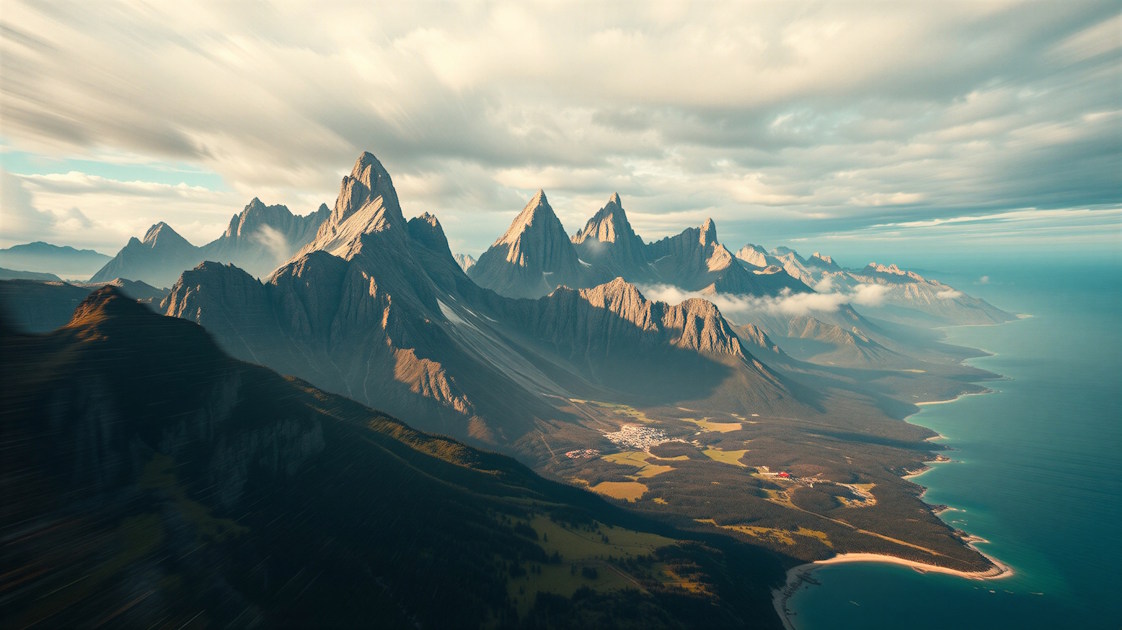
The Alderden Mountains form Uhl's eastern spine, a long and forbidding chain that rises from the northern coast where the Miradathia Sea batters the cliffs below and drives south until the range loses itself in the broken terrain of the Hollow Hills. Neither as ancient as the Ugulls nor as geographically central, the Alderdens nonetheless exert an outsized influence on the lands around them. The fishing town of Isia clings to the foothills at the range's northern end, its fortunes shaped as much by the mountains at its back as by the sea at its feet. Deeper into the range, where the peaks climb highest and the air sharpens with altitude, the dwarven thane of Akenraen-tor occupies a position the other thanes regard with a mixture of admiration and unease—a fortress built not downward into the earth's warmth but upward into cold and sky, its upper chambers reaching elevations where clouds form below the battlements and the stars burn with uncommon clarity. To the west, the eslar kingdom of Panthora presses close to the range's lower slopes, the two regions separated by terrain rugged enough to discourage casual passage but not so impassable as to prevent the trade and occasional conflict that have defined their long relationship.
The Alderdens are a range defined by contrast. Their northern peaks, carved by sea wind and glacial cold, bear little resemblance to the drier, more fractured terrain of the southern reaches, where the mountains break apart into a maze of ridges and ravines before yielding to the Hollow Hills. Between these extremes, the range supports a striking diversity of climate and ecology—dense pine forests on the middle slopes, alpine meadows above the treeline, and exposed granite faces near the summits that even experienced climbers approach with caution. Gaugath tribes move through the middle elevations with the ease of long familiarity, their presence a persistent hazard for travelers on the mountain roads and for the dwarven patrols that range out from Akenraen-tor. The passes connecting the eastern coast to the interior see steady enough traffic to have acquired names and reputations, but no road through the Alderdens fully earns the word reliable—the mountains hold their own counsel, and those who travel them do so on the range's terms, not their own.
Alzion Mountains

The Alzion Mountains form a formidable natural barrier running south of the Dormont Forest, their peaks dividing the fiefdom of Seacea to the west from the Freelands to the east. Separate from the Ugull Mountains to the north, the Alzions are a range unto themselves—ancient stone riddled with ore veins, deep caverns, and tunnel networks that extend far into the Underland below. Two of the seven great dwarven thanes have claimed their place here: Merkinjel, the Golden Vaults, whose miners struck gold veins of staggering richness during the Age of Change and whose refined ingots now serve as the monetary standard across much of Uhl; and Berjendale, known as the Iron Gates of the South, a fortress of black stone and uncompromising severity that has spent centuries in unrelenting warfare against the goblin strongholds infesting the southern peaks. Beneath the mountains altogether, carved from vast natural caverns by centuries of goblin labor, lies Gugal—one of the great goblin fortress-cities of Uhl, governed by a rare triumvirate of gaugath, haurek, and imp, its tunnel networks pushing outward toward both Seacea and the Freelands and its raiding parties a persistent threat to every settlement within reach.
The ruins of Alzion Hall, one of three ancient institutions that once guarded the great forests and mountains of Darshavon, lie somewhere within these peaks—a reminder of what the range once represented before the Fall of the Old Gods shattered the old order. Where the Hall of the Simmaron survived the cataclysm and endures to the present day, Alzion Hall was lost to the chaos, and only its broken stones remain. Today, the Alzions are a place of dangerous beauty and deep conflict, where dwarven forges burn against the dark, goblin armies test ancient gates, and the mountain passes that connect east and west can never be crossed without an eye toward what moves in the heights above.
Read more about the Alzion Mountains.
Amber Plains
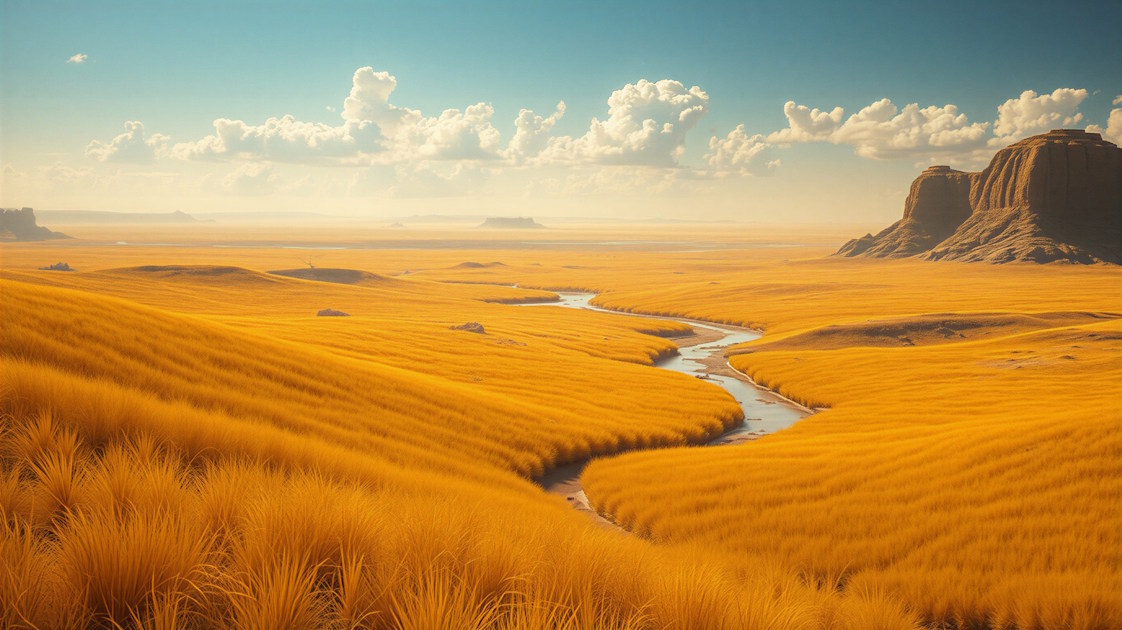
The Amber Plains stretch across the western fringes of the Southern Reaches, a vast transitional expanse where the punishing dunes of the Great Thirst yield reluctantly to sparse, wind-scoured grassland. Named for the honey-gold grasses that carpet the terrain during favorable seasons, the plains extend for hundreds of miles between the desert proper and the more hospitable lands to the west and north, their flat horizons broken only by low ridges of sun-bleached stone and the occasional cluster of wind-warped acacia trees marking a hidden seep or shallow well. The amber grasses themselves are more valuable than they appear; herbalists and alchemists throughout the region prize certain varieties for the compounds they yield, and weavers in the oasis settlements harvest them for cordage and coarse textiles. In the brief wet season, when rains push in from distant coasts, the plains flush a startling green and support modest herds of desert antelope and the semi-nomadic pastoralists who follow them, their low-slung tents appearing and vanishing with the same rhythm as the rains themselves.
The Amber Plains have long served as the primary threshold between the Southern Reaches and the broader world beyond. Caravan roads trace ancient paths across the grassland, threading through the network of oasis way-stations where merchants, guides, and travelers rest before pushing deeper into the desert or emerging from it. These settlements are hardened, pragmatic places — built around precious water and defended accordingly — and their inhabitants know better than most how quickly the plains can turn hostile. Flash floods carve sudden channels through the flatlands after heavy rains, sandstorms roll in from the east without warning, and the same wide-open terrain that makes travel straightforward also strips away any shelter from the elements. Despite the hardships, the plains endure as one of the most-traveled corridors in all of Uhl, a liminal zone where the cultures of the desert and the north intermingle, where deals are struck over shared water, and where the Southern Reaches announce themselves to the wider world through dust, amber grass, and the creaking wheels of laden caravans.
Argalos Isles
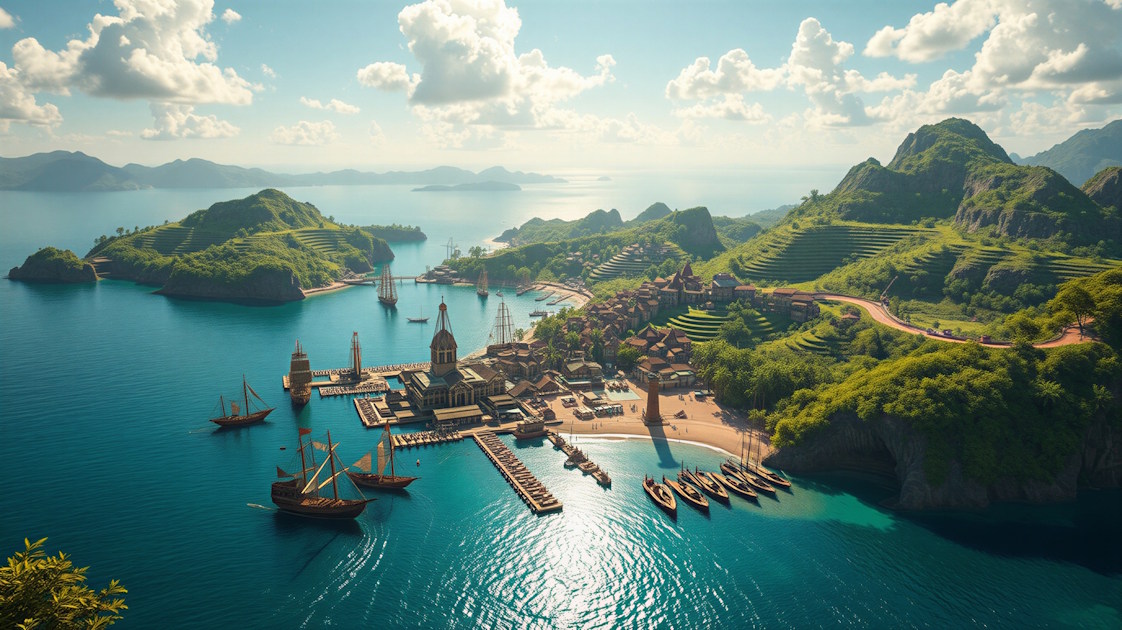
The Argalos Isles rise from the waters of the Miradathia Sea near the mouth of Tithiel Bay, an archipelago set close enough to the Panthoran mainland to serve as its maritime doorstep and far enough out to have spent much of its history as something separate. The isles were independent once, governed on their own terms before they came under Panthoran rule, and today they are firmly and unambiguously part of the eslar kingdom. Their position accounts for a good deal of that history: any vessel bound for the sheltered harbors of Tithiel Bay passes within sight of them, which made the archipelago valuable to whoever held it and made it difficult for Panthora to leave in other hands indefinitely.
The isles are now integral to the kingdom's economy rather than merely adjacent to it. Sugar cane grows across the island slopes, feeding distilleries whose spirits travel outward along the Miradathia trade lanes. Fishing fleets work the surrounding waters, supplying a portion of the marine bounty that features so prominently in Panthoran cuisine. Along the shores, shipbuilding yards turn out vessels for eslar merchants and the Panthoran navy alike — an industry that gives the archipelago a strategic weight well beyond its size. In a kingdom hemmed in overland by the krill-patrolled Merrow Woods to the west, the sitheri-infested Grimmere Swamp to the south, and the haunted Dead Lands to the north, the sea is Panthora's one dependable path outward, and the Argalos Isles build the ships that travel it.
Barrens Ocean
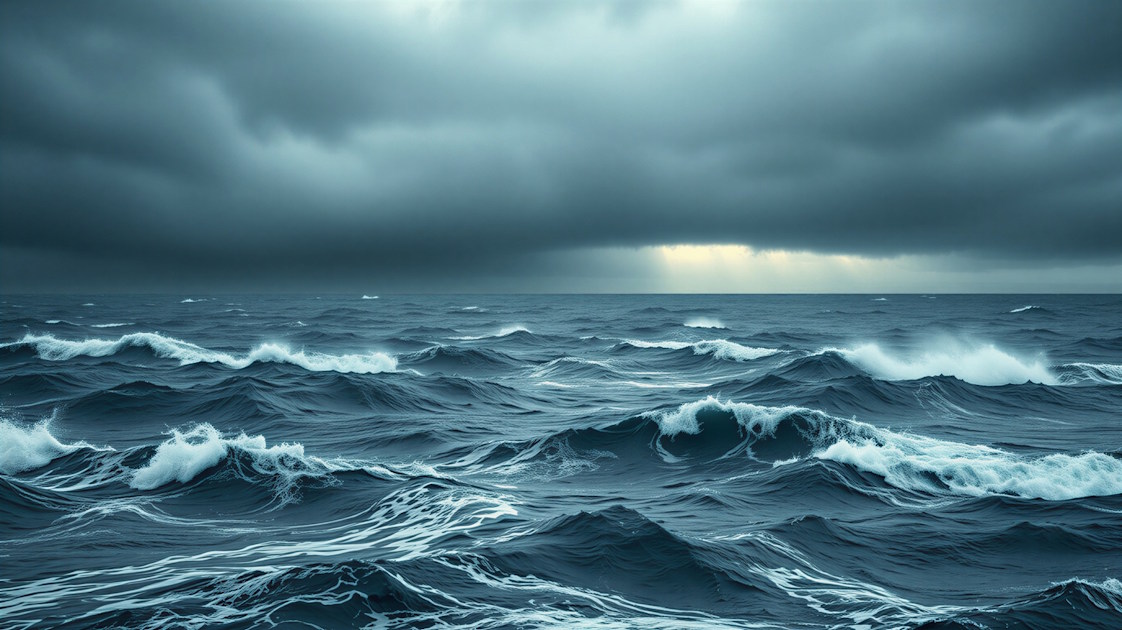
The Barrens Ocean stretches west of the Four Fiefdoms in grey, wind-scoured immensity, a body of water so vast and so punishing that even the most seasoned mariners speak of it with quiet respect. During the Age of the Old Gods, the kingdoms of Darshavon pressed boldly into its reaches—explorers launched from harbors along the western Anolgan coast and from the sheltered cove at Dunmere on Oslo, the Isle of the King, charting currents and far shores with the confidence of a civilization sustained by divine favor. Trade routes threaded across the Barrens, and the royal navy patrolled its eastern fringes to protect the coastal provinces. The Eriatic Channel, cutting between the mainland and Oslo, served as the ocean's inland gateway, a passage where Darshavonian sailors learned to read the tide shifts and erratic weather that made the Barrens as dangerous as any enemy fleet.
The Fall of the Old Gods stripped away that confidence. With Darshavon shattered and Oslo abandoned, the accumulated navigational knowledge of generations was lost, and the Barrens reverted to something closer to myth—a grey horizon that swallowed ships and returned nothing. Anolgan sea lords reclaimed fragments of the old routes through necessity and recklessness, and Seacea eventually rose to dominance over the Eriatic Channel, making the kingdom the de facto gatekeeper to both the ocean's eastern approach and the haunted island that broods at the channel's heart. Today the Barrens yields fish, trade, and occasional discovery to those skilled and stubborn enough to work its waters, but it concedes nothing easily. Storms roll in without warning off the open swells, currents conspire against the unwary, and the western depths remain as uncharted as they were the day Oslo fell silent. What wealth or ruin lies beyond the known lanes, no living sailor has yet returned to say.
Bay of Lochwell
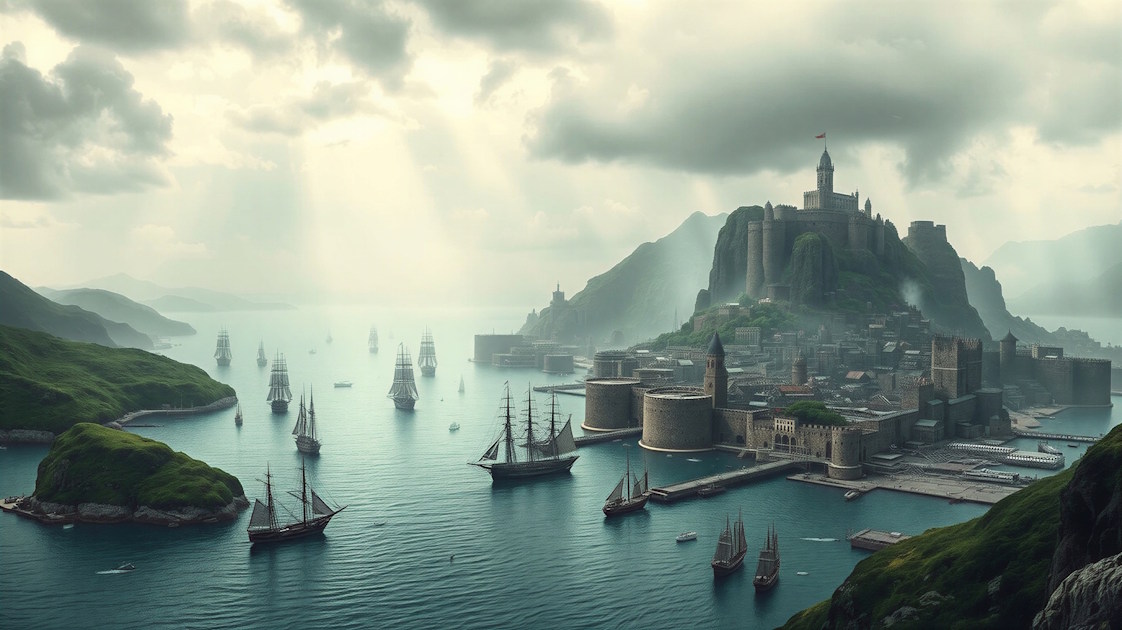
The Bay of Lochwell cuts deep into the western coast of Seacea, its waters broad and well-sheltered enough to have made it the most strategically significant natural harbor along the entire western seaboard. During the age of the One Kingdom, Darshavon's admirals recognized its value immediately — a deep anchorage positioned within easy sailing distance of the Eriatic Channel, ringed by low headlands that break the worst of the ocean swells and leave the interior waters calm enough for loading and unloading through all but the severest storms. The crown formalized a naval installation there centuries before the Fall, and the fishing clan already settled on the inner shore — the Sirrona — found themselves absorbed into a larger imperial purpose without ever fully surrendering the bay they considered their own. When the Old Gods fell, and the royal garrison dissolved, it was the Sirrona who held the bay, conscripting the sailors left behind into what their leader called, with characteristic understatement, the Bay Defense. The name stuck. The clan name became the city name, the city name became the dynastic name, and the dynasty built itself into the most formidable maritime kingdom in the Four Fiefdoms.
The bay remains the economic and military engine of Seacea today. Its mouth, wide enough for traffic in both directions but narrow enough to be commanded by artillery batteries on each headland, feeds into an anchorage capacious enough for fleets and busy enough on any given morning that the flags of a dozen nations share the waterfront with Seacea's own. Sirron, the Seacean capital, occupies the eastern and northeastern shore, spreading uphill from the working harbor to the ducal palace on the ridge above, the naval yards along the western arm, and the long commercial quays where merchant vessels from across the Barrens Ocean discharge their cargoes. The Lochwell River enters the bay at the city's northern edge, carrying timber from the interior forests that feeds the shipbuilding yards in a steady stream. Fort Lochward on the northern headland and Fort Seaward to the south have guarded the entrance since the Darshavon era, their foundations ancient, their guns maintained in a state of readiness that has never yet been tested to its limit — a record the garrison commanders treat as worth preserving at considerable expense. The bay chose the site. The site made the city. The city built the kingdom. That chain of consequence is as intact today as it was the day the Sirrona first pulled their boats onto its shore.
Blackwood Forest
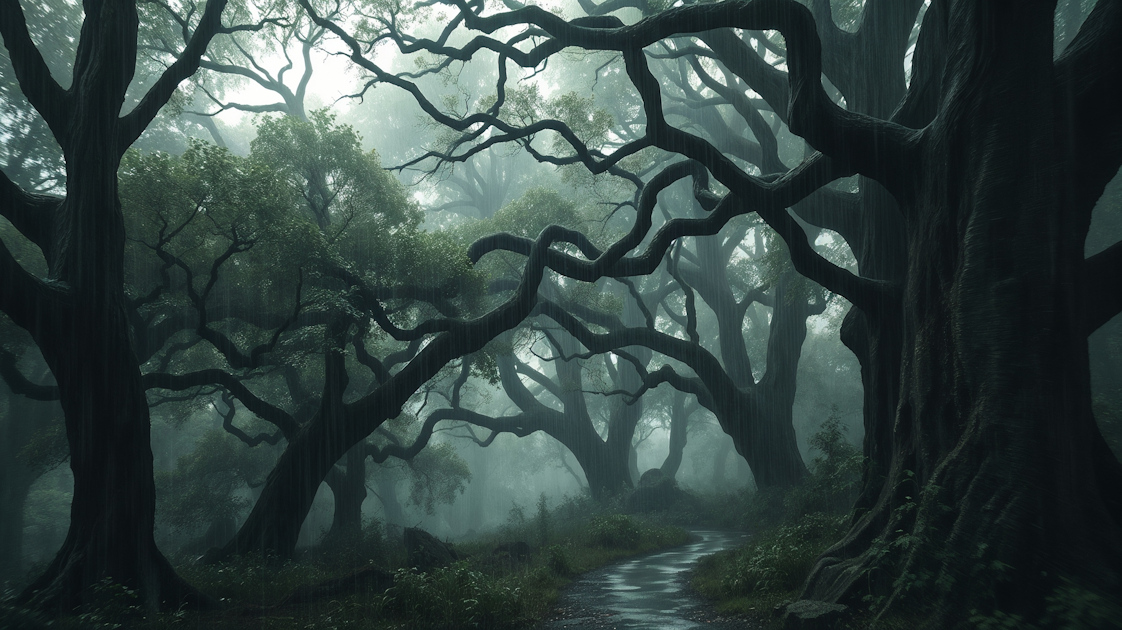
The Blackwood Forest is one of the great woodlands of the Freelands, a vast expanse of ancient oaks surrounding the settlement of High Holt. The forest takes its name from the dark bark of its oldest trees, which absorb light rather than reflect it, giving the deeper reaches a perpetual twilight even at midday. Smaller than the Dormont Forest to the south or the Merrow Woods to the east, the Blackwood nonetheless dominates the landscape for leagues in every direction, its canopy broken only by the clearings where farms, lordly estates, and trade routes have carved out space among the trees. It served as a frontier boundary during the Age of the Old Gods and later as a refuge for the survivors who fled eastward after the Fall — and it was from that chaos that High Holt eventually took root at the forest's heart, transforming the Blackwood from wilderness into a working landscape shaped by centuries of human need.
Today, the Blackwood is as much a place of commerce and conflict as it is of natural wonder. Its dense oaks yield the strong timber favored by the smiths and carpenters who supply the mercenary trade, its game-rich interior sustains hunters and trappers from settlements across the region, and its trails knit High Holt to the broader network of Freelands roads and waterways. The semi-permanent mercenary encampment that has grown up in the clearings outside High Holt's walls — with its canvas shelters, cooking fires, and the ring of hammers from Smith's Row — has become as much a part of the forest's character as the ancient trees themselves. Bandits work the deeper reaches with enough regularity to keep the mercenary companies in steady employ, and the shifting corridors of light and shadow beneath the canopy have swallowed more than a few travelers who underestimated what lay beyond the well-worn roads. The Blackwood endures as it always has — indifferent to the ambitions of those who shelter within it, and older by far than any of them.
Read more about the Blackwood Forest.
Dormont Forest
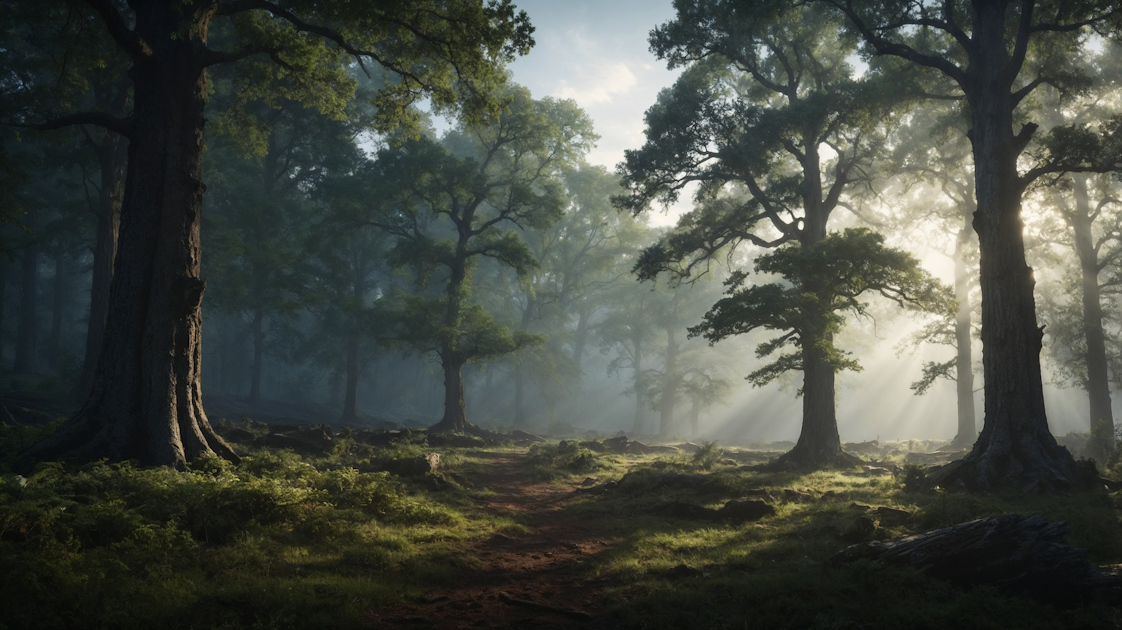
The Dormont Forest is an ancient woodland whose origins stretch back ten thousand years, to an age of great magical upheaval when primordial forces infused the land with life. Early tribes revered it as sacred, believing the gods themselves walked among its towering trees and winding streams. Over time the forest became inseparable from the legend of the Woman of the Wood — known as Ursool — once a beloved protector celebrated for her wisdom and her bond with nature, who made a fateful pact with dark forces in exchange for power and paid for it with her humanity. Transformed into something feared rather than cherished, she retreated into the depths of the forest, and her shadow has fallen across the region ever since. The towns of Bromsgrove, Easthedge, and Woodfell grew up along the forest's edges in her wake, their people cultivating the land and drawing on the forest's resources while trading whispered stories of shadows at the tree line, ghostly figures in the moonlight, and misfortunes blamed on the witch who would not leave.
Yet the Dormont Forest defies easy judgment, and so does the figure at the heart of its legend. Generations of living alongside the forest's mystery have softened the townspeople's fear into something more complicated — an understanding that Ursool may represent not malice but consequence, the price of desire unchecked and the delicate balance that nature demands of those who would bend it to their will. Healers have long harvested the forest's medicinal herbs, and protective charms woven from its wood hang in doorways across all three towns. Today scholars and adventurers are drawn to the Dormont as much as they are warned away from it, curious whether the Woman of the Wood still walks its depths as a spirit awaiting redemption or one forever lost to the choice she made long ago.
Read more about the Dormont Forest.
Eriatic Channel
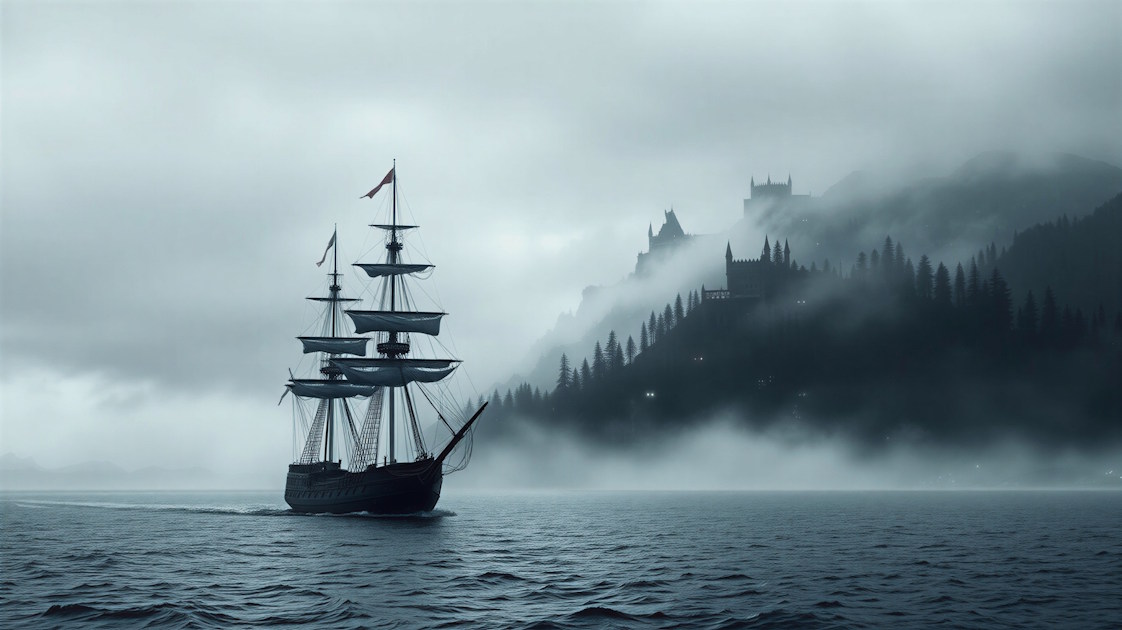
The Eriatic Channel is the stretch of open water separating Oslo, the Isle of the King, from the western coast of the mainland, running between the Seacean shoreline to the east and the outer face of the island to the west. During the Age of the Old Gods, the channel was one of the most traveled waterways in the known world. Royal vessels crossed it in constant rotation, carrying lords and envoys to and from Sarradin Keep, while merchant ships laden with goods from every province of Darshavon crowded its approaches. Navigational waypoints along the Seacean coast and the watchtowers at Vael Morin on Oslo's northeastern shore served as guides through its currents and tides, reducing what could be a treacherous crossing to a matter of routine for experienced crews. The channel was so thoroughly integrated into the rhythm of the One Kingdom that it was thought of less as a natural barrier than as a kind of road—the last leg of the journey to the center of the civilized world.
The Fall of the Old Gods emptied Oslo and stilled the channel in a single catastrophic stroke. Where fleets once moved freely across its waters, the Eriatic Channel became something else entirely: a boundary between the known world and a place that had turned its back on the living. Today, the channel falls under the naval authority of Seacea, whose warships patrol its length and exercise de facto control over all maritime approaches to the island. Sailors who pass through its lanes speak of unnatural fogs rolling off the Oslo shore without warning, of lights moving through the Thornwall Forest on moonless nights, and of an oppressive stillness that descends over vessels that drift too close to the island's coast. Whether these accounts reflect genuine phenomena or the accumulated superstitions of generations, the practical effect is the same: the Eriatic Channel is the moat no one crosses willingly, and the grey-peaked silhouette of the Greycloak Mountains rising beyond it remains one of the most haunting sights in all of Uhl.
The Great Thirst

The Great Thirst stretches across the heart of the Southern Reaches in an expanse of rolling dunes that humbles every traveler who attempts to cross it — a sea of sand so vast that its far edges vanish into haze long before the horizon appears. For most of recorded history, it has served the Southern Reaches better as a barrier than any wall or army could: the logistical demands of moving a fighting force through hundreds of miles of waterless desert have consistently defeated northern ambitions for conquest, leaving the communities on its far side to develop along their own lines, on their own terms. The Great Thirst does not merely discourage invasion; it makes it prohibitively expensive in lives and provisions, and the desert has no interest in negotiating those terms. Crossing it safely requires expert guides who can read the subtle signs of shifting dunes, locate hidden water sources by the behavior of insects or the faint discoloration of sand, and recognize the atmospheric conditions that precede a sandstorm before the sky gives any obvious indication one is coming. Zahra the Sandreader, the most celebrated figure in Southern Reaches history, built her early reputation — and ultimately her entire trading empire — on precisely this knowledge.
The desert's dangers have not prevented commerce; they have shaped it. Caravan routes thread the Great Thirst along paths established over centuries, their courses adjusted seasonally as dune formations shift and water sources fluctuate, each waypoint a closely guarded piece of knowledge passed between guide families like an inheritance. The communities clustered at the desert's edges and at the precious oases that interrupt its interior have grown prosperous not despite their isolation but because of it — the same inhospitable terrain that discourages armies also limits competition, giving Southern Reaches merchants near-exclusive control over the exotic goods flowing north toward the Four Fiefdoms. The Great Thirst demands everything from those who live beside it: resourcefulness, patience, and an intimate understanding of a landscape that punishes inattention without warning. What it offers in return is a degree of independence that more temperate lands have never known.
Grey Hills
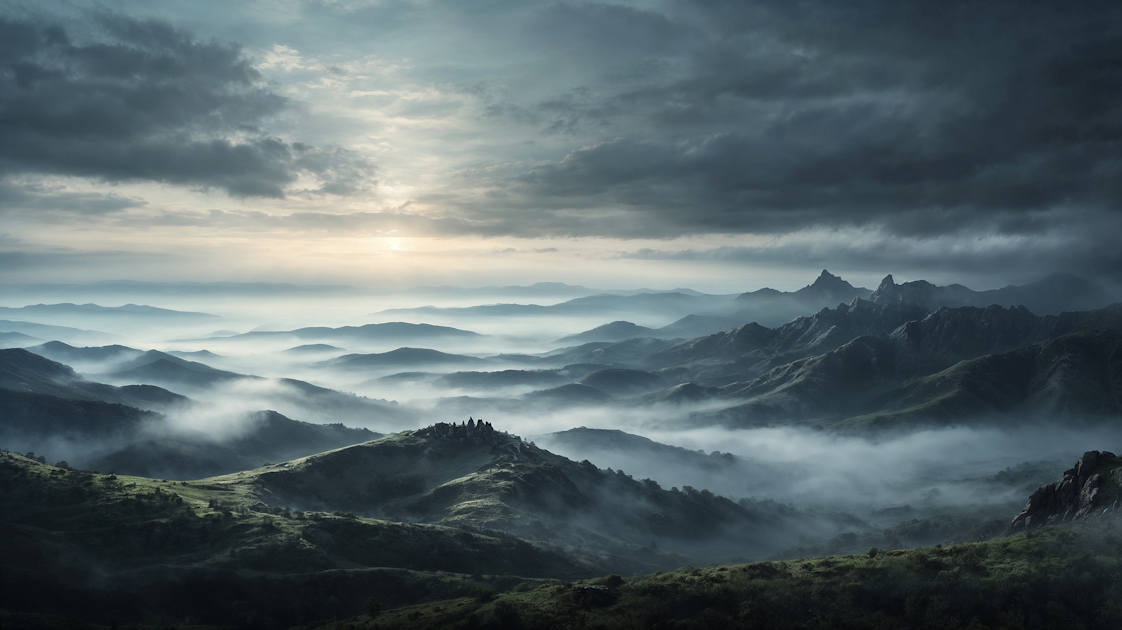
The Grey Hills are a region of ancient, rocky terrain shrouded in mist, their brooding atmosphere born of geological upheaval so old it predates recorded history. Long before the Fall of the Old Gods, indigenous tribes revered these hills as sacred ground, erecting shrines in the sheltered dells to honor the spirits of nature — chief among them the Wind Spirit, believed to wander the fog-draped heights and whisper wisdom to those willing to listen. That reverence gave way to bloodshed as factions warred for control of the hills over subsequent centuries, and the legends of heroes tested and broken in those battles became as much a part of the landscape as the stones themselves. When the Barony of Fallmere was established during the Age of Change, its knights took up patrols through the hills to guard against threats from the south, but their presence did little to dispel the growing reputation for strangeness — if anything, their own accounts of ghostly figures walking the heights at night only deepened it.
Today, the Grey Hills carry an aura of dread as much as beauty. Unexplained disappearances, the haunting echoes of ancient battles drifting through the ravines, and spectral figures glimpsed in the thickening fog have made these hills a place most travelers prefer to skirt rather than cross. That same eeriness draws adventurers and treasure hunters in spite of every warning, lured by the promise of shrines, ruins, and relics half-buried beneath centuries of creeping mist. Whatever secrets the hills conceal, the fog guards them jealously, and the Wind Spirit — if it still walks here — has not yet seen fit to reveal them.
Learn more about the Grey Hills.
Grimmere Swamp
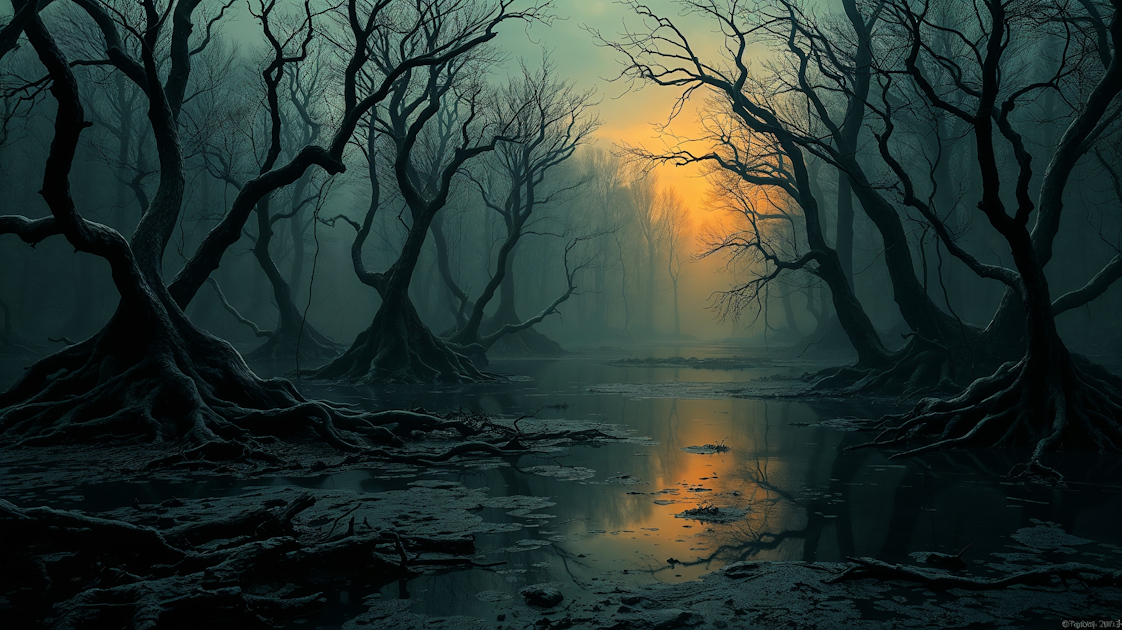
The Grimmere, known to outsiders as Death's Head Swamp, is a vast and treacherous wetland stretching across the lowlands between the eslar kingdom of Panthora and the Shadow Downs to the north, the Freelands to the west, the Hollow Hills to the south, and the Alderden Mountains to the east. Comparable in size to the Blackwood Forest, it dominates its corner of the continent as an impenetrable morass of stagnant waterways, quickbogs, and dense thickets of gray swamp trees whose tangled canopies trap heat and moisture in an atmosphere so oppressively humid that even seasoned travelers find themselves gasping for breath within minutes of entering its borders. Two rivers feed its sprawling interior: the Rotwater, which descends from the Shadow Downs through a series of silted channels before losing itself in the wetlands, and the Mireborn, which winds northward from the Hollow Hills carrying the mineral-rich runoff that gives portions of the swamp its characteristic brackish, iron-tinged waters. Venomous serpents, disease-carrying insects, and predators both natural and unnatural thrive in conditions that remain deadly to most other living things. The swamp's grim reputation is well earned.
Beneath the murk and mist lie the ruins of Il'kell, an ancient empyrean city that flourished thousands of years before the Age of the Old Gods, when the land was fertile and the climate hospitable. The slow transformation of the region into swampland claimed both the city and the civilization that built it, and what remains is considered sacred ground by the sitheri, the fierce serpentine race that has claimed the Grimmere as its homeland for millennia. The sitheri are the undisputed masters of the swamp, organized into ten territorial broods, each led by a brood mother who commands absolute authority over her tribe and each holding a distinct region — from the ink-black springs of the Blackwater Reaches to the iron-red channels of the Crimson Marshes and the flooded cave systems of the Abyssal Reaches far below. Their perpetual warfare with one another has prevented any single brood from achieving lasting dominance, yet their collective presence ensures that the Grimmere remains one of the most dangerous and inaccessible regions in all of Uhl.
Read more about the Grimmere Swamp.
Hollow Hills
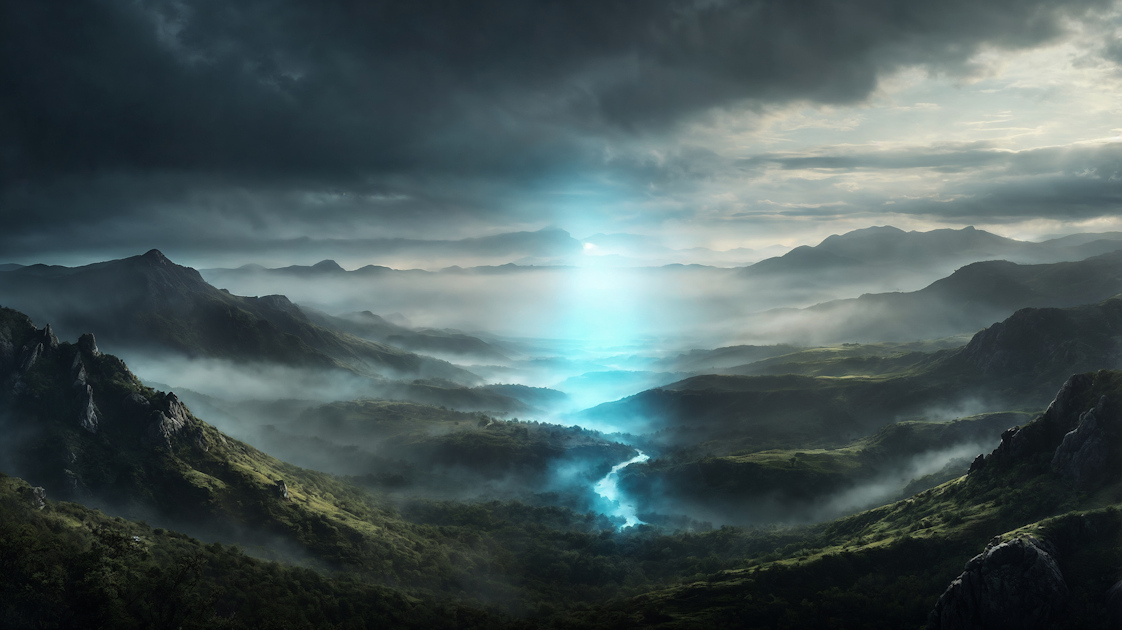
Rising from the eastern reaches of the Freelands like the arched backs of sleeping giants, the Hollow Hills stretch across a broad swath of terrain between the Freelands proper and the distant Grimmere Swamp. At first glance, they appear unremarkable—a series of low, rounded hills blanketed in pale grass that ripples in the wind and dense stands of white-barked trees whose leaves never seem to change color regardless of the season. A persistent mist clings to the valleys between them, never fully burning off even on the clearest summer mornings, as though the hills exhale it from somewhere deep within the earth. Travelers who have skirted their edges report hearing voices on the wind—not quite words, but almost—and seeing lights drifting between the hilltops at night that extinguish the moment anyone draws near. The hills are riddled with openings, some no wider than a man's shoulders, others broad enough to admit a cart, and every one of them descends into a darkness that no torch has ever fully illuminated. What the hills are hollow with, no one living can say with certainty.
The few who have ventured into the hills and returned—fewer by far than those who entered—tell contradictory stories that agree on only a handful of details: the mist thickens the deeper one travels, sounds become unreliable and echo from directions that make no sense, and familiar landmarks rearrange themselves with no apparent cause. Some survivors speak of companions who walked beside them one moment and were simply absent the next, leaving no footprints, no cry, no sign of struggle. Others describe pale shapes glimpsed through the fog, figures that move with the fluid grace of the living but cast no shadow and leave no impression in the soft earth, shapes that watch from a distance and never approach but never depart either. Scholars in Kallendor have debated whether these are the spirits of those who entered and were lost, or something older and stranger that inhabited the hills long before any living race set foot in Uhl. The Freelanders who dwell nearest the hills offer no theories. They simply do not go there, and they do not need a reason beyond the hills themselves.
Merrow Woods
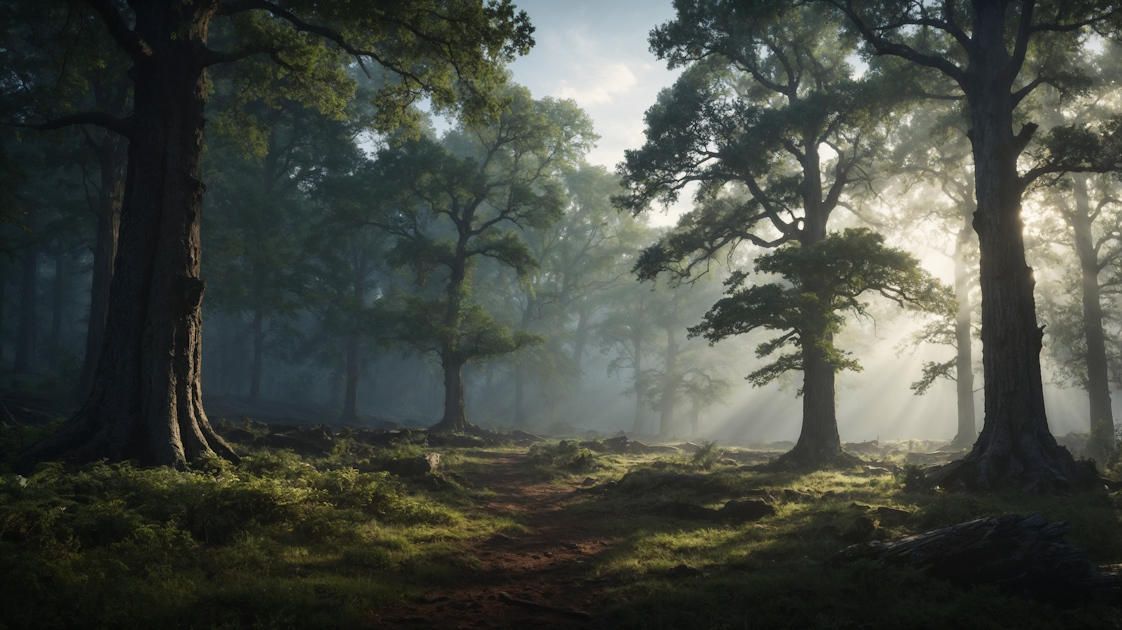
The Merrow Woods is the largest forest in all of Uhl, a vast expanse of ancient woodland stretching hundreds of miles across the continent's interior. Bordered by the Vernesse Steppes to the west, the Blasted Land and Shadow Downs to the south, the eslar kingdom of Panthora to the east, and the Ugull Mountains to the north, the forest dominates the landscape between these disparate regions like a green sea unto itself. Its towering canopy, formed primarily of massive blackwood oaks, rises in some places to heights exceeding two hundred feet, creating an elevated world of interlocking branches and dense foliage that blocks much of the sunlight from reaching the forest floor. Beneath that canopy, the woodland teems with life both mundane and dangerous. Numerous streams, rivers, and natural springs thread through the undergrowth, sustaining an ecosystem as rich as it is perilous, for the deeper reaches of the Merrow Woods harbor creatures that have kept even the most seasoned hunters and explorers at bay for centuries, wendigos among them.
The forest's sheer scale and the dangers lurking within its depths have made it a natural barrier between the civilizations surrounding it. Few roads penetrate its interior, and those that do are seldom traveled without considerable armed escort. The krill, a reclusive bipedal feline race organized into six fiercely independent tribes, have claimed the Merrow Woods as their homeland for millennia, building their civilization among the highest reaches of the canopy where other races cannot easily follow. Their presence, combined with the forest's predatory wildlife and trackless interior, ensures that the Merrow Woods remains one of the most inaccessible and least understood regions of Uhl, a place where the ancient world endures largely untouched by the advancing age.
Miradathia Sea
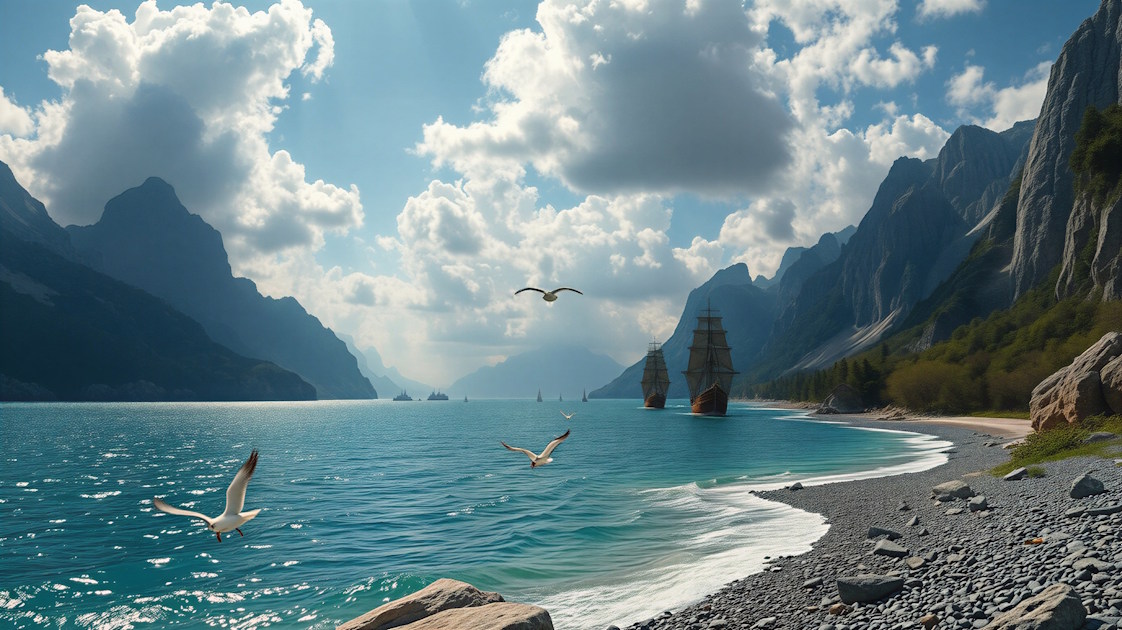
The Miradathia Sea stretches along Panthora's eastern coast, a vast body of water that has shaped eslar civilization as profoundly as any mountain range or forest. Its waters connect the sheltered harbors of Tithiel Bay to the wider maritime world, carrying merchant vessels laden with Panthoran innovations outward and returning with the raw materials and exotic goods the eslar cannot produce within their own borders. The Ugull Mountains descend to meet its northern shores, while the coastline curves southward past the mouth of Tithiel Bay and onward toward the distant waters beyond. For the eslar, the sea represents their primary gateway to the outside world, a vital counterbalance to the hostile overland routes blocked by the krill-patrolled Merrow Woods to the west, the sitheri-infested Grimmere Swamp to the south, and the haunted Dead Lands to the north.
The Argalos Isles rise from the Miradathia's waters near the mouth of Tithiel Bay, an archipelago now firmly under Panthoran rule though it was once independent. The isles have become integral to the kingdom's economy, their sugar cane plantations, distilleries, fishing fleets, and shipbuilding yards supplying goods and vessels that sustain trade across the sea. Beyond the isles, the Miradathia's open waters serve as the highway along which eslar trader-diplomats maintain their carefully controlled commercial relationships with the Four Fiefdoms and other distant peoples. Fishing vessels work the coastal shallows and deeper waters alike, harvesting the marine bounty that features prominently in Panthoran cuisine, while Panthoran naval patrols ensure the sea lanes remain safe for the commerce upon which much of the kingdom's prosperity depends. For all the eslar's reputation as a reclusive people hemmed in by dangerous borders, the Miradathia Sea has always offered them a path outward—one they have navigated with the same precision and care they bring to everything else.
Simmaron Woods
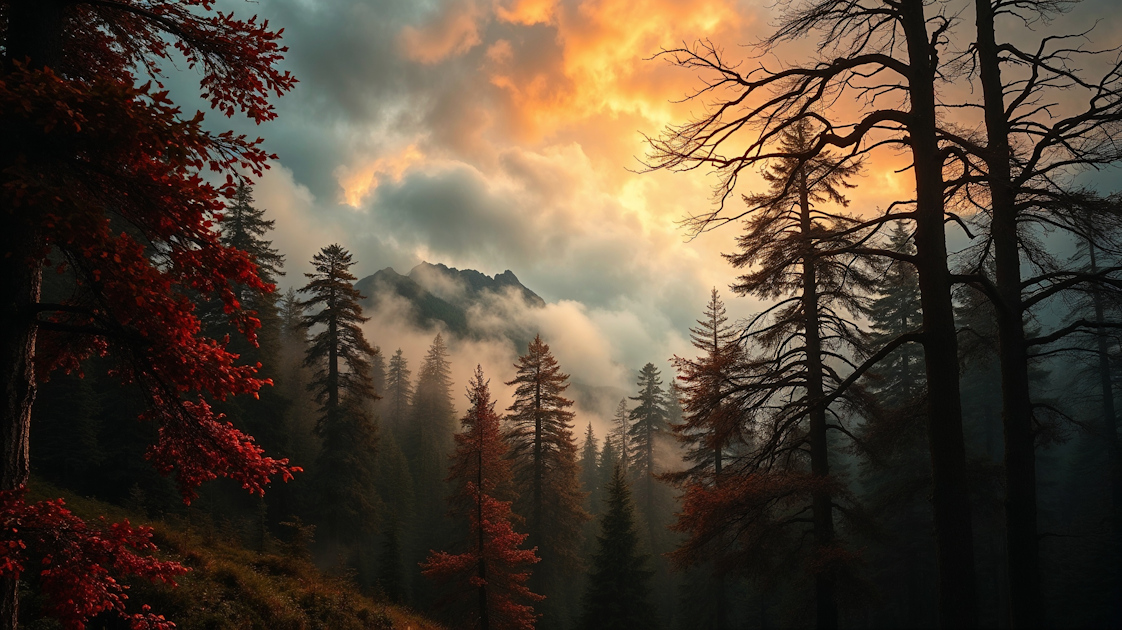
The Simmaron Woods is an ancient forest nestled between the Ugull Mountains to the north and east, with the settlement of Homewood marking its southern edge. Long before the Fall of the Old Gods, the dryads of Sollin-kel sang the forest into being, weaving enchantments deep into root and stone and establishing a fey court where the barriers between worlds grow thin. The druid Delbin Kinkaed, one of the last great servants of the old order, made his home within these woods, forming a bond with the dryads and helping to ward a place of deep corruption in the forest's northern reaches known as the Cavern of the Well. When the Fall came, and the gods destroyed themselves, Delbin and his order vanished from the mortal realm, leaving behind only their wards, their sacred groves, and the enduring magic woven into the forest itself. The survivors who sought refuge in the Woods' shadow eventually founded Homewood, inheriting, by necessity, the role of protectors that the druids had left behind.
It is the Simmaron Hall of the Wood, however, that stands as the Simmaron's most steadfast guardian. This ancient institution, one of only two great Halls to survive the Fall, has trained generations of patrollers in the arts of woodcraft, forest diplomacy, and the defense of wild places. For centuries, the Woods enjoyed a fragile peace, but that peace was shattered twenty years ago when a cunning goblin lord named Gral united the fractured mountain tribes, rebuilt the fortress of Greth high in the Ugull Mountains, and turned his ambitions southward toward the Simmaron — and toward the dark power that still stirs within the Cavern of the Well. Today, the patrollers of the Hall face an enemy of uncommon cunning, the forest's ancient magic flows without the guidance of its vanished creators, and the Woods stand as both a sanctuary and a fortress under siege.
Learn more about the Simmaron Woods.
Sunspear Mountains
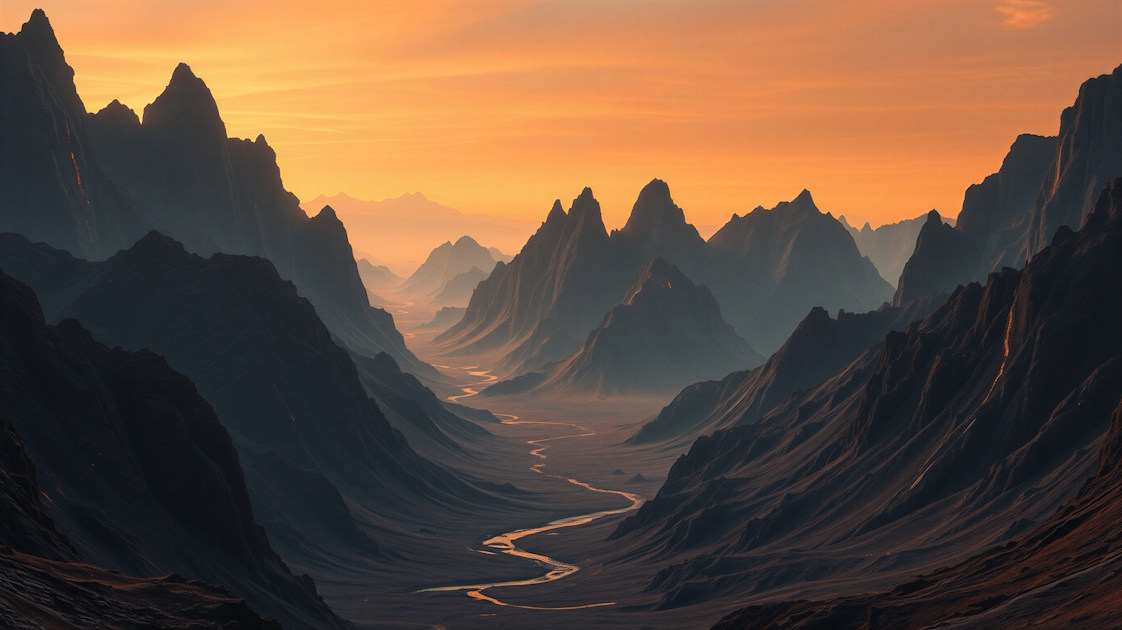
The Sunspear Mountains rise along the eastern edge of the Southern Reaches, a jagged spine of sun-blasted rock whose peaks catch the light at dawn and dusk in ways that give the range its name — shafts of amber and copper blazing across the stone as if the mountains themselves burn from within. Ancient in ways even the oldest records struggle to account for, the Sunspears long predate the settlements that grew up in their shadow, and the range's peculiar geology — volcanic in origin, streaked with mineral deposits found nowhere else on Uhl — has drawn prospectors, engineers, and fortune-seekers for generations. Precious metals run deep in the rock, but it is the unusual crystalline formations the locals call sunstone that define the mountains' true value. These translucent amber crystals, formed under conditions unique to the Sunspears' superheated geology, serve as the essential material component in sunforge metallurgy, a technique developed by the peoples of the Southern Reaches to produce blades and tools of remarkable edge retention and heat resistance.
Despite their wealth, the Sunspears are inhospitable terrain, and the settlements clinging to their lower slopes are hardy, spare places built by people accustomed to hardship. The high passes, navigable only during narrow windows between the scorching summer months and the bitter highland winters, channel nearly all overland trade through a handful of chokepoints, giving those who control them disproportionate economic and political influence over the broader region. The mountains also intercept what little moisture drifts east across the Great Thirst, and the rare microenvironments sheltered in their upper valleys — where thin soil and sparse vegetation somehow sustain life against all expectation — are jealously guarded by those who know where to find them. Travelers crossing the Sunspears without a local guide rarely emerge on the other side.
Tithiel Bay
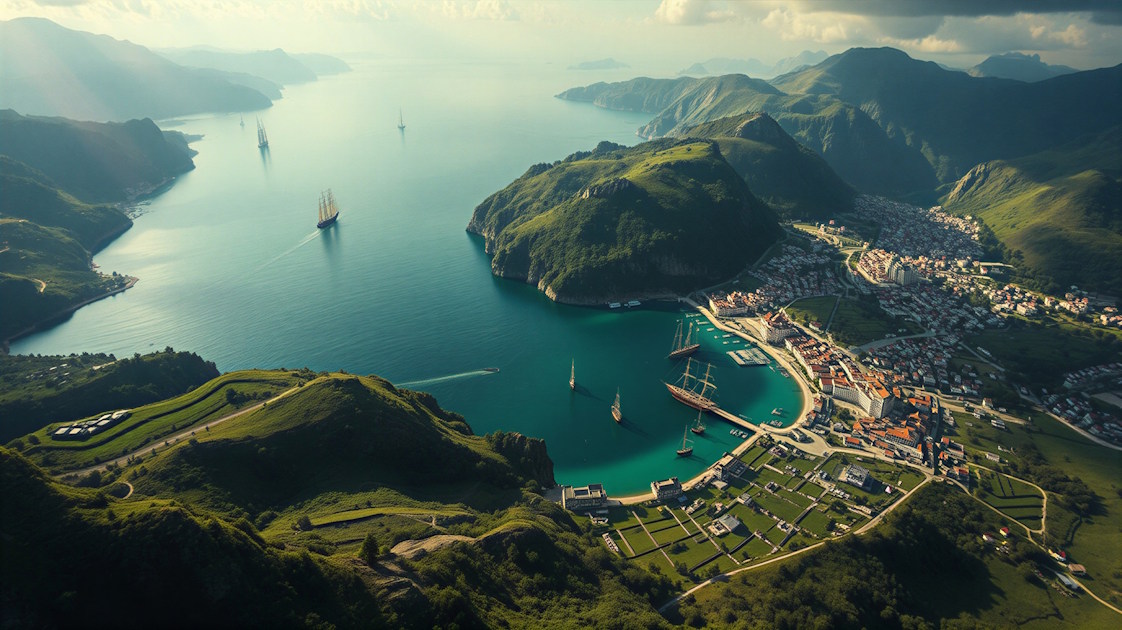
Tithiel Bay is a long, narrow body of water that cuts deep into the heart of Panthora, its shoreline wrapped on all sides by eslar lands before opening eastward into the vast Miradathia Sea. The bay serves as the commercial lifeblood of the eslar kingdom, its waters busy with merchant vessels, fishing boats, and coastal traders moving goods between the dozens of cities, towns, and settlements that dot its extensive shores. Amon Ive, the largest eslar city on the bay, commands the western shoreline, where it functions as a major port and center of commerce serving the communities of that coast. Across the water on the bay's eastern shore, smaller cities and towns handle the steady flow of trade destined for Isia, the eslar capital, which sits on the opposite side of the bay from Amon Ive. Much of Panthora's internal commerce follows this pattern, with goods arriving by sea and dispersing through the eastern settlements before making the overland journey to the capital.
Peldin Ive, another significant city, lies near the bay's southern shore, set slightly inland but close enough to benefit from the maritime trade that defines the region. Beyond the bay's mouth, the Argalos Isles rise from the Miradathia Sea. Once independent, the isles are now part of Panthora and have become vital to the kingdom's economy, producing sugar cane and distilled spirits while supporting robust fishing fleets and shipbuilding yards that supply vessels to merchants and the Panthoran navy alike. Together, the bay and its surrounding settlements form the economic engine of the eslar nation, a thriving network of harbors and trade routes sustained by the same spirit of industry and innovation for which the eslar are renowned throughout Uhl.
Ugull Mountains
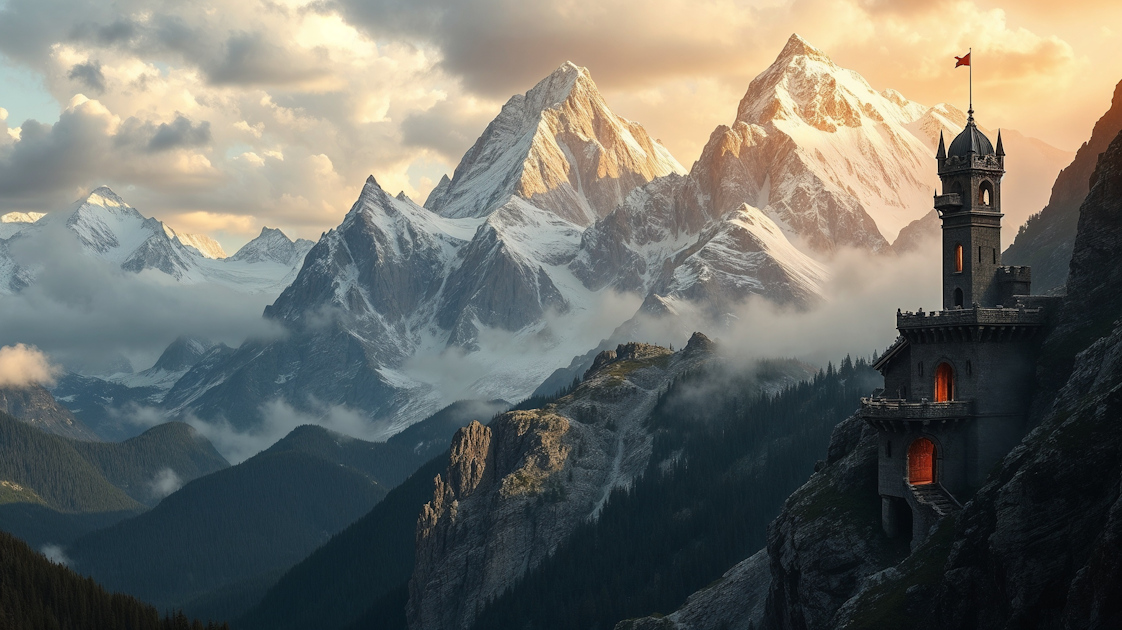
The Ugull Mountains stand as one of Uhl's most formidable geographic barriers, a towering range of jagged peaks, treacherous passes, and windswept heights that have shaped the history of civilizations for millennia. Stretching from the depths of the Simmaron Woods in the west to the shores of the Miradathia Sea in the east, with the Merrow Woods marking their southern boundary, the Ugulls have long served as both sanctuary and fortress for those daring enough to call these unforgiving heights home. Within the range dwell two of Uhl's most distinctive peoples: the dwarves, who have carved magnificent strongholds into the living rock at Brokken-Tor and Dwathenmoore, and the goblins, whose ancient fortresses of Mount Kroom and Greth command strategic positions throughout the range. The mountains are a place of extremes, where bitter winds scream across barren slopes, hidden valleys shelter unexpected beauty, and the thin mountain air carries the weight of countless ages. For travelers, merchants, and patrollers who must cross the Ugulls, the journey is never taken lightly. The passes become impassable with the first heavy snowfall, and even in summer, the trail demands respect. Those who venture into these heights must contend not only with the elements but with the ever-present threat of goblin raids and the isolationist tendencies of the dwarven thanes who guard their territories jealously. The ruins of Eagle's Nest, once a proud watchtower from the Age of the Old Gods, still offer shelter to those who brave the crossing, a reminder that others have walked these dangerous heights before and that the mountains have indifferently outlasted them all.
Learn more about the Ugull Mountains.