BLACKWOOD FOREST
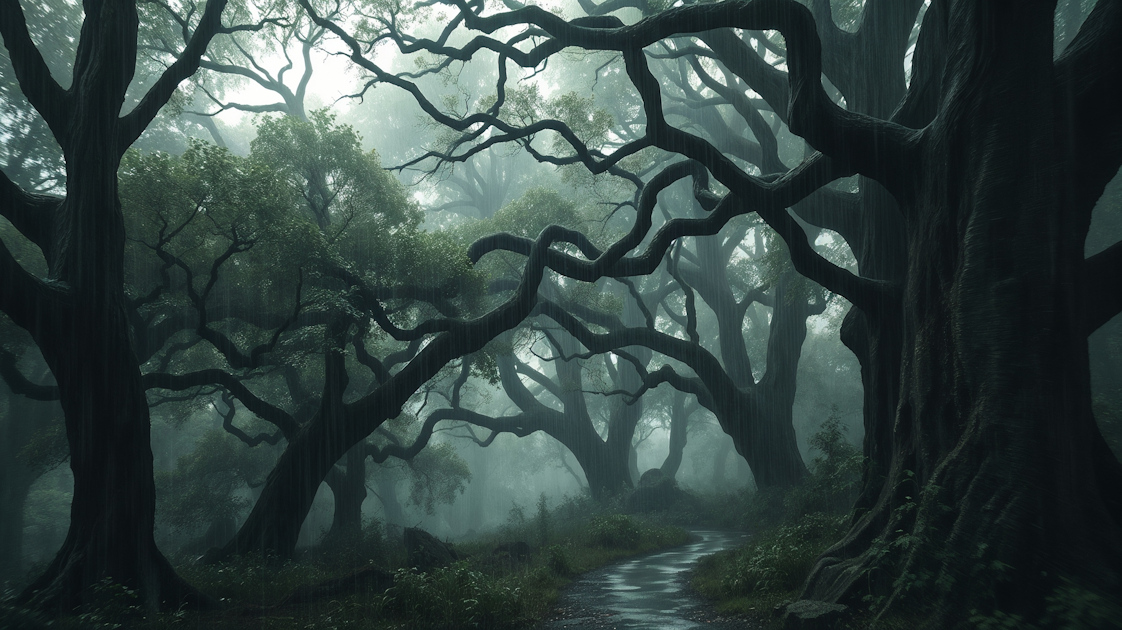
The Blackwood Forest is one of the great woodlands of the Freelands, a vast expanse of ancient oaks that stretches across the region surrounding High Holt. Smaller than the Dormont Forest to the south and the Merrow Woods to the east, the Blackwood nonetheless dominates the landscape for leagues in every direction, its majestic canopy broken only by the clearings where settlements, mercenary encampments, and trade routes have carved out space among the trees. The forest takes its name from the dark bark of its oldest oaks, which absorb light rather than reflect it, giving the deeper reaches of the woodland a perpetual twilight even at midday.
The Blackwood's origins predate human settlement in the region by millennia. During the Age of the Old Gods, the forest served as a natural boundary between the frontier territories of the Kingdom of Darshavon and the wilder lands beyond. Indigenous peoples regarded it as a place of passage rather than habitation, using its trails to move between hunting grounds but rarely lingering beneath its canopy after dark. When the Fall of the Old Gods shattered the kingdom and drove refugees eastward into what would become the Freelands, the Blackwood's dense growth and defensible terrain made it a natural refuge for those seeking shelter from the chaos that followed.
The founding of High Holt at the forest's heart transformed the Blackwood from wilderness into a working landscape. Over the centuries, the settlement's growth created a layered relationship with the surrounding woodland. The inner reaches nearest the town were cleared for farmland and the lordly estates that crown the surrounding hills. Beyond the farms, the forest provides timber, game, and the natural resources that sustain both the permanent population and the mercenary companies that camp among its clearings. The Blackwood's oaks yield strong, dense wood favored by the smiths and carpenters who serve the mercenary trade, and its trails connect High Holt to the broader network of Freelands settlements and trade routes.
Despite centuries of human habitation, the Blackwood retains its wild character. Bandits use the forest's depth and density to prey on travelers and trade caravans, ensuring steady employment for the mercenary companies that patrol its roads. Deeper in, where the canopy closes overhead and the undergrowth thickens, the forest harbors creatures and dangers that keep even seasoned woodsmen alert. Swallows dart between the trees in swift, irregular patterns, and the interplay of sunlight filtering through the canopy creates shifting corridors of light and shadow that can disorient the unwary. Clearings large enough to accommodate airship landings have become increasingly valuable as traffic from the Four Fiefdoms and beyond brings visitors to the region with growing frequency.
The mercenary encampment that sprawls through the Blackwood's clearings outside High Holt's walls has become one of the forest's most distinctive features. What began as temporary bivouacs has evolved into a semi-permanent settlement in its own right, with canvas and timber structures nestled between the oaks, cooking fires burning among the roots, and the sound of hammers on steel ringing from Smith's Row at all hours. The camp's population rises and falls with the demand for hired swords, but its presence has become as much a part of the Blackwood's character as the ancient trees themselves.
Today, the Blackwood Forest continues to define life in and around High Holt. Its resources sustain the settlement's economy, its depths provide both danger and opportunity, and its vast canopy shelters a way of life that has persisted for centuries. Loggers from nearby towns like Wynham work the forest's edges, trappers and boatmen from the rivers and Lake Holten pass through its trails, and the lords of High Holt look out from their hilltop manors across a sea of green that has outlasted every dynasty, every conflict, and every ambition that has played out beneath its branches. The Blackwood endures, as it always has, indifferent to the schemes of those who shelter within it.