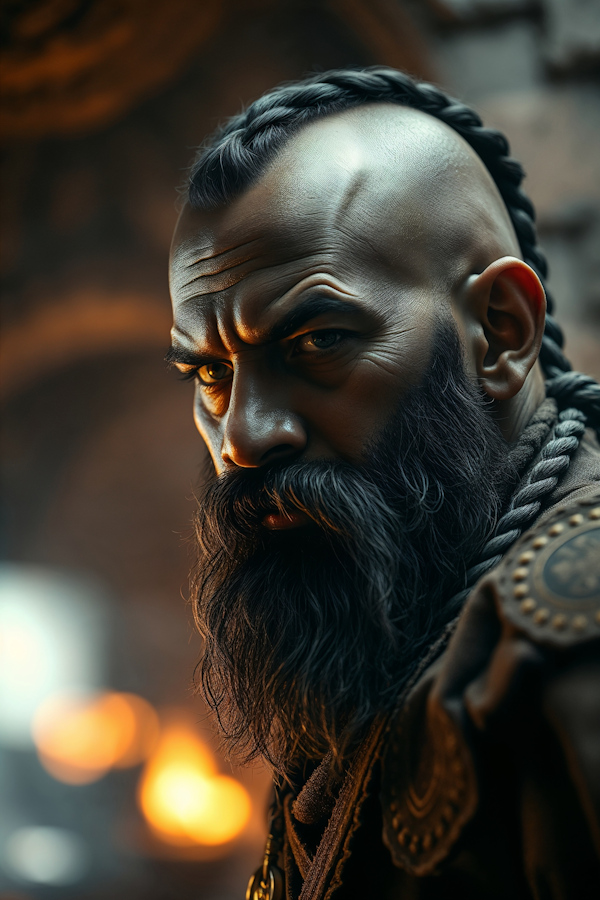
Borin Deepdelver has spent more of his life in the dark than in the light, and he prefers it that way. The Thane of Dwathenmoore is a dwarf of the deep places — born in the lower halls where the stone radiates heat from the earth's own core, raised in tunnels whose silence is broken only by the groan of shifting rock, and shaped by an environment so extreme that it produces either the hardiest dwarves in Uhl or no dwarves at all. Borin is the former. He has never been anything else. The surface world, with its shifting weather and its open sky and its endless noise, holds no appeal for a dwarf who grew up knowing that the most important things in the world are found not above the mountains but miles beneath them.
He earned his seat through the oldest and most straightforward path that dwarven culture recognizes: he proved himself. Not through political maneuvering or hereditary claim or the accumulation of wealth, but through decades of service in the Deep Guard that built a reputation for valor, sound judgment, and the kind of unshakable reliability that matters more in Dwathenmoore's extremes than cleverness or charisma ever could. Borin fought in the tunnels where the deepest passages push into regions of heat and pressure that test even dwarven endurance. He led expeditions into the unmapped reaches below the fortress's lowest levels, where geological hazards and the strange creatures that inhabit the lightless depths make every step forward a calculated risk. He brought his people back alive from situations that should have killed them, not through brilliance but through the stubborn refusal to accept outcomes that a more imaginative dwarf might have recognized as inevitable. When the elder council convened to select a new thane after his predecessor's death, the discussion was brief. Borin's name was the first raised and the last challenged. No one who had served alongside him could argue that the Deepest Halls deserved a steadier hand.
His appearance tells the story of where he comes from. He is darker in complexion than most dwarves — a trait common among the deep-dwelling families of Dwathenmoore, where generations of life in the geothermal heat have produced skin tones closer to deep bronze than the ruddy pink typical of surface-adjacent communities. His beard is black, streaked heavily with iron gray, worn in a single thick braid that hangs to his chest without ornamentation. He does not decorate his beard. He does not decorate anything. Borin's personal effects are functional to the point of austerity — well-maintained armor, weapons whose quality speaks for itself without embellishment, clothing suited to the heat of the lower halls, where lighter fabrics and minimal layers are practical necessities rather than stylistic choices. His hands are enormous even by dwarven standards, scarred across the knuckles and palms from decades of work with stone and steel in conditions where even the handles of tools can burn unwary flesh. His eyes, dark and deep-set beneath a heavy brow, carry the permanent squint of a dwarf who has spent most of his life reading his environment through the faintest variations in heat, sound, and the feel of stone beneath his feet rather than through conventional sight.
Borin is gruff in the way that deep stone is hard — not out of hostility but because that is simply what he is. He does not make small talk. He does not soften his assessments to spare feelings. He does not repeat himself, assuming that anyone worth speaking to has heard him the first time. His council meetings are notably brief by dwarven standards, a quality his elders appreciate even when they disagree with his conclusions, because Borin considers long deliberation a luxury that the deep environment does not always permit. When a vent shifts or a tunnel wall shows signs of imminent collapse, the correct response is not discussion but action, and Borin governs with the same bias toward decisiveness that his years in the Deep Guard instilled. This does not mean he is reckless — he listens to his advisors, weighs their expertise, and changes course when evidence warrants it. But he does these things quickly, without the extended consensus-building that characterizes governance in thanes where the consequences of delay are less immediately lethal.
He was married to Kora Deepdelver, born Kora Hearthstone, a woman whose death remains the only subject on which Borin's characteristic bluntness fails him. She died during a geological event in the middle tiers — a sudden vent eruption that claimed eleven lives, including hers, when superheated steam breached a chamber wall without the warning signs that Dwathenmoore's engineers had learned to watch for. The event was not unprecedented, but its speed and the location of the breach — in a residential corridor rather than in the industrial zones where such risks are anticipated and prepared for — made it catastrophic, exposing gaps in the fortress's safety systems. Borin oversaw the engineering review that followed, implementing changes to the thermal monitoring network that have since prevented similar incidents. He does not speak of Kora often, but those who know him well recognize that the intensity he brings to matters of structural safety and geological assessment carries a personal weight that no amount of professional diligence fully explains.
Their three children — two sons and a daughter — were young when their mother died, and Borin raised them with the help of the extended clan networks that Dwathenmoore's communal culture provides. His eldest son, Garrek, serves in the Deep Guard with a physical toughness that matches his father's, though he lacks the elder Deepdelver's instinct for reading the stone and has compensated by becoming the most technically proficient combat engineer in his unit. His daughter, Maren, works in the Deep Forges as a metallurgist, drawn to the mysterious properties of the alloys produced by Dwathenmoore's extreme temperatures and determined to understand the principles underlying qualities that even the master smiths describe in terms closer to instinct than to science. His youngest son, Torvald, manages the fortress's ventilation systems — a role that sounds mundane until one understands that Dwathenmoore's survival depends entirely on the correct functioning of air circulation networks that must manage temperature differentials spanning hundreds of degrees across vertical distances measured in thousands of feet. A failure in the ventilation systems would kill more dwarves faster than any goblin army ever could, and Torvald approaches his work with a gravity that reflects this reality.
Dwathenmoore under Borin's leadership remains the most isolated of the Seven Thanes. The fortress's contact with the surface world is limited to infrequent trade missions that carry Deep Forge metals upward in exchange for the foodstuffs and surface goods that the halls cannot produce for themselves. These missions are managed efficiently and without sentiment — Borin views surface trade as a practical necessity rather than an opportunity for cultural exchange or diplomatic relationship-building. The traders who make the long journey to the surface and back are selected for their reliability and discretion, entrusted with Dwathenmoore's most valuable exports and expected to return with what the fortress needs without entangling themselves in the politics, conflicts, or curiosities of the world above. Borin has never visited the surface himself and has expressed no interest in doing so. The Four Fiefdoms, the wars of human kings, the technological innovations that other thane lords discuss with varying degrees of interest or alarm — none of it registers as relevant to a dwarf whose concerns begin and end with the stone that surrounds his people and the heat that rises from below.
This isolation is not ignorance. Borin is aware that the surface world exists and that events there sometimes affect the trade goods his fortress depends upon. But he draws a sharp distinction between awareness and involvement. Dwathenmoore has thrived for centuries by attending to its own affairs, and Borin sees no evidence that entangling his people in the complications of the wider world would produce any benefit worth the cost. The other thane lords — Vera Ironworks with her surface engineering partnerships, Thorek Skywatcher with his eslar correspondences, even Dain Frostbeard with his limited trade missions — all maintain relationships with the world above that Borin considers unnecessary at best and dangerous at worst. The deep earth provides what Dwathenmoore needs. The Deep Forges produce metals that the surface world cannot replicate. The trade is simple: metal goes up, food and supplies come down, and everyone attends to their own business. Borin has never seen a reason to complicate the arrangement.
On dwarven reunification, Borin is undecided in the specific sense that he has never heard an argument in its favor that he found compelling. He does not oppose it with the philosophical conviction that Dain Frostbeard brings to the question, nor does he resist it out of self-interest the way Vera Goldheart does. He simply does not see what Dwathenmoore would gain. The fortress is self-sufficient in everything that matters — its defenses are impregnable, its forges are unmatched, its traditions are intact, and its people lack nothing essential. What would a unified dwarven kingdom offer that Dwathenmoore does not already possess? A distant authority making decisions about a fortress it has never visited, issued by dwarves who have never felt the heat of the deep levels or navigated a thermal lock or stood watch in a tunnel where the stone itself can kill you? Borin poses these questions not rhetorically but with genuine curiosity, willing to be persuaded if anyone can provide answers that account for Dwathenmoore's unique circumstances. So far, no one has.
The challenges that occupy Borin's attention are the same ones that have occupied every thane of Dwathenmoore for centuries, and he addresses them with the pragmatic directness that defines his character. The geological hazards of deep habitation require constant monitoring and occasional intervention when the earth shifts in ways that threaten inhabited areas. The creatures of the deep — things adapted to heat and darkness that surface dwellers have never encountered — must be dealt with when they intrude upon Dwathenmoore's expanding tunnels. The Deep Forges must be maintained and their techniques preserved, passed from one generation of master smiths to the next with the precision that the work demands. The oral traditions that carry Dwathenmoore's history must be kept alive through the lore-keepers whose memories hold centuries of accumulated knowledge in forms that the written word could never adequately capture. These are not glamorous concerns. They do not make for dramatic stories at inter-thane councils. But they are the concerns that keep the Deepest Halls standing, and Borin Deepdelver attends to them with the unwavering focus of a dwarf who knows that the mountain is always testing, and that the only acceptable response is to endure.
In the deepest halls of Dwathenmoore, where the stone is warm to the touch and the silence holds a weight that dwarves from lighter places find oppressive, Borin Deepdelver governs with the authority of a leader who has earned every measure of trust his people place in him. He is not eloquent. He is not charming. He is not interested in impressing anyone, inside his fortress or out. He is a dwarf who understands his environment with an intimacy that borders on communion, who leads his people not by inspiring them with grand visions but by doing the work that needs doing with a competence so consistent that it has become invisible — noticed only in its absence, which has never occurred. The mountain tests. Borin endures. It is enough.