Durin Coalbeard the Peacemaker
Introduction
Durin Coalbeard of Brokken-tor is the only figure in dwarven legend who achieved immortal fame without ever killing anything, forging or mining anything, or defending anything from assault. He talked. He listened. He made jokes at moments when jokes should have been impossible, and the jokes worked because they were exactly the right jokes delivered at exactly the right moments by a dwarf who understood that sometimes the fastest way to defuse a confrontation between two furious people is to make both of them laugh at themselves before they can do something they will spend centuries regretting.
He never held the title of thane lord. He never commanded warriors or presided over councils of elders or wielded any formal authority beyond the personal respect that his competence earned him. Yet his influence on dwarven civilization exceeds that of most who wore those titles, because the thing he built—the Compact of Seven Hammers, the agreement that allows the seven thanes to resolve their disputes through contests of skill rather than warfare—has prevented more dwarven deaths than any army, any fortress, or any weapon in their history. Durin saved the dwarves not from goblins or cosmic catastrophe but from themselves, which the dwarves, with characteristic honesty, acknowledge was possibly the more difficult achievement.
Appearance
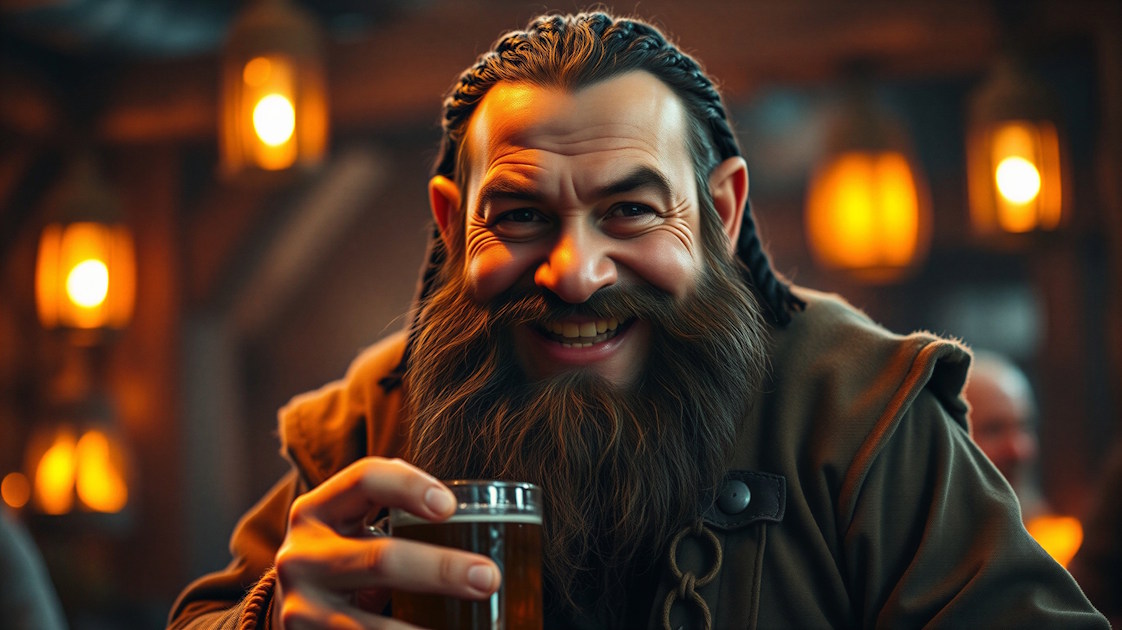
Durin was short and broadly built even by dwarven measure, standing at the sturdy middle of dwarven height, with the thick shoulders and heavy forearms of a clan that had spent generations tending charcoal fires for the fortress forges. There was nothing imposing about him; his was a comfortable, approachable solidity, the frame of a dwarf who looked as though he belonged on the near side of a shared cask rather than across a battlefield. His cheeks held the ruddy warmth common to his people, made ruddier still by an easy laugh, and his face fell naturally into the creases of a lifetime spent smiling—deep laugh-lines around eyes that were quick, warm, and perpetually on the edge of amusement, the eyes of someone already halfway to the joke that would take the heat out of a room.
His beard was the coal-black that gave his clan its name, thick and full and worn with the same unpretentious pride any dwarf takes in his beard, kept practical rather than ornate—a few simple braids, no elaborate rings or precious clasps, the beard of a working dwarf rather than a lord. Faint traces of soot and charcoal dust clung about him in a way no washing ever quite removed, the honest mark of the Coalbeard trade that he wore without a trace of embarrassment. His clothing was plain and drab in the dwarven fashion, sturdy and well-worn, chosen for comfort on the long walks between fortresses rather than for display. What people remembered of him, in the end, was not any single feature but the particular smile that accompanied everything he said—the disarming, good-humored expression of a dwarf who had never met a quarrel he could not talk his way to the far side of.
The Dwarf
Durin was born in Brokken-tor to a clan of middling reputation whose primary occupation was the production of charcoal for the fortress’s forges—essential work that placed the Coalbeards squarely in the category of useful but unglamorous contributors to dwarven civilization. The surname, which in other contexts might have carried connotations of soot and manual labor, was worn by Durin with the cheerful lack of pretension that characterized everything about him. He was not embarrassed by his origins. He was not ambitious to transcend them. He was a Coalbeard, his family made charcoal, and the forges would not burn without charcoal, and anyone who had a problem with that was welcome to discuss the matter with him over a drink, at which point Durin would explain, with patient good humor, exactly how foolish they sounded and exactly why they should stop.
His talent for persuasion manifested early and in contexts that did not suggest future greatness. He was the child who settled arguments in the workshop, the adolescent who negotiated peace between feuding apprentice groups, the young adult whose ability to articulate both sides of a dispute made him the first person sought out when clan disagreements threatened to escalate beyond the parties' capacity to resolve them. These early mediations were small in scale—arguments over workshop space, disputes about the allocation of forge time, the occasional personal grievance that had soured a working relationship—but they established the pattern that would define his career: Durin listened until he understood, he spoke until both parties felt understood, and he proposed solutions that gave each side enough of what it wanted to make concession on the remainder acceptable.
His humor was the instrument that made his diplomacy possible. Dwarven culture values directness, and direct confrontation between proud individuals defending positions they have publicly committed to is a recipe for escalation that no amount of logical argument can prevent, because the argument is no longer about the issue but about the humiliation of being seen to yield. Durin understood this dynamic with the intuitive clarity of someone who had grown up watching it operate in every workshop and clan hall in Brokken-tor, and he understood that the only way to break the cycle was to change the emotional temperature of the room before the parties locked into positions from which retreat would cost them face. His jokes did this. They were never cruel, never directed at either party’s expense exclusively, and always precisely calibrated to the absurdity of the situation rather than the character of the people in it. He made disputants laugh at the dispute, and once they were laughing, they were no longer defending positions. They were solving problems. The transition happened so smoothly that participants often did not realize they had been managed until the agreement was reached and they found themselves wondering how they had arrived at a compromise they would have rejected an hour earlier.
The Crisis
The crisis that elevated Durin from a respected local mediator to a figure of civilizational significance began, as most dwarven crises do, with ore. A rich vein of iron had been discovered in the mountains between Brokken-tor and Dwathenmoore, running through a region where the territorial boundaries between the two thanes had never been precisely defined because the area had previously contained nothing worth disputing. The discovery changed the calculation instantly. Both thanes claimed the vein, citing historical precedents that supported each position with roughly equal legitimacy, and neither was willing to concede because the iron deposits were substantial enough to affect the economic balance between the two fortresses for generations.
The dispute might have been contained between Brokken-tor and Dwathenmoore if not for its implications for the other thanes. Heidelheim, which traded with both parties and whose territorial boundaries were similarly ambiguous, recognized that whatever precedent the dispute established would affect its own claims. Merkinjel saw an opportunity to strengthen its negotiating position by supporting whichever side offered better trade terms in exchange for political backing. Rillock and Akenraen-tor, though geographically distant from the contested region, understood that a conflict between two Ugull Mountain thanes could disrupt trade routes that affected all seven fortresses. What had started as a bilateral resource dispute was rapidly becoming a multilateral crisis that threatened the entire system of inter-thane relations.
The situation deteriorated when warriors from both Brokken-tor and Dwathenmoore began patrolling the disputed area, establishing competing claims by physically occupying territory that neither had previously bothered to garrison. The patrols encountered each other with increasing frequency, and the encounters grew progressively more tense as the warriors involved recognized that their professional reputations and clan honor were bound up in the positions they had been sent to defend. No blows had yet been struck, but the conditions for violence were assembling themselves with the methodical inevitability that the dwarves associated with geological processes—slow, seemingly manageable, and catastrophic once the threshold was crossed.
The prospect of inter-thane warfare was almost unthinkable. The dwarves had not fought each other since before the establishment of the seven thanes, and the cultural prohibition against fratricidal conflict was deeply embedded in their identity. But the prohibition operated through custom rather than law, and customs can be overridden when the stakes are high enough and the parties involved have committed themselves too publicly to retreat without losing the respect of their communities. The thane lords of Brokken-tor and Dwathenmoore were both honorable dwarves who genuinely did not want war. They were also leaders who could not be seen to yield without consequence, and the gap between those two realities was narrowing daily.
Durin was not the obvious choice for a mediator. He held no rank that entitled him to involve himself in inter-thane disputes. He had no experience in diplomacy at the level the crisis required. He was a charcoal maker’s son from Brokken-tor, which meant that Dwathenmoore had every reason to view him as a partisan rather than a neutral party. His qualifications consisted entirely of a reputation for settling arguments in workshops and a sense of humor that his fellow Brokken-tor dwarves found alternately delightful and exasperating. That these qualifications proved sufficient to prevent a war says something about the nature of the crisis, something about the limitations of more conventional approaches to resolving it, and a great deal about Durin Coalbeard.
He began by traveling to Dwathenmoore alone, without authorization from his own thane lord, carrying nothing but a cask of Brokken-tor’s finest ale and the observation that two fortresses preparing for war over a vein of iron they had both ignored for centuries might want to consider the possibility that they were being ridiculous. The observation was not received warmly. Dwathenmoore’s council of elders, who had spent weeks building their case for territorial sovereignty over the disputed region, did not appreciate being told that their grievance was absurd by a charcoal maker from the other side. Durin listened to their objections with the patient attention that was his primary professional tool, acknowledged every point they made with genuine respect for the reasoning behind it, and then asked a single question that reframed the entire discussion: “If this vein had been discovered a hundred yards further into your territory, would you be preparing for war with Brokken-tor over the principle of the thing, or would you be mining it and selling the iron?”
The question did not resolve the dispute. It was not intended to. It was intended to shift the elders’ thinking from the defense of a position to the assessment of a problem, and it succeeded because the answer was obvious and because Durin delivered it without the smugness that would have made his audience defensive. He was not scoring points. He was genuinely trying to help, and the Dwathenmoore elders, who were shrewd enough to recognize sincerity even when it arrived in the form of unsolicited advice from a foreigner, allowed themselves to engage with his question rather than dismissing the questioner.
From Dwathenmoore, Durin traveled to each of the other thanes, conducting similar conversations with their leadership, listening to each community’s concerns, identifying the specific interests that each party needed the resolution to address, and building, through dozens of individual meetings, a comprehensive understanding of what a solution would need to look like to be acceptable to all seven fortresses. The process took months. Durin walked between the thanes through mountain passes and underground tunnels, carrying messages, testing proposals, and refining his understanding of the problem with each conversation. He was frequently told that his efforts were futile. He responded to this assessment with the cheerful agreement that it might very well be futile and that he intended to continue regardless, because the alternative was watching the dwarves do something stupid and he found that prospect more objectionable than wasted effort.
The Compact of Seven Hammers
The Compact of Seven Hammers is Durin’s masterwork—an agreement that solved not just the immediate crisis but the underlying structural problem that had produced it. The Compact established protocols for resolving disputes between thanes through contests of skill rather than warfare, creating a system that channeled competitive instincts into productive rather than destructive channels and that provided mechanisms for achieving resolution without requiring either party to suffer the humiliation of capitulation.
The system was elegant in its simplicity. When two thanes disagreed on a matter that their own negotiations could not resolve, each would select its finest craftsman in a discipline relevant to the dispute. The craftsmen would compete in a formal contest judged by masters from the uninvolved thanes, and the outcome would determine the resolution. A dispute over mining rights might be settled by a contest between the two thanes’ best smiths, each producing a piece from ore drawn from the disputed deposit, with the quality of the finished work determining which thane’s claim was recognized. A dispute over trade routes might be resolved by a contest of engineering, with each thane designing and constructing a mechanism that demonstrated superior capability for the logistical challenge at hand.
The genius of the system lay not in the contests themselves but in what the contests replaced. Under the Compact, the energy that would have been directed toward preparing for war was instead directed toward producing the finest possible craftsmanship, because the outcome of the dispute depended on the quality of the work rather than the size of the army. The competitive instinct that had been driving the thanes toward conflict was not suppressed but redirected, channeled into a form that strengthened dwarven civilization rather than tearing it apart. Each contest pushed both sides to exceed their previous standards, and the results—masterworks produced under the pressure of inter-thane rivalry—became treasured additions to the thanes’ collections, tangible proof that competition serves the dwarves best when it produces excellence rather than casualties.
The Compact also addressed the problem that had made the original crisis so dangerous: the absence of mechanisms for resolving disputes without loss of face. Under the Compact, the losing party in a contest had not been defeated. They had been outperformed, which in dwarven culture carries no shame—every smith knows the experience of encountering work that surpasses his own, and the proper response is admiration rather than humiliation. By reframing dispute resolution as a contest of craftsmanship rather than a contest of arms, Durin had created a system in which losing was not merely tolerable but educational, providing the losing party with a clear standard to surpass in future competitions and a motivation to improve that warfare could never provide.
Legacy & Enduring Influence
The Compact of Seven Hammers has governed inter-thane relations for centuries, surviving changes in leadership, shifts in economic conditions, and evolving threats to dwarven civilization. It has been invoked dozens of times to resolve disputes that might otherwise have escalated into conflicts, and it has never failed to produce a resolution that both parties accepted—not because the outcomes were always perfectly satisfactory to the losing side, but because the process itself was so fundamentally fair and so deeply aligned with dwarven values that rejecting its verdict would have been more damaging to a thane’s reputation than accepting an unfavorable result.
The saying “seek Durin’s wisdom” has entered the dwarven vocabulary as an exhortation to seek solutions that serve everyone’s interests rather than forcing zero-sum outcomes. The phrase is used in contexts ranging from inter-thane diplomacy to family disputes, always carrying the implication that the speaker believes a mutually beneficial solution exists and that finding it requires the same qualities Durin demonstrated: patience, empathy, the willingness to listen longer than is comfortable, and the humor to remind everyone involved that the alternative to agreement is usually something far more ridiculous than any compromise could be.
Durin’s legacy extends beyond the Compact itself to the broader principle it embodies: that competition between the thanes should produce excellence rather than destruction. The inter-thane craft competitions that the Compact formalized have become one of the most important cultural institutions in dwarven society, events that maintain friendly rivalry between the fortresses while ensuring that all thanes continue pushing the boundaries of their crafts. Heidelheim’s gem-cutters compete against Merkinjel’s weapon-smiths. Rillock’s naval fittings are measured against Dwathenmoore’s mining equipment. Brokken-tor’s mechanical innovations are evaluated alongside Akenraen-tor’s precision instruments. The competitions serve multiple purposes—establishing relative status, maintaining standards, identifying the next generation of masters—but their fundamental purpose is the one Durin designed them for: ensuring that dwarven energy goes into creating masterworks rather than destroying each other.
Concluding Remarks
Durin Coalbeard never held the position of thane lord. He never commanded an army, defended a fortress, or produced a masterwork of craftsmanship that could be displayed in a hall of honor. What he produced was an agreement, written in the air between seven stubborn people who had been preparing to hurt each other, and the agreement has outlasted every weapon forged and every fortress built during the centuries since he brokered it. He saved the dwarves from the one enemy their walls could not keep out—themselves—and he did it with the only tools a charcoal maker’s son from Brokken-tor had available: a sharp mind, a patient ear, and the conviction, delivered with the particular smile that the dwarves who knew him remembered long after they had forgotten more dramatic things, that any problem created by stubborn people could be solved by someone willing to be more stubborn than they were, as long as that person had a better sense of humor.
The Compact holds. The contests continue. And somewhere in the oral tradition of every thane, the memory of a dwarf who walked between the fortresses with nothing but a cask of ale and a good question persists as proof that wisdom, properly applied, is worth more than any army, and that the dwarf who can make two angry rivals laugh at themselves before they do something they will regret has done more for his people than any warrior who ever held a line or any smith who ever swung a hammer. Seek Durin’s wisdom. The dwarves have been seeking it for centuries, and they have never once been disappointed by what they found.