EDMUND HALE DUNCASTLE
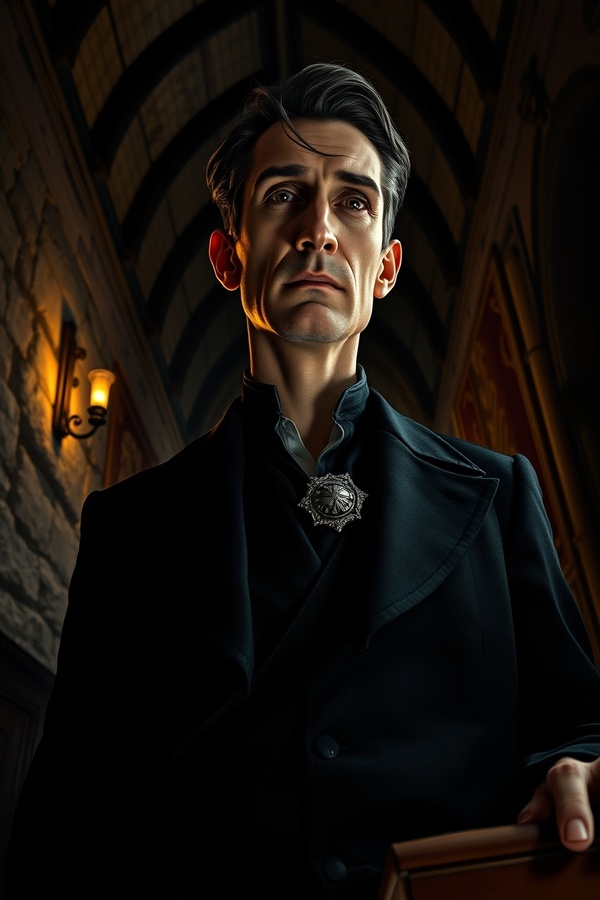
Edmund Hale Duncastle was born into one of Kallendor's oldest noble families, a house whose influence predated the formal establishment of the fiefdom itself. The Duncastles had served as advisors, diplomats, and confidants to Kallendor's rulers for as long as anyone could remember, their estate in the rolling countryside east of Alchester a fixture of the landscape as enduring as the Vernesse Steppes themselves. Edmund's father held a seat on the Ducal Council. His grandfather had served in the same capacity before him. The family's wealth derived not from trade or industry but from land, political connections, and an institutional memory that stretched back generations—a treasury of favors owed, secrets kept, and alliances maintained through the careful cultivation of trust and dependency.
Young Edmund received the education expected of a Duncastle heir: private tutors in history, languages, and diplomacy, followed by study at Alchester's most prestigious institutions alongside the sons and daughters of the fiefdom's ruling class. He excelled without apparent effort, a quality that endeared him to his instructors and infuriated his peers in equal measure. Those who knew him during those years recalled a quiet, watchful boy who listened far more than he spoke and who seemed to understand the currents of social power with an instinct that bordered on preternatural. He made friends selectively, choosing companions not for their warmth or humor but for their families' positions and their potential usefulness. Even as a young man, Edmund treated relationships as instruments rather than indulgences.
His entry into government service surprised no one, though the path he chose raised eyebrows among his own family. Rather than claiming a seat on the Ducal Council as his birthright entitled him, Edmund sought appointment to the Duke's Office of Foreign Intelligence, a shadowy branch of the government that most Kallendorians knew existed only through rumor. The office handled matters that fell outside the purview of conventional diplomacy—the gathering of intelligence from rival fiefdoms, the management of informants and agents abroad, and the quiet resolution of threats that could not be addressed through official channels. It was unglamorous work by noble standards, conducted far from the public ceremonies and political theater that defined the lives of most aristocrats. Edmund's father considered it beneath the family name. Edmund considered it the only position in Kallendor worth holding.
He proved extraordinarily capable. Within a few years of his appointment, Edmund had reorganized the office's network of informants across the Four Fiefdoms, replacing a patchwork of unreliable contacts with a structured intelligence apparatus that delivered actionable information with unprecedented speed and accuracy. He recruited agents from every level of society—merchants, sailors, servants, scholars—understanding that the most valuable intelligence rarely came from those who moved in powerful circles but from those who moved invisibly around them. His methods were methodical, his patience inexhaustible, and his willingness to employ coercion when persuasion failed became well known among those unfortunate enough to find themselves on the wrong side of his attention.
When Duke Classus Thelindor assumed power, Edmund recognized immediately that the young duke's ambitious vision for Kallendor would require an intelligence apparatus far more sophisticated than anything his predecessors had maintained. Classus was transforming the fiefdom through technological innovation and aggressive diplomacy, initiatives that generated both admiration and resentment among Kallendor's neighbors. The other fiefdoms watched Alchester's rise with a mixture of envy and suspicion, and Classus needed someone who could monitor those reactions, anticipate threats, and ensure that the kingdom's enemies—both foreign and domestic—never gained enough advantage to undermine his plans. Edmund positioned himself as that someone, and the duke, recognizing the spymaster's value, elevated him to the title of Lord and granted him authority that placed him second only to the duke himself in matters of security and intelligence.
As Lord Duncastle, Edmund built an intelligence network whose reach extended into every guild, every garrison, and every back alley in Alchester—and far beyond the city's walls. His agents operated in Vranna, Anolga, and Seacea, embedded within foreign courts and merchant houses, feeding information back to Alchester through channels so carefully concealed that even Kallendor's own diplomats remained unaware of their existence. He maintained contacts among the goblin tribes, the dwarven thanes, and the merchants who traded in the Freelands, ensuring that no development of significance occurred anywhere in the known world without word reaching his desk. The phrase "eyes in every shadow" became associated with his office, a reputation he cultivated deliberately, understanding that the perception of omniscience served his purposes almost as effectively as actual omniscience.
His relationship with Duke Classus is built on mutual utility rather than personal affection. The duke values Duncastle's intelligence and his ability to resolve problems that conventional authorities cannot address. Duncastle, in turn, values the autonomy the duke grants him—a latitude that permits him to operate with minimal oversight and maximum discretion. The arrangement serves both men well, though it requires a degree of trust that neither extends lightly. Classus understands that his spymaster keeps secrets, some of which may never be shared. Duncastle understands that the duke's patience, while considerable, has limits that are unwise to test.
Lord Duncastle carries himself with the calculated casualness of a man who has nothing to prove and everything under control. His lean frame and angular features give him a hawkish appearance, softened only by the faint, knowing smile he wears when others believe they have surprised him. His manner is unfailingly polite, his speech precise, and his patience seemingly infinite—qualities that make him a formidable negotiator and a deeply unsettling adversary. Those who mistake his courtesy for weakness learn otherwise only once, as Lord Duncastle does not offer second lessons. He operates with absolute conviction that the security of Kallendor justifies the methods required to maintain it, a philosophy that has served the fiefdom well but leaves little room for the concerns of individuals caught in the machinery of his designs.
Whether Edmund Hale Duncastle serves as Kallendor's greatest protector or its most dangerous liability depends largely on whom one asks and how much that person knows. His allies consider him indispensable. His enemies, those few who recognize him as such before it is too late, consider him something far worse. Lord Duncastle himself would likely find either characterization amusing, offering that thin smile and a polite deflection before returning to the work that occupies him—work that, by its very nature, will never be fully understood by those it is designed to protect.