Gareth Ironhand, the First Independent
Introduction
Gareth Ironhand is the founder of Freelander independence—the man who called the great gathering, spoke the Oath, and proved through the defense of High Holt that a people who refuse to kneel can stand against anything that tries to make them. He is not a mythological figure whose deeds have been inflated beyond recognition by centuries of retelling. He was a soldier—a former commander in Darshavon’s armies who fought the last wars of a dying kingdom, watched his king and his gods destroy each other, and decided in the wreckage that he would rather build something new than spend the rest of his life serving the next ambitious fool who claimed the right to rule by inheritance or divine mandate.
The Freelands exist because Gareth Ironhand stood up at a gathering of desperate, angry, leaderless people and said something no one in the eastern territories had thought to say aloud: that the problem was not which king to serve but whether to serve a king at all. The words he spoke that day—“let us be free or dead, but never again slaves to false promises of security”—became the Oath of Independence, and the Oath became the foundation of a civilization that has endured for over five hundred years without a crown, a throne, or a single individual whose authority extends beyond what their competence has earned them. Gareth did not merely reject the old order. He articulated a replacement, one that is still working to this day. That is his legacy.
Appearance
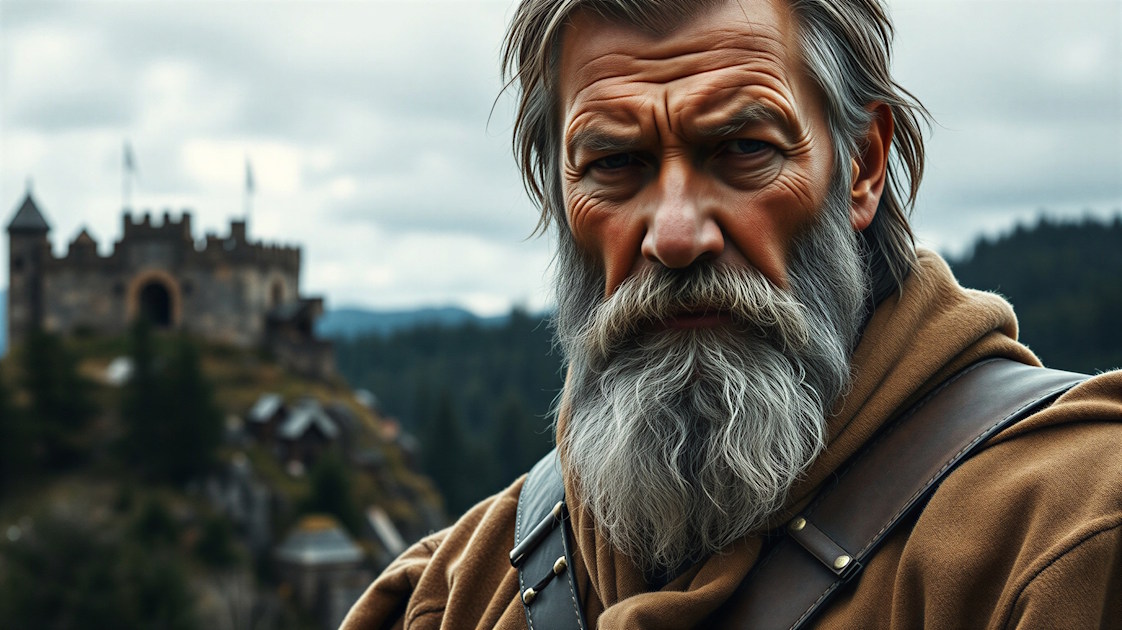
Gareth carried himself with the plain, unhurried bearing of a man who had spent his life in the field rather than the court—solidly built and broad through the shoulders, with the durable, weathered strength of a career soldier who had endured decades of frontier campaigning and hard living where the border met the wild lands. He was tall enough to be seen at the back of a crowded hall but made no use of the fact, standing among the representatives at the great gathering as one of them rather than above them. His face was seamed and wind-burned, tanned to leather by years under an open sky, and the scars he bore he wore without display, the ordinary marks of a man who had held a line more than once and did not consider the fact worth mentioning.
By the time the Freelands took shape, he was already past his prime years, his hair and short-cropped beard gone iron-grey, and he aged into a spare, upright old age that never diminished his presence because his authority had never rested on physical strength in the first place. What people remembered was the eyes—steady, level, and unhurried, with the cold, assessing patience of a commander who had learned to measure a situation before committing to it. He dressed simply and practically to the end of his life, in the sturdy, unadorned garb of the frontier rather than anything resembling the regalia of the kings he had refused, wearing no crown, no chain of office, and no ornament that would have marked him as anything other than the first among free equals that he insisted on remaining.
The Soldier
Gareth was a career military officer in the armies of Darshavon, the great kingdom that had ruled the known world under the authority of the High King and the Old Gods whose power sustained both the throne and the civilization it governed. He served with distinction through the final years of the kingdom’s existence, commanding units in the eastern territories where the frontier met the wild lands and where the soldiers who kept the border spent more time fighting goblins, krill raiders, and the harsh conditions of the hinterlands than they did enjoying the benefits of the civilization they were supposedly protecting.
The eastern garrisons were Darshavon’s forgotten soldiers. The court at Oslo, preoccupied with the divine politics that consumed the kingdom’s final decades, allocated minimal resources to the frontier, sending reinforcements that arrived late, supplies that arrived spoiled, and orders that arrived irrelevant to conditions that the officers who issued them had never seen and could not be bothered to understand. Gareth and his soldiers learned to operate without support, developing the self-reliance and practical resourcefulness that would later characterize the entire Freelander civilization. They also learned something more corrosive: contempt for the authority that claimed their loyalty while providing nothing in return. A soldier who watches his men die because the kingdom that demanded their service could not be troubled to send them adequate equipment develops opinions about the value of distant authority that no amount of patriotic rhetoric can undo.
The Three Great Wars drove the lesson home with the finality of a headsman’s axe. Gareth’s units were deployed in support of divine campaigns whose strategic objectives were incomprehensible to the mortal soldiers who bled for them. His men fought and died for gods who treated them as expendable material, in battles whose outcomes had been determined by celestial calculations that placed no value on the human lives consumed in the execution. Gareth obeyed his orders because he was a soldier and because the alternative was execution for desertion, but the obedience was mechanical, devoid of the conviction that transforms duty into commitment. He served. He survived. And he watched, with the cold attention of a man assembling a case against an employer, as the system that demanded his service failed every test of competence, justice, and basic decency that a soldier has the right to apply to the authority sending him to die.
When the Fall of the Old Gods killed the gods, destroyed the High King, and shattered the kingdom of Darshavon in a single cosmic convulsion, Gareth felt something that surprised him: relief. The authority he had served was gone. The obligation that had bound him was dissolved. The chain of command that had sent his men to die for incomprehensible purposes had been severed at every link simultaneously, and for the first time in his adult life, Gareth Ironhand was free to decide for himself what his service meant and to whom he owed it. The answer he arrived at was simple, radical, and permanent: himself. His men. The communities that had sheltered and supported them when the kingdom would not. And no one else, ever again.
The Refusal
The years immediately following the Fall were a time of chaos, as nobles, warlords, and opportunists emerged from the wreckage of Darshavon to stake their claims on the pieces. In the eastern territories, this took the form of emissaries arriving from self-proclaimed western kingdoms, demanding oaths of fealty from communities that had barely survived the cataclysm and were in no position to resist armed demands. Some communities submitted, reasoning that any authority was better than the anarchy that threatened to consume them. Others resisted and were crushed, their defiance serving as examples to discourage further dissent.
Gareth refused. He did not submit, and he was not crushed, because the refusal he offered was not the desperate resistance of a community acting alone but the coordinated defiance of a network of settlements that had spent years learning to operate without central authority and that recognized, in Gareth’s articulation of what they had all been feeling, the philosophical framework for what they had already been doing. They did not need a king. They had been governing themselves—defending their own borders, managing their own resources, resolving their own disputes—for years while the kingdom that claimed sovereignty over them rotted from within. The arrival of new claimants to that sovereignty did not solve their problems. It was a repetition of the problem that had caused their problems in the first place.
Gareth spent the years between the Fall and the great gathering traveling the eastern territories, visiting communities, talking to leaders, and building the consensus that would make the Oath of Independence possible. He was not recruiting followers. He was not assembling an army. He was doing something more difficult and more important: he was helping people who had independently arrived at the same conclusion articulate that conclusion in terms that could serve as the foundation for a shared identity. The eastern communities did not need to be convinced that independence was preferable to submission. They needed to be shown that independence could be organized, that cooperation without subordination was possible, and that a refusal to serve distant masters did not require a descent into the chaos that the would-be kings were using as their primary argument for submission.
The Gathering at High Holt
The great gathering of Year 23 was the moment when individual refusal became a collective principle. Representatives from dozens of settlements across the eastern territories traveled to the site that would become High Holt—then a modest fortification built around a natural defensive position near the Blackwood Forest—to coordinate their response to the increasing pressure from western kingdoms demanding their submission. The representatives included village elders, militia commanders, successful merchants, craftsmen, and a significant number of former soldiers like Gareth himself who had served the old kingdom and had no intention of serving a new one.
Gareth’s speech at the gathering is preserved in oral tradition and recounted at every anniversary of the Oath. The Freelanders do not treat the speech as sacred text—that would be too close to the reverence for authority they reject—but they maintain it with the accuracy of people who understand that the words matter because they describe a decision whose consequences are still being lived. Gareth did not deliver a rousing call to arms or a passionate denunciation of tyranny. He delivered an argument—a calm, systematic case for why the communities of the eastern territories should refuse to submit to any external authority and instead organize themselves around principles of earned leadership, personal sovereignty, and voluntary cooperation.
The argument was practical rather than ideological. Gareth did not appeal to abstract concepts of liberty or natural rights. He appealed to experience—the shared experience of communities that had been failed by every authority they had trusted, that had learned to govern themselves out of necessity, and that now faced the choice between submitting to new masters who offered the same promises the old masters had broken and continuing on the path they had already proven they could walk. The eastern territories had survived the Fall without a king. They had defended themselves without a king’s army. They had fed themselves without a king’s granaries. They had resolved their disputes without the king’s courts. What, exactly, did a king offer them that they could not provide for themselves?
The Oath of Independence was sworn collectively, every representative speaking the words that Gareth had composed: “Never again shall we kneel to king or god, for both have proven to be the source of endless war and suffering.” The oath was followed by Gareth’s personal declaration—“let us be free or dead, but never again slaves to false promises of security”—which the Freelanders adopted as the defining expression of their civilization’s founding principle. The gathering concluded with the establishment of the first agreements for mutual defense, trade cooperation, and dispute resolution that would evolve over centuries into the Merchant Compact and the Code of Personal Sovereignty.
The Defense of High Holt
The Oath of Independence was a statement of principle. The defense of High Holt proved that the principle could survive contact with reality. The first serious test came when a would-be king—a former Darshavon noble who had assembled a substantial army from the remnants of the old kingdom’s military—marched east to bring the rebellious territories to heel. He expected easy victory. He was accustomed to commanding professional soldiers, he possessed superior numbers and equipment, and he assumed that a collection of farmers, merchants, and frontier militia could not withstand a proper military campaign. He was wrong on every count, and Gareth Ironhand was the reason.
Gareth organized the defense of High Holt with the professional competence of a career military officer and the improvisational creativity of a man who had spent years making do with inadequate resources. He understood that his defenders could not match the invading army in open battle, and he did not attempt to. Instead, he used High Holt’s natural defensive advantages—its elevated position, its proximity to the Blackwood Forest, the rugged terrain that channeled approaching forces into predictable routes—to negate the invader’s numerical superiority. He positioned his militia forces where their knowledge of the local terrain gave them advantages that professional soldiers from the flatlands could not overcome. He organized the civilian population into support roles that kept the defenders supplied and the fortifications maintained. And he demonstrated, for the first time in the Freelands’ brief history, what a community of free people could accomplish when they fought not because they were ordered to but because they were defending something they had chosen for themselves.
The invading army broke against High Holt’s defenses over the course of a campaign that lasted weeks but that was decided in its opening days, when the would-be king discovered that the “rabble” he had expected to scatter at the sight of professional soldiers fought with a ferocity and cohesion that his intelligence had completely failed to predict. Gareth’s defenders did not merely hold their positions. They counterattacked, using their knowledge of the surrounding terrain to strike at supply lines, harass the invader's flanking forces, and deny him the set-piece engagement his tactical training had prepared him for. The would-be king had prepared for a conquest. He had not prepared for a war against an entire population that considered its freedom worth dying for, and the distinction proved decisive.
The invader withdrew. Other would-be conquerors studied the result and adjusted their ambitions accordingly. High Holt’s defense established the military reality that would protect Freelander independence for centuries: the Freelands could not be conquered at any cost that a rational commander would accept, because every settlement would fight with the same determination that High Holt had demonstrated, and the decentralized structure of Freelander society meant that capturing any single stronghold accomplished nothing strategically. There was no capital to seize, no king to defeat, no center of gravity whose fall would bring the entire region under control. The Freelands were, by design, unconquerable—not because they were militarily superior to the kingdoms that might try, but because the cost of conquest exceeded any conceivable benefit.
Legacy & Enduring Influence
Gareth lived to the age of seventy-three, long enough to see the Freelands established on foundations that would endure without him. He spent his final decades at High Holt, which grew under his influence from a modest frontier fortification into the fortress-city that it remains today. He did not rule High Holt. He did not take the title of king or lord or any designation that would have contradicted the principles he had articulated at the gathering. He served as an advisor, a mediator, and an example—a man whose authority derived entirely from the respect his competence had earned and whose influence waned not at all as his body aged because the influence had never depended on physical strength in the first place.
The principles he articulated at the great gathering—earned authority, personal sovereignty, mutual cooperation without subordination—became the philosophical foundation for a civilization that has outlasted every kingdom founded in the same period. The Four Fiefdoms, which emerged from Darshavon’s ashes around the same time the Freelands took shape, have weathered dynasties, civil wars, and periodic crises of succession that the Freelands’ decentralized structure would make impossible. The Freelanders attribute this stability—or, more accurately, this productive instability that prevents catastrophic failure—to the soundness of Gareth’s original design: a system that distributes power broadly enough that no single failure can bring the whole structure down and that replaces leaders through constant competition rather than waiting for crises that might not produce suitable replacements.
His military legacy endures in the Freelanders’ approach to defense: the conviction that a free people fighting for something they have chosen is more formidable than any professional army fighting because it has been ordered to. This conviction is not merely inspirational rhetoric. It is a doctrine, tested at High Holt and validated by every subsequent attempt to bring the Freelands under external control. The doctrine does not claim that free fighters are individually superior to professional soldiers. It claims that the motivation of defending one’s own freedom, combined with the tactical advantages of fighting on home ground with the support of an entire population, creates a defensive capability that conventional military analysis consistently underestimates. Gareth proved it once. The Freelands have been proving it ever since.
The Oath of Independence is renewed each year at the anniversary gathering in High Holt, spoken by representatives from across the Freelands in the same words that Gareth composed over five centuries ago. The renewal is not a ceremony. It is a recommitment—a collective decision, made annually, to continue the experiment that Gareth began. The Freelanders understand that independence is not a condition achieved once and maintained automatically. It is a choice, made every day, by every individual who decides that the burdens of freedom are preferable to the comforts of submission. Gareth made that choice first. The Freelanders have been making it ever since.
Concluding Remarks
Gareth Ironhand was a soldier who stopped being a soldier and became something the world had not seen before: a man who built a nation on the principle that nations do not require kings. The idea was not original to him—the eastern communities had been governing themselves without royal authority for years before the gathering at High Holt. What Gareth provided was not the idea but the articulation, the organization, and the proof. He gave scattered communities a shared vocabulary for what they had independently discovered. He gave isolated acts of self-governance a framework that connected them into a coherent system. And he gave the first would-be conqueror who tested the system a defeat thorough enough to discourage the rest.
He died at seventy-three, in the fortress he had defended and the civilization he had founded, having never held a title higher than the one the Freelanders gave him informally, which he accepted with the same pragmatic lack of ceremony that characterized everything about him: the First Independent. Not the first king. Not the first lord. The first man who said no and built something from the refusal that was worth more than what he had refused. The Freelands are that something, and they remain standing, and the Oath he composed is still spoken every year by people who mean every word of it, because the words describe a choice that has been proven correct by five centuries of a civilization that was told it could not exist and that has existed anyway, stubbornly, imperfectly, and free.