GHURAT THE BONE-READER
Overview
Ghurat is a haurek shaman who has spent the better part of a long life studying what most goblins prefer to leave alone: death magic, necromantic artifacts, and the histories of those who wielded them. Born into one of Gugal’s lesser blood clans during the early decades of the Age of Advancement, he showed an aptitude for the spirit arts that the clan’s witch mothers recognized early and encouraged in their own fashion—which is to say they gave him access to the oldest bones in the clan’s reliquary and left him to make sense of them on his own.
He did. What Ghurat lacked in physical prowess, he compensated for with an insatiable hunger for knowledge and a patience uncommon among his kind. While other young haureks trained for raids and clan politics, Ghurat spent his days in the deepest archives of Gugal, poring over carved tablets, salvaged manuscripts, and artifacts recovered from goblin expeditions stretching back centuries. His particular fascination—the necromantic traditions of the eslar and the relics those traditions produced—earned him a reputation as both an invaluable resource and a deeply unsettling presence. The Triumvirate has consulted him on matters touching the undead and the arcane on more than one occasion, though they have never done so publicly, and Ghurat has never sought credit for his counsel.
His title, the Bone-Reader, refers to both his divinatory practices—he reads omens in the cracks and coloration of burned bones, a traditional haurek method he has refined into something approaching a precise art—and his broader expertise in the remains of the dead, whether those remains are physical, magical, or historical. To Ghurat, bones tell stories. The bones of the recently fallen speak of how they died. The bones of the ancient dead speak of how they lived. And the artifacts crafted from death magic speak of ambitions so vast and terrible that even the passage of centuries has not dulled their edge.
He lives alone in a chamber near the border between haurek territory and the imp warrens—a location no one else wants, which suits him perfectly. The solitude allows him to work without interruption, and the proximity to the deeper tunnels gives him access to materials and specimens that rarely surface in the more populated districts. Visitors are infrequent and seldom welcome, though Ghurat will tolerate those who come bearing genuine questions. He has no patience for the idle, the foolish, or the insincere, and his manner of dismissing those who waste his time has become the subject of stories told in Gugal’s market stalls—stories that grow more elaborate with each retelling.
Appearance
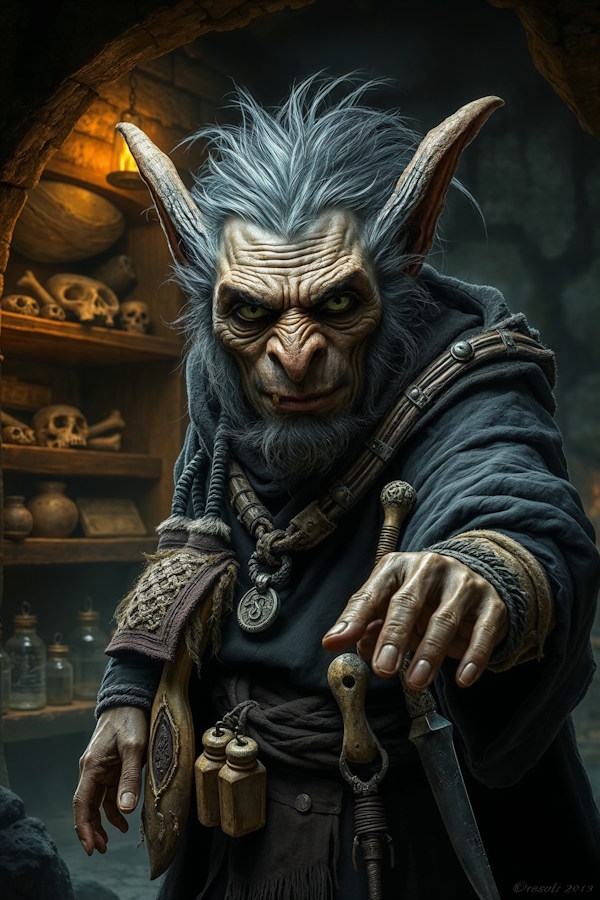
Ghurat is old by haurek standards, and his body carries every one of those years without apology. His frame, once broad, has narrowed with age, leaving him lean and slightly stooped, though he still stands over six feet tall when he bothers to straighten. His skin has darkened from the parched tan of youth to a deeper, weathered brown, creased and furrowed like leather left too long in the sun. The bristly hair common to haureks has thinned to sparse patches on his arms and the back of his neck, and what remains has gone the color of old ash.
His face is dominated by his eyes—beady and green, like most haureks, but sharper than his age would suggest, carrying the focused intensity of someone who has spent decades looking at things others cannot see. His fangs, yellowed and worn, protrude from dark lips that rarely smile and never without cause. His hands are his most distinctive feature: long-fingered, scarred from decades of handling caustic materials and sharp-edged artifacts, and stained permanently at the fingertips with pigments and residues from his work. He moves those hands when he speaks, tracing shapes in the air that may be habitual gestures or may carry meaning only he understands.
He dresses in layered robes of rough-spun fabric, dark and shapeless, hung with the tools of his trade: pouches of ground bone, vials of unidentifiable liquids, and small bundles of dried herbs whose purposes range from the medicinal to the ritualistic. A belt of cured leather circles his waist, from which hang carved bone tokens, metal implements of uncertain function, and a knife whose blade has been worn thin by decades of use. He carries a staff of dark wood capped with an iron ferrule at its base and a cluster of small bones wired to its head—finger bones, Serena would later realize, though from what species she preferred not to ask.
Personality & Demeanor
Ghurat is not hostile, but neither is he welcoming. He occupies a space between the two that most visitors find disorienting—a calm, assessing neutrality that offers neither warmth nor threat, as though the shaman has long since decided that emotional engagement with others is a resource expenditure his work does not justify. He speaks when he has something to say and falls silent when he does not, sometimes for stretches long enough that visitors assume the conversation has ended, only to find him resuming his point minutes later as though no pause occurred.
His knowledge is vast and idiosyncratic, organized according to a system that makes perfect sense to him and little sense to anyone else. He can recite the lineage of eslar necromantic artifacts across centuries, describe the properties of death magic with a precision that would unsettle most academics, and identify the provenance of a relic from its residual magical signature alone. He delivers this knowledge without editorializing, presenting the horrifying and the mundane with the same measured tone, and expects his listeners to keep up without requiring him to slow down or explain himself twice.
Beneath the detachment runs a genuine passion for understanding. Ghurat does not study death magic because he wishes to practice it but because he believes it represents one of the most consequential forces in Uhl’s history, and that ignorance of such forces is more dangerous than knowledge of them. This conviction has made him valuable to the Triumvirate and simultaneously kept him at the margins of Gugal’s society, where his expertise is sought but his company is not.
Notable Relationships
Ghurat’s social world is sparse by choice. He maintains a functional relationship with the Triumvirate, who consult him when matters of the arcane or the undead arise and otherwise leave him to his work. Among the haurek blood clans, he belongs to none—his original clan dissolved decades ago in one of the factional disputes that periodically reshape Gugal’s internal politics, and he saw no reason to attach himself to another.
His connection to Madilyn Oakthorn dates to the Amber Rift job, during which the Mavens’ captain incurred a debt to Gugal that has yet to be fully settled. Ghurat served as an intermediary during that arrangement, providing the mercenaries with intelligence they needed in exchange for a service whose nature he has not disclosed. He respects Oakthorn’s directness and trusts her word, two qualities he finds vanishingly rare among warm-bloods.
Zarg the Steady, the haurek mercenary who left Gugal to join the Mavens, is known to Ghurat, though the nature of their prior association is unclear. Ghurat has made no comment on Zarg’s departure from the fortress-city, which in haurek culture constitutes either supreme indifference or a deliberate refusal to pass judgment—and with Ghurat, discerning which is the case is rarely straightforward.
Role & Affiliations
Ghurat holds no formal title within Gugal’s hierarchy. He is not a member of the Triumvirate, does not lead a blood clan, and commands no warriors. His influence, such as it is, derives entirely from what he knows and the fact that no one else in the fortress-city knows it. When questions arise concerning necromantic artifacts, undead threats, or the deeper histories of death magic in Uhl, Ghurat is the authority to whom the Triumvirate’s advisors defer—quietly, and never in a manner that might suggest the council requires outside help.
His chamber serves as a workshop, an archive, and a home. Shelves carved into the rock hold his collection: bones arranged by species and age, tablets inscribed with texts he has spent years translating, salvaged artifacts sealed in stone containers to contain residual magical energy, and stacks of his own notes written in a shorthand no one else can read. The room smells of burned bone, dried herbs, and the faintly metallic tang of old magic—a smell that, once encountered, is not easily forgotten.