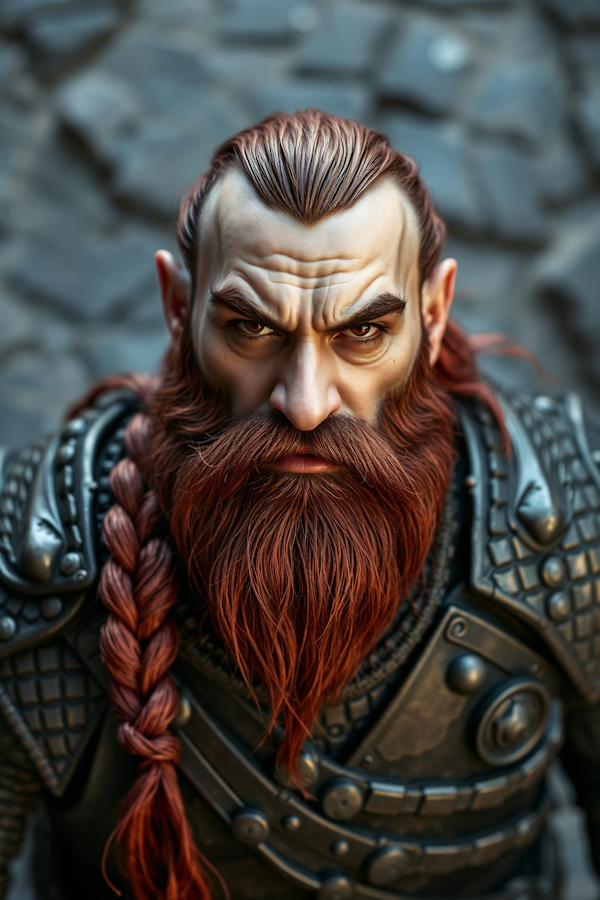
Grak Ironforge did not wait to be chosen. When he decided that Berjendale required different leadership than the council of elders was prepared to provide, he walked into the gathering hall, invoked the ancient rite of challenge, and defeated the sitting thane lord in single combat before witnesses who had not expected the morning to go that way. The fight was not long. The ancient rite was upheld in every technical particular. And when it was over, Grak took the seat that he had determined was his and set about making Berjendale into what he believed it had always been meant to be — not a fortress that endured goblin raids, but a war machine that ended them.
He looks, at first encounter, like an ordinary dwarf. This surprises people who have heard the stories before meeting the man. He is compact and powerfully built in the way that all dwarves are, with the broad shoulders and thick arms of a lifetime at the forge and in the tunnels. His beard is red-black, worn in a single tight braid bound with iron rings. His eyes are dark and very steady. There are no obvious signs of whatever it is that has made Grak Ironforge into something the other thane lords discuss in lowered voices — no unnatural stillness, no strange light behind the eyes, no physical characteristic that marks him as different from the dwarves who serve him. He carries a war hammer of his own forging whose head is scarred from decades of use but whose balance, those who have seen him wield it note, seems to respond to his grip with a fluency that goes beyond craftsmanship. That is the closest thing to evidence that anyone outside his inner circle has ever been able to point to. Everything else is results, and the results are undeniable.
He rose through Berjendale's ranks the way the fortress has always elevated its best — through combat, through the respect of warriors who serve alongside you, through the kind of reputation that accumulates not from a single act but from the accumulation of engagements where the outcome was uncertain and the right dwarf made it certain. Grak served in Berjendale's assault units for decades, earning the command of the primary fighting clan through a sequence of actions in the tunnels and on the surface of the Alzions that the fortress's oral tradition has already begun to mythologize. He was not a cautious or defensive fighter. He was the dwarf who led the push forward, who identified the moment when a holding action could become a rout if someone had the will to make it one, and who was consistently that someone. By the time he challenged for the thane's seat, the warriors who would fight for him outnumbered those who would fight against him by a margin that the previous thane lord apparently failed to assess correctly until it was too late.
The conviction that drives Grak is the kind that makes a leader genuinely dangerous — not cynical, not performative, but real. He believes, with the absolute certainty of a dwarf who has tested his beliefs against the sharpest available opposition and found them holding, that Berjendale's centuries of defensive posture represented a fundamental misunderstanding of what dwarven strength is for. The Iron Gates of the South were built to keep goblins out, and they succeeded. But keeping goblins out, in Grak's view, is the lowest possible ambition for a people who are superior to goblins in every way that matters — in discipline, in craft, in the quality of their weapons, in the intelligence of their tactics, and in the depth of their commitment to the ground they claim as their own. Defensive warfare cedes the initiative to the enemy, allows the enemy to choose the time and place of engagement, and produces at best a stalemate that must be defended forever. Offensive warfare takes the initiative away, destroys the enemy's capacity to threaten rather than merely deflecting that threat, and achieves a security that walls alone can never provide. Grak does not consider this philosophy controversial. He considers it obvious, and the difficulty he experiences in making others see its obviousness has contributed to a contempt for slower minds that colors every inter-thane relationship he maintains.
He has no wife and no children. This is a matter of priority rather than circumstance — Grak is not a dwarf whose attention wanders far from the work. The work is Berjendale's transformation, the ongoing campaigns in the Alzions, the management of an alliance whose terms and nature he discusses with no one outside the circle of commanders who share whatever it is that has altered their capabilities. He expects to have time for other considerations when the goblin strongholds in the range are broken. Until then, the fortress is his family, the primary fighting clan his kin, and the transformation of Berjendale from the greatest defensive position in the south to the greatest offensive force in the dwarven world his consuming purpose.
The alliance that has fueled this transformation is the subject he discusses least and deflects most smoothly. When the topic arises — and among the other thane lords, it arises with increasing frequency — Grak's responses are consistent in their form and uninformative in their content. Berjendale has always sought advantages in the prosecution of its centuries-long war with the Alzion goblins. The current leadership has found advantages that previous leaderships did not. The fortress's warriors fight better, hit harder, and recover faster than they did before, and the goblin populations that have menaced the southern Alzions since before living memory are being driven back at a rate that should satisfy anyone who cares about the security of the dwarven world. What more needs to be said? What Grak does not say — what no one in his inner circle says — is anything about the nature of what was offered or accepted, the terms under which the enhancement was obtained, or what, if anything, might eventually be asked in return. The silence on these questions is as complete and as carefully maintained as the Iron Gates themselves.
Reunification interests Grak the way rain interests stone. He acknowledges its existence without feeling its weight. The periodic discussions among the Seven Thanes about closer cooperation or shared governance strike him as a distraction that leaders with insufficient work to occupy them use to fill their councils with the sound of their own voices. Berjendale does not need the other thanes. The other thanes, in his assessment, are increasingly dependent on what Berjendale's aggressive campaigns in the Alzions produce — a safer southern mountain range — without contributing anything equivalent to the dwarven world's collective security. If they wish to discuss that dependency honestly, he is willing to have that conversation. If they want to talk about reunification as though the past five centuries of separate development have not made the thanes into seven different civilizations that share an ancestry and almost nothing else, he has better uses for his time.
This dismissiveness toward his fellow thane lords extends beyond reunification to a broader assessment that Grak makes no particular effort to conceal. He considers himself stronger than them. Not just militarily — though he is — but in the more fundamental sense of character and conviction. Dain Frostbeard's warmth, in Grak's view, is the warmth of a leader content with endurance when he should be demanding victory. Thorek Skywatcher's curiosity about the sky strikes him as the occupation of a dwarf looking in the wrong direction. Borin Deepdelver's isolation earns more respect than the others, but even Dwathenmoore's depth seems to Grak like a retreat from engagement rather than a position of strength. Vera Ironworks is competent in her narrow domain. Vera Goldheart serves her gold with the devotion she ought to direct toward her people. Nali Borderward comes closest to the kind of leader Grak can respect — the willingness to fight, the indifference to convention, the results-first orientation — but even Rillock's thane lord, in Grak's estimation, is ultimately playing at war rather than prosecuting one. These are not opinions Grak advertises at inter-thane councils. They are the framework through which he perceives everything that is said there, and they are visible to anyone paying close enough attention to his silences.
Within Berjendale, Grak's authority is absolute in a way that no other thane lord's has been in living memory. The fortress's population has organized itself around him with a completeness that reflects both the genuine results he has delivered and the subtle shift in the culture that his rise has accelerated. Berjendale was always a military community. Under Grak, it has become something closer to a military organism, each element functioning in service of the whole with an integration that feels, to visitors from other thanes, slightly uncanny in its precision. The warriors fight together as though they share a single set of instincts. The smiths produce to schedules that have never been formally established but that everyone seems to know. The council of elders meets, fulfills its ceremonial function, and takes no position that the thane lord has not already arrived at independently. None of this is enforced through obvious compulsion. No one appears afraid. The coherence is simply there, the way that certain metals, once alloyed, cease to behave like their constituent parts and become something with properties that the original components did not possess. Whether this coherence is the natural result of decades of shared purpose under effective leadership or something more — something that arrived alongside the alliance, that was part of what changed when Grak's inner circle changed — is a question that Berjendale's inhabitants seem not to ask, and that outsiders who ask too loudly find discouraged in ways that are difficult to describe precisely.
The goblins of Gugal are learning what it means to face a Berjendale that attacks rather than waits. The other thane lords are learning what it means to share a dwarven world with a fortress whose thane believes he has transcended the limitations that govern the rest of them. The cost of what Grak Ironforge has built — in the absolute sense, the full accounting of what was given to obtain what was received — remains unknown outside the fortress's innermost councils, and perhaps within them as well. What is known is that the Iron Gates of the South now open outward as readily as they close, that the warriors who emerge from them fight like something more than dwarves, and that the thane who leads them does so with the fire of a dwarf who has decided, somewhere along the way, that the world's approval is a resource he does not need.