Grommara the Mother of Stone, She Who Shaped the Deep
Introduction
Grommara, the Mother of Stone, is the chief goddess of the dwarven pantheon—the shaper of mountains, the molder of the first dwarves, and the divine embodiment of the earth from which all dwarven civilization springs. She is the stone beneath the feet, the ore in the vein, the bedrock upon which the thanes were built, and the patience that held them standing through every age the world has endured. Where her sons Morden and Rurik represented the specific gifts of fire and protection, Grommara represents the foundation itself—the raw substance of the world and the will that shaped it into something capable of sustaining life.
She is the most revered figure in dwarven mythology, though the reverence she receives is of a different character than the affection the dwarves lavish on Morden or the quiet respect they accord Rurik. Grommara is not a god that the dwarves celebrate with boisterous stories around the hearth. She is the god they speak of, the way they speak of the mountains themselves—with a gravity that reflects the understanding that some things are too fundamental to be treated lightly. Morden makes them laugh. Rurik makes them stand taller. Grommara makes them pause, because to think of her is to think of the ground beneath everything, and the ground beneath everything is not a subject that invites casual conversation.
Grommara is dead. She died last among the three dwarven gods, after watching both of her sons precede her—Morden consumed by his sacrifice at the Sundering Deep, Rurik destroyed at the World’s Gate during the Fall of the Old Gods. She witnessed both, endured both, and carried the weight of both losses before her own end came. The dwarves tell her death with a solemnity that exceeds even the gravity they bring to Morden’s sacrifice and Rurik’s last stand, because Grommara’s death is not only the end of a goddess but the end of the divine family that gave the dwarven people their existence, their purpose, and everything they have ever built.
Origins
Grommara’s origin is told as a shaping story because the dwarves understand the world through the work of their hands on stone. Before the mountains had names, before the caverns had ceilings, before the deep places of the world had been carved into the spaces that would become the dwarven homeland, the earth was formless—an undifferentiated mass of raw stone and mineral without structure, without purpose, without the contours that would eventually define the geography of Uhl. The stone existed, but it meant nothing. It was material waiting for a maker.
Grommara was the maker. The myths do not describe her birth because the dwarves do not believe she was born. She was always there, present in the stone the way a sculpture is present in the block before the chisel touches it—latent, implicit, waiting to be revealed. At some point, before the measurement of time, Grommara became aware of herself, and in becoming aware, she became separate from the stone she inhabited. She was still stone. She was still earth. But she was also a will, a consciousness, a being capable of looking at the formless mass around her and seeing what it could become.
Her first act was to shape. She pressed her hands into the raw earth and pushed upward, and where she pushed, mountains rose. She dragged her fingers through the substrate, and where she dragged, valleys formed. She hollowed spaces beneath the peaks she had raised, creating the caverns and tunnels that would become the great halls of the dwarven thanes. She worked without tools, without plans, without any model to follow except the vision in her mind of what the world should look like when it was finished. The work took an immeasurable span of time—the myths do not specify how long, because Grommara’s relationship with time was like stone's with rain. She acknowledged its existence without being governed by it.
When the shaping was done, Grommara looked at the mountains she had raised and the caverns she had carved and found them beautiful but empty. The stone was perfect. The architecture was sound. The veins of ore ran true. But there was nothing in the halls she had built, no one to walk the corridors she had shaped, no hands to work the stone she had placed. And so she performed the act that would define her for all of dwarven history: she took the living rock of the mountains—stone that had been part of her own body, material she had shaped and known and carried within herself—and she molded it into the first dwarves. She breathed her own qualities into them: patience, resilience, an intimate understanding of stone and the deep places of the earth, and a stubbornness so profound that it would endure for millennia beyond her own existence. Then she set them on their feet in the halls she had built for them, and she watched them take their first steps, and the dwarves say that this was the only time in all of mythology that Grommara smiled.
Domains & Attributes
Grommara’s primary domain is stone itself—every form of rock, mineral, and earth that constitutes the physical substance of the world beneath its living skin. Her authority encompasses the mountains she raised, the caverns she carved, the veins of ore she threaded through the deep earth, and the bedrock upon which everything else rests. To work stone is to work with Grommara’s substance. To mine ore is to draw from her body. To build in stone is to extend the architecture she designed. Every dwarven mason, miner, and stonemason operates within the domain that Grommara established and that her death has not diminished, because the stone does not require divine supervision to continue being stone.
Patience constitutes her second domain—not the tactical patience of Rurik’s vigilance or the predatory patience of a hunter waiting for the kill, but the geological patience of stone that endures through ages without hurrying, without complaining, without losing its essential character regardless of what the world above does to its surface. Grommara’s patience is the patience of mountains that weather storms for millennia and remain mountains. It is the patience of a mother who watches her children make mistakes and waits for them to learn rather than intervening. It is the patience that the dwarves consider their highest cultural virtue—the ability to outlast any problem by refusing to abandon one’s position, one’s standards, or one’s identity under pressure.
Motherhood forms her third domain, understood by the dwarves not in the sentimental terms that some races apply to the concept but in the foundational sense of the word: the act of producing something from one’s own substance, investing it with one’s own qualities, and then releasing it into the world to become what it will become. Grommara made the dwarves from her own body. She gave them her patience, her resilience, and her understanding of stone. Then she let them go. She did not hover. She did not control. She watched, was available when they needed her, and trusted that the qualities she had invested in them would prove sufficient. The dwarves consider this the ideal model of parenthood: provide the foundation, share the knowledge, and then have the courage to step back and let the work speak for itself.
Endurance constitutes her fourth domain—the capacity to absorb damage, bear weight, and maintain structural integrity under conditions that would destroy lesser materials. Grommara’s endurance is not the active resistance of a warrior bracing against a blow. It is the passive, implacable endurance of stone that does not resist because resistance implies the possibility of yielding. Stone does not yield. It may crack. It may erode over millennia. But it does not choose to give way, and the distinction between breaking under force and choosing to surrender is one that the dwarves consider theologically significant. Grommara endured because enduring is what stone does. It is not a decision. It is a nature.
Appearance & Symbols
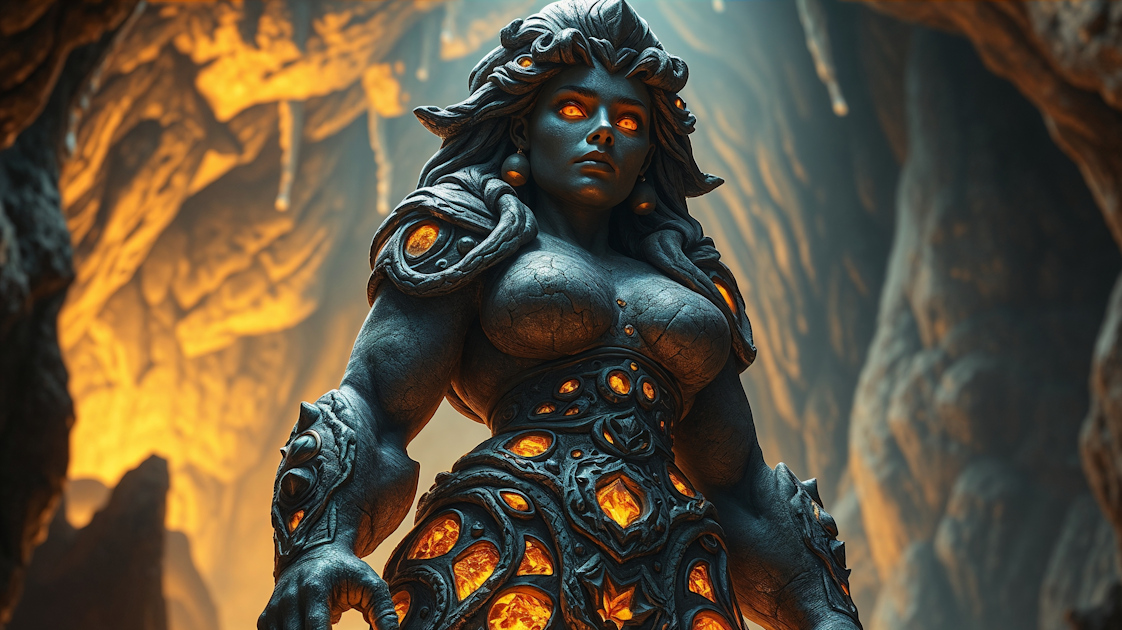
Grommara is depicted as a giantess of unmistakably dwarven proportions—broad, solid, and built with the compact power that characterizes her people, simply rendered at a scale that makes her sons look like children at her feet. She is the largest figure in dwarven mythology, and her size is not merely physical but atmospheric: depictions of Grommara fill the space they occupy the way a mountain fills a valley, not through height alone but through the sense of mass, of weight, of substance that makes everything around her seem smaller and less permanent by comparison.
Her most distinctive feature is her hair, which cascades from her head and shoulders as a living rock and mineral—not hair shaped like stone, but stone that moves like hair, shifting and settling with the slow fluidity of a geological process compressed into visible motion. The strands are composed of every type of rock and mineral found in the dwarven territories: granite, basalt, marble, quartz, veins of gold and silver threading through darker stone, crystals catching the light and scattering it in patterns that dwarven gem-cutters have spent centuries trying to replicate. Her hair is the mountains in miniature, and the dwarves say that every stone formation in the world carries an echo of the patterns found in the Mother’s hair.
Her skin is depicted as the warm brown of fertile earth in some traditions, and as the grey of unworked stone in others, though all agree on the quality of permanence it conveys—skin that does not age, does not scar, does not show the effects of time because time affects stone differently than it affects flesh. Her eyes are the deep amber of cave crystals illuminated from within, carrying a warmth that distinguishes her from every other earth-bound figure in Uhl's mythology. Grommara’s eyes are not cold. They are not remote. They are the eyes of a mother looking at something she made, and the warmth in them is the warmth of stone that has absorbed the heat of a fire and holds it long after the flames have died.
She carries no weapons. Her hands, in every depiction, are open—palms outward, fingers spread, the posture of a shaper rather than a fighter. The hands themselves are enormous, rendered with the specific attention to detail that dwarven artists bring to the tools of their trade, because Grommara’s hands are the original tools: the instruments that shaped the mountains, carved the caverns, and molded the first dwarves from living rock. Some traditions depict traces of stone dust on her palms and fingers, the residue of the shaping work that defined her existence, never cleaned because the work was never finished.
The primary symbol associated with Grommara is the Mountain Heart—a mountain peak with a circle at its center, representing both the hollow spaces within the mountains where the dwarves dwell and the maternal love that created those spaces for them. This symbol appears on the oldest structures in every thane, carved into the stone above the entrances to the deepest and most ancient halls. Secondary symbols include the Open Hands, representing the shaping act that created the dwarven race, and the Layered Stone, a stack of horizontal lines representing the geological strata that constitute Grommara’s body and the dwarves’ home.
Nature & Character
Grommara is the warmest presence in the dwarven pantheon—a quality that surprises those who associate stone with coldness and the earth with indifference. The myths portray her with a maternal tenderness that the dwarves, a people not given to public displays of sentiment, describe with unusual care, as though acknowledging that this quality in their chief goddess is both unexpected and essential. Grommara is not soft. Stone is never soft. But she is warm in the way that stone is warm after a long day of absorbing sunlight, or the way the walls of a deep cavern are warm from the geothermal heat that rises from the earth’s core. Her warmth is not effusive or demonstrative. It is steady, reliable, and so deeply embedded in her character that the dwarves perceive it as a physical property rather than an emotion.
Her patience is her most celebrated quality, inseparable from the maternal warmth that accompanies it. The myths describe Grommara watching the first dwarves learn to work stone—watching them chip and crack and waste material through inexperience, watching them produce pieces that fell short of any reasonable standard—and responding not with criticism or divine instruction but with the silent, inexhaustible patience of a mother who knows that her children will learn in their own time and that the learning will mean more if it comes from their own effort. She did not correct their mistakes. She did not show them the right way. She waited, and when they figured it out for themselves—when the first dwarven mason produced a joint so precise that the seam was invisible, when the first smith drew ore from stone using techniques Grommara had not taught but that the stone had taught him through long practice—she was there, watching, and the dwarves say that this was the second time Grommara smiled.
Her strength is the kind that reveals itself through endurance rather than action. The myths contain no episodes of Grommara fighting, no battles, no dramatic confrontations. Her responses to threats are structural rather than violent: when something endangers the dwarves, Grommara does not attack it. She reinforces the stone around her children, adds depth to the caverns that shelter them, and hardens the rock that separates them from harm. She protects by providing rather than by destroying, and the dwarves who honor her tradition do the same—building stronger walls rather than raising larger armies, investing in foundations rather than weapons, trusting that what is well-built will outlast what merely threatens.
Her grief is the quality the dwarves find hardest to speak about, because Grommara’s grief is the grief of a mother who lost both of her children and lived long enough afterward to understand fully what she had lost. The myths describe her weeping tears of molten stone when Morden descended into the Sundering Deep, and the dwarves say that certain geological formations—flows of cooled obsidian found in the deepest tunnels, their surfaces smooth as glass and shaped like falling drops—are Grommara’s tears, hardened into permanence by the same stone that composed her body. Her grief at Rurik’s death is described differently: not tears but silence, a withdrawal of presence so complete that the mountains themselves seemed emptier, as though something fundamental to their composition had been removed.
Her Sons
Grommara’s relationship with her sons is the emotional center of dwarven mythology—a story of creation, pride, rivalry, sacrifice, and loss that the dwarves tell with a depth of feeling they permit themselves in few other contexts. She made them from different aspects of herself: Morden from the molten heart where fire and stone are one, Rurik from the deepest granite where pressure has compressed the earth into something harder than iron. Each son carried qualities she recognized as her own, refined and concentrated into forms that exceeded her in their respective domains while, in her estimation, remaining incomplete without each other.
Her relationship with Morden was defined by the particular joy a maker takes in a creation that surpasses expectation. Morden’s boisterous energy, his reckless creativity, his refusal to sit still—these were qualities that Grommara did not possess herself but that she recognized as necessary for the civilization she was building. She watched him with the bemused affection of a patient mother whose child is nothing like her and who loves him specifically for the ways in which he is different. The myths describe her shaking her head at his louder excesses while smiling at the results they produced, understanding that the fire she had drawn from the deep was always going to burn in its own way and that her role was not to control it but to provide the hearth within which it could burn without destroying itself.
Her relationship with Rurik was quieter and, in some ways, deeper. Rurik was stone as Grommara was stone—patient, watchful, inclined toward silence and the long view. The myths describe them communicating in the way that stone communicates with stone: through pressure, through proximity, through the slow transfer of weight and warmth that occurs when two masses of rock rest against each other for geological spans of time. They did not need words because they shared a nature, and the nature spoke for itself. Rurik’s protective instinct—his first act of placing himself between Grommara and the cave mouth—was not a gesture she had to teach him. It was her own nature, reflected back to her as a son who understood that the purpose of strength is to shelter what matters.
The rivalry between her sons was a source of private satisfaction that Grommara never publicly acknowledged. The myths suggest she subtly encouraged it, understanding that the competition between fire and stone would push both sons to exceed what either could achieve alone. When Morden argued that creation was the higher calling, Grommara said nothing. When Rurik countered that defense was more essential, Grommara said nothing. She let them argue because the argument produced better craftsmen and better guardians, and because she knew—as only a mother knows—that the rivalry was an expression of love neither son would have been comfortable naming.
The Great Works
Grommara’s Great Works are the mountains themselves—the entire geological architecture of the world as the dwarves know it, from the highest peak to the deepest cavern, from the broadest valley to the narrowest ore vein. Every other Great Work in dwarven mythology—Morden’s Anvil’s Voice, Rurik’s Deepward, the Seven Hearths, Thokkengrul—was created from materials that Grommara provided. Her work is not a list of objects but the substrate upon which all other objects rest. She did not create items. She created the world in which items are made.
The Shaping of the Seven Seats is the specific deed that the dwarves celebrate most among Grommara’s works—the selection and preparation of the seven locations that would become the dwarven thanes. According to the myths, Grommara did not choose these sites randomly. She studied the stone for an immeasurable period, reading its grain, its density, its mineral composition, and its relationship to the geological forces that would shape it over the coming millennia. She chose locations where the stone was strongest, where the ore ran richest, where the natural architecture of the rock lent itself to creating spaces large enough to house civilizations. Then she shaped each site with the particular care of a mother preparing a home for children she knows will arrive but has not yet made—because Grommara prepared the thanes before she created the dwarves, understanding that a people need a place before they need a purpose.
The Threading of the Veins describes Grommara’s placement of ore deposits throughout the mountains—veins of iron, copper, gold, silver, and the rarer metals that dwarven smiths would eventually learn to work. The myths describe this as an act of deliberate provision: Grommara placed the ore where her future children would find it, at depths they could reach, in concentrations they could exploit, creating a resource base that would sustain dwarven civilization for millennia. The placement was not random. Each deposit was positioned to reward the patient and the skilled—deep enough to require effort, pure enough to reward expertise, distributed widely enough that every thane would possess the materials necessary for independence. The dwarves see in this arrangement evidence of Grommara’s foresight and her refusal to make things easy for her children when making them competent would serve them better.
The Molding of the First is the creation of the dwarven race itself—Grommara’s most personal and most celebrated work, the act that transformed her from a shaper of stone into the Mother of a people. The myths describe the process with the reverence that dwarven craftsmen bring to the description of a masterwork: the careful selection of stone, the patient shaping of each feature, the moment when Grommara breathed her own qualities into the stone and felt it respond, the first heartbeat, the first breath, the first opening of eyes that looked back at their maker with the awareness she had given them. The dwarves consider this the greatest creative act in their mythology—greater than Morden’s forging, greater than any artifact or structure, because it produced the beings who would produce everything else.
The Sundering Deep
Grommara was the first to recognize the Sundering Deep for what it was. She felt it before any other being, divine or mortal, because the rift opened in her body—in the stone and earth that constituted her physical substance as surely as flesh constitutes a mortal body. The myths describe the sensation as a wound: not a crack in distant rock but a tearing in her own composition, a violation of the fundamental integrity that she had maintained since the beginning of her existence. Something was coming apart beneath the world, and the coming apart was happening inside her.
She tried to close it. The myths are clear on this: Grommara poured her power into the stone surrounding the rift, commanding it to hold, willing it to seal, applying every technique she had developed through millennia of shaping to force the wound shut. The stone obeyed her as it always had—compressing, hardening, filling the gaps she directed it to fill. But the Sundering Deep consumed her efforts as fast as she could produce them, unmaking the stone she placed with the same patient inevitability with which she had shaped the mountains. She could not close the rift because the rift was not a gap in the stone. It was the undoing of stone itself, and no amount of additional stone could plug a hole that ate stone.
She convened her sons. The myths describe this council with the weight of a moment that the dwarves consider the hinge upon which their entire history turns. Grommara told her sons what she had found, what she had tried, and what she had concluded: the Sundering Deep could not be sealed from the outside. It had to be sealed from within. And the seal required fire—not stone, which the rift could unmake, but fire hot enough and sustained enough to fill the void faster than the void could consume it.
Morden understood. Rurik understood. Grommara understood. And the understanding broke something in her that the Sundering Deep itself had not managed to break, because the mother who had shaped the mountains and molded the dwarves and provided everything her children needed to thrive was now required to provide one more thing: the acceptance that her firstborn son would not survive the solution to a problem she could not solve herself.
She embraced Morden before he descended. She wept tears of molten stone that hardened as they fell, creating the obsidian formations that the dwarves find in the deepest tunnels and treat with the reverence due a mother’s grief made permanent. Then she watched him go, and the myths say that in the silence that followed, the mountains grew heavier, as though the stone itself were absorbing the weight of what had just occurred.
The Fall of the Old Gods
Grommara endured her firstborn’s sacrifice with the patience that defined her nature, carrying the loss the way stone carries weight—silently, completely, without visible strain but with a fundamental change in the distribution of forces within her. She was diminished. Not weakened in the way that a warrior is weakened by wounds, but reduced in the way that a mountain is reduced by the removal of its peak: still massive, still formidable, but no longer whole. Morden’s absence left a space inside her that no amount of shaping could fill, because what had been removed was not stone but fire, and Grommara had never possessed fire of her own.
When the Fall of the Old Gods came, it found Grommara already grieving. The cosmic cataclysm that erupted across the surface world reached the dwarven territories in the form of earthquakes, tunnel collapses, and disruptions to the geological stability that Grommara had maintained since the beginning. She felt the damage the way she had felt the Sundering Deep—as violations of her own body, cracks forming in stone she had shaped, caverns collapsing that she had carved. But this time, the damage was everywhere at once, spreading too fast and across too many fronts for even a goddess of stone to address simultaneously.
Rurik went to the World’s Gate without telling her. The myths are specific about this detail, and the dwarves tell it with the particular pain of a story in which the worst outcome could have been prevented by a single conversation that never took place. Rurik knew that his mother would try to stop him or take his place, and he knew that the world could not afford to lose Grommara—the mother, the shaper, the foundation upon which the dwarven race itself rested. So he went in silence, the way he had entered the world in silence, and he held the threshold for three days while the great doors of the thanes ground shut, and the void consumed him degree by degree until nothing remained but a ridge of fused stone and the absence where a son had stood.
Grommara learned of Rurik’s death after the doors sealed. The dwarves who were present describe the moment in terms they usually reserve for geological events: the stone shuddered. The walls of the deepest halls groaned. The columns that had stood since before the first dwarf drew breath cracked along their length, not breaking but recording in their surfaces a fracture that had occurred not in the stone but in the being who had shaped it. Grommara did not weep this time. She did not make a sound. She simply stood in the deepest hall of the oldest thane and absorbed the knowledge that both of her sons were gone, and the mountains absorbed the knowledge with her, and the dwarves who watched did not dare to speak.
The Death of Grommara
Grommara’s death did not come quickly. The dwarves tell this with the somber recognition that the slowness was consistent with her nature, because stone does not shatter all at once unless something strikes it. Stone crumbles. Stone erodes. Stone loses itself gradually, one grain at a time, and the process can take so long that those who watch it cannot tell it is happening until the shape they knew is gone.
In the days and weeks following the Fall, with both sons dead and the dwarven people sealed behind their great doors in a world forever changed, Grommara began to withdraw. Not physically—she did not leave the mountains or retreat to some hidden chamber. She withdrew in the way that a consciousness withdraws from a body that has sustained too much damage: gradually, quietly, the animating presence receding from the stone the way heat recedes from a rock carried out of sunlight into shade. The dwarves felt it as a change in the quality of the stone around them—subtle at first, then unmistakable. The walls that had always felt alive, that had carried the faintest impression of being watched and held and cared for, began to feel like ordinary rock. The warmth that had seeped through the deepest halls without any visible source grew cooler. The stone did not change its composition. But it changed its character, the way a house changes its character when the person who made it a home is no longer there.
Grommara did not choose to die. The dwarves are insistent on this point, because the alternative—that the Mother of Stone chose to leave her children—is a possibility they refuse to accept. What happened, as the dwarven storytellers tell it, is that Grommara gave too much. She had poured her power into the Sundering Deep, trying to seal the rift before Morden sacrificed himself. She had sustained the mountains through the cataclysm of the Fall, holding the geological structures together through sheer force of will while the world above tore itself apart. She had absorbed the deaths of both sons, each loss carving away a portion of her essence that she could not replenish. And when the crisis was over—when the doors were sealed, the dwarves were safe, and the immediate need for her strength had passed—there was not enough of her left to sustain the consciousness that had shaped the world.
She dissolved into the stone. Not in the dramatic fashion of a god falling in battle but in the slow, imperceptible way that a grain of salt dissolves into water—her consciousness spreading outward through the mountains she had shaped, thinning as it spread, losing coherence and identity as it merged with the rock that had been her body and her life’s work. The process took months. The dwarves watched it happen without being able to stop it, the way one watches the last light leave the sky after sunset—knowing what is occurring, knowing it cannot be prevented, watching anyway because looking away would be a betrayal of what is being lost.
When the last trace of Grommara’s awareness faded from the stone, the dwarves were alone. The gods who had made them, taught them, and protected them were gone—Morden consumed by his sacrifice, Rurik destroyed at his post, and Grommara dissolved into the mountains she had spent eternity shaping. The stone remained. The forges remained. The great doors held. But the presence that had made the stone feel like home was gone, and the dwarves understood for the first time what it meant to live in a world without the mother who had made it for them.
Legacy & Enduring Influence
Grommara’s legacy is the world itself—the physical structure of the mountains, the caverns, the ore veins, and the geological foundations upon which dwarven civilization rests. Every stone that a dwarven mason shapes was placed by Grommara. Every ore that a dwarven smith smelts was threaded through the earth by her hand. Every hall that echoes with the sound of hammers was carved by her before the first dwarf drew breath. The dwarves live inside her work the way they live inside the mountains: surrounded by it, sustained by it, so thoroughly immersed in it that they sometimes forget it is there until something reminds them of what they owe.
The dwarven reverence for stone—the near-sacred respect with which they treat the material they work—derives directly from the understanding that stone is Grommara’s substance. When a dwarven mason speaks of reading the grain of a block of granite, he is engaged in a practice that Grommara invented. When a miner follows a vein of ore into the deep earth, he follows a path that Grommara laid. The intimacy with stone that defines dwarven culture is not a learned skill but an inherited relationship—the echo of the connection between creator and creation that Grommara established when she molded the first dwarves from the living rock of the mountains and breathed her own qualities into them.
The dwarven concept of motherhood reflects Grommara’s example in ways that other races sometimes find surprising. Dwarven mothers are not expected to be gentle, permissive, or emotionally demonstrative. They are expected to be strong, patient, and willing to provide everything their children need without providing anything their children should earn for themselves. A dwarven mother who shelters her child from every hardship is not honoring Grommara’s legacy. A dwarven mother who provides a foundation and then steps back to let her child build on it is. This understanding produces a parenting culture that values competence over comfort and that measures maternal love not by the warmth of the embrace but by the quality of what the child becomes.
Grommara’s dissolution into the stone has created a theological legacy unique among the dwarven gods. Morden’s fire burns at the heart of the world, separate and identifiable. Rurik’s remains fused into a ridge of stone at the World’s Gate, localized and specific. But Grommara is everywhere. She dissolved into all the stone, not just one formation. Every mountain, every cavern, every pebble on every tunnel floor carries some infinitesimal trace of her awareness, too dispersed to constitute a consciousness but too pervasive to constitute absence. The dwarves who work the stone sometimes speak of feeling something in the rock—not a presence, exactly, but a quality that suggests the stone is not entirely indifferent to how it is treated. They do not claim this is Grommara. They do not need to.
Worship & Observances
Worship of Grommara is the most pervasive and least ceremonial of all dwarven religious practices. The dwarves honor the Mother of Stone by working stone itself, treating every interaction with the earth as an observance that requires no formal ritual to make it sacred. The mason who carefully selects a block of granite honors Grommara. The miner who follows the grain of the ore rather than forcing his way through it honors Grommara. The builder who tests a wall’s integrity one more time than strictly necessary honors Grommara. The worship is embedded in the work, and the work is continuous.
The most significant formal observance is the Day of the Mother, held once a year in every thane at the onset of spring when the first meltwater seeps through the stone to replenish the deep wells. On this day, the dwarves cease all work—the only day in the dwarven calendar when the forges are deliberately allowed to cool, and the hammers fall silent. The silence is the observance. The dwarves spend the Day of the Mother in the quiet contemplation of the stone around them, listening for whatever remains of the consciousness that shaped it. Some report hearing nothing. Some report feeling a warmth in the stone that has no geological explanation. None claim certainty about what they experience, and the dwarves consider this uncertainty the most honest form of devotion: the willingness to sit in silence with a loss that cannot be resolved and a presence that cannot be confirmed.
The Shaping Blessing, spoken before any significant stonework or mining operation begins, invokes Grommara’s name and acknowledges that the material about to be worked was placed by her hand and carries the residue of her purpose. The blessing is brief—a few words spoken quietly, a palm pressed flat against the stone, a moment of attention given to the material before the tools make contact. The blessing does not request divine assistance. It expresses respect for the substance being shaped and the being who placed it, and the dwarves consider this respect more important than any prayer.
New mothers in dwarven society receive the Stone Cradle benediction, a tradition in which the eldest female of the clan places a smooth river stone in the newborn’s first cradle and recites Grommara’s name. The stone remains with the child throughout its life, carried as a personal talisman that connects the individual to the Mother of Stone through a chain of maternal association stretching back to the goddess herself. The dwarves do not claim the stones possess power. They claim the stones possess a connection, and for a people who define themselves through their relationship with the earth, connection is sufficient.
Sayings & Proverbs
Dwarven sayings associated with Grommara carry the particular weight of words spoken about a mother—careful, respectful, and occasionally raw with an emotion that the dwarves permit themselves in no other theological context.
“The stone remembers” is the most common expression associated with Grommara, used to convey both comfort and warning. The stone remembers the shaping it received. The stone remembers the ore it carries. The stone remembers the footsteps of those who have walked its corridors. And, the dwarves believe, the stone remembers Grommara, carrying whatever dispersed trace of her consciousness persists in the mountains she shaped. The saying is used to remind dwarves that their actions leave marks—in the stone, in the community, in the legacy they are building—and that those marks endure longer than the individuals who make them.
“She gave us the mountain and let us climb it” captures Grommara’s parenting philosophy in a single phrase, honoring the goddess who provided everything the dwarves needed to build their civilization without doing the building for them. The saying is used by dwarven parents who are resisting the impulse to intervene in their children’s struggles, reminding themselves that Grommara’s example counsels patience rather than protection and competence rather than comfort.
“Patient as the Mother” is the highest compliment that can be paid to a dwarf’s endurance, invoking a patience so vast that it operates on geological timescales and considers centuries the way ordinary beings consider hours. The phrase is reserved for situations that have tested a dwarf’s composure beyond what any reasonable standard would demand, acknowledging that the individual has demonstrated the same inexhaustible capacity for endurance that Grommara brought to every challenge she faced.
“She smiled twice” is the most poignant saying in dwarven mythology, referencing the two moments when Grommara is recorded as having smiled: once when the first dwarves took their first steps, and once when the first mason produced a joint invisible to the naked eye. The phrase is invoked when a dwarf achieves something that merits genuine pride—not the casual satisfaction of routine competence but the rare, profound achievement that would have made the Mother of Stone smile. To say “she would have smiled” about a piece of work is to place it in the company of the only two achievements that moved a goddess to visible emotion.
“The mountain does not move for the wind” is attributed to Grommara’s philosophy of endurance, already established in dwarven culture, but carries additional resonance when linked to the goddess who shaped the mountains. The saying counsels against reacting to temporary pressures with permanent changes, reminding the listener that the wind is brief and the mountain is forever, and that altering one’s course to accommodate forces that will pass is a betrayal of the stability that Grommara embodied.
Sacred Sites
Every mountain in the dwarven territories is, in a sense, sacred to Grommara, as each one was shaped by her hands and carries whatever dispersed trace of her consciousness persists in the stone. But certain locations hold particular significance in her mythology, either because of their association with specific events in her story or because the quality of the stone there embodies a character that the dwarves interpret as tangible evidence of Grommara’s influence.
The Heartstone Chamber, located in the deepest accessible level of Rillock, is traditionally identified as the place where Grommara molded the first dwarves. The chamber is a natural formation of unusual beauty—a dome of polished stone with walls that reflect light in patterns suggestive of fingerprints, as though the rock retains the impression of the hands that shaped it. The chamber is not open to the public. Access is restricted to thane lords, master stonemasons, and individuals who have completed extraordinary achievements in the working of stone. Those who enter describe a warmth in the walls that has no geological source and a sense of being examined—not watched, but studied, the way a craftsman studies a piece of work to determine whether it meets the standard.
The Tears of Grommara are a network of obsidian formations found in the deepest tunnels of multiple thanes, their surfaces smooth as glass and shaped like elongated drops. The dwarves identify these formations as the hardened tears that Grommara shed when Morden descended into the Sundering Deep, and they treat them with the quiet reverence that grief demands. The obsidian is never mined, never carved, never disturbed. It remains where it fell, permanent evidence of a mother’s loss preserved in the stone that was her body.
The Seven Seats themselves—the seven locations where the dwarven thanes were built—constitute the most significant sacred sites in Grommara’s mythology, as each one was selected and prepared by the goddess before the dwarves existed to inhabit them. The entrance to each thane bears a carving of the Mountain Heart symbol so ancient that its origins predate the thanes’ construction, placed there, the dwarves believe, by Grommara herself as a mark of consecration. These carvings are maintained with meticulous care but never recarved—the original marks are preserved as Grommara left them, their slow erosion over millennia accepted as the natural process of stone aging rather than something to be corrected by mortal hands.
Concluding Remarks
Grommara, the Mother of Stone, is gone, dissolved into the mountains she spent eternity shaping, her consciousness dispersed across the stone of the world until what remains is not a presence but a quality—the faintest suggestion that the rock is not entirely indifferent to the beings who live within it. She watched both of her sons die. She bore the weight of both losses. And when the weight of grief was added to the exhaustion of millennia spent holding the world together, there was not enough of her left to remain, and so she returned to the stone that was her origin and her life’s work and her children’s home.
The dwarves carry her legacy in their hands every time they touch stone. They carry it in their patience, their endurance, their stubborn refusal to abandon a position or lower a standard regardless of the pressure applied. They carry it in the way they raise their children—providing the foundation, sharing the knowledge, and then stepping back with the difficult courage of a parent who trusts her work enough to let it stand on its own. And they carry it in the quiet moments when the forge is cold, and the hammers are silent, and a dwarf presses a palm against the cavern wall and feels, or imagines he feels, or hopes he feels, something in the stone that is warmer than geology can explain.
She smiled twice. Once, when her children took their first steps. Once, when they proved they had learned. The dwarves have spent every generation since trying to earn a third, and though the mother who would have given it is gone, the effort has never stopped—because the stone remembers, and the dwarves believe that what the stone remembers, the Mother remembers with it.