Gugal
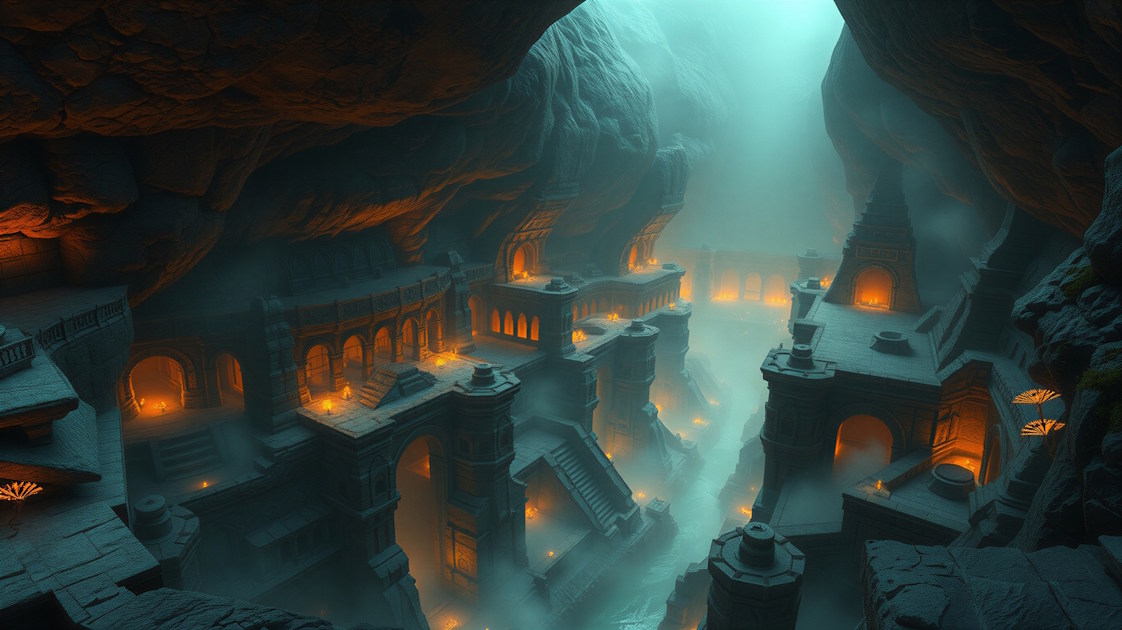
Deep beneath the Alzion Mountains, where tunnels carved through ancient stone descend into a darkness no surface light has ever touched, lies Gugal—one of the great goblin fortress-cities whose name is spoken with dread throughout the eastern reaches of the Four Fiefdoms and the settlements of the Freelands beyond. Alongside Greth in the Ugulls and Grimlock beneath the ruins of Khoras, Gugal stands as a testament to what goblin-kind can achieve when its fractious subspecies unite in common purpose. Yet where Greth is dominated by the brute strength of its gaugath warlord and Grimlock answers to the cunning of a haurek lord, Gugal has forged something rarer and more enduring: a triumvirate council where gaugath, haurek, and imp rule as equals.
The fortress-city's origins trace to the Age of Resilience, that chaotic century following the Fall of the Old Gods when the great human kingdom of Darshavon lay shattered and its people scattered. Goblin war bands, sensing weakness in the surface world, pushed outward from their ancestral tunnels to claim new territory. In the Alzions, several tribes converged upon a vast network of natural caverns where underground rivers had spent millennia hollowing out chambers of staggering size. The gaugaths came down from the high peaks, drawn by reports of defensible stone and mineral wealth. The haureks arrived from deeper passages to the south, recognizing the strategic value of a stronghold positioned between the emerging fiefdom of Seacea and the lawless territories that would become the Freelands. And the imps followed in great numbers, as they always do, providing the labor necessary to transform raw caverns into something greater.
What made Gugal different from other goblin settlements was the manner of its founding. No single warlord seized control through brute force or political manipulation. Instead, the three groups that converged on the site found themselves in a rare equilibrium. The gaugaths possessed the raw strength to hold the upper tunnels and mountain approaches but lacked the numbers to excavate the deeper chambers. The haureks brought engineering knowledge and tactical cunning but could not match the gaugaths in open combat or the imps in sheer manpower. The imps outnumbered both other groups combined but had neither the individual fighting prowess of the gaugaths nor the strategic sophistication of the haureks. Out of this balance—or perhaps out of the mutual recognition that destroying either rival would leave the victor too weakened to hold the prize—the Triumvirate was born.
The Triumvirate Council consists of three rulers who govern Gugal jointly: a gaugath war-chief, a haurek blood-lord, and an imp overlord. Each holds absolute authority over their own subspecies within the fortress-city while sharing power over matters that affect all of Gugal—defense, external raids, resource allocation, and the management of the fortress-city's considerable tunnel network. Decisions require the agreement of at least two of the three council members, a system that prevents any single ruler from acting unilaterally while ensuring that deadlocks can be broken without resorting to civil war. The arrangement is not without tension. Disagreements between council members can simmer for weeks or months, and the political maneuvering within each faction to position the next potential council member is constant and occasionally violent. Yet the system has endured for centuries, outlasting countless individual rulers and surviving internal crises that would have torn a less pragmatic society apart.
The fortress-city itself is arranged in tiers that reflect the preferences and capabilities of its inhabitants. The uppermost levels, where natural fissures in the mountain still admit traces of wind and the faintest suggestion of outside air, belong to the gaugaths. Here, in chambers carved from the living rock of the Alzions, the great bear-goblins maintain their tribal halls, brewing vats, and armories. The gaugath quarters are the most sparsely populated but the most heavily fortified, serving as the first line of defense against any surface assault. Massive gates of iron and stone seal the primary entrances, each one designed to funnel attackers into killing zones where gaugath warriors can bring their devastating strength to bear in close quarters. The war-chief who sits on the Triumvirate traditionally maintains their hall nearest to these gates, a position of both honor and danger that reinforces the gaugath role as Gugal's shield against the world above.
Below the gaugath levels, the fortress-city opens into the sprawling administrative and residential districts controlled by the haureks. These middle tiers represent the heart of Gugal's civilization, such as it is—a labyrinth of corridors, chambers, clan compounds, and marketplaces that would take days to traverse in their entirety. Haurek engineering is on full display here, with sophisticated ventilation systems that circulate air through miles of carved channels, drainage networks that manage the underground rivers running beneath the city, and an elaborate system of traps and defensive mechanisms that can seal entire districts in moments should an enemy breach the upper gates. The haurek blood-lord who serves on the Triumvirate governs from a fortified compound near the center of these levels, surrounded by advisors, witch mothers, and the political apparatus necessary to manage the complex web of clan relationships that defines haurek society.
The deepest and most extensive levels of Gugal belong to the imps, whose vast numbers require equally vast living spaces. These lower tiers extend far beyond the footprint of the upper city, branching outward through tunnel networks that connect to mining operations, fungus farms, underground waterways, and the seemingly endless passages of the Underland itself. The imp quarters lack the architectural refinement of the haurek districts or the imposing grandeur of the gaugath halls, but what they sacrifice in elegance they make up for in sheer scale. Thousands of imps inhabit these levels, their communal warrens buzzing with constant activity as workers cycle through shifts in the mines, the forges, and the construction projects that continuously expand Gugal's reach deeper into the mountains. The imp overlord who represents their subspecies on the Triumvirate is typically chosen not for individual combat prowess but for the ability to coordinate and command these enormous populations—a skill that requires organizational talent and the force of personality necessary to maintain order among the most numerous and volatile of goblin-kind.
Gugal's position in the Alzion Mountains gives it strategic importance that extends well beyond its own borders. The mountain range separates the fiefdom of Seacea to the west from the Freelands to the east, and Gugal's tunnel network reaches toward both. Raiding parties emerge from hidden exits on either side of the mountains, striking at Seacean border settlements and Freelander communities with equal frequency. These raids are carefully planned affairs, coordinated by the Triumvirate to ensure that no single target is hit so often that it provokes a unified military response, while maintaining enough pressure to keep the surrounding human populations off balance and unable to mount an offensive against the fortress-city itself. Caravans traversing the mountain passes are particular targets of opportunity, their goods enriching Gugal's stores while their destruction disrupts the trade routes that connect east and west.
The fortress-city's relationship with the other great goblin strongholds is complex and often competitive. Greth, in the Ugull Mountains to the north, and Grimlock, beneath the ruins of Khoras near the Kallendori capital of Alchester, represent rival power centers whose interests sometimes align with Gugal's and sometimes conflict. Communication between the fortress-cities occurs through grekkel messengers who navigate the deep passages of the Underland, carrying intelligence, trade proposals, and occasional threats between the goblin powers. Gugal's triumvirate model is viewed with suspicion by the more traditional strongholds, where singular warlords brook no sharing of authority. Yet the fortress-city's longevity and military effectiveness have earned it a grudging respect that prevents outright hostility from its goblin neighbors.
The grekkels themselves occupy a unique position within Gugal. Too few in number and too solitary in nature to warrant formal representation on the Triumvirate, they nonetheless permeate every level of the fortress-city, inhabiting the cracks and forgotten spaces between the territories of the three ruling subspecies. Their magical abilities and talent for espionage make them invaluable to all three council members, who employ them as spies, messengers, and saboteurs. The grekkels exploit this demand with characteristic opportunism, selling their services to whichever faction offers the best price while maintaining their own hidden agendas in the shadows between the walls. Their presence is tolerated because their absence would be felt—without grekkel intelligence networks, Gugal's raiding operations would lose much of their effectiveness, and the Triumvirate's ability to monitor threats both internal and external would be severely diminished.
Mining and smithing form the backbone of Gugal's economy. The Alzion Mountains are rich in iron, copper, and various lesser metals that goblin smiths work into weapons, armor, and tools. Deeper excavations have uncovered veins of rarer minerals that command high prices in the black market trade that connects Gugal to the wider world through intermediaries and smugglers. Imp miners work in rotating shifts that never cease, their picks and shovels biting into stone around the clock as the fortress-city's hunger for raw materials drives them ever deeper. The metals extracted from these mines feed a network of forges where haurek engineers and gaugath smiths produce the armaments that equip Gugal's substantial military forces. While individual pieces may lack the refinement of dwarven or eslar craftsmanship, they are produced in quantities that ensure every warrior who marches from Gugal's gates carries functional, durable equipment suited to the brutal realities of goblin warfare.
The brewing traditions that unite all goblin-kind find particularly robust expression in Gugal, where the convergence of three subspecies has produced a blending of techniques and recipes found nowhere else. Gaugath brewmasters contribute their thick mountain stouts, aged in stone casks carved from the Alzion bedrock. Haurek brewers add complexity through unusual ingredients sourced from the deep Underland—strange fungi, mineral-rich waters, and fermented substances that surface dwellers would scarcely recognize as fit for consumption. Even the imps maintain their own brewing traditions, producing vast quantities of a harsh, potent ale that fuels their laboring masses through grueling shifts in the mines and tunnels. The annual brewing competition, one of the few occasions when all three subspecies gather peacefully in a common space, serves as both a celebration of shared culture and a rare moment of unity in a society otherwise defined by factional tension.
Gugal's military strength lies not in any single overwhelming force but in the coordinated deployment of its diverse capabilities. Gaugath shock troops provide devastating close-combat power, their massive frames and bear-like ferocity capable of breaking through fortified positions that would stymie lesser warriors. Haurek tacticians plan and coordinate operations with a sophistication that belies the common perception of goblins as mindless raiders, deploying troops with careful attention to terrain, timing, and the exploitation of enemy weaknesses. Imp formations supply the numbers necessary for sustained campaigns, their vast ranks able to absorb casualties that would cripple smaller forces while maintaining pressure on objectives through sheer persistence. When these elements work in concert—gaugath strength directed by haurek intelligence and supported by imp endurance—Gugal can field armies capable of threatening even well-defended surface settlements.
The defensive capabilities of the fortress-city are equally formidable. Centuries of continuous construction and improvement have created a layered defense system that has never been breached by an external force. The mountain approaches are watched by gaugath sentries whose keen senses can detect intruders long before they reach the concealed entrances. The tunnel networks leading into the city proper are riddled with traps designed by haurek engineers—collapsing passages, flooding mechanisms, concealed pits, and deadfalls that can be activated at a moment's notice to seal off entire sections. Even should an invader penetrate these outer defenses, the internal layout of the fortress-city ensures that every corridor becomes a potential killing ground, with murder holes, barricaded intersections, and hidden passages allowing defenders to strike from unexpected angles before melting back into the labyrinth.
Life within Gugal follows rhythms dictated by the absence of natural light. Without sun or moon to mark the passage of time, the fortress-city operates on cycles maintained by tradition and the practical demands of its various industries. Shift changes in the mines, guard rotations at the gates, and market hours in the haurek districts create a pattern of activity and relative quiet that substitutes for day and night. The constant glow of torches, braziers, and phosphorescent fungi cultivated in the deeper passages provides illumination that ranges from the warm amber of the gaugath halls to the dim, bluish light of the lowest imp warrens. The air carries the mingled scents of forge smoke, brewing vats, cooking fires, and the mineral tang of deep stone—an atmosphere that would be oppressive to surface dwellers but is simply home to the thousands of goblins who have known no other world.
The fortress-city's present-day challenges reflect the broader pressures facing goblin civilization in the Age of Advancement. Human military capabilities have grown more sophisticated, and the increased use of airships has made even the Alzion passes easier to patrol and defend. Seacea, in particular, has strengthened its border defenses in response to centuries of goblin raids, forcing Gugal's war planners to develop more elaborate strategies for penetrating the fiefdom's perimeter. The Freelands, though lacking a centralized military, have proven equally difficult targets as their independent communities have learned through hard experience to maintain vigilance and mutual defense agreements against goblin incursions. These challenges have not diminished Gugal's threat to its neighbors, but they have forced the Triumvirate to adapt, investing in intelligence gathering, tunnel expansion, and the development of new tactics designed to counter human technological advantages.
Despite these pressures, Gugal endures as it has for centuries—a fortress-city born from an unlikely balance of power that has proven more durable than the tyrannies of its rival strongholds. The Triumvirate model, for all its inefficiencies and internal tensions, provides a stability that single-ruler fortresses cannot match. When a gaugath war-chief falls in battle or a haurek blood-lord is deposed by a rival clan, the remaining two council members maintain order while the affected subspecies sorts out its succession. This continuity of governance has allowed Gugal to weather crises that have toppled lesser goblin settlements and to maintain the long-term strategic planning necessary for a fortress-city whose ambitions extend far beyond mere survival. In the deep places beneath the Alzion Mountains, where the ring of hammers on anvils never ceases and the glow of forge fires paints the cavern walls in shifting shades of red and gold, Gugal stands as a monument to goblin persistence, pragmatism, and the dangerous potential of a race too often underestimated by the surface world above.