General Information and History
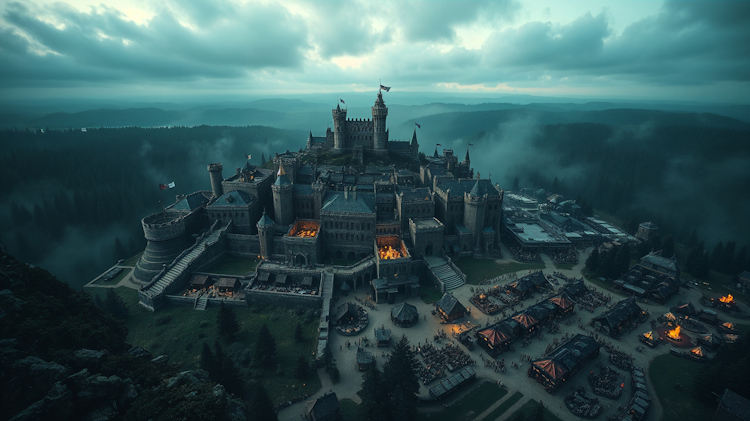
High Holt stands as one of the most notorious settlements in the Freelands, a fortress town where petty lords wage ritualized wars over territory and influence, while mercenary companies grow fat on the profits of their ambitions. Located east of the Alzion Mountains within the Blackwood Forest's sprawling expanse, High Holt embodies the Freelands' defining contradiction: a place of perpetual conflict that has nonetheless endured for centuries, its survival owed not to unity but to the stubborn refusal of its inhabitants to submit to any authority beyond their own.
The settlement consists of two distinct layers. At its core rises the original fortress, a walled stronghold that has changed hands and purpose many times since its founding. Around it, a sizeable town has grown over the centuries, its streets and districts shaped by the needs of commerce, craftsmanship, and the ever-present mercenary trade. Beyond the town walls, a sprawling encampment of mercenary companies expands and contracts like a living thing, swelling when conflict between the lords intensifies and shrinking when temporary truces hold. This camp has developed its own economy of provisioners, smiths, moneylenders, taverns, and combat arenas, creating a chaotic yet functional marketplace that coexists with the more established businesses within the walls.
Governed by the Lord's Council, a collective body of the noble houses that control the surrounding lands, High Holt operates without a single ruling authority. The Council settles disputes, punishes transgressions that threaten the settlement's stability, and manages the shared resources that keep the town functioning. In practice, power within the Council shifts constantly, driven by alliances, betrayals, and the ever-changing fortunes of the lordly houses. People in the Four Fiefdoms do not speak kindly of the Freelands, and High Holt least of all. They call it a lawless land ruled by petty thieves, mercenaries, and lowborn lords of little station. Some of that is true. But High Holt has outlasted many a proper kingdom, and those who live there understand something the outside world often fails to grasp: order does not require a crown.
Historical Periods
The Age of the Old Gods (Before Year 0)
Before the Fall of the Old Gods, the lands that would become High Holt were a remote frontier within the unified Kingdom of Darshavon, far from the high king's court at Oslo and the centers of civilization that flourished under divine patronage. The region's dense forests and hilly terrain made it a natural refuge for those seeking distance from royal authority—outlaws, dissenters, and communities that preferred isolation to compliance. Small settlements existed in the woodland clearings, sustained by timber, hunting, and limited trade with the kingdom's interior.
The Blackwood Forest dominated the landscape then as it does now, its ancient oaks providing shelter and resources but also limiting the kind of large-scale agriculture that supported major population centers elsewhere in Darshavon. The hills that would later host lordly estates served as defensive positions for local chieftains who maintained an uneasy relationship with royal authority—paying tribute when pressed, ignoring it when not. The Three Great Wars that consumed the Old Gods created waves of refugees who pushed eastward into these frontier lands, swelling the scattered communities with people who had every reason to distrust the powers that had failed them.
The Age of Resilience (Year 0 to 100)
The Fall of the Old Gods and the collapse of Darshavon severed whatever tenuous connections the frontier communities maintained with the wider kingdom. As the Four Fiefdoms coalesced to the west and fought over the remnants of civilization, the peoples east of the Alzion Mountains found themselves isolated and, for the first time, truly free. This freedom came at a cost. Without trade networks, royal protection, or the infrastructure that had sustained frontier life, communities either adapted or perished.
During this turbulent century, the hilltop that would become High Holt's fortress saw the construction of its first permanent fortification. A warlord whose name survives only in fragments of local legend recognized the site's strategic value—commanding views of the surrounding forest, defensible slopes, and proximity to freshwater springs. The crude wooden palisade he erected attracted others seeking protection, and a pattern that would define High Holt for centuries began to take shape: a strongman offering safety in exchange for loyalty, rivals challenging that arrangement, and the resulting cycle of conflict and consolidation that passed for governance in a land without kings.
By the end of the Age of Resilience, several competing lordships had established themselves on the hills surrounding the original fortress, each claiming authority over portions of the surrounding territory. The Freelands' ethos of radical independence was already taking root—these lords owed allegiance to no fiefdom, no duke, and no distant throne. They answered only to their own ambitions and to the blades of those who contested them.
The Age of Change (Year 101 to 450)
The Age of Change saw High Holt transform from a loose collection of rival strongholds into something resembling a functioning settlement. As the Four Fiefdoms stabilized to the west and the Freelands developed their own identity as a region apart, High Holt emerged as a natural gathering point for the mercenary companies, traders, and opportunists who thrived in the spaces between established kingdoms.
The fortress itself was rebuilt in stone during this period, replacing the original timber construction with walls capable of withstanding a proper siege. Noble houses established themselves on the surrounding hills, each constructing manors that served as both residences and defensive positions. The Caldwell family, whose silver hawk sigil would become one of High Holt's most recognizable heraldic devices, established their estate on the tallest hill during this era, beginning a dynasty that would endure for generations—along with darker traditions that would remain hidden for centuries.
The formation of the Lord's Council provided High Holt with its first collective governing body. Born not from democratic ideals but from practical necessity, the Council emerged after a particularly destructive period of inter-lordly warfare that threatened to destroy the settlement entirely. The lords recognized that while they might despise one another, they despised the prospect of losing their seat of power even more. The Council's authority remained limited by design—settling boundary disputes, managing shared defenses, and punishing actions that threatened the settlement as a whole—while leaving each lord free to govern his own lands as he saw fit.
The mercenary trade became central to High Holt's economy during this period. As the lords' constant jockeying for position created steady demand for hired swords, companies began establishing semi-permanent camps outside the walls. What started as temporary bivouacs grew into a sprawling encampment with its own infrastructure—forges, provisioners, moneylenders, and the combat arenas that became one of High Holt's most distinctive features.
The Age of Advancement (Year 451 to Present Day — 539)
The current age has seen High Holt continue its centuries-old patterns of conflict and commerce while adapting to the broader changes sweeping the World of Uhl. The mercenary industry remains the settlement's economic engine, with companies like the Black Guard, the Mavens, and the Death Serpents maintaining a presence that fluctuates with the demand for hired steel. The Lord's Council continues to function as a collective governing body, though its effectiveness varies depending on the personalities and ambitions of its current members.
Recent events have tested High Holt's stability in ways both familiar and unprecedented. The exposure of the Caldwell family's generations-long involvement in dark rituals within the Withered Woods—a smaller forest on the western edge of Caldwell's lands, distinct from the Blackwood Forest that surrounds the broader region—sent shockwaves through the Lord's Council. The revelation that one of their most established houses had maintained a blood pact with a forest witch for centuries, sacrificing their own people in exchange for political power, temporarily united the normally fractious lords in a display of collective outrage. Lord Caldwell was forced to surrender a sizeable portion of his lands and pay restitution to the affected villages, though many observed that the rich and powerful, even in the Freelands, rarely face consequences proportional to their crimes.
High Holt's position as a waypoint for travelers and mercenaries moving through the Freelands has also brought it into contact with the growing complexities of the wider world. Airships from the Four Fiefdoms have begun using the Blackwood Forest's clearings as landing sites, and visitors from as far as Panthora and the Southern Reaches now pass through the settlement with increasing frequency. Whether this exposure will change High Holt's fundamental character or simply provide its lords with new tools for their eternal rivalries remains to be seen.
Geography and Key Locations
The Fortress
High Holt's original fortification crowns the central hill, its stone walls a testament to centuries of construction, repair, and reinforcement. The fortress serves as the seat of the Lord's Council and the symbolic heart of the settlement, though its practical importance has diminished as the town expanded beyond its walls. Gates at multiple compass points provide access, with the western gate serving as the primary route toward the outlying farmlands and the forests beyond.
The Lordly Estates
The hills surrounding the fortress host the manor houses of High Holt's noble families, each estate a self-contained stronghold in its own right. The most prominent of these is Caldwell Manor, perched on the tallest hill with commanding views of the settlement and the surrounding countryside. Its great hall, with vaulted ceilings carved in the Caldwell sigil of hawks and thorns, reflects the generational wealth and ambition that characterize High Holt's ruling class. Other estates dot the surrounding elevations, their banners and heraldic devices a visible reminder of the competing interests that define the settlement's politics.
The Town
The town that has grown up around the fortress supports the daily life of High Holt's permanent population. Its streets house merchants, tradespeople, craftsmen, taverns, banks, and the various services required by both the lordly estates and the mercenary encampment beyond the walls. The Sterling Exchange and banking houses like Raddadad and Burnum handle the complex financial transactions generated by the mercenary trade, converting currencies from the Four Fiefdoms, Panthora, and the Southland with varying degrees of honesty. A local brew with a distinctive pear flavor and pleasing aroma has earned a modest reputation among those who frequent the settlement's drinking establishments.
The Mercenary Camp
Beyond the town walls, the mercenary encampment sprawls through the Blackwood Forest's clearings, its size fluctuating with the demand for hired swords. At its peak, the camp hosts multiple companies, each claiming territory marked by their banners and surcoats. The camp supports its own provisional economy—a central square teems with traders, food vendors, acrobats, minstrels, and moneylenders, while Smith's Row rings with the sound of hammers on metal as armorers and weaponsmiths ply their trade. Combat arenas draw crowds of spectators and fighters seeking to test their skills or settle disputes through ritualized combat known as the Challenge. Makeshift taverns spring up wherever a mercenary company sets down roots, their improvised bars serving cheap ale to off-duty soldiers swapping war stories.
The Blackwood Forest
The Blackwood Forest surrounds High Holt in every direction, its ancient oaks forming a vast woodland that defines the region's character. The forest provides timber, game, and natural defenses while also sheltering the various threats—bandits, creatures, and worse—that keep the mercenary companies employed. Trade routes thread through the Blackwood, connecting High Holt to the wider Freelands and, eventually, to the passes through the Alzion Mountains that lead to the Four Fiefdoms beyond.
The Withered Woods
A smaller forest on the western edge of the region, the Withered Woods were once a healthy woodland sheltering several small villages on the borders of Caldwell's lands. In recent years, a creeping corruption transformed the woods into a twisted parody of nature—blackened trunks, unnatural silence, and a spreading rot that consumed crops, livestock, and people. The source of the corruption, a forest witch named Morvena, was eliminated by mercenary captains hired by Lord Caldwell himself, though the full truth of the Caldwell family's involvement in the woods' dark history proved far more damning than the lord anticipated. The forest is now healing, though the scars of Morvena's influence and the centuries of blood magic practiced there will take years to fade entirely.
The Surrounding Farmlands
Between the town and the forests, farmlands support the settlement's basic agricultural needs. These holdings fall under the authority of whichever lord claims the surrounding territory, and the farmers who work them exist in a precarious relationship with their landlords—protected from external threats but vulnerable to the political machinations of the lords they serve. When conflicts escalate, these farmlands often bear the brunt of the consequences, their inhabitants fleeing to the safety of the walls or deeper into the forests.
Economy and Resources
High Holt's economy revolves around the mercenary trade with an almost singular focus. The constant rivalry between the lordly houses creates steady demand for hired swords, and the settlement's reputation as a gathering point for mercenary companies draws warriors, adventurers, and opportunists from across the Freelands and beyond. When conflict between the lords intensifies, the mercenary camp swells, coin flows freely, and the town's merchants, smiths, and provisioners prosper. When temporary truces take hold, the camp contracts, companies move on to seek employment elsewhere, and the settlement's economy tightens accordingly.
This dependence on conflict has produced a perverse but functional economic logic. Peace, in High Holt, is bad for business. The lords understand this as well as anyone, which ensures that their rivalries never quite reach resolution, and the cycle of tension, escalation, and temporary settlement continues to feed the mercenary industry that sustains the town.
Supporting industries include weapons and armor smithing, provisioning, banking, and the various services that a population of transient warriors requires. The Freelands lack their own currency, so High Holt's financial institutions deal in coinage from the Four Fiefdoms, Panthora, and the Southland, exchanging currencies and extending credit with fees that reflect both the risk of doing business in the Freelands and the opportunism of those who facilitate it. Timber from the Blackwood Forest serves as raw material for construction and trade, while the surrounding farmlands produce enough food to supplement imports from the settlement's trade connections.
Culture and People
High Holt's culture is defined by the blade. In a settlement where strength of arms and sharpness of wit determine social standing, the values of the mercenary profession permeate every aspect of daily life. Courage, competence, and the ability to survive are respected above birth, wealth, or title—though the lords who sit on the Council would prefer their subjects believe otherwise. The combat arenas that operate in the mercenary camp serve as both entertainment and proving grounds, where reputations are made and disputes settled through ritualized combat that draws cheering crowds and heavy wagering.
The population is diverse by Freelands' standards, drawing humans from every corner of the known world alongside the occasional dwarf, eslar, or haurek who has found reason to pass through or settle. The mercenary companies themselves represent a cross-section of cultures and backgrounds, united by the common language of contracts and coin. Women serve alongside men in many of the companies, and the settlement's meritocratic culture—such as it is—extends opportunities to anyone capable of seizing them, regardless of origin.
Outsiders from the Four Fiefdoms view High Holt with a mixture of fascination and contempt, dismissing it as a lawless den of thieves and killers. Those who have spent time within its walls recognize a more nuanced reality: a place where the rules are different, not absent, and where the consequences for breaking them are often swifter and more severe than anything a distant king's court might impose. The lordly houses maintain their own traditions of nobility and heraldry, complete with ancestral portraits, family crests, and the elaborate manors that crown the surrounding hills—a veneer of civilization stretched over a foundation of ambition and violence.
Slavery remains legal in the Freelands, and High Holt is no exception, though the practice coexists with a general ethos of personal sovereignty, creating an uncomfortable tension that outsiders quickly notice. Tavern culture thrives, from the established drinking houses within the town to the improvised establishments that spring up in the mercenary camp, their crude signs and barrel-top bars serving as gathering places where information flows as freely as the ale and contracts change hands with subtle nods and coded phrases.
Political Structure
High Holt operates under the Lord's Council, a collective governing body composed of the noble houses that control the lands surrounding the settlement. The Council functions without a single ruling lord, its authority distributed among members who cooperate only insofar as cooperation serves their individual interests. Decisions are reached through negotiation, intimidation, and the shifting alliances that characterize Freelands' politics. The Council's jurisdiction extends to matters affecting the settlement as a whole—shared defenses, boundary disputes between houses, punishment of crimes that threaten collective stability—while leaving each lord autonomous within his own territory.
In practice, the Council's effectiveness depends entirely on the current balance of power among its members. Strong lords with well-funded mercenary forces exert disproportionate influence, while weaker houses scramble to form alliances that might protect them from their more ambitious neighbors. Betrayals are common, alliances are temporary, and the notion of lasting peace between the houses is treated as a pleasant fiction by anyone who has lived in High Holt long enough to know better.
The mercenary companies that operate in and around High Holt exist in a complex relationship with the lordly houses. Hired by individual lords to advance their interests, the companies maintain professional neutrality, allowing them to serve one employer today and his rival tomorrow without lasting allegiance. This transactional relationship keeps the companies independent while ensuring the lords have access to the military force they need to pursue their ambitions. Captains of the most respected companies—forces like the Black Guard, the Mavens, and others of similar reputation—command a degree of influence that sometimes rivals that of the lords themselves, though most prefer to exercise that influence quietly, through the weight of their swords rather than words at a council table.
Current Challenges and Tensions
High Holt faces the same challenge it has faced for centuries: the tension between the individual ambitions of its ruling houses and the collective stability required for the settlement to survive. The recent exposure of the Caldwell family's dark practices has temporarily united the Council, but such unity is historically fragile, and the redistribution of Caldwell's forfeited lands has already created new rivalries as neighboring lords vie for the territory.
The mercenary economy, while reliable in its way, makes the settlement vulnerable to external factors beyond the lords' control. Rumors of potential conflicts in the Four Fiefdoms—including whispers that the Duke of Kallendor entertains ambitions of declaring himself king—threaten to draw mercenary companies away from High Holt in pursuit of more lucrative contracts, potentially leaving the lords without the hired steel they depend upon to maintain their positions.
The growing frequency of contact with the wider world, through airship traffic and travelers from distant lands, presents both opportunities and threats to High Holt's insular culture. New money and new ideas flow into the settlement, but so do new ambitions and new dangers. The Blackwood Forest shelters threats ranging from common banditry to darker forces, as the Caldwell affair demonstrated, and the settlement's decentralized governance makes coordinated responses to such threats difficult, at best.
Perhaps most fundamentally, High Holt must contend with the question that has defined the Freelands since their founding: whether a society built on the rejection of central authority can endure the pressures of a world that grows more connected and more complicated with each passing year. For now, the answer appears to be the same one High Holt has given for five centuries—survival through stubbornness, prosperity through conflict, and order through the understanding that in the Freelands, a sharp blade speaks louder than any law.