Kalthar, the God Between Shadows
Introduction
Kalthar, the God of Assassins, occupies a position in the divine order of Uhl that no other deity claimed and no other deity wanted. He stood apart from the eternal conflict between Luminance and Darkness, neither champion of the light nor servant of the dark, but the god of the space between—the shadow that exists only because both light and darkness exist, the silence between the sounds that makes the sounds meaningful, the agent of balance who operated in the territory that neither side controlled and both sides needed. Other gods fought to tip the scales in their favor. Kalthar existed to ensure the scales remained scales—that neither side achieved the total dominance that would collapse the tension their opposition sustained.
He was worshipped by a secret organization of shadow priests who were also assassins. He governed the act of killing performed with purpose, precision, and the understanding that every ending creates a beginning, every removal creates a vacancy, and every blade drawn in the right cause at the right moment maintains something larger than the life it takes. He was not a god of murder. He was a god of consequence—of the deliberate, considered act that changes the balance of forces in ways that raw power cannot accomplish and that indiscriminate violence would only worsen. The distinction is one that most people do not draw, and that Kalthar drew precisely, because precision was the foundation of everything he embodied.
He is thought dead, fallen in the catastrophe that ended the Age of the Old Gods and extinguished the divine presences that had shaped the world since before recorded history. The Brotherhood of Shadows that served him vanished with the Fall, their order broken by the Holy Knights of Warding and their knowledge scattered across the ruins of the world they had tried to balance. What remains of Kalthar is reputation—the memory of a god who refused the comfort of absolute allegiance and who paid for that refusal with an isolation that no amount of mortal worship could fully compensate for, serving a principle that neither side of the eternal conflict could wholly endorse because both sides understood, at some level, that what Kalthar protected was the possibility of their own defeat.
Appearance & Symbols
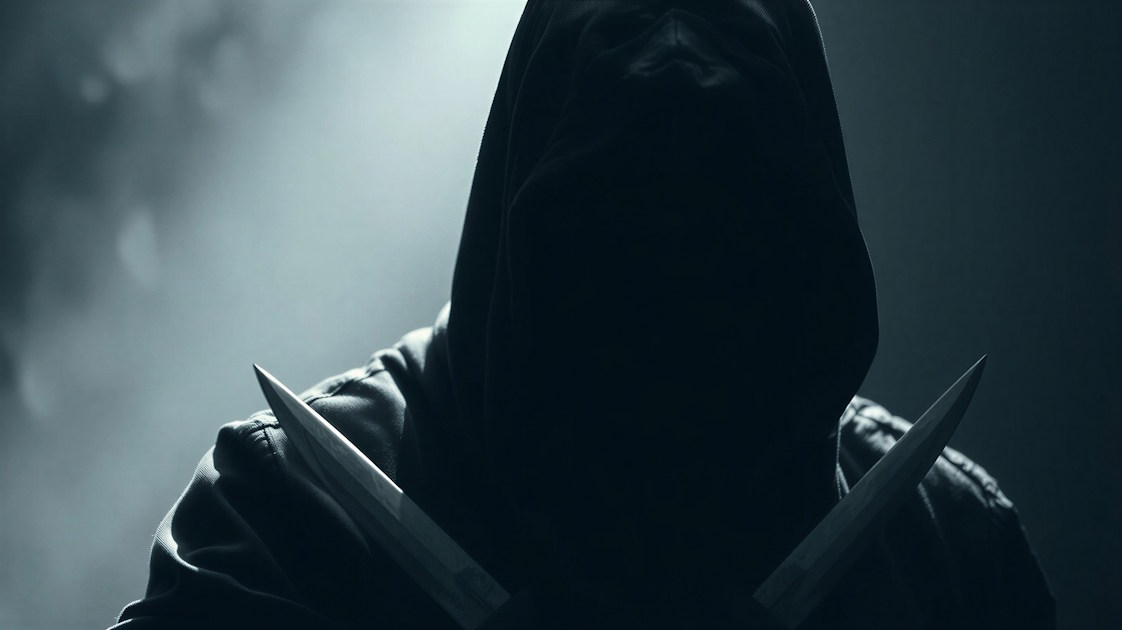
Kalthar appears, in the rare artistic traditions and oral descriptions that have survived the Brotherhood’s dispersal, as an assassin. Not a god taking the form of an assassin as a disguise or a condescension to mortal understanding, but a being whose essential nature expresses itself most honestly in the form of a practitioner of the killing trade: dark clothing that drinks the light rather than reflecting it, a hood drawn low over features that are present without being visible, a mask that conceals identity without quite concealing the attention of the eyes behind it. He carries weapons—knives at his belt, a sword at his back, and the miscellaneous tools of calculated violence that his profession requires—not as symbols of martial power but as working instruments, maintained and ready, the equipment of someone for whom killing is a practice rather than a performance.
The darkness of his appearance is not the absolute darkness of void but the particular darkness of shadow—a darkness that requires light to exist, that is defined by its relationship to illumination rather than by its independence from it. Observers who have encountered depictions of Kalthar in the oldest surviving Brotherhood texts describe an impression not of malevolence but of absolute stillness, the quality of a predator so completely at rest that the eye slides past it even when looking directly at it. He is present in every representation, but never quite fully there—the edge of the hood always in partial shadow, the features behind the mask always slightly indistinct, the overall impression of a being who occupies the threshold between visible and invisible as naturally as other beings occupy the solid ground beneath their feet.
His primary symbol is the Shadow Blade—a knife depicted half in light and half in darkness, its illuminated edge sharp and precise, its shadowed edge dissolving into the background as though the blade itself is only partially present in any given moment. This symbol appears in the oldest Brotherhood texts, carved into the walls of their hidden sanctuaries, and stamped onto the tokens that members used to identify themselves to each other in the dangerous anonymity of their profession. Secondary symbols include the Half-Face, a mask divided precisely between a white half and a black half that represents Kalthar’s position between the two great forces of the cosmos, and the Crossed Knives in Shadow, which appears in later Brotherhood iconography and represents the trade through which his will was enacted.
He casts no shadow himself. The Brotherhood considered this detail theologically significant: Kalthar is the shadow, not its source, and a shadow cannot cast another shadow without a light to create it and a surface to receive it. In the darkness between stars, Kalthar is everywhere. In full daylight, he is nowhere. The spaces where he operates are exactly the boundaries between these states, and the practitioners who served him learned to seek those spaces, to make themselves at home in the threshold territory that most beings merely passed through.
Origins & Nature
Kalthar’s origins are distinct from those of the gods who emerged directly from the forces of Luminance or Darkness. He was not created by either power, did not serve either power, and did not define himself in relation to either power except insofar as both powers were necessary for his existence. Shadow requires both light and darkness to exist—it is not the absence of light but the specific interaction of light and darkness at a boundary, and Kalthar was that boundary given divine form. He arose where the two forces met, in the contested territories between absolute illumination and absolute void, and the nature he acquired from this origin was as much defined by what he was not as by what he was.
The oldest theological texts that reference Kalthar describe him as a god of necessity rather than preference—a divine being whose existence was required by the structure of the cosmos rather than desired by any party within it. The forces of Luminance did not want a god who would prevent their ultimate triumph. The forces of Darkness did not want a god who would prevent theirs. Yet both forces needed an agent capable of intervening when the balance tilted too far in either direction, because the annihilation of either side would eventually consume the victor as well—a truth that the combatants could not acknowledge without undermining their own claims to absolute righteousness, but that the structure of the cosmos enforced regardless of their preferences. Kalthar was that enforcement. He was the universe’s acknowledgment that neither side was entirely right, delivered in the form of a god who would act on that acknowledgment whether either side welcomed it or not.
His relationship with the assassination trade was not accidental. Killing, performed with deliberate purpose and precise targeting, is one of the few acts capable of altering the balance of forces without escalating the conflict that generates the imbalance. An army defeats an army by opposing force with force, creating a cycle of escalation that tends toward the annihilation of one side or the other. An assassin removes a specific individual whose presence is creating an imbalance, leaving the underlying forces intact but redirected. Kalthar recognized in this approach the same principle he embodied: that the most effective interventions are the targeted ones, that precision accomplishes what brute force cannot, and that the shadow between opposing forces is the only territory from which both can be seen clearly enough to understand what each actually requires.
Domains & Attributes
Kalthar’s primary domain is balance—not the static balance of equally matched forces in permanent stalemate, but the dynamic balance of a system maintained in productive tension through the active intervention of an agent willing to act wherever the tension threatens to collapse into dominance. He governs the threshold between opposing states: light and darkness, life and death, exposure and concealment, order and chaos. These thresholds are his territory, and the beings who operate along them—those who move between states rather than inhabiting either permanently—fall under his particular attention and protection.
His second domain is the deliberate, purposeful act of killing. Kalthar makes no claim to the whole of death, which belongs to larger and older forces than any god of his particular character could encompass. What he governs is the specific subset of killing that is performed with intent, precision, and the understanding that the act serves a purpose beyond the immediate transaction between killer and target. The assassin’s art, as Kalthar’s Brotherhood understood it, was a spiritual discipline as much as a martial one—a practice that required the practitioner to understand the consequences of the act before committing to it, to ensure that what was removed needed removing, and to perform the removal with a cleanness that honored the gravity of what was being done.
Shadow magic constitutes his third domain—the ability to move unseen, to exist in the boundary between visibility and invisibility, to occupy the spaces that observation overlooks and that memory fails to retain. Kalthar’s shadow magic is not the dark magic of necromancy or corruption but the neutral magic of concealment—the power to be present without being perceived, to act without being seen, and to withdraw without leaving traces that could be followed back to their source. The shadow priests of his Brotherhood mastered these techniques as both practical tools of their trade and spiritual expressions of their god’s nature: beings who moved through the world as Kalthar moved through the cosmos, in the spaces between the forces that other beings inhabited.
Precision and patience complete his domains. Kalthar governed the discipline of waiting for exactly the right moment and striking with exactly the right force—not more, not less, but the precise application of capability that accomplishes the objective without creating the collateral consequences that excess generates. This precision was both a tactical doctrine for his Brotherhood and a theological statement about the nature of Kalthar’s interventions in the cosmic conflict: he did not attempt to shift the balance permanently in any direction but to correct specific imbalances with specific actions, and the correction ended when the balance was restored.
Personality & Character
Kalthar is described in Brotherhood texts with a consistency that suggests genuine theological understanding rather than mythological invention: he is calm, patient, precise, and entirely without the dramatic quality that characterizes most divine personalities. He does not rage. He does not celebrate. He does not grieve, inspire, or demand devotion with the emotional intensity that other gods bring to their relationships with their worshippers. He observes, assesses, and acts when action is required, and he withdraws when it is not. When he does withdraw, it is complete, leaving no trace of presence in the spaces he has vacated.
His patience is absolute in the way that Brunhilde Gemheart’s patience was absolute—not the patient endurance of someone waiting for something to happen, but the patient attention of someone who understands that the right moment will arrive and that the cost of acting before it arrives exceeds the cost of continuing to wait. Kalthar never acted in haste. The Brotherhood texts describe a god who could watch an imbalance develop for years before intervening, not because he was indifferent to its development but because he understood that premature intervention would produce a correction that required correction, while well-timed intervention would produce a correction that held.
His loyalty to neither side of the eternal conflict was the quality that most isolated him among the divine order and that most defined the character of those who served him. The shadow priests of the Brotherhood occupied the same social position among mortals that Kalthar occupied among gods: neither fully accepted by either side, viewed with suspicion by those who required absolute allegiance, and possessing a clarity about the costs and benefits of their position that allowed them to perform it without the bitterness that might otherwise accompany such consistent rejection. Kalthar understood that he was not liked by the forces whose excesses he corrected. He did not require their approval. He required their continued existence, and the balance he maintained served that requirement, whether they appreciated it or not.
The quality that the Brotherhood valued most in their god, and that they attempted to cultivate in themselves, was what their texts call “the empty blade”—the state of a weapon that is neither sheathed nor drawn, neither committed to action nor withdrawn from it, but held in perfect readiness without the tension that readiness normally produces. Kalthar existed in this state permanently, poised at the threshold between intervention and restraint, capable of acting without anticipating action, capable of waiting without resisting the wait. His shadow priests spent their entire training attempting to achieve a moment of this state. The best of them achieved it occasionally. Kalthar inhabited it completely.
The Brotherhood of Shadows
The Brotherhood of Shadows was the organization through which Kalthar enacted his will in the mortal world—a secret order of shadow priests who were also assassins, trained in the simultaneous practice of spiritual discipline and lethal skill, dedicated to the maintenance of balance between Luminance and Darkness through targeted interventions that neither side could accomplish for itself. The Brotherhood drew members from multiple races, united not by blood or nation but by their devotion to Kalthar and their acceptance of the principle that his service required: that balance mattered more than victory, that the health of the system mattered more than the triumph of any component of it, and that the willingness to act against the interests of either side when those interests threatened to become dominant was not betrayal but the highest form of loyalty to the cosmos that produced them both.
Initiation into the Brotherhood was a process designed to eliminate candidates who wanted to be assassins and select candidates who could become something more difficult: practitioners who understood killing as a sacred discipline, who accepted its gravity without either relishing it or flinching from it, and who could maintain the emotional equilibrium necessary to assess each target’s removal in terms of its consequences for the balance rather than in terms of personal satisfaction, moral judgment, or the preferences of whichever client was paying. The Brotherhood did accept payment for their services—they were not impractical idealists who believed that principle could sustain an organization without resources—but the contracts they accepted were evaluated not just for their fee but for their contribution to the balance Kalthar had charged them to maintain. A contract that paid well but that would tip the scales too far in any direction was refused, regardless of the sum offered.
The shadow magic that members of the Brotherhood practiced was taught first as a spiritual discipline, then as a practical skill. Initiates learned to move without sound, to conceal themselves in incomplete darkness, to pass through spaces that seemed too small to contain them, and to withdraw from scenes without leaving the traces—disturbed dust, displaced air, the residual warmth of presence—that other practitioners inadvertently left behind. These techniques served the obvious purpose of making the Brotherhood’s members effective at their work. They also served the theological purpose of embodying Kalthar’s nature in the practitioners who served him: beings who existed at the threshold between visible and invisible, who were present in the world but not fully of it, and who left the world they moved through as balanced as they had found it—no more disturbed than necessary, no less changed than required.
The Brotherhood’s targets were selected according to criteria that their leaders maintained in records that have never been recovered. What is known from surviving accounts is that Brotherhood contracts tended to cluster around moments when the balance between Luminance and Darkness was shifting in ways that threatened to become permanent—when a champion of one side achieved an advantage that the other side lacked the capacity to counter, when a leader whose removal would allow the natural balance to reassert itself had become too protected to be reached by conventional means, or when an individual whose continued existence was driving events toward a catastrophic imbalance needed to be removed before the catastrophe became irreversible. The Brotherhood did not prevent conflicts. They prevented conclusions.
The Fall of the Brotherhood
The Brotherhood’s destruction came from the one failure that Kalthar’s doctrine most explicitly warned against: the abandonment of the shadow for the open field. For centuries, the Brotherhood had operated with the discipline their god’s nature demanded—hidden, targeted, precise, striking from concealment and withdrawing before their presence could be confirmed. This discipline was both tactically effective and theologically sound, reflecting Kalthar’s own mode of operation at the cosmic level. What destroyed the Brotherhood was not an enemy too strong to resist but an alliance too tempting to refuse.
The shadow dragon Malefang offered the Brotherhood what their discipline had always denied them: open power, visible force, the ability to act without concealment, and to be acknowledged as the agents of balance they believed themselves to be. The offer was corrupting precisely because it appealed to something legitimate—the Brotherhood’s genuine belief in the importance of their work and their genuine frustration at operating in anonymity while the forces whose excesses they corrected received the acknowledgment that their own efforts never could. Malefang understood this frustration, and Malefang exploited it, and the Brotherhood that emerged from the alliance was a fundamentally different organization than the one Kalthar had built: no longer a force of the threshold but a participant in the conflict, no longer maintaining balance but tipping it, no longer invisible but visible and therefore vulnerable.
The Holy Knights of Warding broke the Brotherhood in open battle—the battle that Kalthar’s own doctrine had always insisted his servants could not win and should never attempt. When Malefang fell, the Brotherhood’s confidence in the alliance’s invincibility fell with it, and the organizational structure that had sustained centuries of careful, disciplined operation fractured under the sudden exposure of its central vulnerability: the Brotherhood’s strength had always been its invisibility, and invisibility, once abandoned, cannot be immediately recovered. The Warding Knights pursued the scattered Brotherhood with the systematic thoroughness of a military force that had been preparing for exactly this opportunity, and what survived the pursuit were fragments—individuals and small cells who went to ground and maintained their anonymity but who lacked the connections and resources to reconstitute the organization that had been dismantled.
The Death of Kalthar
Kalthar’s death, like his life, is not clearly documented. The god who occupied the space between Luminance and Darkness left no clear record of his passing, and the Brotherhood that might have preserved such a record had been scattered before the Fall of the Old Gods completed what the Warding Knights had begun. What scholars have pieced together from surviving texts suggests that Kalthar’s end was consistent with his nature: not a dramatic final battle, not a sacrifice of cosmic significance, but a withdrawal so complete that it became permanent—a god of the threshold crossing the final threshold and not returning.
The Brotherhood’s dispersal had already severed the network of devotion through which Kalthar’s presence was sustained in the mortal world. Without his shadow priests to serve as conduits between his domain and the world he had dedicated himself to balancing, the interventions that had expressed his will became impossible, and a god who cannot act is a god whose existence has become theoretical. The Fall of the Old Gods, which extinguished presences far more robust than Kalthar’s diminished state, almost certainly completed what the Brotherhood’s destruction had begun. He is thought dead by every serious scholar who has studied the question, categorized with the other Old Gods whose divine fires burned out in the cataclysm that ended the age they had shaped.
Whether Kalthar knew his end was coming is a question that the surviving Brotherhood texts leave unresolved. A god of patience and precision who had observed the development of imbalances for years before acting would presumably have recognized the trajectory that led to his own dissolution. Whether he attempted to prevent it or accepted it as the final expression of the principle he had always served—that the balance requires sacrifice from every quarter, including the guardian of the balance itself—is not recorded. The silence in the historical record at this point is either an absence of evidence or the most characteristic thing Kalthar ever did: leaving the scene so completely that no trace remained to be interpreted.
Legacy & Enduring Influence
Kalthar’s legacy persists not in organized worship or institutional continuity but in the professional culture of assassination itself, which carries traces of his theological framework in its most deeply embedded assumptions about what the trade is for and what distinguishes its highest practitioners from common killers. The understanding that assassination is a discipline rather than a profession, that the deliberate targeting of individuals whose removal serves a larger purpose is categorically different from indiscriminate violence, and that the practitioner bears responsibility for assessing the consequences of their acts rather than simply executing the contracts they accept—these principles circulate through the culture of Drax-Korrum and the guilds it influenced, stripped of their theological framing but preserving the essential ethical structure that Kalthar’s Brotherhood had built around them.
The Brotherhood itself is remembered primarily through its failure rather than its centuries of success—a historical irony that Kalthar would presumably have found instructive rather than unjust. The alliance with Malefang and the subsequent destruction at the hands of the Warding Knights is the story that survives, preserved in the accounts of those who witnessed the Brotherhood’s end and in the texts of scholars who studied the wreckage of the organization. The centuries of careful, invisible work that preceded the catastrophic end are largely unrecorded because they were, by design, invisible. The Brotherhood’s greatest successes left no evidence of their occurrence, and history, which can only record what is observable, has consequently underestimated the significance of what was lost when the order fell.
Occasional attempts to revive the Brotherhood have emerged in the centuries since its destruction, motivated by both genuine devotion to Kalthar’s principles and the more pragmatic recognition that a secret organization of trained assassins dedicated to the maintenance of balance would be an extraordinarily useful instrument for anyone who could claim to lead it. None of these revivals has achieved the organizational coherence or the theological authenticity of the original Brotherhood, though their existence suggests that the principle Kalthar embodied retains its appeal even in the absence of the divine presence that originally gave it form.
Worship & Observances
Kalthar was not worshipped publicly, and the Brotherhood that served as his priesthood operated under such strict anonymity that conventional religious observance was structurally impossible. The shadow priests did not build temples. They did not conduct public ceremonies. They did not proselytize or recruit openly or in any way that would have made their affiliation visible to observers. Their worship was entirely private, entirely personal, and entirely embedded in the practice of their profession—each act performed in Kalthar’s service was itself a form of devotion, and the discipline with which it was performed was the measure of the devotion’s quality.
The Brotherhood’s internal observances, reconstructed from surviving fragments, centered on the concept of preparation rather than petition. Shadow priests did not pray to Kalthar for assistance, guidance, or protection. They prepared—sharpening blades, maintaining equipment, reviewing the assessment of a target with the thoroughness that Kalthar’s standards demanded—and the preparation itself was the prayer, the act of making oneself worthy of the god’s work a more meaningful expression of devotion than any verbal formula. A shadow priest who went into an assignment with a dull blade or an incomplete understanding of the target’s circumstances was not merely tactically deficient but theologically negligent, having failed the preparation that constituted their primary religious obligation.
The one formal observance that surviving texts describe consistently is the Threshold Vigil—a period of solitary silence conducted before any significant assignment, during which the shadow priest sat at the boundary between light and shadow, neither fully illuminated nor fully concealed, and assessed the balance implications of the work they were about to perform. The vigil was not a request for Kalthar’s blessing. It was a final evaluation, conducted in the manner and the location most appropriate to a god of thresholds, ensuring that the action being contemplated was genuinely necessary for the balance rather than convenient for the Brotherhood, the client, or the priest’s own preferences.
Sayings & Proverbs
The Brotherhood’s theological tradition produced a body of sayings that circulate in attenuated form through the professional culture of assassination, their origins in Kalthar’s worship forgotten but their practical wisdom preserved by practitioners who find them useful regardless of their source.
“The shadow serves neither sun nor night” is the Brotherhood’s most fundamental theological statement, expressing Kalthar’s independence from both the forces of Luminance and Darkness. In its broader application, the saying is used to describe practitioners who refuse to pledge absolute allegiance to any patron, maintaining the independence that allows them to assess each situation on its merits rather than through the distorting lens of partisan commitment. Among assassins, it carries the additional meaning that competent practitioners do not allow their personal preferences for clients or targets to influence the quality of their assessment.
“The empty blade is readier than the drawn one” distills Kalthar’s doctrine of patient readiness into a single phrase, counseling against the premature commitment that narrows options and creates vulnerabilities. The drawn blade has announced its intentions. The empty blade retains all possibilities. In the Brotherhood’s theological framework, Kalthar’s power derived precisely from this quality—his capacity for action was not diminished by restraint but preserved by it, held at constant readiness without the tension that readiness normally produces.
“Precision serves balance; violence serves itself,” expresses the Brotherhood’s fundamental distinction between Kalthar’s domain and the crude power that other forces employed. Violence that exceeds its necessary scope creates imbalances rather than correcting them, requiring further correction in a cycle that tends toward escalation rather than equilibrium. Kalthar’s practitioners were trained to use exactly the force required and nothing more, understanding that excess was not just tactically inefficient but theologically incorrect—a failure to embody the precision that their god represented.
Sacred Sites
The Brotherhood maintained hidden sanctuaries rather than temples—spaces carved into the boundaries between inhabited and uninhabited zones, positioned at the physical thresholds that mirrored Kalthar’s theological domain. Caves at the edge of cities, underground chambers beneath crossroads, rooms concealed within the walls of buildings rather than within their identifiable spaces—these were the Brotherhood’s sacred spaces, chosen not for grandeur but for the quality of threshold they embodied. The sanctuaries served as training facilities, libraries of the Brotherhood’s accumulated knowledge, and the spaces where the Threshold Vigil was conducted before significant assignments.
Most of the Brotherhood’s sanctuaries were destroyed by the Warding Knights following the organization’s defeat, their locations identified through the interrogation of captured members or through the same methodical investigation that had broken the Brotherhood’s organizational structure. A small number are believed to have survived undiscovered, their concealment so thorough that not even the systematic search of the victorious Knights could locate them. If these sanctuaries still exist, they contain whatever records the Brotherhood maintained of their operations, their theology, and the centuries of targeted interventions through which they enacted their god’s will. Their contents, if ever recovered, would represent the most complete surviving record of Kalthar’s worship and the most comprehensive account of the invisible work that the Brotherhood performed in the centuries before its fall.
Concluding Remarks
Kalthar, the God Between Shadows, is dead—or as dead as a being constituted of the boundary between life and death can be, which is perhaps a more complicated state than the word implies. He is gone from the world, his divine presence extinguished with the rest of the Old Gods in the catastrophe that ended the age he had occupied, his Brotherhood scattered and broken before the Fall completed what the Warding Knights had begun. What remains is principle: the understanding that balance requires active maintenance, that precision serves what force cannot, and that the most necessary interventions are often the invisible ones—the corrections that work because they are not recognized as corrections, the presence that achieves its purpose because it is never confirmed as present.
He occupied a position that no other god claimed and that the world, in his absence, has not replaced. The eternal conflict between Luminance and Darkness continues without the agent who monitored its excesses, and whether the balance Kalthar maintained has suffered in his absence or whether the cosmos has found other mechanisms for preventing either side’s total dominance is a question that scholars debate and practitioners consider in the quiet hours before difficult assignments. The shadow priests who served him are gone. The sanctuaries where they were prepared are hidden or destroyed. The records of what they accomplished are lost with them. And the god who stood between the great forces of the world, watching with the absolute patience of a being for whom time was a tool rather than a constraint, has withdrawn to wherever gods go when the world no longer sustains them.
The blade is sheathed. The shadow is empty. The threshold stands unguarded, and on both sides of it, the forces that Kalthar balanced continue their ancient conflict without the quiet hand that once corrected their excesses. Whether that correction is missed, whether its absence is felt in the slow tilting of the scales that no agent now exists to right, is a matter that the world is still in the process of discovering—one imbalance at a time, one consequence at a time, in the slow accumulation of a reckoning that Kalthar’s presence would have prevented and that his absence has made inevitable.