KAZAD-GRIMM
Introduction
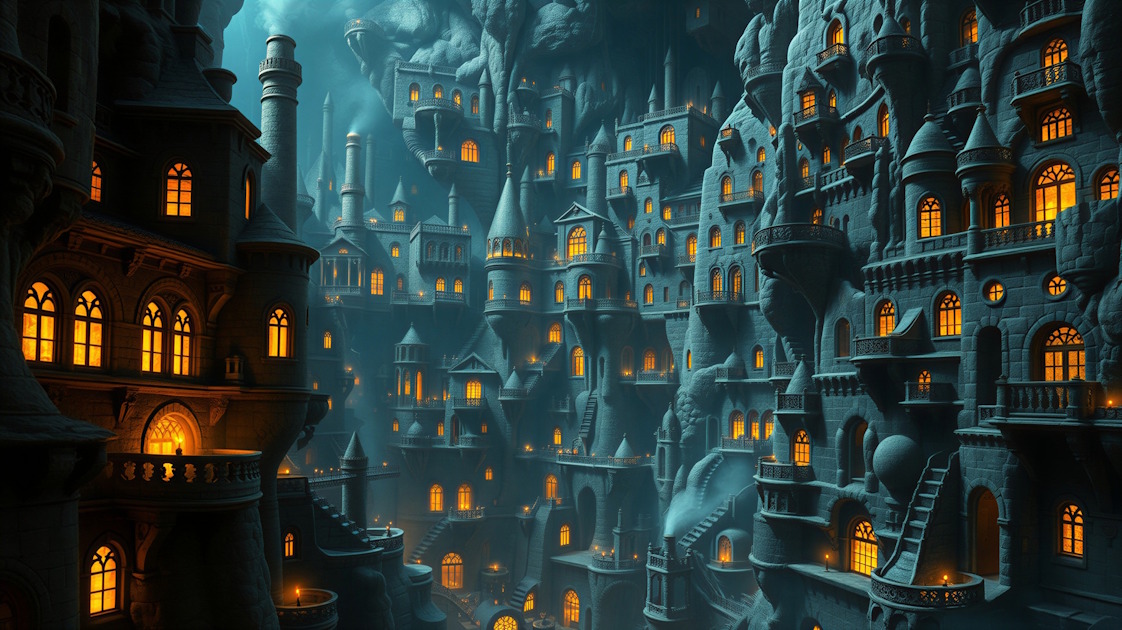
Kazad-Grimm, the One Kingdom Below, is arguably the greatest achievement in the history of dwarven civilization—a unified underground realm whose scope, complexity, and ambition have not been matched in the five centuries since its destruction. At its height, the kingdom stretched beneath every major mountain range of Uhl, connected by hundreds of miles of carved highways wide enough for supply wagons to travel abreast, linking communities separated by distances that would have required weeks of surface travel into a single coherent civilization that moved goods, messages, and armies with a speed and efficiency the modern world cannot replicate. Under the rule of a single High King who governed from the Throne of Seven Hammers in the great capital, the dwarves of Uhl were one people, and what they built together dwarfs anything the Seven Thanes scattered in their isolation have managed since.
The kingdom endured across ages, its people carving deeper and broader into the earth with each generation, expanding their domain, refining their craftsmanship, and developing the engineering principles that would define dwarven civilization for all time. Its master-crafters set the standards against which every subsequent dwarven artisan has been measured. Its engineers built structures whose techniques surviving thanes can observe in the occasional sealed chamber broken into by modern miners, but cannot reproduce, the knowledge of their construction having been lost with the kingdom itself. Its historians preserved traditions going back to the earliest days of dwarven existence in forms that made the past present, and its governance system balanced the competing interests of geographically diverse communities with a sophistication that the perpetually feuding Seven Thanes find impossible to achieve.
Yet for all its magnificence, Kazad-Grimm was not eternal. The kingdom that had endured through every previous challenge could not survive the catastrophe that ended the Age of the Old Gods. The divine warfare that shook the world above sent geological shockwaves through the earth below, collapsing tunnels, destroying the capital, and severing the highways that had held the kingdom together. The fall was not instantaneous but agonizingly gradual—a process by which communication failed, isolated communities lost contact with the center, supply lines withered, and a civilization that had been a single unified organism slowly died of disconnection. What remains of Kazad-Grimm exists now in sealed chambers, in oral traditions, in the ruins that the Seven Thanes occasionally discover in their own deep excavations, and in the dream of reunification that every generation of dwarves inherits and every generation fails to achieve.
Through the Ages
Origins and the Early Kingdom
The origins of dwarven civilization reach back further than any other race can reliably trace, into a period of the world's history before the divine powers took their final forms and before the surface races had organized themselves into the communities that would later become nations. The earliest dwarves were neither the unified people of Kazad-Grimm's golden age nor the isolated clans of the modern thanes, but something in between—scattered tribal groups occupying individual mountain strongholds, connected by cultural kinship and occasional trade, yet lacking the political unity that would define later dwarven civilization.
The process of unification began with the recognition that the deep earth offered challenges no single community could meet alone. The goblin populations that inhabited the Underland—the vast subterranean realm beneath the mountain ranges—represented a constant threat to isolated dwarven halls. The mineral deposits most valuable to dwarven industry often lie in regions between established communities, requiring either cooperation or endless conflict to exploit. And the underground highways that would become Kazad-Grimm's defining infrastructure could only be built through coordinated effort across generations.
The first High King, whose name the oral traditions preserve as Kazad Ironforge, unified the scattered dwarven halls through a combination of diplomatic skill, military prowess, and the articulation of a vision that resonated with communities who had long felt the vulnerability of isolation. His argument was simple and practical: the dwarves faced threats too large for any single hall and opportunities too rich for any single community to develop. Unity was not merely desirable but necessary for survival and prosperity. The Compact of Seven Hammers, the founding document of Kazad-Grimm, bound the original seven halls together under a single High King while preserving substantial autonomy for each community in its internal affairs.
The name Kazad-Grimm itself combines the old dwarven words for “stone-seat” and “deep-home,” reflecting both the physical reality of the kingdom—a civilization rooted in stone, delving ever deeper—and the philosophical orientation that distinguished dwarven culture from all other surface races. Where humans looked outward to the horizon and the sea, dwarves looked inward and downward, finding in the earth’s depths not darkness and claustrophobia but comfort, resource, and the foundational stability upon which all genuine achievement rests.
The Age of the Old Gods
The Age of the Old Gods represented Kazad-Grimm at its greatest extent and most profound achievement. The underground highways that connected every major hall ran for hundreds of miles through engineered passages of remarkable stability, their routes carefully calculated to avoid geological fault lines and underground water sources while maximizing accessibility to the mineral deposits that sustained dwarven industry. These highways were maintained by a dedicated engineering corps whose responsibilities included not merely repair but continuous improvement—widening passages that proved too narrow for heavy supply wagons, reinforcing sections threatened by seismic activity, and extending the network into newly opened territories as exploration revealed promising regions for settlement or mining.
The capital, where the High King ruled from the Throne of Seven Hammers, stood at the convergence of the major highway routes in a cavern system of natural magnificence enhanced by centuries of dwarven craftsmanship. The central hall where the throne sat rose to a vaulted ceiling sixty feet above, supported by columns carved from the living rock and decorated with relief sculptures depicting the kingdom's history and the deeds of past High Kings. The throne itself—seven massive hammer-shaped projections of worked iron and precious metals rising from a seat carved from the deepest black stone found in the kingdom—was less a functional chair than a symbol of everything the kingdom represented: strength, craftsmanship, the union of the seven founding halls, and the authority of the dwarven people over the deep places of the world.
During this era, the kingdom’s relationship with the surface world was carefully managed but genuinely cooperative. Dwarven engineers contributed to the infrastructure projects of Darshavon, the great human kingdom above, whose roads and aqueducts benefited from dwarven expertise in stone construction. Masterwork weapons and armor flowed upward through trade, exchanged for agricultural products and surface goods that the underground kingdom could not produce. These relationships were understood by both sides as partnerships of mutual benefit, conducted with the formality and respect that dwarven culture extended to honorable trading partners regardless of race.
The Three Great Wars and Their Underground Consequences
The Three Great Wars that raged among the Old Gods were experienced very differently underground than on the surface. While surface peoples witnessed the visible manifestations of divine conflict—earthquakes, storms of supernatural intensity, the physical destruction of battlefields—the dwarves of Kazad-Grimm experienced the same events as geological catastrophes whose causes were remote but whose effects were immediate and concrete. Each of the Three Great Wars produced seismic events that damaged portions of the underground highway network, required emergency engineering responses to prevent the collapse of inhabited chambers, and disrupted the mining operations that sustained the kingdom’s economy.
The first two wars were survivable. Kazad-Grimm’s engineering capabilities proved sufficient to address the damage, and the kingdom’s centralized organization allowed rapid deployment of resources to affected areas. The kingdom emerged from each conflict with its fundamental structures intact, though with significant losses of life and infrastructure that required years of recovery. These experiences reinforced the dwarven cultural values of patience, resilience, and the importance of maintaining reserves sufficient to weather unexpected crises.
The Third Great War was different in both kind and degree. The divine cataclysm that destroyed the Old Gods and ended the Age of their influence was not merely a larger version of what had come before, but a fundamentally different phenomenon—a geological event of such magnitude that it altered the basic structure of the underground realm on which Kazad-Grimm depended. Major fault lines that had been stable for millennia shifted simultaneously. Underground rivers changed course, flooding passages that had been dry for centuries. The cavern systems that had provided the kingdom’s most spacious inhabited chambers collapsed in sequences that overwhelmed any engineering response, each collapse triggering additional failures in surrounding structures.
The Fall (Year 0)
The destruction of the capital was the event that transformed a geological catastrophe into civilizational collapse. The convergence point of the kingdom’s major highways, the location of the Throne of Seven Hammers, and the seat of High Royal authority, the capital was also the point of greatest geological vulnerability—the massive cavern system that housed it had been enlarged and modified by centuries of construction to such an extent that the natural rock formations providing stability had been compromised in ways that the kingdom’s engineers had recognized as a concern but never addressed with sufficient urgency.
When the final divine cataclysm struck, the capital fell. The sequence of collapses that consumed it played out over days rather than hours, each chamber falling in turn as its supporting structures gave way, until the vast space that had housed the Throne of Seven Hammers was buried beneath hundreds of feet of fallen stone. The High King perished in the capital. The senior members of the High Council who had not already fled died with him. The Compact of Seven Hammers, the founding document that had defined the kingdom’s governance, was lost along with the libraries and archives that had preserved centuries of accumulated knowledge.
In the immediate aftermath, the surviving halls found themselves connected to the highway network but not to one another. Passages that had carried traffic daily were blocked by collapses. Communication systems that depended on relay stations throughout the network fell silent as stations lost their operators and power sources. Communities that had always known themselves as part of a greater whole suddenly experienced a silence from the center that grew more alarming with each passing day, then week, then month, without a word from the capital or an explanation of what had occurred.
The Aftermath
The century following the Fall—the Age of Resilience—saw the surviving dwarven halls confront the reality of their isolation in ways that each community processed differently based on its location, resources, and leadership. Those closest to the destroyed highways initially tried to clear the blockages and restore communication, deploying their best engineers to projects that proved impossible with the resources available to a single, isolated hall. Those furthest from the capital, who had always operated with greater self-sufficiency, adapted more readily to independence, their responses shaped by a pragmatism that accepted the present reality rather than working to restore what had been.
The critical decisions made during this period determined the character of each surviving thane for centuries to come. Halls that directed their resources toward self-sufficiency developed the specialized cultures and capabilities that now define communities like Dwathenmoore and Rillock. Halls that persisted in attempting to restore contact with neighbors expended resources on efforts that ultimately failed, emerging from the Age of Resilience with capabilities depleted by decades of misdirected effort. The diversity that characterizes the modern Seven Thanes is in large part the legacy of these divergent responses to the same foundational catastrophe.
Culture and Society
The culture of Kazad-Grimm was shaped by the unique conditions of a civilization that had achieved what no other dwarven community had managed—the unification of geographically dispersed communities into a single political and cultural entity without requiring those communities to abandon their local identities. The challenge of maintaining coherent cultural identity across hundreds of miles of underground passages, among halls that might not communicate in person more than a few times per decade, demanded institutional solutions whose sophistication rivals anything the surface kingdoms achieved during the same era.
The central cultural institution was the Grand Gathering, held in the capital every seven years, at which representatives from every hall in the kingdom came together for trade, celebration, artistic competition, and political deliberation. These gatherings served functions that went far beyond their formal agenda. They were occasions for the renewal of personal relationships between leaders and crafters from distant halls, for the exchange of cultural innovations developed in isolation by local communities, and for the reinforcement of the shared identity that bound the kingdom together. A dwarf from Rillock who had never met a dwarf from what would later become Heidelheim could nevertheless recognize them as kin, share the same ritual greetings, and understand the same ancestral stories—a product of the cultural infrastructure that the Grand Gatherings maintained.
Daily life throughout the kingdom followed rhythms defined by the deep earth rather than the surface world above. The absence of natural light required artificial systems of timekeeping, and the kingdom developed sophisticated mechanical devices—among the earliest ancestors of the clockwork mechanisms that now define Brokken-tor—to mark the passage of hours and coordinate activities across the underground realm. Meals, work shifts, ceremonial observances, and rest cycles were all calibrated to these artificial rhythms, creating a shared temporal framework that united communities too distant to share the same natural environment.
The role of women in Kazad-Grimm society was defined by the same practical values that characterized all aspects of dwarven culture: contribution to the community determined status, not birth or gender. Women served in every profession, including the military, the engineering corps, and the High Council, though certain roles—particularly those requiring extended absences from home halls during the most vulnerable years of child-rearing—tended to be male-dominated simply for logistical reasons rather than any formal prohibition. The large dwarven family, with four or five children considered normal, was as much an economic institution as a personal one, providing both labor for family enterprises and security for parents in old age.
Architecture and Craftsmanship
The architecture of Kazad-Grimm represented the absolute pinnacle of what dwarven engineering could achieve when organized on a continental scale with resources accumulated over centuries. The most striking feature of this architecture, for those who encounter it in the sealed chambers occasionally broken into by modern miners, is not its scale—though the scale is indeed extraordinary—but the quality of its execution. Joints between stone blocks that admit no gap. Ceilings vaulted at angles calculated to distribute weight across supporting structures with mathematical precision. Ventilation systems that maintain breathable air in chambers hundreds of feet below any natural opening, using pressure differentials engineered to function without mechanical assistance. These achievements are not individually impossible for modern dwarven builders, but achieving all of them simultaneously in a single structure, across the entire kingdom, reflects a standard of coordinated craft that the isolated thanes cannot replicate.
The underground highways themselves represent the kingdom’s greatest architectural achievement. These were not mere tunnels but engineered corridors designed for specific purposes: primary highways wide enough for two wagons to pass with room to spare, their floors smoothed and leveled to facilitate travel, their walls regularly pierced by alcoves where travelers could rest or shelter from the unexpected flooding that underground travel occasionally required. Secondary passages branched from the primaries, providing access to mines, smaller communities, and the strategic reserves buried in locations known only to the High King and senior members of the engineering corps. Tertiary routes—narrower, less finished, but structurally sound—provided redundant connections that would allow the network to continue functioning even if primary sections were blocked.
The capital’s architecture operated on a scale that individual thanes had never approached. The Great Market, where goods from across the kingdom converged during normal commerce, covered an area larger than most modern thane fortresses, its ceiling supported by columns so tall that the upper reaches disappeared into shadows even when the chamber was fully lit. The residential districts of the capital housed populations that dwarfed any modern thane, their uniform construction reflecting the kingdom’s ability to standardize quality across massive projects in ways that local craftsmanship alone cannot achieve.
Craftsmanship throughout the kingdom was organized through the Guild System, a network of professional organizations that maintained standards, transmitted techniques, and regulated the training of apprentices across all the kingdom’s halls. A weapon forged in any hall bearing the Guild’s mark met standards set and enforced by the central organization, ensuring that a buyer anywhere in the kingdom could trust the quality of goods purchased from any guild member. The highest achievement of this system was the Master’s Mark—a designation earned through examination by a panel of senior guild members from multiple halls, certifying that the holder had demonstrated techniques and quality exceeding the already high guild standard. Masterwork items bearing this designation commanded prices that reflected both the quality of the object and the rarity of the skill required to produce it.
Geography and Resources
The geographic extent of Kazad-Grimm’s underground realm encompassed territory beneath every major mountain range of Uhl—the Ugulls, the Alzions, the Alderdens, and the Anolgan Peaks—connected by highways that passed through the deep earth between ranges, sometimes at depths where the geological stability required for safe passage could only be achieved miles below the surface. The kingdom’s total extent, measured in miles of maintained highway, exceeded the road networks of Darshavon at its greatest extent, though the comparison is somewhat misleading since underground distance is a more complex concept than surface distance.
The mineral wealth of the underground realm was staggering in its variety and abundance. Iron, copper, tin, silver, and gold—the metals essential to both practical industry and luxury craftsmanship—were found throughout the kingdom in concentrations that surface mining could never match. Rarer materials, some without names in any surface language, existed in deposits accessible only through the deep mining techniques that Kazad-Grimm’s engineers had developed over centuries. The geological knowledge accumulated by the kingdom’s mining corps represented one of its greatest intellectual achievements, mapping the underground distribution of resources across the entire realm with a degree of completeness that enabled rational extraction planning rather than the opportunistic exploitation that characterized surface mining.
Underground water sources—rivers, lakes, and aquifers whose existence was unknown to surface peoples living above them—provided the kingdom with fresh water throughout its territory, reducing dependence on surface sources and enabling the establishment of communities in regions too remote from mountain sources for surface water to be practically accessible. The engineering required to harness these sources safely, preventing the flooding that underground water could cause in inhabited chambers, was among the most technically demanding of the kingdom’s achievements.
The Underland itself—the vast subterranean realm whose depths extended far below even Kazad-Grimm’s deepest halls—represented both resource and threat. The kingdom’s miners periodically broke through into sections of the Underland that had never been mapped or explored, encountering ecosystems of extraordinary strangeness and, occasionally, the goblin populations whose presence in the deep earth had defined the threat environment for dwarven civilization since its earliest days. These encounters informed both the kingdom’s defensive strategies and its understanding of the underground realm’s true complexity.
Trade and Diplomacy
Internal trade within Kazad-Grimm operated with an efficiency that reflected both the kingdom’s physical infrastructure and its institutional sophistication. The underground highways carried not just people and communications but a continuous flow of goods between halls whose geographic specializations made each dependent on the others. Halls near rich iron deposits produced the raw material for weapons and tools used throughout the kingdom. Communities with access to rare metals supplied the specialized materials required for high-quality craftsmanship. Agricultural production—limited underground, concentrated primarily in the cultivated fungi and root vegetables that provided nutritional supplements to the preserved and imported foods that formed the bulk of the dwarven diet—was distributed through the same networks that carried everything else.
The Guild System provided the institutional framework for this trade, with guild chapters in every hall maintaining consistent standards and pricing mechanisms that prevented the exploitation of geographic monopoly. A hall that sat atop the kingdom’s only deposit of a particular rare metal could not simply charge whatever it wished for that material; the Guild’s pricing principles—negotiated at each Grand Gathering and enforced through the threat of exclusion from the broader network—ensured that the distribution of natural resources was understood as a collective benefit rather than a private windfall.
External diplomacy was conducted through the High King’s court, with permanent representatives of the major surface kingdoms maintaining a presence in the capital and dwarven envoys operating in key surface cities. The relationship with Darshavon was the most extensive, reflecting both geographic proximity and the genuine mutual benefit of dwarven-human trade. Dwarven masterwork served markets that no surface craftsperson could satisfy. Human agricultural abundance supplemented dwarven food production with variety and nutritional content that underground farming alone could not provide. The exchange was not merely commercial but cultural, with each civilization gaining understanding of the other that shaped their approaches to everything from engineering challenges to political theory.
Military and Defense
The military organization of Kazad-Grimm reflected both the kingdom’s geographic reality and the particular nature of the threats it faced. Surface armies organized for open-field battle were largely irrelevant to underground warfare, where the terrain imposed constraints that rendered most surface tactics useless. The kingdom’s military forces were instead organized around the specific requirements of defending and attacking in confined underground spaces—narrow passages, vaulted chambers, the intersection points where highways converged and could be held against forces many times larger.
The Deep Wardens, the kingdom’s standing military force, were specialists in underground warfare whose training emphasized the particular skills that confined spaces demanded: shield formations capable of holding passage intersections against attackers who could only approach in narrow columns, engineering capabilities that could rapidly construct barricades or collapse tunnels to seal off approaching threats, and the sustained endurance required to fight in conditions of heat, limited oxygen, and complete darkness if the enemy managed to extinguish lighting systems. A Deep Warden unit of a hundred dwarves could hold a highway intersection indefinitely against a goblin force ten times its size if the intersection was properly prepared—a fact that the goblin populations of the Underland learned through repeated, costly attempts to penetrate dwarven territory.
The primary military challenge facing Kazad-Grimm throughout its history was not surface armies but goblin incursion from the Underland. The goblin fortress-cities whose names have passed into legend—predecessors of the modern Greth, Gugal, and Grimlock—controlled portions of the deep earth that the kingdom could not simply eliminate without committing resources beyond any practical justification. The strategic approach that Kazad-Grimm developed over centuries was containment: maintaining fortified positions at the boundaries of goblin-controlled territory, blocking the passage routes that goblin forces would need to use for large-scale incursion while accepting a degree of small-scale raiding as the unavoidable cost of proximity to an irreconcilable enemy.
Heroes of Legend
Kazad Ironforge, the First High King
In dwarven tradition, Kazad Ironforge occupies a position equivalent to that of the Last King in human memory—the founding figure whose achievement defined everything that followed, whose personal qualities represented the ideals of the civilization he created, and whose legacy is so thoroughly intertwined with the kingdom itself that separating the historical person from the mythological figure has become impossible. What the oral traditions consistently preserve is a portrait of a leader who combined genuine physical prowess with unusual diplomatic sensitivity—a combination rare enough in any culture to accumulate legendary qualities regardless of the original person’s actual virtues.
The tradition of the Compact of Seven Hammers—the founding agreement that gave the kingdom both its name for the throne and its organizational principle—is attributed entirely to Kazad’s diplomatic skill. He is remembered as having spent years traveling between halls that had been in conflict for generations, finding in each the particular concern that unified governance could address better than isolation, and constructing agreements that gave each community confidence that unity would serve their interests rather than subsume them. The seven founding halls, which became the symbolic core of the kingdom even as it grew to encompass many more, were each represented by a hammer on the throne as acknowledgment that no single community had simply submitted to another but had entered a partnership of equals under a High King whose authority derived from their collective agreement.
Master Engineer Durrak Stoneshaper
The figure credited in the dwarven oral tradition with designing the underground highway system that made Kazad-Grimm possible, Durrak Stoneshaper is remembered as the engineer who solved the fundamental challenge facing the early unified kingdom: how to maintain genuine unity among communities separated by hundreds of miles of solid mountain. His insight was that unity is not primarily a political achievement but a physical one—that communities which cannot communicate reliably and regularly will inevitably develop divergent interests that political agreements cannot bridge. The highway network he designed addressed this reality by making communication fast, reliable, and cheap enough that the kingdom’s diverse communities would interact as frequently as neighbors rather than as distant strangers.
The engineering challenges Durrak solved were formidable. Passing tunnels through the geological zones between mountain ranges required an understanding of deep-earth geology that had never been systematically developed. His contribution was as much scientific as technical—the development of survey methods, geological assessment protocols, and engineering principles that allowed tunnels to be planned through territories that had never been explored, predicting with sufficient accuracy where stable passage was possible and where the attempt would fail. The Deep Survey techniques that Kazad-Grimm’s engineering corps used for centuries to extend the highway network were all derived from the foundational work attributed to Durrak.
High Queen Vekara Stonecrown
The only female High King in Kazad-Grimm’s history—the dwarven tradition uses the title High King regardless of gender, a reflection of the position’s function rather than its holder—Vekara Stonecrown is remembered primarily for her governance during the First Great War, when the divine conflict above threatened to collapse the kingdom from its foundations. Her response to the crisis established principles of emergency governance and resource management that were formalized into the kingdom’s legal framework after the war’s end and that informed Kazad-Grimm’s responses to every subsequent crisis.
Vekara’s particular contribution was the Reserve System—a requirement that every hall maintain emergency supplies sufficient to sustain its population for a minimum period without external trade, and that the central kingdom maintain additional reserves at strategic points throughout the highway network. The cost of maintaining these reserves was high and generated political opposition from communities that resented tying up resources in storage rather than productive investment. Vekara’s insistence on the system, against sustained opposition from the High Council, proved prescient when the First Great War’s disruptions to the highway network left multiple halls dependent on their reserves for survival. Her precedent of looking ahead to crises that hadn’t yet occurred became a foundational principle of dwarven governance throughout the kingdom’s subsequent history.
Laws and Governance
The governance of Kazad-Grimm faced a challenge that no other civilization in Uhl’s history had confronted at a comparable scale: maintaining meaningful unity among communities so geographically dispersed that normal channels of communication required days or weeks. The solution was an institutional architecture of remarkable sophistication that balanced the authority necessary for unified governance with the local autonomy necessary for dispersed communities to manage their own affairs effectively.
At the apex of the system stood the High King, whose authority derived from the Compact of Seven Hammers and whose legitimacy was renewed at each Grand Gathering through the affirmation of the assembled hall representatives. The throne was not strictly hereditary—though in practice, the families of High Kings tended to produce the most credible candidates for succession—but was held by the individual whom the High Council certified as most qualified to serve the kingdom’s needs. This qualification process combined assessment of demonstrated capability with the political reality that a High King who lacked the confidence of major halls could not effectively govern.
The High Council, composed of the thane lords of each affiliated hall, served as both advisory body and legislative authority for matters affecting the kingdom as a whole. Highway maintenance, inter-hall trade regulations, military coordination, and the allocation of the kingdom’s central reserves were all Council responsibilities. Decisions required majority agreement, with extraordinary matters requiring broader consensus that reflected the founding principle of the Compact: that no hall’s fundamental interests would be sacrificed to the convenience of others.
Internal affairs of each hall were entirely the responsibility of the hall’s own thane lord and council of elders, with no interference from the central government except in cases where a hall’s actions threatened the interests of other halls or violated the basic terms of the compact. This division of authority was not merely a political accommodation but a genuine philosophical conviction: dwarven culture held that the people best positioned to govern a community were those who lived within it and understood its specific conditions, and that distant authority imposing uniform solutions on diverse situations was a recipe for resentment and inefficiency.
Social Structure
Kazad-Grimm’s social structure was hierarchical but permeable, organized around the twin principles of clan loyalty and demonstrated capability. At the foundation of dwarven social life was the clan—the extended family network that provided its members with identity, economic support, political representation, and the framework for the oral traditions that preserved collective memory. Clans were not static formations but living institutions that grew, merged, divided, and occasionally collapsed as families and their fortunes changed across generations.
Above the clan level, the Hall represented the primary political and social unit, with the thane lord’s authority legitimized by the consent of the hall’s most powerful clans as expressed through the council of elders. The thane lord’s position combined executive, judicial, and military authority in a single role, a concentration of power tempered by the council’s advisory function and by the deeply ingrained dwarven cultural understanding that thane lords who governed badly would simply lose the confidence of the clans whose support sustained them.
The Guild System created a parallel social structure that cross-cut clan and hall affiliations, providing craftspeople with professional identities and networks that extended throughout the kingdom. A master smith from a small hall in the Alderdens and a master smith from the capital were colleagues in their guild, regardless of their different origins, sharing technical knowledge, professional standards, and mutual obligations that had nothing to do with their clan or geographic loyalties. This cross-cutting institutional network was crucial to the kingdom’s cultural coherence, creating bonds of professional identity that supplemented and reinforced the political bonds of the compact.
Arts and Entertainment
The arts of Kazad-Grimm were expressions of the same values that defined dwarven culture more broadly: precision, durability, and the transformation of raw material into finished objects of both function and beauty. Dwarven aesthetic sensibility was not indifferent to beauty—as the elaborate relief sculptures of the capital demonstrate—but it was suspicious of beauty that served no purpose beyond itself. The highest artistic achievement, in dwarven understanding, was the object that combined perfect function with perfect form—the weapon whose balance was so precise that it extended the warrior’s will with no effort of compensation, whose surface was worked with designs that told stories while its edge held against the hardest use.
Music in Kazad-Grimm was a communal rather than a performative art, with song and percussion serving as the standard soundtrack to both work and celebration, rather than specialized entertainment reserved for trained professionals. The rhythmic songs that coordinated the work of mining teams—timing hammer strikes, regulating rest intervals, maintaining the steady pace that prevented exhaustion—were simultaneously functional tools and artistic expressions, their lyrics preserving historical and mythological content alongside their practical purposes.
The Grand Gatherings at the capital provided the kingdom's most spectacular venue for artistic display and competition. Craftspeople from every hall competed for recognition of their best work, with Guild masters serving as judges whose assessments could establish or transform reputations that would follow artisans throughout their careers. Storytelling competitions, whose participants were the finest lore-keepers of their respective halls, extended the oral traditions that preserved collective memory while entertaining audiences who had traveled hundreds of miles for the occasion. Wrestling, stone-lifting, and other physical competitions that tested the same qualities valued in everyday work provided entertainment that blurred the line between sport and the practical demonstrations of capability that defined dwarven social status.
Cuisine and Drink
Dwarven cuisine in the era of Kazad-Grimm reflected the practical constraints of underground life while demonstrating the creativity that dwarven culture brought to every challenge. The fundamental limitation was straightforward: underground environments support agriculture only under specific, carefully managed conditions, making the kingdom dependent on preserved foods, cultivated fungi, and the trade networks that brought surface produce into its halls. The response to this limitation was a culinary tradition that became genuinely distinctive through its mastery of preservation, fermentation, and the development of flavor profiles that surface peoples found alien but dwarves regarded as the natural expression of their environment.
Preserved meats, cured in salt and mineral-rich waters drawn from underground sources, formed the protein foundation of the dwarven diet throughout the kingdom. The mineral compositions of different underground water sources produced subtly different curing profiles, and halls famous for their preserved meats were known throughout the kingdom for the distinctive flavors imparted by their local geology. The cultivation of underground fungi—varieties developed over centuries of careful selection for nutritional content, flavor, and yield in artificial growing conditions—provided vegetables and hardy root crops that could be grown in chambers illuminated by engineered light, supplementing imported surface produce.
Brewing was the art that united all of dwarven culture more than any other single practice, and Kazad-Grimm’s era saw the development of traditions that still define dwarven brewing among the modern thanes. The thick, heavy ales and stouts that characterize dwarven preference were developed in large part because they preserved better than lighter beverages in the varying temperature conditions of underground storage and because their caloric density made them valuable dietary supplements for workers engaged in physically demanding labor. The seasonal ales whose recipes were jealously guarded by individual halls and shared only at Grand Gatherings—sometimes traded for engineering knowledge or mining rights of considerable value—represented the form of craft competition that most clearly united all dwarves regardless of their hall affiliations or professional specializations.
Education and Knowledge
Kazad-Grimm’s approach to education and knowledge reflected the kingdom’s particular combination of oral cultural values with the practical demands of a technologically sophisticated civilization. Dwarves had little use for reading and writing as general cultural practices—the oral traditions that preserved history, mythology, and cultural values were considered more reliable than written records, which could be altered, lost, or misinterpreted. But the technical knowledge required to maintain the kingdom’s engineering infrastructure, manage its mines, and operate its Guild systems demanded forms of precise information transmission that pure oral tradition could not reliably support.
The solution was a two-track educational system. The first track, universal throughout the kingdom, transmitted cultural knowledge through the oral traditions maintained by every clan and hall—the ancestral stories, the ethical principles encoded in narrative, the historical accounts of past events that shaped present identity. Every dwarf learned these traditions from childhood through the same methods that had transmitted them for generations: recitation, repetition, and the gradual expansion of competence as the learner’s capacity to hold and reproduce complex material developed.
The second track, restricted to those entering technical professions, transmitted specialized knowledge through Guild apprenticeships that combined practical instruction with written technical documentation accessible only to guild members. The Guild’s written records—the engineering drawings, the metallurgical formulas, the geological survey data, the accounting systems that tracked the kingdom’s resource flows—represented a specialized literacy that served specific functional purposes without displacing the oral tradition that sustained the broader culture. The loss of these records in the Fall was as devastating as the destruction of any physical infrastructure, depriving the surviving thanes of the accumulated technical knowledge that had made the kingdom’s achievements possible.
Mythology and Beliefs
The religious and mythological traditions of Kazad-Grimm centered on figures and themes fundamentally different from the divine pantheons that organized the spiritual lives of surface races. Dwarves had limited engagement with the Old Gods—those distant powers who shaped the surface world and whose great conflicts eventually destroyed everything—and instead maintained a spiritual framework oriented around the deep earth itself and the forces perceived as governing it. The geological events that shaped the underground realm—cave-ins, seismic tremors, the discovery of new mineral deposits, the appearance of underground water sources—were interpreted as expressions of divine intention by the ancestor spirits who maintained a presence in the stone itself.
The central mythological tradition was the Cycle of the Seven Founders, a complex narrative encompassing the origins of dwarven civilization, the establishment of Kazad-Grimm by Kazad Ironforge and the six leaders who joined him in the original compact, and the ethical and practical principles that the kingdom was understood to embody. The Cycle was not a fixed text but a living tradition that lore-keepers adapted and extended with each retelling, incorporating contemporary events into the framework of the founding narrative in ways that connected present challenges to ancestral wisdom. A thane lord faced with an unfamiliar problem might consult a lore-keeper not for practical advice but for the relevant section of the Cycle—the story of how the founders had faced an analogous challenge and what principles their response embodied.
The ancestor cult that pervades all dwarven spiritual practice found its most elaborate expression in Kazad-Grimm’s central institutions. The burial chambers of the capital, carved from the living rock with the same precision devoted to residential and industrial spaces, were understood as places of continued presence rather than mere memorialization. The spirits of the honored dead were not gone but changed—transformed from embodied dwarves into forces of the stone itself, available to their descendants through the proper ritual practices that maintained the connection between the living and the dead. The Final Forge ceremony, in which a commemorative item embodying the essence of the departed was crafted and placed in the burial chamber, was not merely a memorial rite but a practical transaction: the offering of craft in exchange for the continued protection and guidance of an ancestor who would now be part of the stone surrounding every dwarf who walked those halls.
Legacy and Lingering Effects
Five centuries after its fall, Kazad-Grimm continues to shape the world in ways both visible and hidden. The most immediate legacy is the Seven Thanes themselves—the surviving fragments of the unified kingdom, each shaped by the particular combination of geographic circumstance and leadership decision that determined how each hall responded to the catastrophe of isolation. Every thane’s culture, specialization, and character can be traced to the conditions of that original separation, the choices made during the first decades of isolation determining trajectories that have continued for centuries.
The physical legacy of the kingdom is encountered periodically by miners and explorers throughout the dwarven world. The sealed passages that occasionally break open during excavation, revealing chambers whose construction quality no modern hand could match, serve as both inspiration and humbling reminder. The tools and artifacts found in these chambers—some still functional after five centuries of abandonment—provide occasional insights into techniques the modern thanes have lost, contributing to the slow, incomplete process of recovering the knowledge that the Fall destroyed. These discoveries generate excitement throughout dwarven communities, each a small connection to a civilization that now exists primarily in memory.
The underground highway network itself, while mostly collapsed or inaccessible, still exists in fragments throughout the mountain ranges. Some sections have been rediscovered and partially restored by modern thanes seeking efficient connections to mining sites or neighboring communities. Others lie sealed and unknown, their locations estimated from the geographic logic of the original network but not yet confirmed by physical exploration. The possibility that any excavation might break through into a preserved section of the ancient highways gives Kazad-Grimm a presence in everyday dwarven life that it would not have if its remains were simply buried and gone—it is perpetually potentially discoverable, always possibly just one mining operation away from revealing another fragment of what was lost.
The dream of reunification is Kazad-Grimm’s most powerful and most troubling legacy. Every generation produces dwarves who look at the Seven Thanes—isolated, sometimes rivalrous, collectively possessing only a fraction of the strength that unity would provide—and see in the gap between present reality and past achievement a challenge that should be met. The arguments for reunification are straightforward: individually, the thanes are vulnerable to threats that a unified kingdom could address with ease; the loss of technical knowledge that accompanied the Fall could be recovered through the combination of specialized expertise currently dispersed among isolated communities; and the economic integration that the original kingdom achieved produced prosperity that no individual thane has matched.
The arguments against are equally straightforward, rooted in five centuries of independent development that have produced communities with genuinely different values, priorities, and self-understandings. Rillock’s dwarves, shaped by centuries of partnership with Anolgan humans, are different from Dwathenmoore’s deep conservatives in ways that go beyond surface custom. Brokken-tor’s innovation culture and Heidelheim’s frozen-world traditionalism represent genuine philosophical differences about what dwarven civilization should value. The question of what authority would govern a reunified kingdom—and which thane’s values would define its direction—is one that no aspirant to the restoration of the Throne of Seven Hammers has answered convincingly enough to build the consensus that reunification would require.
The Throne of Seven Hammers itself, lost in the destruction of the capital, has become the symbolic focus of reunification ambitions in ways that occasionally cross the line from aspiration into dangerous obsession. Several expeditions over the centuries have attempted to locate and excavate the buried capital, seeking not merely the throne but the accumulated treasures, Guild records, and historical documentation that went down with it. None has succeeded, and some have not returned, the collapsed tunnels and unstable geology of the destroyed capital claiming explorers as they claimed its original inhabitants. The throne remains buried, its location approximately known but its recovery beyond the technical capabilities of any single thane—a perfect embodiment of the general principle that what Kazad-Grimm achieved required all the dwarves working together, and that its recovery will, if it ever happens, require the same.
Concluding Remarks
Kazad-Grimm endures in dwarven memory as both the greatest achievement of their people and the most devastating proof that even the most solid-seeming foundations can be destroyed by forces beyond any civilization’s control. The One Kingdom Below demonstrated what dwarves could accomplish through unity, coordinated effort, and the pooling of resources and capabilities that no individual community could develop alone. Its underground highways once bound communities separated by hundreds of miles into a single functioning organism. Its engineering achievements set standards that have not been matched in five centuries of subsequent effort. Its cultural institutions maintained genuine unity among communities so geographically dispersed that other peoples would not have known how to attempt the same.
The lesson that dwarven culture draws from Kazad-Grimm’s fall is not that greatness is impossible or that unity is a trap, but that the most fundamental vulnerability of any civilization is dependence on conditions it cannot fully control. The kingdom’s single point of failure—the centralized highway network whose destruction severed the connections that held everything together—was also the source of its greatest strength. The same integration that made the kingdom powerful also made it fragile in ways its builders, focused on the external threats unity addressed, failed to adequately account for.
The Seven Thanes carry this lesson in their bones without always being able to articulate it. Their fierce independence, which frustrates those who advocate for reunification, is not merely provincial stubbornness but an institutional memory of what happens when a civilization bets everything on a single form of connection and loses. The dwarves who survived the Fall and built the thanes did not simply fail to restore the kingdom; they actively chose not to, understanding, at some level, that the resilience of distributed, independent communities was a strength that centralized unity, for all its power, could not provide.
Whether the dream of reunification will one day be realized, whether the Throne of Seven Hammers will be recovered from the rubble of the capital, and whether a new High King will bind the thanes together under a compact worthy of the name remain the central open questions of dwarven civilization. The arguments for it grow no weaker with time. The obstacles diminish no faster. And the stone beneath every dwarven hall, formed over ages that make even the longest dwarven memory seem brief, preserves within it the ruins of what was built and lost—waiting, patient as only stone can be, for the generation of dwarves who will finally prove equal to the task of reclaiming it.