KERG THE SORCERER
Overview
Long before S’Sarren-kull found what remained of him, Kerg walked among the living as a sorcerer of considerable standing within the eslar courts of Panthora. The details of his early life have faded from all but the most obscure records, and even those who once knew his name speak it rarely, as if the centuries have deliberately swallowed the man's history. What survives is fragmentary: that he was born to a minor eslar house during an age predating the Necromantic Wars, that he demonstrated an unusual attunement to the darker currents of sorcery even as a young man, and that his ambitions exceeded what any reputable institution would sanction. He did not begin as a necromancer. He began as a seeker, restless and brilliant, drawn to the forbidden not out of malice but out of a conviction that knowledge withheld was knowledge wasted. It served him well for a time and destroyed him in the end.
The eslar have long understood that necromancy is not simply a category of magic but a corruption of the self, a slow unraveling of the soul that proceeds in lockstep with the practitioner’s mastery. Kerg understood this as well as anyone. He pursued it anyway. His research took him to the margins of eslar civilization and eventually beyond them, into ruins and libraries and the company of others whose names history has also chosen to forget. Somewhere in that long descent, he crossed a threshold from which no return was possible, and whatever warmth or wonder had once animated him gave way to something colder and more precise. He became, in the parlance of his people, a dead-walker, though he was still very much alive. The eslar courts branded him an exile and, for at least a generation, hunted him. They never found him, which suggests either that he was more powerful than they anticipated or that he simply stopped being somewhere they could reach.
His death is unrecorded. There is no account of a final confrontation, no chronicle of a last stand or a quiet end in some forgotten corner of the world. He simply ceased to appear in any account. Centuries passed. The eslar who had known his name died themselves, and the name Kerg faded to the kind of obscure notation found only in dust-covered academic texts, where it appeared as little more than a cautionary footnote in the longer history of necromancy’s temptations. He might have remained nothing more than that, a warning and a ghost, were it not for the patient and far-reaching intelligence of a sitheri magi who made a study of such forgotten things.
S’Sarren-kull did not stumble upon Kerg by accident. The magi had spent the better part of his extended life cataloging the dead, specifically those who had practiced necromancy in life and whose remains might therefore carry within them a residual attunement to that dark art. What he sought was not merely an undead servant but a vessel already shaped for dark power, one that would not need to be broken to its purpose. When he located what remained of Kerg, the work of raising him was less an act of creation than one of reclamation. The sorcerer’s bones remembered what the man had known, and S’Sarren called those memories back. What returned was not Kerg the man. It was something assembled from the architecture of who he had been, wearing his knowledge like armor while his identity existed only in fragments.
Appearance
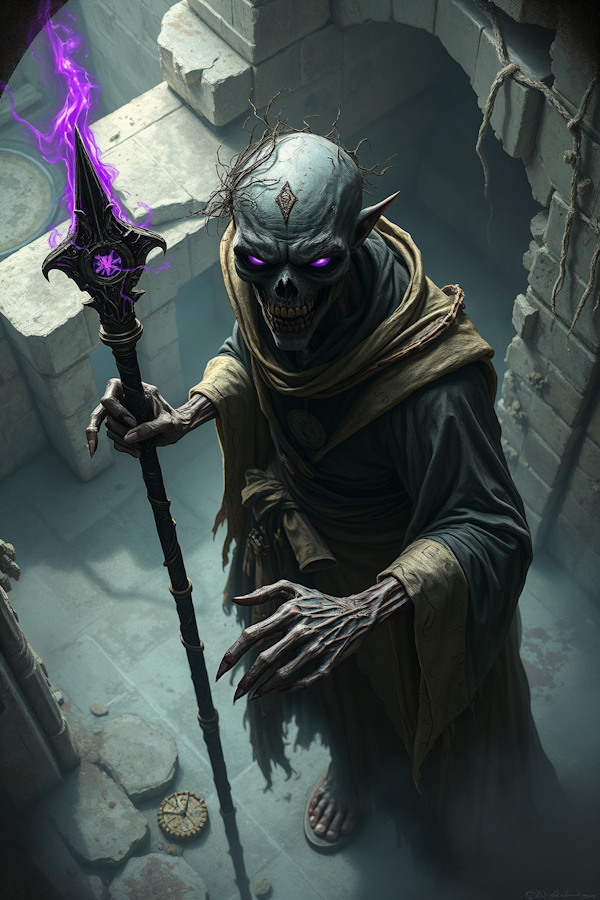
Kerg goes robed and hooded, and the hood does its work—the depths of it swallow his face entirely, so that those who face him often meet nothing but a dark aperture where features should be. The robe is etched with runes, faded to the eye until his power rises, when they kindle along every fold and seam and burn with the same violet light as his staff.
Beneath the hood is a corpse held together by will and necromancy. His skin is leathery, the color of burned parchment, drawn tight over a skull patched with stray tufts of hair. The flesh at his throat and hands is darkened, withered, and pockmarked. His eye sockets are empty, yet they track a target across a room. His hands end in elongated nails that burn with violet energy when his power is up, and when his lips draw back in what serves him for a grin, they reveal darkened gums and decaying teeth.
He carries a thick metal staff and leans on it, moving with a hobbling gait that misrepresents him badly. The hobble vanishes the moment a fight starts.
His voice is the detail that lingers with survivors. It arrives like a deep rustling of wind, carrying neither threat nor emotion, and in its lower registers it becomes a baleful groan that settles on the spine like stabbing pins.
Abilities
Kerg is the most versatile of the Four Acolytes and, in a straight contest of sorcery, the most dangerous. His staff serves as both focus and weapon. Through it, he raises the dead with a flick of one finger, calling skeletons up from scattered bones and setting them on his enemies without breaking stride. He commands a coterie of wraiths—a dozen or more, appearing in a burst of many colors and unaffected by ordinary weapons—and when they are banished, the banishment holds only temporarily. They reform where they fell.
His defensive sorcery is formidable. He can sweep the staff around himself to raise a crackling shield of violet power that turns a sword like a physical wall, and the shield keeps time with his footfalls, moving with him and stopping when he stops. He can shroud himself in a miasma of purple smoke so toxic that armed opponents back away rather than close through it.
His necromancy extends to objects as well as bodies. He can seal a fissure in worked metal by driving his staff into it—and, in sealing it, corrupt it, the shining alloy darkening as necromantic taint spreads through the material like a purplish bruise. He senses negative energy in others across a distance, recognizing at a glance those who have been touched by death magic, and he knows his fellow acolytes for what they are without being told.
What most surprises those who fight him is the staff work. Kerg fights a half-dozen trained soldiers at once and holds them all—sweeping legs from under one, doubling another with a jab to the abdomen, flooring a third with a strike to the head, dodging and sidestepping and countering every blow with one of his own. He is quick and fluid, and he shows no signs of tiring, because there is nothing left in him to tire.
He is also extraordinarily hard to destroy. Elemental fire sufficient to gut a chamber leaves him a smoking ruin—robe burned to tatters, hood shredded, face a seething mass of charred and desiccated flesh—and he returns from it still able to lift the staff and work his power.
Personality & Demeanor
Kerg speaks like a priest of a faith with one convert. He announces himself formally before violence, giving his name and his office, and frames the deaths he intends as a kindness: the blessed gift of eternal unlife, offered to those too limited to recognize the offer. Told he has explained nothing, he does not argue. Told he will not have what he came for, he replies that the speaker is forgiven, for he knows not what he says, and invites him to accept that forgiveness along with his death.
Underneath the liturgy sits the scholar he used to be. He interrupts his own work to ask about an unfamiliar artifact—what is this, where did you get it—with a curiosity that has outlived nearly everything else about him. He is precise, patient, and entirely without cruelty, which somehow makes him worse rather than better. He has a habit of tutting at opposition, a small fussy sound of disapproval, before answering it with the dead.
Those who encounter him note something that troubles them in ways they cannot easily articulate. He is not mindless. He reasons, observes, adapts, and occasionally says things that suggest he understands far more about his own condition than an obedient instrument ought to. Whether this is a remnant of the man who spent a lifetime in pursuit of forbidden knowledge or simply the magi’s design, none can say. What is certain is that Kerg, even in undeath, remains exactly what he had always been: a sorcerer who went further than anyone thought wise and did not come back from it.
Notable Relationships
S’Sarren-kull raised him and holds him, and Kerg speaks of the magi in terms approaching reverence—the Great One, the one who slithers in the dark, speaks to the dead, sees your doom, and brings the blessed gift of eternal unlife. Whether that devotion belongs to Kerg or to the binding is a question he has never been asked in a setting where he could answer.
Among the Four Acolytes, he appears to hold first place, or at least a spokesman’s role. He names the roster aloud when it suits him—the Sorcerer, the Warrior, the Archer, and the Scientist—and he recognizes his counterparts on sight, sensing in them the same negative energy that animates him. He operates alongside Korn and Kern, and formerly alongside Kiva, though none of the four cooperate in any way that resembles fellowship.
Of the living he keeps no relationships at all, only assessments. He weighs what stands before him, calculates whether it can be turned or must be removed, and proceeds accordingly.
Role & Affiliations
Kerg serves as the Sorcerer among the Four Acolytes of S’Sarren-kull. Where the other three are instruments of force, Kerg is the one the magi sends when a task requires judgment—recovering artifacts, claiming sites of power, and reshaping what he finds to serve his master’s design. He travels by means his opponents cannot follow, arriving where he is not expected and departing the same way, and he pursues an objective with a patience that treats setbacks as delays rather than defeats.
He holds no rank among the living and answers to no institution. The eslar courts that exiled him are centuries gone, and whatever standing he once held in Panthora died with the people who remembered it.