KERN THE ARCHER
Overview
The man who became the Archer among S’Sarren-kull’s Four Acolytes left behind no family name, no house, and no legacy anyone thought worth preserving. Records place him in the western reaches of Vranna roughly two centuries before the present—a time when the frontier between settled land and wilderness was still being drawn, and people who could put an arrow through a target at distance were valued less for artistry than for keeping others alive.
He was a hunter by trade, though the word covers more ground than it should. In the border settlements, a hunter tracked predators threatening livestock, brought back meat, and put down threats the undermanned local militias could not handle. He did all of these things, and by most accounts did them well enough that his name—whatever it was—carried weight within a few days’ ride. Beyond that radius, no one had heard of him. He was, in every respect that mattered to history, unremarkable. A competent man in a profession that did not reward competence with fame.
What set him apart was not skill alone but a quality those who knew him struggled to describe, and that later accounts have done no better at articulating. He saw things. Not in the prophetic sense that defines S’Sarren-kull’s gift, but in the practical, immediate sense of a man whose awareness of his surroundings exceeded what training and experience could account for. He read the movement of game through underbrush at distances that strained credibility. He gauged wind and trajectory with an intuitive precision other archers spent lifetimes trying to achieve through calculation. Some attributed this to natural talent. Others, particularly those who watched him work at close range, suspected something else—a sensitivity to the currents of energy flowing through the natural world, an attunement so subtle the man himself may not have recognized it as anything other than instinct.
If he was aware of this gift, he never spoke of it. He lived simply, kept his own counsel, and died in circumstances no surviving record describes. The frontier swallowed him the way it swallowed so many others—quietly, without ceremony, and without anyone beyond his immediate circle noticing. His bones lay wherever they fell for the better part of two centuries, undisturbed and forgotten.
S’Sarren-kull’s search for suitable vessels led the sitheri magi to many such forgotten dead, but his interest in this particular set of remains was specific and deliberate. His prophetic visions had shown him the work ahead required an operative capable of striking at range with unerring accuracy—not a marksman, but one whose connection to the energies of the natural world could be repurposed through necromancy to create something far more dangerous than any living archer could become. The hunter’s latent sensitivity, preserved in his bones like an echo that refused to fade, was precisely the foundation S’Sarren needed.
Appearance
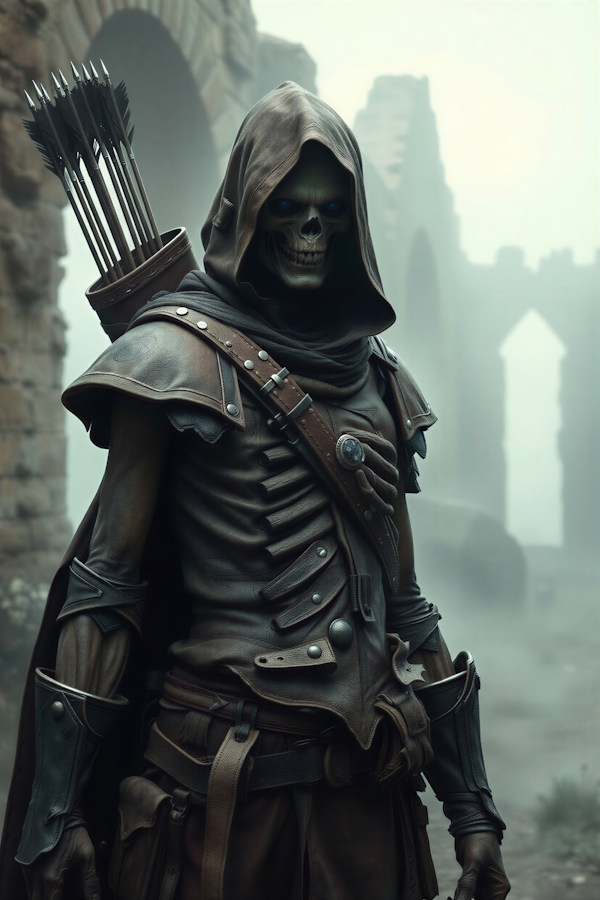
What S’Sarren-kull raised bears little resemblance to the man the border settlements once knew. Kern is skeletal, his flesh desiccated and drawn tight across the frame beneath. His eyes are dead and empty, offering nothing to read and nothing to appeal to. His hands—all dry tendon and exposed joint—move with a smoothness that contradicts every visible indication they should not move at all. He carries a bow of bone and sinew, a weapon that absorbs blows without cracking and serves equally as a melee defense when enemies close the distance. Arrows driven by necromantic energy crackle with violet light on impact and detonate with enough force to shatter stone.
Abilities
The necromantic process did not merely restore the hunter’s capabilities—it stripped them of everything that had made them human and rebuilt them around a single function. His awareness of his surroundings, the quality that made him exceptional in life, has been amplified into something closer to omnidirectional perception. He feels the movement of living things the way a spider feels vibrations in its web and responds with the same dispassionate efficiency.
In combat, he nocks, draws, and looses in a single continuous motion. Every parry flows into a counter. Every step repositions him for the next shot. When pressed at close quarters, he fights with the economy of a man who never wasted a motion in life and sees no reason to start in death—his bow doubling as a parrying weapon while he seeks the half second of separation needed to draw and loose at point-blank range. Arrows that strike him punch through desiccated flesh and lodge in something dry and hollow, and he does not react at all. He neither flinches nor looks down.
Personality & Demeanor
Of all four acolytes, the Archer is the most difficult to read. Kerg retained fragments of personality. Kiva carried the residue of habits formed over decades. The Archer offers nothing. He does not speak unless spoken to, and rarely then. He does not reason aloud or volunteer observations. He assesses, aims, and releases. Whether anything of the quiet, practical man persists behind those dead eyes is a question his silence makes impossible to answer.
Notable Relationships
S’Sarren-kull is the only relationship the Archer possesses, if the word even applies. The sitheri magi raised him, commands him, and regards him as a tool refined to its ideal state—a weapon that walks on two legs and carries its own bow. Kern operates alongside the other acolytes—Kerg, Kiva, and Korn—but the four do not cooperate in any way that resembles fellowship. They are instruments deployed in concert, each serving a distinct function within S’Sarren’s designs.
Role & Affiliations
Kern serves as one of the Four Acolytes of S’Sarren-kull, the sitheri necromancer-prophet. His function within the group is ranged precision—the capacity to eliminate targets at distance with an accuracy no living archer can match, and to deny terrain, disrupt formations, and suppress opposition through the explosive force of his necromantically charged arrows. He is a function without affect, precision without intent. S’Sarren, who values efficiency above all else in his instruments, appears to consider this an ideal outcome.