KIVA THE WITCH
Overview
No one now living knows the woman’s name, and that anonymity is perhaps fitting for someone who spent the better part of her mortal life operating in deliberate obscurity. She was human, that much can be said with certainty, and the age in which she lived was one roughly a century removed from the present, a time when the boundaries between the settled lands and the wilder places beyond them were considerably less defined. She came from one of those border settlements, the kind of community that exists in the space between maps, where the law arrives late if at all and where the inhabitants learn early that survival depends on knowing things the law-abiding world prefers to leave unknown. She learned fast. She was clever, perceptive, and possessed of a natural sensitivity to the unseen currents that most people spend their lives never noticing. In another time or place, she might have become a healer or a scholar. Instead, she became something the settlements whispered about and the wider world had no proper name for: a woman who knew the dead.
Her craft grew in the way such things do when there is no teacher and no tradition to restrain it, organically and without guardrails, shaped entirely by what worked and what she was willing to try. She did not call herself a witch. The word belonged to the fearful imaginings of people who had never seen real dark magic and had no framework for the distinction between what she did and what they feared. But the word followed her regardless, and in time she stopped arguing against it. She had no coven, no lineage, no grimoire handed down from a mentor. What she had was a mind that would not stop asking questions and a tolerance for the places where those questions led. The dead, she discovered, were far more present than the living generally assumed. They persisted in ways that defied easy categorization, and if a person knew how to listen, they would tell you things. She became very good at listening, and then, in time, at speaking back.
Her end came the way the ends of such people often do, not dramatically but incrementally, as the work she was doing began to cost more than she had anticipated. Dark craft of the kind she practiced exacts its payment in stages, and the ledger is not always settled as the practitioner expects. She died with her knowledge intact and her will still strong, which was precisely what made her interesting to the one who found her. S’Sarren-kull was not the first to seek her out in life. Others had come to her with requests, some of which she had honored and some of which she had refused. The magi came after, in the patient way of those who can afford to wait, and he came not with a request but with a purpose already decided.
What S’Sarren reclaimed when he raised her was not a personality but a capability. The woman had understood the dead in life, and that understanding did not dissolve with her. He returned her to her body and imbued in her a will to serve, though that will is his now, not hers.
Appearance
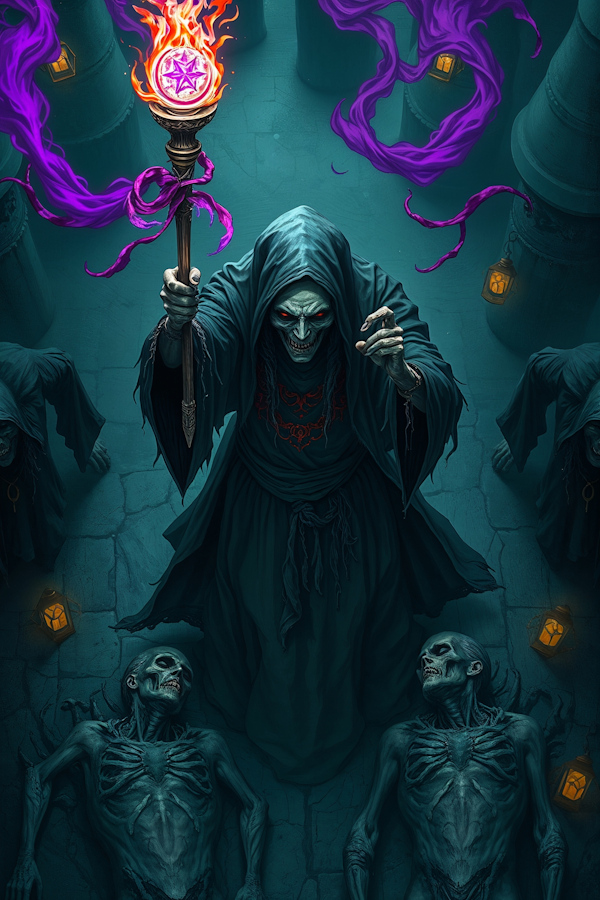
A century in the ground leaves little behind, and what walks under the Witch’s name shows every year of it. Her face is gray and dead and deeply desiccated. The eye sockets are hollowed out entirely. Her nose is gone. Her cheeks have sunk inward and gape with open holes in the flesh, and when her lips part they reveal corroded teeth set in a jaw that has nothing left to hold them but habit. She has no tongue, which does not stop her from making sound.
The bones beneath have grown fragile with age. A hard enough blow to the face will collapse the front of her skull outright—and she will keep fighting afterward, with half her head caved in and her aim undiminished, because she was not using her eyes to begin with.
She goes wrapped in dark robes, a covering that hides most of what age and death have done to the rest of her. Up close she carries the fetid stench of a corpse, strong enough to repulse anyone who closes to sword’s reach. The Scepter of the Dead is in her hand—dark metal, spiked along its length, a violet gemstone burning at the tip.
Abilities
What remains of her own self is less a coherent self than a kind of residue, the habits and instincts of someone who spent decades cultivating a particular kind of attention. She feels the dead around her the way other people feel the weather. She directs them, coaxes and commands them, and does so with a fluency that no freshly made undead could match.
Her ritual work is deliberate and slow. She stands over the bodies she means to raise with her arms lifted, chanting invocations in a language no living scholar in the Four Fiefdoms would recognize, the same two names recurring through every repetition: Jux Jeorn, Ill Sigith. The undead she has already raised stand motionless around her while she works, ranks of skeletons and shamblers and freshly killed townsfolk facing inward, not shifting a foot or flexing a finger, waiting on a signal that has not yet come.
When it comes, it comes as a shriek—a piercing cry that rolls across the assembled host and kindles them to motion all at once. They take up the sound as they move, shrieking in her voice, and they go where she points. This is her real function. Anyone can raise a corpse. Kiva raises them in numbers and then commands them as a single instrument.
She is dangerous in her own right besides. She wields the scepter as a club with force enough to knock a grown man off balance, and violet energy leaps from it to any blade that meets it. Arrows through the torso rock her back a step and accomplish nothing further. Unlike the shamblers, whose movements are slow and predictable, and unlike the skeletons, who fight with skill but no tactics, the Witch shuffles clear of a killing stroke and turns back into the attack just as fast. She judges a fight while it happens, and when the odds turn against her she recognizes it and moves to withdraw rather than spending herself on a lost position.
Personality & Demeanor
Those who face her in her undead state describe the encounter in terms that go beyond the usual horror of confronting the risen dead. There is an intentionality to her that unsettles people in a way that mindless shamblers do not. She moves with purpose. She assesses situations. She makes decisions. Some fragment of the woman who had spent a lifetime learning to read the dead and the living alike still animates those desiccated bones, and it looks back at you when you meet her eyes, or would have, had she still possessed them.
She has no face left to read—no expression, no tell, nothing an opponent can use. What she has instead is a hiss and a shriek, and both carry meaning to anyone who has heard them more than once. Frustration sounds different from command. Whether that fragment suffered its condition or was simply indifferent to it, no one who encounters her survives long enough to ask.
Notable Relationships
S’Sarren-kull raised her, commands her, and holds the will that moves her. Whatever the woman might have made of the arrangement, the acolyte does not appear to question it. Of all his reclamations she is arguably the most natural fit—a practitioner who spent her life doing in miniature what the magi intends to do on a continental scale.
She operates alongside the other Acolytes—Korn, Kern, and Kerg—though the four are not companions in any sense a living person would recognize. They are instruments deployed toward a common design, each carrying a distinct function. Hers is the one that turns a town’s own dead against whatever remains of it.
The dead themselves constitute the closest thing she has to a relationship. She listened to them for decades in life and speaks to them still, and whatever she was before, she is now more at home among them than she ever was among the living.
Role & Affiliations
Kiva serves as the Witch among the Four Acolytes of S’Sarren-kull, entrusted with the Scepter of the Dead and deployed where the magi needs not just force but precision—the ability to raise and direct the fallen in ways that serve a larger and more calculated design. She holds no rank in any human institution, belongs to no coven, and answers to no authority but the one that raised her.
Her work takes her well beyond the Grimmere, into the woodland towns and outlying settlements of the Four Fiefdoms where the dead are plentiful and the defenses thin. A place taken by her does not merely fall. Its guardsmen and townsfolk rise again within the hour and turn on whoever is left, and the host that walks out is larger than the one that walked in.