KORN THE WARRIOR
Overview
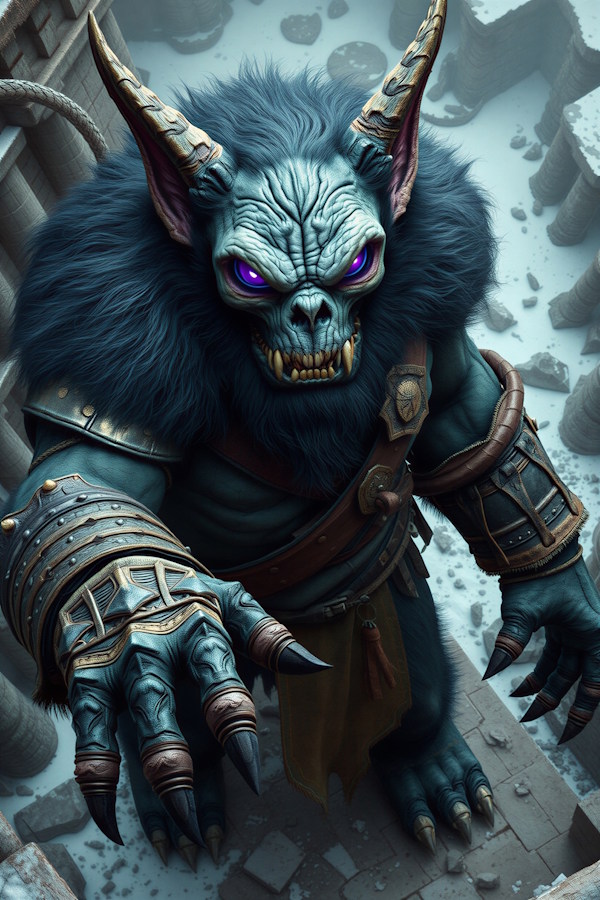
Among the goblin races, the gaugaths are built for war. Standing seven to eight feet tall, covered in coarse fur, and possessing claws that can rend iron, they are the shock troops of the Underland, the mountain sentinels whose reputation for savagery has kept human settlements at a wary distance for centuries. They fight with raw power, overwhelming force, and a ferocity that owes nothing to discipline and everything to a primal refusal to yield ground. Their warriors are feared across Uhl, and with good reason.
Korn was not typical of his kind. He was gaugath in every physical respect—massive, fur-covered, with the characteristic shoulder hump and thick claws of his species. He came from a mountain tribe in the Alzion range, one of many gaugath clans that contested territory with the King’s Patrollers of Alzion Hall and raided surface settlements when opportunity presented itself. But where most gaugath warriors relied on brute strength and the overwhelming momentum of their charge, Korn fought with a deliberateness that unsettled even his own kind. He studied his opponents. He waited for openings rather than creating them through sheer force. He fought the way a haurek might plan a campaign—with patience, observation, and a coldness his fellow gaugaths found alien and, in their blunter moments, cowardly.
He was not a coward. The distinction was lost on most of his peers, but not on the enemies who faced him and survived long enough to appreciate it. A gaugath who charges headlong into a shield wall is dangerous. A gaugath who circles the shield wall, identifies the weakest point, and strikes it with precisely calibrated force is something else entirely. Korn killed more enemies than warriors twice his age, sustaining fewer injuries than any of them—a fact that earned him grudging respect from his chieftain and quiet resentment from rivals who could not match his record.
His intelligence did not extend to the scholarly or the philosophical. He could not read, cared nothing for the world beyond his mountains, and viewed the other goblin subspecies with the casual contempt most gaugaths reserved for anything smaller than themselves. But within the narrow domain of combat, his mind operated with a sophistication that had no precedent in his tribe’s oral history. He understood leverage, timing, and economy of motion in ways that transcended instinct. Some among the haureks who traded with his clan speculated something unnatural lay behind it—that his tactical awareness owed less to experience than to some deeper, inborn attunement to violence itself, a sensitivity to the rhythms of combat operating below the level of conscious thought.
His death came in a manner the gaugaths would have considered appropriately violent, if disappointingly mundane. A territorial skirmish with a rival clan ended with Korn surrounded and outnumbered. He killed seven before the eighth brought him down. His body was left where it fell, as was gaugath custom, and the mountain claimed him. Snow covered his remains, then earth, then the slow accumulation of centuries. The Alzion range is littered with the bones of gaugath warriors. His were one more set among thousands.
S’Sarren-kull found them through the same patient methodology he applied to all his acolytes—cataloging the dead who carried within their remains some residual quality necromancy could exploit. The magi had no interest in an ordinary gaugath brute. The Underland and the Grimmere were full of those, and S’Sarren could raise any number as mindless foot soldiers. What he sought for the role of Warrior was something rarer: a combatant whose understanding of violence went beyond the physical, whose bones remembered not only how to fight but how to think about fighting.
Raising a gaugath presented challenges the magi’s other reclamations had not. The sheer mass required more necromantic energy to animate, and the gaugath skeletal structure—denser and more heavily reinforced than that of humans or eslar—resisted the binding in ways that demanded adaptation. S’Sarren spent considerable time refining his methods until what emerged was not a reanimated corpse but a weapon of extraordinary capability.
Appearance
Korn retains the towering frame and brutal proportions of the gaugath in every detail—the massive shoulder hump, the long arms ending in thick claws, the dense skeleton built for absorbing and delivering punishment. His fur, once the grizzled brown common to his mountain clan, has darkened to a uniform black, matted and stiff with the residue of the necromantic energy that holds him together. His claws, always dangerous, carry the same violet charge as the other acolytes’ foci. His eyes are empty sockets that nonetheless track movement with unnerving precision, the predatory yellow they held in life replaced by a hollow darkness that gives nothing away and misses nothing.
His weapon of choice, in death as in life, is a battle axe scaled to match its wielder. Violet necromantic energy dances along the twin blades, and the weapon splits the air with a sound like tearing cloth when it swings. Steel rings against his dead bone without effect. Arrows lodge in his frame and draw no reaction. Swords driven through his torso slow him no more than wind slows a mountain.
Abilities
The necromantic process amplified every quality S’Sarren valued in life and discarded the rest. Korn’s physical power—already formidable as a living gaugath—now operates without the constraints of fatigue, pain, or self-preservation. The necromantic engine driving his massive frame shows no sign of flagging, and no blow inflicted upon him registers as damage worth acknowledging. His claws gouge parallel trenches into flagstone. His axe cracks stone columns and sends showers of dust and fragments across the battlefield. He rips a sword free from an opponent’s grip with the same ease another creature might brush away a fly.
But the raw power is not what makes him lethal. The tactical mind S’Sarren valued most survived the transition from life to undeath with a fidelity that surprised even the magi. Korn does not charge. He evaluates. He positions himself with a patience that contradicts his enormous frame, waiting for the moment when his intervention will cause the most damage with the least expenditure of effort. He reads an opponent’s intent—a circling maneuver, an attempt to draw him into open ground—and cuts it off, planting himself between his quarry and escape with his axe held across his body like a gate. When he strikes, it is exactly where and when the blow will matter most, and the cold precision his living peers mistook for cowardice has, in undeath, become absolute.
Personality & Demeanor
Of the Four Acolytes, the Warrior is the one most likely to be underestimated by those who have never faced him. His appearance suggests a brute—a massive, shambling, undead goblin, terrifying but ultimately predictable. Those who survive their first encounter learn otherwise, though by then the lesson has cost them more than they can afford. Korn does not speak, does not posture, does not telegraph his intentions through body language or aggression. He absorbs information the way stone absorbs heat—slowly, silently, and with a capacity that only becomes apparent when the surface radiates it back at lethal temperature.
Notable Relationships
S’Sarren-kull raised Korn, commands him, and regards him as the most labor-intensive and most rewarding of his reclamation projects. The sitheri magi adapted his binding methods specifically to accommodate the gaugath’s dense skeleton and enormous frame, an investment of time and energy he would not have made for a lesser instrument. Korn operates alongside Kerg, Kiva, and Kern—the remaining three of the Four Acolytes. They do not cooperate as allies. They deploy as instruments in concert, each serving a distinct function, and Korn’s function is the one that leaves the most visible wreckage.
Role & Affiliations
Korn serves as the Warrior among S’Sarren-kull’s Four Acolytes. His role is close-quarters dominance—the capacity to hold ground, break formations, and destroy anything that enters his reach with a force that living combatants cannot match and undead resilience that ensures he will still be standing when they are not. He is the anvil against which S’Sarren’s enemies are hammered, and the gate through which no one passes without the magi’s consent.