Marcus Stormbreaker, the Undefeated Lordling
Introduction
Marcus Stormbreaker died less than a decade ago, still leading his forces in battle at seventy, and the Freelands have not finished grieving him. This is unusual. The Freelanders do not grieve leaders as a rule—they are a people who judge by deeds, and not words or birth, who believe that power must be constantly earned and that those who lose it have simply been surpassed, and who regard prolonged mourning for fallen lordlings as a sentimental indulgence that the practical demands of life in the Freelands cannot long sustain. Marcus Stormbreaker is the exception, and the exception says everything about the man. He earned his territory, his reputation, and his people’s loyalty through thirty years of consistent, visible, personally committed competence, and the grief that followed his death is the grief of people who have lost not just a leader but the living proof that their civilization’s founding principle—that earned authority is real authority—can produce something not just functional but genuinely great.
He was a blacksmith’s son from a minor settlement who joined a mercenary company at fifteen, commanded it at twenty-five, and controlled High Holt’s largest stronghold by forty. He held that stronghold for thirty years against every challenger who came for it, while simultaneously investing in the infrastructure, trade, and defense of a territory that grew more prosperous under his governance than it had ever been under anyone else’s. He died as he had lived—at the front, personally present, fiercely committed to the people and the territory that his competence had earned him and that his conviction would not allow him to abandon even when age had made the front a less appropriate place for him than it had been at thirty. The goblins killed him. The Freelands have not forgiven them for it, and Marcus would have found the ongoing grudge both gratifying and excessive, which is exactly the kind of reaction the people who knew him best expected of him and miss most now that he is gone.
Appearance
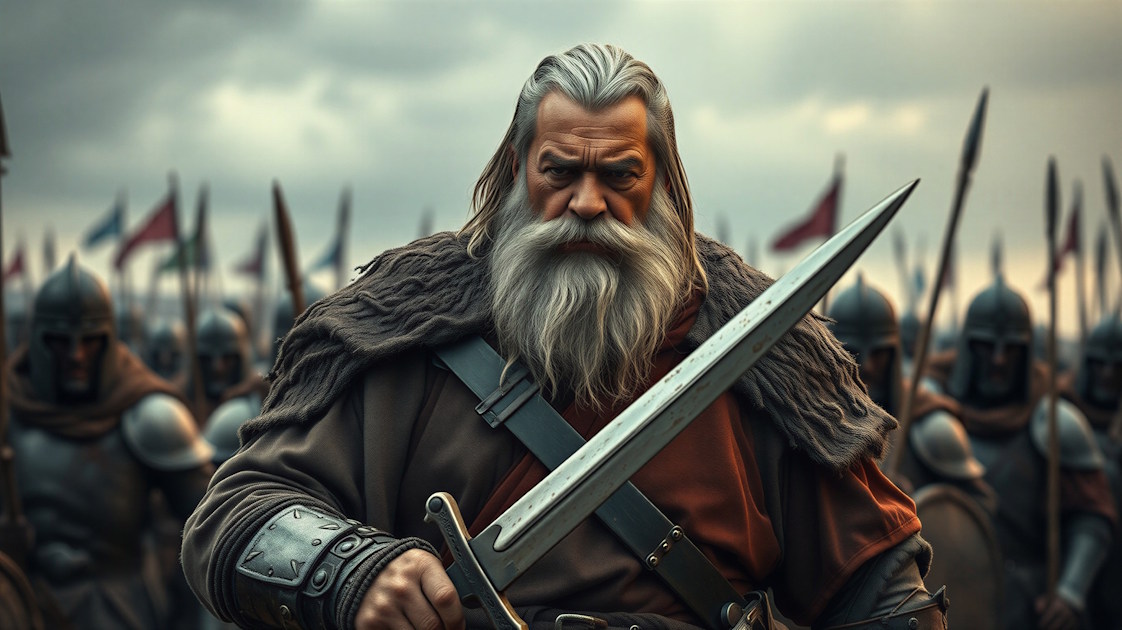
Marcus was built like the trade he was born into—broad through the chest and shoulders, thick-armed, and powerfully made, with the deep-set physical strength of a man who had grown up swinging a hammer at a forge and then spent fifty years swinging weapons in the field. He was of solid middling height, but he filled a room in a way that had little to do with stature and everything to do with the plain, grounded physical confidence of someone entirely at home in his own body. Even at seventy, when age had greyed him and slowed him, he retained the powerful frame and upright, unbowed carriage of a man who had never once considered ruling from anywhere but the front, and who carried the accumulated nicks and scars of thirty years of personal combat as unremarkable features of a working life rather than trophies.
His face was weathered and open, tanned and lined by decades of campaigning under open skies, and it wore its warmth plainly—the face of a man quick to laughter and quicker to fierce resolve, with a directness of expression that put working people at ease and ambitious rivals on notice. His hair and beard, dark in the years of his rise, had gone iron-grey and then nearly white by the end, kept short and practical in the manner of a man with no patience for grooming that served no purpose. He dressed for the work rather than the title, favoring sturdy, well-made, unpretentious gear—serviceable armor worn from long use, plain garments in the muted colors of the frontier, and none of the ostentatious display of wealth or status that the Freelanders instinctively distrust. What he wore, he had earned; what he wore, he could fight in; and the sight of him among his soldiers, indistinguishable at a glance from the people he led except by the deference they showed him, was itself the clearest possible statement of the principle he had built his life upon.
The Blacksmith’s Son
Marcus was born in a minor settlement whose name appears in no important records and whose primary distinction was producing the man who would eventually govern more Freelander territory than anyone in the region’s history. His family was blacksmiths—working smiths of competent reputation whose daily lives consisted of the practical metalwork that kept a frontier settlement functional. The Stormbreaker name was not his birth name, but one he earned later; what his parents called him was Marcus, and they raised him with the combination of practical expectation and unstated pride that working families of the Freelands typically bring to children who show early evidence of exceeding the circumstances they were born into.
He showed early aptitude in two directions that the Freelanders consider the ideal combination: craftsmanship and strategic thinking. In the forge, he had his father’s hands—strong, precise, patient with materials that required patience and decisive with materials that required decisiveness. In the settlement’s militia drills, which every able-bodied child participated in from early adolescence, he showed something rarer: the ability to perceive the whole of a tactical situation while others were still processing its individual components, to identify what mattered and what could be managed later, and to communicate his assessments in terms clear enough that people older and more experienced than him took them seriously. These qualities announced themselves quietly, through accumulated small episodes rather than dramatic demonstrations, and the adults around Marcus drew their conclusions about his future with the practical certainty of people who have seen enough young talent to know when they are looking at something different in kind rather than degree.
He left for a mercenary company at fifteen, which was young but not unprecedented in the Freelands, where the Code of Personal Sovereignty recognizes the right of individuals to determine their own paths at ages that more conventional societies would consider premature. The company he joined was a mid-sized outfit of professional fighters whose reputation for reliability exceeded their reputation for brilliance—exactly the kind of organization where a young man with Marcus’s qualities could learn the trade without being either overwhelmed by exceptional talent around him or unchallenged by mediocrity. He learned. He contributed. He distinguished himself gradually and then decisively, and by twenty-five, he commanded the company he had joined at fifteen, not through political maneuvering or the elimination of rivals but through the simple, consistent demonstration that his judgment was better than everyone else’s and that following it produced better outcomes than the alternatives.
The Rise
The path from mercenary company commander to lord of High Holt’s largest stronghold took fifteen years and required the simultaneous application of every quality Marcus possessed: military competence that won campaigns, economic acumen that converted military success into accumulated wealth, diplomatic skill that built alliances without creating the dependencies that would have compromised his independence, and a personal warmth that made the people who worked for him want to keep working for him rather than seeking employment with his competitors.
His military record during these years was exceptional without being miraculous—a distinction that Marcus himself considered important and that the Freelanders who followed his campaigns emphasized in their accounts of his rise. He did not win through supernatural gifts or by overcoming impossible odds through sheer heroism. He won because he prepared more thoroughly than his opponents, understood terrain more intuitively, managed logistics with greater care, and made fewer mistakes in the crucial moments when mistakes were most costly. He was, in the most precise sense of the phrase, better at the work than anyone he competed against, and the consistent margin of his superiority made him the kind of commander that soldiers wanted to serve under and that clients wanted to hire, because both groups understood that competence at his level was not luck and did not run out.
The wealth that accumulated from successful campaigns was invested rather than consumed—another quality that distinguished Marcus from lordlings whose military success produced prosperity that they then spent on the displays of status and comfort that the Freelanders traditionally viewed as warning signs of declining relevance. Marcus invested in his people, in the fortifications that protected them, and in the commercial infrastructure that gave them livelihoods independent of the vagaries of mercenary work. By the time he made his move on High Holt’s largest stronghold at forty, he had already created the economic and organizational foundations that would sustain his rule for three decades. The acquisition of the stronghold itself was the capstone of a structure that had been under construction for fifteen years, not a sudden seizure of opportunity but the planned conclusion of a patient, methodical campaign of preparation that Brunhilde Gemheart would have recognized and approved.
The Thirty-Year Reign
Marcus governed High Holt’s largest territory for thirty years, and the most remarkable thing about that tenure is not its length but its quality. In a political system defined by constant competition and the perpetual threat of displacement, maintaining power for three decades requires either eliminating all competitors or creating conditions in which competitors consistently conclude that challenging Marcus was not worth the cost. He achieved the latter, which in the Freelanders’ estimation is the more impressive accomplishment, because it demonstrates not just tactical superiority but a genuine understanding of what power is for.
His governance was characterized by three commitments that he maintained with the fierce conviction that animated everything he did. The first was infrastructure investment. Marcus spent a significant portion of his territory’s resources on roads, water systems, and the fortifications that protected not just his own holdings but the neighboring territories that fell under the umbrella of his defense agreements. These investments made the territory more prosperous and secure, creating conditions in which his people had concrete reasons to prefer his rule to any alternative, rather than simply accepting it as the current reality. The second commitment was fair arbitration. Marcus established dispute-resolution mechanisms that were applied consistently, regardless of the disputants’ wealth or their relationships with his household, building a reputation for impartiality that attracted commerce and settlement from people who valued predictable justice more than they feared paying for it. The third commitment was personal presence. Marcus was not a lord who governed from behind walls and intermediaries. He was visible, accessible, and personally engaged with the challenges his territory faced, and his willingness to share the hardships that his decisions created for others—particularly the hardships of military defense—produced the loyalty that no amount of infrastructure investment can purchase from people who believe their leader considers himself exempt from the costs he imposes on them.
The challengers came because they always come in the Freelands, and Marcus defeated them with the consistency that eventually produced the epithet Undefeated. Some of the defeats were military, delivered in engagements where Marcus’s tactical innovations and organizational superiority produced outcomes that discouraged subsequent challengers from attempting direct force. Others were economic or political, as competitors who could not be beaten in battle found themselves outmaneuvered in the markets and alliance networks through which Freelander power is as often determined as on the battlefield. The Undefeated epithet accrued not because Marcus sought it, but because the consistent pattern of his rule left no other word for what he had accomplished: thirty years in the Freelands’ most contested political environment without a single loss that resulted in the displacement the system was designed to produce.
The Innovations
Marcus’s military innovations became standard practice throughout the Freelands within two decades of their development, which is the highest form of recognition that the practical, results-focused Freelander culture extends to new ideas. He did not theorize about tactics or publish doctrine. He applied approaches that worked; the people who observed them noted what made them work, and the logic spread because it was sound.
His most significant tactical innovation was the integration of mercenary companies with local militias in a unified defensive framework that leveraged the strengths of both while compensating for the weaknesses of each. Mercenary companies brought professional skill, battlefield experience, and the organizational discipline of units that fought together regularly. Local militias brought intimate knowledge of the terrain, the commitment of people defending their own homes, and numbers that no mercenary force could match on a sustainable budget. Previous commanders had typically used one or the other, treating them as distinct tools for distinct purposes. Marcus used them as components of a single system, positioning militia forces in defensive roles that maximized their terrain advantages while deploying mercenary units in the mobile, aggressive roles that required the professional training and cohesion that militias typically lacked. The resulting force was more capable than either component could achieve independently, and more cost-effective than an all-mercenary force of equivalent capability.
His defensive tactics, developed through the practical experience of protecting an extensive territory against both human challengers and goblin incursions, emphasized converting fortified positions into force multipliers that enabled smaller forces to defeat larger ones by rendering the attacker’s numerical advantage irrelevant. Marcus understood fortification not as passive protection but as active tactical infrastructure—positions designed to channel attackers into killing zones, to allow defenders to shift forces rapidly between threatened points, and to sustain a defense through extended engagements that would exhaust attacking forces whose logistical chains were less robust than those of a defender operating from established positions. These principles, applied consistently over thirty years of territorial defense, were refined through practical testing that no theoretical study could replicate, and the commanders who adopted them found that they worked as reliably for others as they had worked for Marcus.
His economic policies demonstrated something that the Freelands’ skeptics had always doubted was possible: that a territory governed without royal authority or hereditary legitimacy could achieve sustained prosperity through consistent, competent administration. Marcus’s approach combined genuine investment in productive capacity—craft workshops, trade infrastructure, the security that allowed merchants to operate without the constant friction of unpredictable violence—with a governance philosophy that treated prosperity as the primary measure of success rather than a secondary benefit of military dominance. The prosperity he created attracted more settlers, more commerce, and more talent than his territorial size alone would have justified, creating a virtuous cycle that expanded his resource base faster than his competitors could match and that gave him the economic foundation for military investments that further secured the prosperity that funded them.
The Death
Marcus Stormbreaker died in battle against a major goblin incursion, at the front, personally commanding the defense of a sector that his subordinates could have managed without him and that he led anyway because he had never asked his people to face dangers he was not willing to share. He was seventy years old. He had been told, by advisors whose concern for his safety he acknowledged and whose counsel he respectfully declined to follow, that a lord of his responsibilities had no business at the front of a battle at his age, that his value to the territory had long since shifted from personal combat effectiveness to strategic leadership, and that his death in battle would create a succession crisis whose damage to the territory he cared about would far exceed anything a goblin incursion could inflict. Marcus listened to these arguments, found them reasonable, and went to the front anyway, because the principle that had governed his entire career was not a principle one applied only when it was convenient.
The manner of his death was consistent with everything he had ever been. He died fighting, not in a foolish exposure to unnecessary risk but in the specific, calculated decision that the defense of a critical sector required the kind of leadership that his personal presence could provide and that the situation genuinely demanded. Whether that assessment was correct—whether the battle required him personally or whether his presence was the decision of a man who had never learned to govern from behind walls and could not start at seventy—is the question that the people who loved him have been arguing about since the news reached them, and will probably continue arguing about for the rest of their lives. It is, in its way, the most Marcus Stormbreaker argument possible: a genuine disagreement about whether the right thing was done, conducted among people who all agree on the values at stake, and entirely unresolvable because the man who would have had the most useful opinion on the matter is no longer available to provide it.
The Freelands learned of his death through the networks of messengers and rumor that carry news through a decentralized society, and the response was something that observers from the Four Fiefdoms found surprising: genuine, widespread, and persistent grief. Not the formal mourning of a society paying its respects to a monarch, but the personal grief of people who had known or known of a man they genuinely liked and respected, who had demonstrated over thirty years that the values they believed in could produce the results they hoped for, and whose death at the front of a goblin battle, still fighting for them at seventy, was the most complete possible expression of who he had always been.
Legacy & Enduring Influence
Marcus Stormbreaker’s legacy is still forming, as legacies do when the subject is recent enough that the people who knew him are still alive and still arguing about what he meant. The immediate legacy is the territory he built—the most prosperous and best-organized in the Freelands —now navigating the succession challenges his death has created, which his governance philosophy, which emphasized competence over continuity, provides no simple mechanism to resolve. The successor who eventually consolidates Marcus’s territory will inherit not just the physical infrastructure he built but the expectations he established, and those expectations—for fair arbitration, visible leadership, shared hardship, and consistent investment in the people governed—are among the most demanding standards any Freelander lord has ever set.
His military and economic innovations are already standard practice throughout the Freelands, adopted by commanders and governors who recognized their effectiveness during his lifetime and have continued to develop them in his absence. The integrated mercenary-militia doctrine is taught to every serious military commander in the region. The defensive tactics he developed are studied by anyone planning to protect fortified territory. The economic philosophy that treated prosperity as the primary measure of governance success has influenced a generation of Freelander lordlings who grew up watching Marcus’s territory expand and drew their own conclusions from what they saw.
His most enduring legacy may be the most personal: the demonstration, still fresh enough for living witnesses to confirm, that the Freelander ideal of earned authority is not just a philosophical principle but a practical reality. Other legendary Freelanders established that principle in distant centuries—Gareth Ironhand proved that independence could be organized, Silvia the Shadow proved that criminals could govern themselves, and Durin Coalbeard proved that even dwarven inter-thane disputes yielded to patient wisdom. Marcus Stormbreaker proved something that no amount of ancient legend could prove as effectively as a living man with a living territory: that in the present day, in the Age of Advancement, with all its complications and pressures and the constant temptation to secure power through hereditary claims or external alliances that would compromise independence, a man from nothing could govern something great through nothing but his own ability, and could do it well enough and long enough that when he died at the front at seventy, the people he had governed wept for him.
Concluding Remarks
Marcus Stormbreaker was the Freelands in their best expression—the blacksmith’s son who became the greatest lord in the region’s history not because fate elevated him or blood entitled him but because he was better at the work than anyone else who wanted the job and because he never stopped being better at it for thirty years of constant competition that would have broken anyone less thoroughly committed to the principle that power must be earned every day rather than inherited once. He was warm, fierce, competent, and entirely without the self-importance that power typically breeds in those who hold it, because he had understood from the beginning that his authority was borrowed from the people who chose to follow him and that the terms of the loan required constant servicing.
He died at the front at seventy because he had never learned to govern from anywhere else, and the Freelands that grieve him are grieving not just a man but the living proof, now absent, that their civilization’s founding values produce the results their founders promised. The proof is not gone—the territory he built still stands, the innovations he developed are still practiced, and the standard he set still defines what Freelander governance at its best looks like. But proof embodied in a living person, in a man you could point to and say there, that is what we mean, is different from proof preserved in records and doctrine and the grudging acknowledgment of people who have to think about it before they can confirm it. Marcus Stormbreaker was the kind of proof that walks into a room and settles the argument by being present, and the Freelands, for the first time in a long time, are having to make do with the other kind.