Morden Fireforge, Keeper of Flames
Introduction
Morden Fireforge, known to the dwarven people as the Keeper of Flames, is the god of fire, the forge, and the transformative act of creation—the divine smith whose hammer rang against the anvil of the world itself and whose flames gave dwarven civilization the power to shape raw stone and metal into works of beauty and purpose. Where his mother, Grommara, the Mother of Stone, provided the raw materials of the earth and his brother, Rurik, the Guardian of the Realm, stood as protector of all the dwarves had built, Morden embodied the creative fire that turned potential into achievement. Without his gift, the dwarves would have possessed stone they could not carve and ore they could not smelt.
Morden is remembered not as a distant or inscrutable deity but as the most dwarven of the gods—loud, boisterous, and full of life. The myths portray him drinking deep from cups of molten gold, bellowing with laughter that shook the caverns, and throwing himself into every endeavor with the reckless confidence of one who believed that courage and skill could overcome any obstacle. He was a god who worked alongside his children rather than above them, his hands perpetually blackened by soot and his beard singed by sparks. The dwarves loved him for this, and they love him still, even though his divine fire has long since passed from the world.
His death—an act of willing sacrifice to seal a catastrophic threat from the depths beneath the world—is considered the defining moment in dwarven mythology, a story that shapes how the dwarven people understand courage, selflessness, and the true meaning of craftsmanship. Every forge fire burning in the seven thanes is said to carry the faintest ember of Morden's essence, a claim that dwarves neither fully believe nor fully dismiss. Like much in dwarven spiritual life, the truth matters less than the tradition—and the tradition of Morden Fireforge burns as brightly today as it ever has.
Origins & Birth
According to the oldest dwarven creation myths, Grommara, the Mother of Stone, shaped the mountains and the deep places of the world before turning her attention to creating life. Having molded the first dwarves from the living rock of the mountains, she found that her children possessed strength and resilience but lacked the means to transform the raw materials of their domain into something greater. Stone remained stone. Ore remained ore. The potential for civilization lay dormant within the mountains, waiting for a catalyst that Grommara alone could not provide.
And so Grommara reached into the molten heart of the world, where fire and stone existed in eternal union, and from that primordial crucible she drew forth Morden—her firstborn son, a being of living flame wrapped in a form of stone and iron. The myths describe his birth as an eruption that split a mountain in two, sending pillars of fire skyward and illuminating the underground world for the first time. Where that light touched bare stone, veins of gold and silver were revealed. Where it touched cold iron, the metal softened and became workable. Morden emerged from the broken mountain already laughing, already reaching for the nearest chunk of ore, already eager to shape something from the raw chaos of creation.
Grommara's second son, Rurik, came later—drawn from the hardest granite of the deepest foundations, shaped not from fire but from the unyielding patience of stone under pressure. Where Morden burned with creative urgency, Rurik stood firm with the quiet strength of a mountain that refuses to crumble. Together, the two brothers represented the twin pillars of dwarven civilization: the fire that creates and the stone that endures. Grommara looked upon her sons and saw that they were complete in ways she was not, each carrying a portion of her nature refined into something distinct and necessary.
The myths hold that Morden's first act upon entering the world was to build a forge. Not a divine forge of celestial proportions but a simple hearth of stacked stones with a bed of coals—the same kind of forge that any dwarven apprentice might construct. He did this, the stories say, to demonstrate that creation begins not with grandeur but with the decision to start. This detail is important to the dwarves, who see in it validation of their belief that making is sacred regardless of scale. A god who builds his first forge from common stones is a god who understands the value of humble beginnings.
Domains & Attributes
Morden's primary domain is fire in all its forms—the literal flames of the forge, the volcanic heat of the deep earth, and the metaphorical fire of inspiration, passion, and creative ambition. Dwarven theology holds that every flame in the world carries some trace of Morden's original gift, from the roaring infernos of the great forges to the smallest candle flame guttering in a miner's lantern. Fire is not merely a tool in dwarven understanding but a sacred element, the medium through which raw materials are transformed into objects of purpose and beauty. To waste fire or treat it carelessly is considered disrespectful to Morden's memory, a minor but real transgression against dwarven values.
Beyond fire itself, Morden governs the act of transformation—the moment when one thing becomes another through the application of skill, heat, and will. This makes him the patron of all crafts that involve changing the fundamental nature of materials: smelting ore into metal, forging metal into tools and weapons, blowing glass, firing ceramics, and even brewing, which transforms grain and water into ale through processes that the dwarves consider no less miraculous than the smith's art. The common thread is that Morden's domain encompasses any endeavor where patience, knowledge, and physical effort combine to create something that did not exist before.
Morden is also associated with courage and bold action. The dwarves see fire as an inherently courageous element—it advances, it consumes, it does not hesitate or retreat. This aspect of Morden's nature made him the patron of dwarves who undertake dangerous ventures, whether exploring uncharted tunnels, defending against goblin assaults, or attempting ambitious feats of craftsmanship that risk failure and public embarrassment. To invoke Morden before such an endeavor is to ask not for safety but for the courage to press forward regardless of the outcome.
His domain does not extend to destruction for its own sake. The dwarves draw a clear distinction between fire as a creative force and fire as a weapon of ruin. Morden's flames build; they do not burn without purpose. A forge fire that melts ore into workable metal serves Morden's will. A fire set to destroy an enemy's home does not. This theological distinction reflects the broader dwarven philosophy that the purpose behind an action matters as much as the action itself, and that the tools of creation should never be debased into instruments of senseless destruction.
Appearance & Symbols
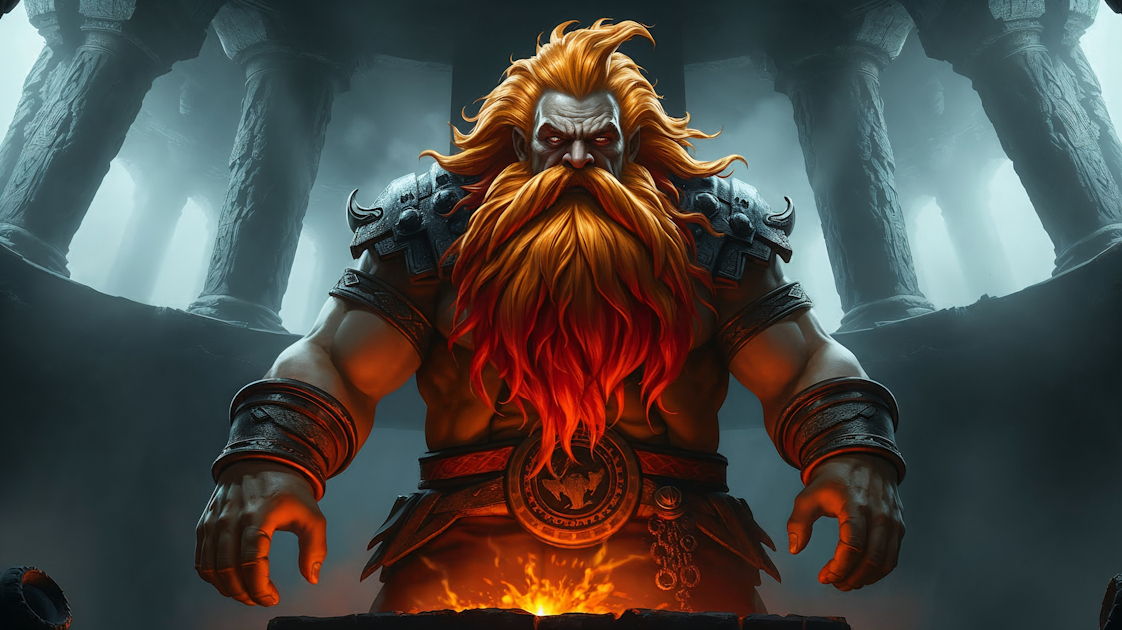
Dwarven artistic tradition depicts Morden Fireforge as an enormous dwarf—not the elegant, elongated proportions of human or eslar deities, but a figure unmistakably dwarven in build, simply rendered at divine scale. He stands twice the height of an ordinary dwarf in most depictions, though some of the oldest carvings show him larger still, his head brushing the ceilings of the great halls. His body is thick and powerfully muscled, the physique of a smith who has spent eternity at the anvil. His skin appears as darkened iron in some traditions and as ruddy, heat-flushed flesh in others, though all agree that fissures of molten light run along his arms and hands, as though the fire within him is perpetually threatening to break through.
His beard is his most defining feature—a magnificent cascade of flame that flows from his jaw and chin like molten metal pouring from a crucible. The beard shifts and flickers in every depiction, never still, composed of interwoven tongues of fire in shades of gold, orange, and deep crimson. Dwarven artists have spent lifetimes attempting to capture the living quality of Morden's beard, and the finest stone carvings achieve an almost supernatural impression of movement through techniques passed down through generations of master sculptors. His eyes are described as twin forge fires, bright and merry in times of peace, blazing white-hot in moments of anger or exertion.
Morden is invariably depicted carrying his great hammer, Anvil's Voice, a weapon and tool of such perfection that it is said to have rung with a clear, resonant tone each time it struck, as though the anvil itself were singing in response. Anvil's Voice was neither the largest nor the most ornate hammer in dwarven mythology, but it was the most perfectly made, balanced so precisely that it could deliver devastating force or the most delicate tap with equal ease. In his other hand or slung across his back, Morden carries a pair of tongs, reminding the faithful that even a god must grip his work firmly before shaping it.
The primary symbol associated with Morden is the Eternal Flame—a stylized depiction of a forge fire burning within a circle of stone. This symbol appears on forges, workshop doors, and ceremonial objects throughout all seven thanes, serving as both a religious emblem and a mark of the craftsman's trade. Secondary symbols include the crossed hammer and tongs, representing the tools of creation, and the Sundered Mountain, a split peak with fire pouring from the gap, referencing Morden's mythological birth.
Personality & Character
The myths paint Morden as the most approachable of the dwarven gods—a deity whose personality would feel at home in any thane's feasting hall. He is loud. He is boisterous. He laughs too hard at his own jokes, drinks deeply and often, and has never once in the entire mythological tradition been described as sitting still for longer than it takes to drain a cup. Where Grommara embodies the patient, enduring qualities of the earth, and Rurik represents the disciplined, watchful nature of the guardian, Morden is pure creative energy barely contained in physical form. He is the god who acts first and considers consequences later, whose enthusiasm for the next project often means the current one gets finished in a spectacular rush of last-minute effort.
Yet beneath the bluster lies a core of profound selflessness. The myths consistently portray Morden as a god who gives without counting the cost. When the first dwarves struggled to master the forge, Morden did not simply grant them knowledge but worked beside them, enduring their mistakes and celebrating their successes as though each small achievement were as important as his own divine works. He shared his techniques freely, holding nothing back, because he understood that knowledge hoarded is knowledge wasted. This generosity extended beyond craftsmanship to encompass his time, his attention, and ultimately his life—a progression that the dwarves see as the natural consequence of a character built on giving rather than taking.
Morden's courage is legendary even by divine standards. The myths describe him charging headlong into dangers that gave even Rurik pause, not out of recklessness but out of an unshakeable confidence that the right course of action is always forward. He feared nothing that could be faced directly, though the stories acknowledge that he sometimes struggled with threats that required patience and subtlety—qualities more naturally associated with his mother and brother. This is not presented as a flaw so much as a defining characteristic, one that made him perfectly suited for the role he would ultimately play in sealing the threat from the deep.
His relationship with mead and ale features prominently in dwarven mythology, where Morden is credited with inspiring the first brewmasters by observing that grain and water, subjected to the right conditions, could be transformed just as metal is transformed by fire. Several myths describe drinking contests between Morden and various challengers—mortal dwarves, other gods, and in one popular tale, a mountain giant who wagered his cave against a barrel of Morden's personal reserve. Morden won every contest, not through divine immunity to drink but through sheer dwarven stubbornness and an iron constitution that the myths suggest he developed through millennia of enthusiastic practice.
The Brotherhood of Fire and Iron
The relationship between Morden and his brother Rurik forms one of the great narrative threads of dwarven mythology—a bond of genuine love and mutual respect complicated by fundamental differences in temperament and occasional flashes of fierce rivalry. The two gods complemented each other perfectly in purpose: Morden created what the dwarves needed to thrive, and Rurik defended what Morden had created. Yet this complementary relationship did not preclude competition, and the myths are filled with episodes in which the brothers tested themselves against each other in contests ranging from the playful to the genuinely heated.
The most famous of these rivalries centered on the question of which brother's contribution mattered more to the dwarven people. Morden argued that without creation, there would be nothing worth defending. Rurik countered that without defense, nothing created would survive long enough to matter. This debate, which the myths present as an ongoing argument rather than a single confrontation, produced some of the most celebrated exchanges in dwarven oral tradition. Neither brother ever conceded the point, and the dwarves consider this unresolved tension to be the correct state of affairs—a reminder that creation and protection are equally vital and that neither should claim primacy over the other.
Physical contests between the brothers are recounted with particular relish in dwarven storytelling traditions. Wrestling matches that lasted for days, hammer-throwing competitions that reshaped mountainsides, and endurance challenges that tested the limits of even divine stamina all feature in the cycle of tales known as the Brotherhood Sagas. These contests always ended in something approaching a draw, with each brother proving superior in certain aspects while acknowledging the other's strengths. Morden was faster and more inventive, finding unexpected solutions to challenges that confounded brute strength. Rurik was steadier and more relentless, outlasting his brother through sheer, grinding persistence.
Despite their rivalry, the brothers' loyalty to each other was absolute. Multiple myths describe situations where one brother faced a threat too great to handle alone, and the other appeared without being summoned, as though the bond between them transcended distance and circumstance. The tale of the Wyrm of the Lowest Deep, in which Morden and Rurik fought side by side against a creature of primordial darkness that threatened to swallow an entire thane, is considered one of the finest examples of this unbreakable bond. Their combined strength—Morden's fire driving the creature from its hiding places while Rurik's hammer crushed it against the stone—demonstrated what the brothers could achieve when they set aside competition and worked as one.
Morden's sacrifice would test this bond in its most devastating form. The myths hold that Rurik was the last being Morden spoke to before descending into the heart of the world, and that the words exchanged between them are considered too sacred to be spoken aloud in any retelling. Storytellers simply pause at this point in the narrative, allowing the silence to carry the weight of what passed between the brothers. What is known is that Rurik attempted to take his brother's place, offering himself as the sacrifice instead, and that Morden refused with the only argument Rurik could not counter: that this task required fire, not stone, and that no amount of courage could change that fact.
The Great Works
Before his sacrifice, Morden Fireforge created works of such magnificence that they have become the measure against which all dwarven achievement is judged. These mythological creations, known collectively as the Great Works, represent the full expression of divine craftsmanship and serve as aspirational ideals for every dwarven smith, mason, and artisan. Whether any of these objects actually existed or exist still is a matter of faith rather than evidence, but their influence on dwarven craft philosophy is beyond dispute.
The first and greatest of the Great Works is Anvil's Voice, Morden's own hammer, described in the preceding section. The myths hold that Morden forged this hammer before all other creations, understanding that a craftsman's first duty is to create the tools that will enable all subsequent work. The hammer was made from a metal that does not exist in the mortal world—a substance the myths call starfall iron, said to have fallen from the sky in the earliest days of creation. Morden heated this metal in a fire he kindled from the friction of two continents grinding together, and he shaped it on an anvil carved from the tooth of a primordial mountain. The process took seven days and seven nights, and when the final blow fell, the resulting tone was so pure and resonant that it established the musical scale the dwarves use to this day.
The Seven Hearths represent another of Morden's legendary creations—the original forge fires that he kindled in each of the seven locations that would become the dwarven thanes. According to the myths, Morden traveled the length and breadth of the mountains, selecting each site with divine insight into the geological conditions that would sustain great civilizations for millennia to come. At each location, he struck the ground with Anvil's Voice, and from the point of impact a forge fire erupted that would never go out so long as dwarves remained to tend it. These Seven Hearths are said to be the ancestors of every forge fire burning in the thanes today, each flame carrying a trace of divine origin passed down through countless rekindlings.
The Crown of Embers, forged as a gift for Grommara, is described as a circlet of perpetually burning metal that neither consumed itself nor radiated destructive heat but instead shed a warm, golden light that revealed the true nature of whatever it illuminated. Under the Crown's light, flawed stone showed its cracks, impure metal revealed its contaminants, and dishonest hearts could not conceal their intentions. The myths suggest Morden created this gift as an act of gratitude for his own creation, understanding that the greatest work a craftsman can produce is one made not for personal glory but in service of someone he loves.
Lesser works attributed to Morden include the Chains of Binding, used to restrain a creature of the deep earth whose name the myths do not record; the First Blade, a sword of volcanic glass that he presented to a mortal dwarven hero whose name has been lost to time; and the Singing Pipes, a network of hollow stone channels running through the mountains that amplified and carried the sound of hammer strikes across vast distances, allowing dwarven communities to communicate through patterns of rhythmic blows. Whether any of these objects survive is unknown, though claims of discovery surface periodically and are met with equal measures of excitement and skepticism.
The Sundering Deep
The event that precipitated Morden's sacrifice is known in dwarven mythology as the Sundering Deep—a catastrophic rupture in the foundations of the world that threatened to consume the mountains and everything the dwarves had built within them. The myths describe the Sundering Deep not as a natural disaster but as the stirring of something ancient and incomprehensible, a force that predated the gods themselves and had lain dormant in the deepest recesses of the earth since before the world took its present form.
The nature of this threat is deliberately left vague in the myths, described through metaphor and impression rather than concrete detail. Storytellers speak of a darkness that was not merely the absence of light but an active, consuming void that unmade whatever it touched. Stone dissolved. Metal lost its cohesion. Fire guttered and died. The fundamental properties of the physical world ceased to function in the presence of this force, as though the rules that governed reality were being rewritten or erased entirely. Some scholarly interpretations suggest the Sundering Deep represented a fissure between the material world and some deeper, more primordial plane of existence, while others argue that the myths describe a force of pure entropy—the undoing of creation itself.
The first signs of the Sundering Deep manifested in the lowest tunnels, where miners reported veins of ore crumbling to dust beneath their tools and forge fires dying without explanation. Stone that had stood for millennia began to crack and shift. Underground rivers reversed their courses or vanished entirely. The deep places of the earth, always a source of both danger and wealth, became actively hostile in ways that defied conventional understanding. Creatures that had never been seen before emerged from fissures that opened without warning—things that the myths describe only as wrong, as though they had been assembled from pieces that did not belong together.
Grommara was the first to recognize the true scope of the threat. The Mother of Stone felt the Sundering Deep as a wound in her own body, a violation of the earth she had shaped and nurtured since the beginning of time. She convened her sons and spoke the words that dwarven storytellers repeat with solemn gravity: the foundations of the world were failing, and if the Sundering Deep was not sealed, everything above it—every mountain, every thane, every living creature—would eventually be consumed. The question was not whether the world would end but how long the process would take.
The Sacrifice of the Eternal Forge
The myths describe a council of three—Grommara, Morden, and Rurik—gathered at the edge of the Sundering Deep, staring down into a void that swallowed even divine sight. Grommara had exhausted her power attempting to close the rift through sheer force of will, pouring her essence into the stone and commanding it to hold, but the Sundering Deep consumed her efforts as fast as she could mount them. Rurik stood ready to descend and fight, but there was nothing to fight—no enemy to crush, no fortress to storm, only an absence that could not be defeated through strength of arms.
It was Morden who understood what was required. The Sundering Deep could not be closed from without; it had to be sealed from within. And sealing it required not stone, which the void could unmake, and not force, which had no purchase against nothingness, but fire—a source of energy so vast and so enduring that it could fill the void faster than the void could consume it. Not ordinary fire, which would burn out in moments, but a fire that would burn forever. A divine fire. His fire.
According to the myths, the decision was not difficult for Morden. Difficult decisions involve weighing options and accepting compromises. Morden saw only one path forward and took it with the same headlong confidence that had defined his character since the moment of his birth. He embraced Grommara, who wept tears of molten stone. He clasped arms with Rurik, and the words that passed between them remain the sacred silence of dwarven storytelling. Then he lifted Anvil's Voice one final time and descended into the Sundering Deep.
What happened next is the most celebrated passage in all of dwarven oral tradition, recounted only during the most solemn observances and only by the most accomplished storytellers. Morden fell through darkness so complete that even his divine fire seemed diminished by it. The void pressed against him from all sides, trying to unmake him as it unmade everything else. But Morden was fire, and fire does not submit to darkness—it fights, it spreads, it consumes. He struck Anvil's Voice against the walls of the void, and with each blow, his own essence poured outward in waves of heat and light that pushed the darkness back.
He forged himself into the seal. Blow by blow, he hammered his divine fire into the fabric of the rift, filling the void with an inferno that the darkness could not consume because the fuel was inexhaustible—the full measure of a god's immortal essence, burning with the accumulated power of a lifetime spent in creation. The Sundering Deep did not close so much as it was overwhelmed, flooded with fire until no space remained for the void to occupy. Morden Fireforge, Keeper of Flames, became the Eternal Forge—a fire burning at the heart of the world that would endure for as long as the world itself endured.
The mountains shook with his passing. Every forge fire in every thane flared white-hot for a single, blinding moment before settling back to their normal glow. Deep in the earth, the rumbling of the Sundering Deep ceased, replaced by a steady, rhythmic pulse that some dwarves swear they can still feel in the deepest tunnels—a heartbeat of fire, slow and eternal, as though the god who gave his life to save the world continues his work even now, hammering away at the seal that holds the darkness at bay.
Legacy & Enduring Influence
Morden's sacrifice did more than save the physical world; it fundamentally shaped dwarven identity in ways that persist to the present day. The concept of selfless creation—of pouring oneself entirely into one's work, holding nothing back, giving everything to the task because the task matters more than the maker—finds its ultimate expression in Morden's final act. Every dwarven smith who loses himself in the rhythm of the forge, every mason who spends decades perfecting a single pillar, every brewer who tends a batch with the same care regardless of whether anyone will taste it, is participating in a tradition that traces its spiritual lineage directly to the god who became his own masterwork.
The phrase "Morden's blessing" has entered common dwarven parlance to describe work that exceeds all expectations—a piece so perfectly realized that it seems to transcend the skill of its maker. When a young smith produces a blade of unusual quality, when an experienced artisan achieves something that surprises even himself, the dwarves say that Morden's fire touched the work. This is not meant literally; the dwarves are too practical a people to expect divine intervention from a dead god. Rather, it acknowledges that the creative fire Morden embodied is not entirely gone from the world—that some spark of it lives on in every dwarf who takes up hammer and tongs and sets about the sacred business of making something from nothing.
Morden's influence extends beyond craftsmanship into the broader dwarven understanding of courage and sacrifice. The willingness to give everything for one's people, to face annihilation not with reluctance but with the same enthusiasm one brings to the forge, is considered the highest expression of dwarven virtue. Warriors going into battle invoke Morden not because they expect divine protection but because his example reminds them that courage is not the absence of fear but the decision that something else matters more. Parents who sacrifice comfort for their children's futures, leaders who accept burdens they would rather refuse, craftsmen who spend years on projects that will outlast them—all are following the path Morden set when he descended into the Sundering Deep.
The geological legacy attributed to Morden is significant as well. The dwarves believe that the geothermal heat warming the deepest halls, the volcanic vents that power the Deep Forges of Dwathenmoore, and the molten rivers flowing far beneath the mountains are all expressions of Morden's ongoing presence at the heart of the world. Whether this represents genuine belief or poetic metaphor varies from dwarf to dwarf, but the connection between Morden's sacrifice and the deep earth's warmth is deeply embedded in dwarven culture. A forge fire that burns particularly hot or a geothermal vent that provides unexpected warmth is said to mark a place where Morden's essence runs close to the surface.
Worship & Observances
Worship of Morden Fireforge in the present day is less a formal religious practice than a set of deeply ingrained cultural traditions that permeate every aspect of dwarven life. The dwarves do not pray to Morden expecting answers; they honor him through the act of creation itself, treating every piece of quality work as an offering to his memory. This approach reflects the dwarven understanding that their gods are gone and that maintaining traditions honoring them is an act of cultural preservation rather than active devotion. A dwarf who invokes Morden before lighting a forge is not requesting divine assistance but acknowledging the heritage that makes his craft possible.
The most significant observance dedicated to Morden is the Festival of Flames, celebrated annually in every thane. The festival centers on the lighting of enormous bonfires in the great halls, fires built from carefully selected woods and minerals that produce flames of spectacular color and intensity. Around these fires, the dwarves gather for storytelling, traditional dances, feasting, and contests of skill at the forge. The most accomplished storytellers recount the tale of Morden's sacrifice, a performance that can last for hours and that reduces even the most stoic dwarves to reflective silence. The festival represents both celebration and mourning—joy in the gifts Morden gave and grief for the price he paid to give them.
The Forge Blessing, conducted before significant crafting endeavors, invokes Morden's name alongside Grommara's in a brief ceremony that focuses the mind and dedicates the work to come. Artisans gather to praise the elements and their contributions to the craft, chanting traditional words while the forge fire is kindled or stoked. The blessing is not considered necessary for routine work but is observed before important commissions, masterwork attempts, or any project that carries particular significance. The dwarves understand that the blessing's power comes from its psychological effect on the craftsmen rather than from divine intervention, but this understanding does not diminish its importance or effectiveness.
Individual dwarves maintain their relationship with Morden's memory through small, daily practices. A smith might whisper Morden's name when lighting the day's first fire. A miner might touch the stone and acknowledge the warmth that comes from deep below. A brewer might pour the first measure of a new batch onto the hearth as a symbolic offering. These practices are personal rather than prescribed, varying from family to family and clan to clan, but they share a common thread of gratitude for the divine gift that makes dwarven civilization possible.
Sayings & Proverbs
Morden's influence on dwarven language and daily expression runs deep, with numerous sayings and proverbs drawing on his mythology to convey lessons about craftsmanship, courage, and character. These expressions are so common that many dwarves use them without conscious reference to their mythological origins, a testament to how thoroughly Morden's legacy has been woven into the fabric of dwarven life.
"Morden's blessing" remains the most widely known expression, used to describe work of exceptional quality that seems to exceed the maker's skill. A related expression, "Morden's last strike," describes giving everything to a task regardless of personal cost, referencing the god's final descent into the Sundering Deep. Dwarves use this phrase when committing fully to a course of action, particularly one that involves significant sacrifice. A warrior making a last stand, a smith attempting a technique at the very edge of his ability, or a leader making a decision that will define his legacy might all be said to be making Morden's last strike.
"The forge remembers" speaks to the dwarven belief that creation leaves a permanent mark on both the object and the maker. Just as metal retains the memory of how it was shaped—its grain structure recording every blow of the hammer—so too does the craftsman carry the experience of every piece he has made. This saying is used both as encouragement, reminding young smiths that every effort contributes to their growth, and as a warning, cautioning that shoddy work leaves its mark as surely as excellent work does.
"Even Morden started with a stone hearth" reminds dwarves that greatness begins with humble effort, referencing the myth of Morden building his first forge from common materials. This saying is often directed at young apprentices overwhelmed by the gap between their current abilities and the mastery they aspire to. It carries the implicit promise that consistent effort will eventually bridge that gap, just as Morden's simple stone hearth eventually gave way to the divine forge that shaped the world.
"Fire does not ask permission to burn" is used to justify bold action, particularly when conventional caution might counsel hesitation. This saying reflects Morden's characteristic approach to challenges—direct, confident, and unapologetic. It is invoked by dwarves who believe the right course of action should be pursued without waiting for consensus or approval, though critics sometimes cite it as an excuse for recklessness. The tension between these interpretations mirrors the tension in Morden's own character, where courage and impetuousness were often difficult to distinguish.
"He drinks with Morden" is a toast offered in memory of fallen dwarves, expressing the belief—or at least the fond hope—that those who have died now share the company of the gods in whatever existence lies beyond the mortal world. The saying reflects the dwarven reluctance to make definitive claims about the afterlife while maintaining the comforting tradition of imagining their dead in the most dwarven of settings: a great hall, a roaring fire, and good company with cups that never empty.
Sacred Sites
While Morden is revered equally across all seven thanes, certain locations hold particular significance in his mythology and serve as focal points for observances in his honor. These sites are not temples in the human sense—the dwarves do not build dedicated houses of worship—but rather natural features or ancient structures that tradition has associated with specific events from Morden's myths.
The most universally revered site is the Great Forge of each thane, the central communal workspace where the most important crafting occurs. Every Great Forge is considered sacred to Morden, as each is said to house a flame descended from the Seven Hearths he kindled at the founding of the thanes. The forge fire in these central halls is never allowed to go out, tended in continuous shifts by designated keepers who treat the responsibility as both a practical duty and a sacred trust. The extinguishing of a Great Forge's fire—an event that has never occurred in recorded dwarven history—would be considered a catastrophe of spiritual as well as practical dimensions.
The Fissure of First Fire, a deep volcanic vent located in the mountains between Dwathenmoore and Heidelheim, is traditionally identified as the site of Morden's birth—the split mountain from which he emerged in the creation myths. The fissure emits a constant stream of superheated air and intermittent bursts of flame that the dwarves attribute to Morden's lingering presence. Pilgrimage to the Fissure is uncommon but not unheard of, particularly among smiths who have achieved master status and wish to pay respects at what they consider the ultimate source of their craft's sacred fire.
Deep beneath the roots of the world, far below even the lowest levels of Dwathenmoore, there exists a point beyond which no dwarf has ever ventured and returned. The dwarves call this place the Threshold of the Eternal Forge, and they believe it marks the boundary where the physical world ends and Morden's sacrifice begins. The stone here is said to be warm to the touch regardless of depth, and miners who have worked near the Threshold report hearing rhythmic vibrations that sound uncannily like the distant ringing of a hammer on an anvil. Whether this represents geological activity, the power of suggestion, or something more is a question the dwarves are content to leave unanswered.
Concluding Remarks
Morden Fireforge endures in the hearts and traditions of the dwarven people not as a god to be worshipped but as an ideal to be emulated. His life, as the myths present it, embodies everything the dwarves value most: the joy of creation, the courage to act decisively, the generosity to share knowledge and skill without reservation, and the willingness to sacrifice everything when the stakes demand it. That he was also loud, boisterous, fond of drink, and occasionally reckless only makes him more beloved, for the dwarves see in his imperfections a reflection of their own nature elevated to divine expression.
His sacrifice at the Sundering Deep resonates across the centuries because it represents the ultimate act of craftsmanship—the forging of salvation from the raw material of one's own existence. Morden did not simply die for his people; he made something from his death, transforming annihilation into an eternal seal that holds the darkness at bay. In doing so, he demonstrated the principle that lies at the heart of dwarven civilization: that the act of creation is the highest calling, that every piece of work matters, and that a life spent making things of value is a life well lived, regardless of how it ends.
Today, when a dwarven smith lights the morning's forge fire and feels the first rush of heat against his face, when the hammer falls and the metal sings, when the sparks fly upward into the darkness of the great halls like tiny stars born and extinguished in the same breath, the spirit of Morden Fireforge is present—not as a ghost or a miracle, but as a tradition so deeply embedded in dwarven life that it has become indistinguishable from life itself. The Keeper of Flames is gone, but his fire burns on.