Morghen the Hunter, Lord of the Hundred Scalps
Introduction
Morghen the Hunter is the sitheri god of predation, the kill, and the warrior’s craft—the divine embodiment of every instinct that drives a sitheri to stalk, to strike, and to take what it needs from a world that gives nothing freely. Where Sythraxis the First Mother represents the creation and governance of the sitheri race, Morghen represents its application: the honed blade of a civilization built on violence, the perfected expression of a people whose survival has always depended on their ability to kill more efficiently than anything that might try to kill them. He is the god that sitheri warriors invoke not through prayer but through performance, honoring him by doing what he did first and doing it well.
Morghen is dead. Unlike Sythraxis, whose fate sustains a productive tension between brood mothers who insist on her death and shamans who whisper of her dormancy, Morghen’s death is acknowledged by all factions of sitheri society without dispute. He was killed—not by the cosmic forces of the Fall, not by the corruption that consumed Sythraxis, not by any impersonal catastrophe, but by another god. Nimala the Swift, the krill goddess of speed and the hunt, tracked Morghen into the Grimmere and slew him in his own territory, a humiliation so absolute that five hundred years have not diminished its sting. The sitheri do not speak of Morghen’s death with the solemn reverence that other races bring to their fallen gods. They speak of it with cold fury, because a hunter killed by another hunter is a hunter who was not good enough, and the sitheri have never learned to make peace with that conclusion.
What remains of Morghen is the Hundred Scalps—the ritual he originated, the standard he set, and the tradition that has forged sitheri warriors into the most feared raiders in Uhl for millennia. Every young male who leaves the Grimmere to collect his hundred kills is walking the path that Morghen walked first, proving himself by the same measure that the god of the hunt established before any mortal sitheri drew breath. The god is gone. The hunt continues. And the debt owed to the krill goddess who killed him remains, in sitheri reckoning, unpaid.
Appearance & Symbols
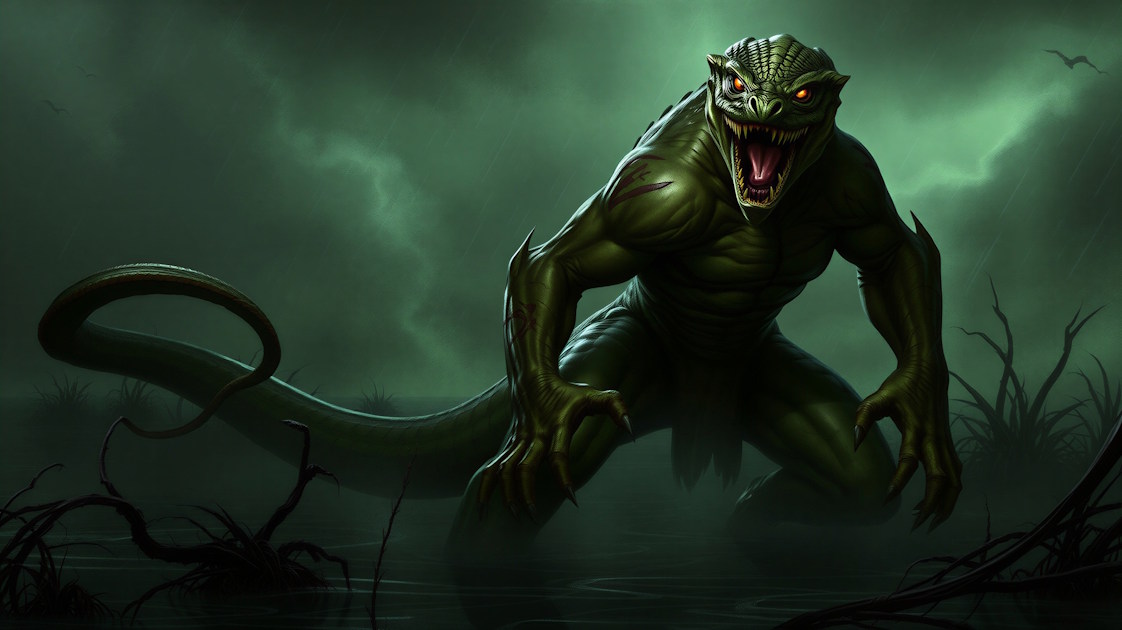
Morghen is depicted as the ideal sitheri warrior—a male of exceptional physical development, his serpentine body rendered in the lean, scarred proportions of a fighter who has spent a lifetime in active predation. He is not the largest figure in sitheri mythology; Sythraxis dwarfs him in every depiction. But where Sythraxis’s size communicates primordial power, Morghen’s proportions communicate functional lethality—a body built not to impress but to kill, every muscle and scale positioned for maximum efficiency in the act of hunting.
His scales are depicted in the mottled greens and browns of the Grimmere’s waterline, the natural camouflage of a predator designed to be invisible in the terrain where he operates. His markings shift between depictions, reflecting the sitheri understanding that the hunter adapts his appearance to his environment rather than maintaining a fixed identity. His eyes are the flat amber of a serpent in full hunting focus—dilated, unblinking, locked onto something that the viewer cannot see but that the god has already decided to kill. The eyes are the feature that sitheri artists consider most essential to capture, because they communicate the specific quality of attention that distinguishes a predator from a creature that merely happens to be dangerous.
He is always depicted in motion or in the coiled readiness that immediately precedes it. Unlike Sythraxis, who is rendered in the absolute stillness of settled power, Morghen occupies the moment between stillness and violence—the last instant before the strike, when the body has committed but has not yet moved, when the prey’s fate is decided but not yet executed. Sitheri artists consider this moment sacred, the purest expression of predatory intent, and they return to it obsessively in their depictions of the hunter god.
His weapons are the weapons of the sitheri warrior tradition—curved blades designed to complement the natural striking motions of serpentine musculature, their edges maintained to the killing standard that Morghen himself established. In some depictions he carries a spear suited for the swamp’s waterways and thick vegetation. In the oldest carvings, he carries nothing at all, his claws and fangs sufficient for the work at hand. The sitheri consider the weaponless depictions most authentic, arguing that Morghen’s original hunts predated the development of forged weapons and that his deadliest tools were the ones his body provided.
His most distinctive feature in every depiction is the shoulder sash—the original sash from which all subsequent sitheri warrior sashes derive, weighted with proof of kills so numerous that the myths decline to count them. The sash is draped across his torso and over one shoulder, heavy with scalps, teeth, and claws collected from prey spanning every race and species the ancient world contained. This sash is the most sacred image in sitheri warrior culture, the visual representation of Morghen’s authority and the template that every young warrior’s own sash aspires to echo.
The primary symbol associated with Morghen is the Crossed Fangs—two curved serpent fangs positioned in an X pattern, representing the strike delivered from concealment. This symbol appears on weapons, warrior equipment, and the boundary markers that delineate hunting grounds throughout the Grimmere. Secondary symbols include the Dragging Trail, a wavy line representing the track left by prey being hauled back to the brood, and the Red Eye, a single eye rendered in blood pigment that marks sites where significant kills have occurred.
Origins
The sitheri tell Morghen’s origin as a kill story, because kill stories are the only stories that matter. In the earliest days after Sythraxis had swallowed the Dark and the Grimmere had begun to teem with life, the swamp produced creatures in reckless abundance—things that crawled, things that swam, things that slithered through the muck in forms that had not yet settled into the shapes the world would eventually require. This abundance was a problem. Too many creatures competing for the same resources meant that none of them thrived, and the swamp’s ecosystem teetered on the edge of collapse from the sheer weight of life it was trying to sustain.
The swamp needed a predator. Not the mindless consumption that Sythraxis had practiced when she devoured the primordial darkness—that was creation through annihilation, necessary but unsustainable. What the swamp needed was selective killing: the precise removal of the excess, the culling of the weak and the redundant, the targeted elimination that transforms a chaotic mass of competing organisms into a functional ecosystem where the strong survive and the strong’s prey survives just enough to sustain them. Morghen was that need given form—not born from Sythraxis directly but emerging from the swamp’s own violence, coalescing from the accumulated killing that the Grimmere’s earliest inhabitants performed on each other until the killing itself achieved consciousness.
His first act was a kill. The myths do not specify what he killed—only that it was large, that it was dangerous, and that he killed it alone, without tools, without hesitation, using nothing but the natural weapons that his serpentine body provided. He consumed a portion of the kill and left the rest for the swamp, establishing the principle that the predator takes what it needs and returns the remainder to the system that produced it. This was not generosity. It was efficiency. A predator that consumes everything starves itself by destroying the food supply. A predator that takes only what it requires ensures that the supply replenishes. Morghen understood this before he understood anything else, and the sitheri absorbed the lesson into the foundations of their hunting culture.
Domains & Attributes
Morghen governs predation as a complete system—not merely the moment of the kill but the entire sequence of behaviors that precedes and follows it. His domain encompasses the identification of prey, the assessment of its value and vulnerability, the planning and execution of the approach, the strike itself, the claiming and processing of the kill, and the withdrawal to safety before retaliation can occur. Each phase of the hunt falls under Morghen’s authority, and each carries its own requirements of skill, patience, and cunning that the sitheri have codified into the warrior traditions that define their military culture.
The warrior’s craft forms his second domain, encompassing not just combat skill but the entire complex of abilities that a sitheri warrior must master to function effectively as a predator. Weapons handling, stealth, navigation of hostile terrain, the reading of tracks and environmental signs, the management of fatigue and injury during extended operations, the discipline to remain motionless for hours while waiting for the optimal moment to strike—all of these skills fall within Morghen’s purview, and all are cultivated with the obsessive attention to detail that the sitheri bring to every aspect of their violent profession.
His third domain is the trophy—the proof of the kill that transforms a private act of violence into a public statement of capability. Morghen established the principle that a kill without proof is a kill without value, because the purpose of hunting is not merely to feed oneself but to demonstrate to the tribe that one is capable of feeding it. The scalps that sitheri warriors display on their shoulder sashes, the teeth and claws collected from dangerous prey, the trophies taken from defeated enemies in inter-tribal warfare—all are expressions of Morghen’s insistence that the hunt is not complete until the hunter returns with evidence that it happened.
His domain does not extend to the killing of one’s own kind for political purposes. Morghen’s hunting is directed outward—toward prey, toward enemies, toward the things beyond the border that sustain the tribe through their deaths. The assassination of rivals, the culling of hatchlings, the ritual sacrifice of captives—these fall under other gods’ authority. Morghen is the blade that faces outward, and the sitheri maintain this distinction with unusual theological precision, viewing the confusion of internal killing with external hunting as a corruption that dishonors the god who taught them the difference.
Nature & Temperament
Morghen is cunning in the specific, functional way that the sitheri value—not the abstract intelligence of the scholar or the visionary foresight of the prophet, but the sharp, immediate cleverness of a predator that reads its environment the way other beings read language, extracting information from every ripple in the water, every shift in the wind, every subtle change in the behavior of the creatures around it. His intelligence is entirely practical, entirely directed toward the hunt, and entirely without pretension. He does not think for the sake of thinking. He thinks because thinking produces better kills.
His patience is the patience of the ambush—the ability to remain motionless for as long as the situation requires, suppressing every impulse toward premature action, waiting with the cold discipline of a creature that has learned through millennia of predation that the hunter who strikes too early eats less than the hunter who strikes at the perfect moment. This patience is not the philosophical endurance of Thyrkos or the analytical contemplation of Velania. It is tactical, purposeful, and entirely subordinate to the kill it serves. Morghen waits because waiting produces results. The moment waiting ceases to be productive, he acts with explosive violence that leaves no time for the prey to react.
His ruthlessness is absolute and impersonal. The myths describe Morghen killing without anger, without satisfaction, without the emotional engagement that other races’ war gods typically display. He kills because killing is his function, the way breathing is a function—necessary, continuous, and devoid of moral content. The sitheri admire this quality above all others in their hunter god, viewing emotional detachment during the kill as the mark of a professional whose work is too important to be contaminated by feeling. A warrior who kills in rage is a warrior whose judgment is compromised. A warrior who kills in cold efficiency is a warrior who honors Morghen.
Yet the myths acknowledge a quality in Morghen that complicates his otherwise flawless predatory profile: pride. Not the warm, demonstrative pride of the boastful warrior, but the cold, internal certainty of a being who has never encountered anything he could not hunt and kill. This pride was his defining characteristic and ultimately his undoing, because a predator who believes himself supreme in all environments and against all opponents eventually enters a territory where that belief is tested by something faster, sharper, and more committed to the kill than he is. Morghen’s pride drove him into the Merrow Woods. What waited for him there ensured he did not leave.
The Swamp Pantheon
Morghen’s position within the Swamp Pantheon is that of the weapon—the directed expression of the violence that the other gods require but do not personally execute. Sythraxis produces the sitheri. Morghen teaches them to hunt. Thessara controls the waters through which they move. Vexthul claims them when they fall. The system is functional rather than affectionate, each god contributing a necessary component to the cycle of sitheri existence without requiring the cooperation or approval of the others.
His relationship with Sythraxis is one of mutual utility expressed through the tension inherent in any interaction between a mother and the weapon she forged from her children. Sythraxis produced the sitheri. Morghen turned them into hunters. Without Sythraxis, there would be nothing to train. Without Morghen, there would be nothing worth training for. The myths describe their interactions as transactional—Sythraxis providing warriors, Morghen returning them as killers, each god taking what it needed from the arrangement without sentimentality or gratitude. When the tides of power shifted between them, the shift manifested in practical terms: which god’s rituals received more resources, whose traditions took precedence in tribal practice, whose authority the brood mothers invoked more frequently when justifying their decisions.
His relationship with Thessara the Tide Bringer is defined by the hunter’s dependence on the terrain the hunt occurs in. The waters of the Grimmere are Thessara’s domain. Morghen hunts in those waters. This creates a dynamic where the hunter must operate within conditions set by another power—an arrangement that Morghen’s pride found perpetually grating. The myths describe episodes where Morghen attempted to hunt in defiance of Thessara’s conditions—pursuing prey through flood-swollen waterways, tracking targets across channels that Thessara had redirected—and the results were mixed enough to demonstrate that neither god could ignore the other’s influence without consequence.
His relationship with Vexthul the Bone Keeper is the simplest in the pantheon: Morghen produces the dead, Vexthul collects them. The hunter and the collector of remains occupy adjacent positions in the chain of sitheri existence, and their interactions carry none of the competitive tension that characterizes the other divine relationships. Morghen kills. Vexthul sorts the results. The arrangement requires no negotiation because neither god wants what the other has—Morghen has no interest in the dead once the kill is complete, and Vexthul has no interest in the living until they cease to be.
The Great Deeds
Morghen’s Great Deeds are hunts, told with the clinical precision that sitheri warriors bring to after-action accounts of successful operations. The myths strip away the narrative embellishment that other races layer onto their divine stories, presenting Morghen’s achievements as sequences of tactical decisions executed with professional competence. The sitheri do not want their god’s deeds to be inspiring. They want them to be instructive.
The Hunt of the Swamp Leviathan is the oldest and most frequently recounted of Morghen’s deeds, describing his pursuit and killing of a creature so massive that it had been mistaken for a geographical feature—an island that moved, a ridge that submerged, a shoreline that was not where it had been the previous day. The Leviathan had no natural predator and no reason to fear anything in the Grimmere, which made it complacent in ways that Morghen exploited with methodical patience. He spent an entire season studying the creature’s patterns—its feeding routes, its resting positions, the rhythm of its breathing that created predictable currents in the surrounding water. When he struck, he did so at the single point on the creature’s body where its hide was thin enough for his fangs to penetrate, at the single moment in its breathing cycle when its movement would carry the venom deepest. The Leviathan died without knowing what had killed it. The sitheri consider this the perfect hunt: the prey eliminated before it realized it was prey.
The Raid on the Fire Lands describes Morghen’s expedition beyond the Grimmere into territories controlled by races who used fire as their primary weapon and defense. Fire is the sitheri’s greatest natural enemy—the one element that their cold-blooded physiology cannot adapt to and their swampland environment cannot neutralize. Morghen entered the fire-using territories deliberately, hunting their warriors on their own ground, proving that a sufficiently skilled predator can operate in any environment regardless of the disadvantages it presents. He returned to the Grimmere carrying trophies from warriors who had believed themselves safe behind their walls of flame, and the lesson he demonstrated became a foundational principle of sitheri military doctrine: no terrain is impassable, no defense is impenetrable, and no prey is beyond reach for a hunter willing to adapt.
The Silence of the Deep Hunt is Morghen’s most enigmatic deed—a hunt conducted entirely underwater, in the lightless channels beneath the Grimmere’s surface, against a prey that the myths refuse to describe. The sitheri shamans who preserve this story maintain that what Morghen hunted in the deep channels was not a creature but a concept—an embodiment of the fear that even predators feel when they enter environments where their advantages are nullified. By hunting and killing this fear, Morghen freed the sitheri from the psychological limitations that would have confined them to the swamp’s upper waters, enabling them to exploit the deep channels that provide both resources and concealment. Whether this myth describes an actual hunt or a metaphorical one is a distinction the sitheri do not consider important. The result is the same: the deep waters are open to sitheri hunters because Morghen opened them.
The First Hundred Scalps
The Hundred Scalps ritual—the coming-of-age trial that defines sitheri warrior culture—originates directly from Morghen’s own practice, and the myths describe its establishment with the same clinical detail that characterizes all of Morghen’s deeds. In the earliest days of sitheri civilization, when the Ten Daughters had established their broods and the first generations of sitheri males were reaching maturity, Morghen recognized a problem that Sythraxis’s matriarchal system had not fully addressed: how to determine which warriors were worthy of adult status, mating privileges, and positions of responsibility within the tribal hierarchy.
The brood mothers could evaluate physical fitness and obedience. They could not evaluate the quality that Morghen valued above all others: the ability to hunt, kill, and return alive from hostile territory. This quality could only be tested in the field, against real enemies, under conditions where failure meant death. And so Morghen left the Grimmere. He traveled alone into the lands beyond the swamp, hunting every race and creature he encountered, collecting proof of each kill on a sash that grew heavier with each trophy. He set the count at one hundred deliberately—a number high enough to require sustained competence rather than a single lucky encounter, low enough to be achievable by a warrior of genuine ability, and round enough to serve as an unambiguous standard that admitted no argument about whether it had been met.
When he returned, his sash heavy with the proof of a hundred kills collected from a dozen different territories, he presented it to Sythraxis and declared that any male who could not match this count was not worthy of standing among the sitheri as an adult. Sythraxis accepted the standard because it served her purposes: it removed aggressive young males from the tribal territory during the period when they were most likely to cause disruption, it provided real-world combat training that no amount of practice could replicate, and it ensured that only the most capable survivors returned to contribute to the next generation. The Hundred Scalps became law, and every sitheri male who has completed it since has walked the path that Morghen walked first.
The ritual’s requirements have remained remarkably consistent since Morghen established them. The warrior must leave his natal territory alone. He must collect one hundred kills from enemies beyond the Grimmere’s borders. He must display the proof on a shoulder sash of prescribed construction. And he must return alive. No other assistance is permitted. No substitution of kills within the Grimmere is accepted. No reduction of the count is entertained for any reason. The standard is absolute because the god who set it was absolute, and the sitheri who fail to meet it receive the only mercy their culture recognizes: the mercy of being forgotten.
The Trespass in the Merrow Woods
The event that preceded Morghen’s death is known among the sitheri as the Trespass—a word that carries different weight in sitheri mythology than it does in other cultures. To the sitheri, trespass is not a minor offense. It is an act of war, a deliberate violation of territorial sovereignty that demands lethal response. That Morghen committed this offense against the krill, a race whose territorial ferocity matched the sitheri’s own, makes the event all the more significant. He did not stumble into krill territory by accident. He entered it with purpose, and the purpose was predation.
The myths describe Morghen’s incursion into the Merrow Woods as a hunt of unprecedented ambition—the god of the hunt entering the domain of another race’s gods to prove that no territory was beyond his reach and no prey beyond his skill. What he did in the Merrow Woods is described in the sitheri myths with a vagueness that suggests either genuine uncertainty about the details or a deliberate refusal to specify an act so provocative that recording it precisely might invite retaliation against the storytellers. The krill accounts, characteristically, do not elaborate either. What is agreed upon by both traditions is that Morghen’s actions in the Merrow Woods constituted a violation so severe that it demanded a divine response.
The nature of that violation remains a matter of speculation. Some sitheri traditions hold that Morghen hunted and killed krill—not ordinary krill but individuals of sacred significance, perhaps shamans or sinji warriors whose deaths represented an assault on krill spiritual heritage. Others suggest that he desecrated a sacred site, violating the territorial sanctity that the krill gods had established. A third tradition, whispered by shamans who claim access to older sources, holds that Morghen attempted to hunt one of the krill gods themselves—that his pride had grown so absolute that he believed himself capable of adding a divine kill to his sash. Whatever the specific act, it was enough to draw the attention of Nimala the Swift, and drawing Nimala’s attention was the last mistake Morghen ever made.
The Death of Morghen
Nimala came to the Grimmere. The sitheri tell this with the flat, unadorned brevity of a people recounting a wound that has not healed. She did not send emissaries. She did not issue warnings. She did not negotiate, threaten, or posture. She entered the swamp alone—a krill goddess in territory that should have been lethal to anything not born to it—and she hunted the god of the hunt in his own domain.
The Grimmere should have stopped her. The swamp was Morghen’s ground, the terrain he knew better than any other being alive or divine. Its waterways, its mud, its treacherous footing, its venomous inhabitants, its choking vegetation—all of these should have served as defenses that no outsider could overcome. Morghen knew this. He had spent millennia hunting in this environment, learning its every advantage, building his tactics around the swamp’s capacity to slow, confuse, and kill any creature that did not belong in it. A krill goddess—a creature of the canopy, built for speed in open air and across branches—should have been helpless in the Grimmere’s clinging depths.
She was not helpless. The myths describe Nimala adapting to the swamp with the terrifying efficiency of a predator that does not care what terrain it operates in because the prey is all that matters. She moved through the waterways without sound. She crossed the mud without leaving tracks. She passed through the vegetation as if it were not there, her speed translated from the horizontal planes of the canopy to the close, tangled dimensions of the swamp with a fluidity that defied everything the sitheri understood about the limitations of non-serpentine creatures. Morghen felt her coming—he was a god of the hunt, and gods of the hunt do not fail to notice when they are being hunted—but feeling her approach and stopping it were not the same thing.
The kill was fast. The sitheri myths acknowledge this with bitter precision, because speed was not supposed to be Morghen’s weakness. He was patient. He was cunning. He had spent millennia outthinking prey that was faster than he was, using the swamp’s terrain to neutralize speed advantages and force confrontations on his terms. But Nimala was not faster than Morghen in the way that ordinary prey was faster. She was faster in a way that rendered his patience irrelevant, his cunning obsolete, and his terrain advantages meaningless. She did not give him time to set an ambush. She did not give him time to read her approach. She did not give him time to do anything except recognize, in the final instant before her claws found his throat, that he had met the one predator in the world against whom his skills were insufficient.
Nimala killed Morghen in the Grimmere, in his territory, surrounded by his swamp, under conditions that should have guaranteed his survival. Then she left. The krill myths do not record this event as a significant deed, which the sitheri find more insulting than the killing itself. To Nimala, Morghen was a problem that required resolution—a trespasser who had violated her territory and who needed to be eliminated with the same clean, decisive efficiency she brought to every hunt. She did not consider it a triumph. She considered it maintenance. The sitheri have never forgiven this, and the debt they believe is owed—a god’s life for a god’s life—has informed their attitude toward the krill ever since.
Legacy & Enduring Influence
Morghen’s death shapes sitheri warrior culture as profoundly as his life does, though the lessons drawn from each are different in kind. His life teaches the sitheri how to hunt. His death teaches them that no hunter is supreme in all conditions, that pride in one’s own prowess can become the vulnerability that an enemy exploits, and that the world contains predators whose abilities exceed what experience has prepared you to face. These are uncomfortable lessons for a people who define themselves through predatory dominance, but the sitheri are too practical to ignore a lesson delivered at such cost.
The Hundred Scalps ritual remains his most tangible legacy—a tradition so central to sitheri identity that its abolition would be equivalent to the dissolution of their warrior culture. Every male who completes the ritual walks the same path Morghen walked, proves himself by the same standard Morghen set, and returns to his brood carrying the same proof of capability that the god of the hunt presented to Sythraxis in the earliest days of sitheri civilization. The ritual has survived Morghen’s death, the Fall of the Old Gods, five hundred years of inter-tribal warfare, and every challenge the changing world has posed to traditional sitheri practices. Its endurance testifies to the soundness of its design: a simple, brutal, effective system for separating the capable from the unworthy, exactly as Morghen intended.
The enmity between the sitheri and the krill, while predating Morghen’s death, was crystallized by it into something permanent and theological. The sitheri do not merely dislike the krill. They owe the krill a debt of blood that their theology cannot forgive and their pride cannot forget. This debt manifests in the particular savagery that sitheri warriors reserve for krill encounters—a ferocity that exceeds what they bring to conflicts with other races, driven by the knowledge that every krill who falls brings the ledger one entry closer to balance. The balance will never be achieved, because no number of mortal kills can equal the death of a god, but the sitheri continue the accounting with the patient, relentless attention to grievance that defines their approach to all debts.
Morghen’s failure in the Merrow Woods has also, paradoxically, strengthened sitheri military doctrine. The lesson of his death—that operating in unfamiliar territory against an enemy adapted to that terrain is a fundamental tactical error regardless of one’s individual capabilities—has been absorbed into the training of every sitheri warrior. The Grimmere is the sitheri’s advantage. The swamp is the weapon. Warriors who leave it to hunt do so with the understanding that they are trading the terrain advantage that kept their god alive for centuries against the risk of encountering something that the swamp would have neutralized. The Hundred Scalps ritual requires this risk. Morghen’s death ensures that every warrior who takes it understands exactly what the risk entails.
Worship & Observances
Worship of Morghen is indistinguishable from the practice of hunting itself. The sitheri do not pray to their dead hunter god. They hunt. They kill. They collect proof and display it. Every successful hunt is an observance, every clean kill a prayer, every trophy added to a warrior’s sash an offering laid at the feet of a god who valued nothing in his followers except their ability to do what he did. The sitheri consider this the only form of worship that Morghen would have tolerated—a god who killed without sentiment would have despised sentimentality in those who honored him.
The most significant formal observance is the Night of the First Hunt, held annually at the onset of the wet season when the Grimmere’s rising waters drive prey into concentrated areas. On this night, the warriors of each brood conduct a coordinated hunt in which the objective is not mere killing but the demonstration of technique—the cleanest approach, the most efficient strike, the most complete use of the kill. The hunt is conducted in deliberate silence, without the war cries and competitive displays that characterize ordinary sitheri combat, reflecting Morghen’s own preference for the quiet, professional execution of the predator’s craft. The kills from this hunt are offered to the brood mother, who distributes them according to the quality of technique each warrior demonstrated.
The Departure Rite, conducted when a young warrior begins his Hundred Scalps journey, invokes Morghen’s name and example in the most direct form of worship the sitheri practice. The departing warrior is presented with a blank shoulder sash—unweighted, empty, carrying no proof of anything—and told that Morghen carried one just like it when he walked this path first. The warrior is then recited the count: one hundred. No more is said. The rite’s brevity is deliberate, reflecting the sitheri conviction that a warrior who needs encouragement is a warrior who is not ready. Morghen did not need encouragement. Neither should they.
The Return Feast, held when a warrior completes his Hundred Scalps and presents his full sash to the brood mother, is one of the few occasions when sitheri celebration approaches something that other races might recognize as joy. The successful warrior’s kills are counted publicly, his sash examined and verified, and his transition to adult status formally acknowledged. The feast that follows involves the communal consumption of prey brought by the returning warrior, symbolically connecting his achievement to Morghen’s original return from the first Hundred Scalps. It is the closest thing the sitheri have to a festival, and it carries an edge of savagery that ensures no observer would mistake it for the celebrations of gentler peoples.
Sayings & Proverbs
Sitheri sayings associated with Morghen are the language of professionals discussing their craft—terse, technical, and entirely without sentiment.
“The count is the count” is used to shut down any attempt to negotiate, reduce, or reinterpret a standard that has been set. The phrase invokes the Hundred Scalps requirement specifically—Morghen set the number, the number does not change, and any discussion of changing it is finished before it begins. The saying has broader application in sitheri culture, used whenever someone attempts to soften a requirement or make an exception to an established rule. Standards exist because Morghen set them. They are not subject to revision.
“He hunted in the wrong woods” is a warning against operating in unfamiliar territory without adequate preparation, invoking Morghen’s fatal error in the Merrow Woods without naming it directly. The phrase is used when a warrior, a brood mother, or any sitheri ventures beyond the limits of their competence into situations where their usual advantages do not apply. It is both a caution and a condemnation—a reminder that even a god can die when he enters terrain where his skills are not enough.
“Fill the sash” is an exhortation to complete what has been started, carrying the specific implication that partial achievement is worthless. A warrior who returns with ninety-nine scalps has failed as completely as one who returns with none. The saying applies beyond the Hundred Scalps to any undertaking where the standard is absolute: the job is done or it is not, and the difference between almost and complete is the difference between failure and survival.
“The prey decides nothing” is a statement of predatory philosophy, asserting that the hunted has no agency in determining the outcome of the hunt. The hunter chooses the target. The hunter chooses the moment. The hunter chooses whether the prey lives or dies. The prey’s preferences, capabilities, and preparations are variables to be accounted for, not authorities to be respected. The saying is used to dismiss the significance of an enemy’s strength or preparation, reminding sitheri warriors that the initiative belongs to the hunter and that a confident prey is simply a prey that has not yet realized its situation.
Sacred Sites
The place where Morghen died is sacred in the way that an open wound is sacred to the sitheri—not reverently, not with gratitude, but with the cold attention that a warrior pays to a lesson written in his own blood. The site is located within the Grimmere, in a stretch of waterway that the sitheri call the Godless Channel, named for the absence that Morghen’s death created. No sitheri hunts in the Godless Channel. No brood claims it as territory. It exists as a void in the map of sitheri civilization, an unmarked space that every warrior knows and no warrior willingly enters. The water there is said to be colder than elsewhere in the swamp, the silence deeper, the darkness more complete. Whether these qualities are real or projected by the weight of what happened there is a question the sitheri do not investigate.
The Sash Stones are a collection of rock formations in the central Grimmere where successful warriors traditionally present their completed sashes to their brood mothers upon returning from the Hundred Scalps. These stones are not carved or decorated—they are natural formations, smoothed by centuries of rising and falling water, that have acquired sacred significance through the accumulated weight of the rituals performed upon them. Each brood maintains its own Sash Stone, and the return of a warrior to his brood’s stone is the formal conclusion of the Hundred Scalps journey, the moment where the solitary hunt becomes a tribal achievement.
The hunting grounds where Morghen conducted his original hunts—the places beyond the Grimmere where he collected his first hundred kills—are remembered in sitheri oral tradition but not visited or venerated. The sitheri do not make pilgrimages to sites outside their territory, and the lands where Morghen hunted have changed beyond recognition over the millennia since he walked them. What matters to the sitheri is not the specific ground where the kills occurred but the principle they established: that the world beyond the Grimmere is hunting ground, and the sitheri are the hunters.
Concluding Remarks
Morghen the Hunter is dead, killed by a faster predator in a lesson that the sitheri have spent five centuries absorbing without fully accepting. He was the best of them—the divine expression of every quality they value in a warrior, the originator of the tradition that makes their males into killers, the god who proved that a sitheri hunter could operate in any terrain and against any prey. And he was not enough. Nimala was faster. Nimala was better. Nimala came into his swamp and killed him on his ground, and the fact that he had given her reason to come does not diminish the result. A dead hunter is a dead hunter, regardless of the circumstances that produced the death.
The sitheri carry this knowledge the way they carry all uncomfortable truths: openly, without self-deception, and with the cold determination to ensure that the lesson is not wasted. Morghen’s death does not make them weaker. It makes them more careful. It makes them more aware of their limitations. It makes them better hunters, because a hunter who has been shown—at the highest possible cost—that he is not the apex predator in every ecosystem is a hunter who will never again make the mistake of assuming that he is. The count remains one hundred. The sash must be filled. The path must be walked. And somewhere in the Grimmere, in the cold water of the Godless Channel, the memory of a god who was not fast enough serves as the final and most effective warning that sitheri warrior culture has ever produced: be better, or be prey.