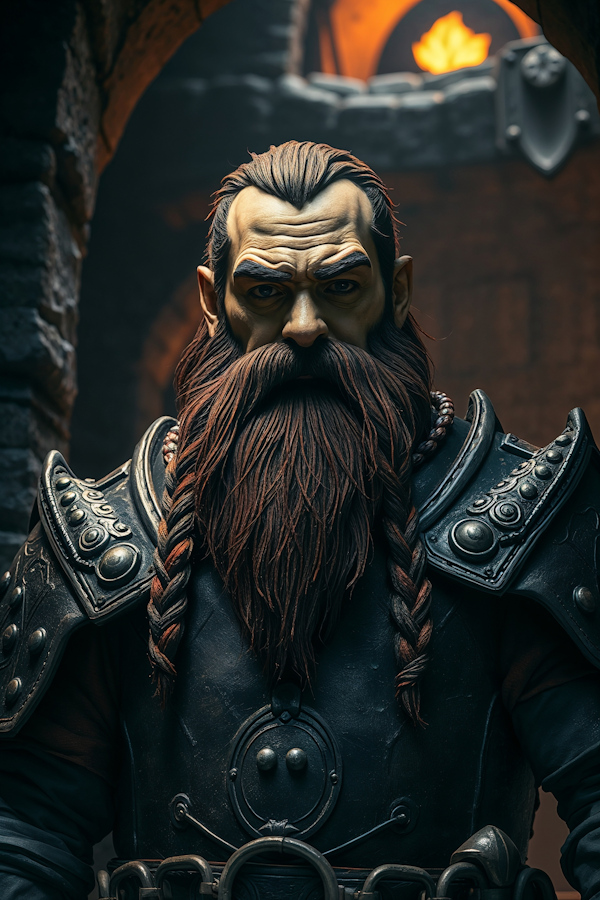
There is a type of leader that emerges from hard borders — from places where civilization and wilderness meet and neither one fully wins. Nali Borderward is that type. The Thane of Rillock is not the most refined of the seven thane lords, nor the most patient, nor the most inclined toward the deliberate consensus-building that dwarven governance traditionally favors. What he is, and what the Anolgan hill people who form his closest human allies recognized the moment they encountered him, is exactly what a leader of the Border Watch needs to be: dangerous, direct, and completely unafraid of anyone who disagrees with him.
He looks the part in a way that surprises visitors who arrive expecting the compact, well-ordered presentation common to dwarven leadership. Nali is broad even by dwarven standards, with the thickened neck and heavy shoulders of a fighter who has spent decades using his body as a weapon rather than simply carrying one. His beard — dark brown, shot through with copper — is worn long but loose, unbraided in the style favored by Anolgan warriors who consider elaborate grooming a distraction from combat. His hair matches it, thick and unkempt in a way that falls just short of violating the dwarven tradition of beard maintenance while radiating the message that the finer points of that tradition concern him less than its spirit. Battle scars mark his forearms and the left side of his jaw, each one a story he has never told and would consider tedious if asked. His weapons — a heavy war axe worn across the back and a short sword at the hip — are present at every occasion that protocol would permit and several that it would not, carried with the casual familiarity of a dwarf who does not think of them as weapons so much as parts of himself. The Anolgan chieftains who first came to Rillock expecting a dwarven politician and found Nali instead reportedly laughed with genuine pleasure and immediate respect. They knew what they were looking at.
His election to the thane's seat is the most controversial event in Rillock's recent history, and Nali's relationship with that controversy is its own kind of statement. Three members of the elder council who had been positioned to oppose his candidacy most vocally died in separate accidents in the months before the vote was cast — a mining collapse, a fall on a cliff path above the Barrens, and a fire that began in a workshop overnight. The coincidence was not lost on anyone in Rillock, and the murmurs that followed the election were audible for years afterward. Nali has never addressed these murmurs directly. He has never denied anything, never offered an explanation, never sought to rehabilitate the narrative. What he has done, consistently and with evident relish, is invite anyone who believes the accusations to say so to his face. In the years since his election, no one has accepted that invitation. The murmurs continue. So does his leadership, which has by any practical measure served Rillock well. The two facts exist side by side, as uncomfortable truths and effective governance sometimes do, and Rillock's population has made its peace with both.
He married Brekka Stonefist late in life — a woman of the Iron Hammers clan whose reputation as a weaponsmith is second only to her reputation for having the shortest temper of anyone in the fortress, qualities that Nali apparently finds complementary to his own. They have no children, a fact that generates periodic concern among the elder council about succession, but that Nali addresses with the same indifference he brings to most concerns about his personal choices. The question of what comes after him is a question for whoever inherits the problem. He is occupied with the present.
The present, in Rillock, means managing the most complex diplomatic position in the dwarven world with a style that would seem entirely unsuited to diplomacy right up until the moment it works. Nali's approach to the Anolgan alliance is built not on careful protocol or studied courtesy but on the same foundation that the alliance itself was built on — mutual recognition of capability. The Anolgan hill people respect strength, directness, and the willingness to share a danger as readily as a meal. Nali provides all three without effort because they are who he is rather than what he does. He attends the Anolgan chiefs' war councils not as a dwarven dignitary but as a fighter whose opinion is valued because he has earned it on the same ground where they have earned theirs. He drinks with them, argues with them, and has on at least one occasion settled a disagreement with his fists rather than his words — an incident that the more protocol-conscious members of his council found deeply embarrassing and that the Anolgan chief involved apparently considered the beginning of a genuine friendship.
His relationship with the Duchess of Anolga operates at a different register. Where his connections with the Anolgan hill chiefs are rooted in shared martial culture, his relationship with the duchess is one of mutual recognition between two leaders who understand that they need each other and are honest enough to admit it without dressing the arrangement in sentiment it does not possess. Nali respects her ability. She respects his. They cooperate on the matters where cooperation serves both their interests — trade agreements, border security, the occasional joint response to threats that neither side wishes to handle alone — and they maintain their respective independence on everything else. Neither owes the other anything beyond what the partnership produces. Both understand this clearly, which is why the partnership has endured. Nali considers this exactly how political relationships between sovereign entities should work, and the directness with which both parties operate suits him far better than the elaborate performances of alliance that characterize relations between the other thanes and their surface neighbors.
On the question of dwarven reunification, Nali's position is perhaps the most dismissive of any among the thane lords. He calls it a bad joke and means it without the bitterness that the phrase might carry in another mouth — it is the assessment of a dwarf who has spent his career navigating the practical realities of cross-cultural partnership and sees nothing in the historical record that suggests a unified dwarven kingdom would function better than the independent arrangement that currently exists. The thanes disagree on nearly everything that matters — governance, trade policy, military priorities, the degree of engagement with the surface world — and the distance between their positions has only grown as each has adapted to its unique circumstances over five centuries of independence. Reunification would require either one thane's approach to dominate all the others or a compromise so diluted that it would satisfy no one. Nali cannot identify a version of the outcome that improves on what the thanes already have, and he suspects that the dwarves who advocate for it have confused nostalgia for a kingdom that was already failing when the gods destroyed it with a workable plan for the present. He says this when the subject arises, without particular heat. It is not, for him, so much a political position as an obvious conclusion that he has stopped expecting other people to reach on their own.
The criticism that other thanes occasionally level at Rillock — that its openness to Anolgan culture represents a dilution of dwarven identity, that a fortress whose dwarves walk freely on the surface and trade jokes with human merchants has strayed from the values that define their people — lands on Nali the way salt spray lands on cliff stone. He does not dispute the observation that Rillock is different from Dwathenmoore, Heidelheim, or Berjendale. He disputes the premise that different means lesser. His fortress cleared its peaks of gaugath raiders generations before any other thane achieved comparable security. Its trade produces returns that fund the most prosperous non-Merkinjel economy in the dwarven world. Its dwarves are tougher on average, in his assessment, than those of any thane that has never had to defend its gates while simultaneously managing relationships with the human civilization next door — because doing two difficult things at once is harder than doing one, and harder makes stronger. He has been known to share this view at inter-thane gatherings with a frankness that falls somewhere between confidence and provocation, and he has never adjusted his tone based on whether it was well received.
What Nali Borderward is not, despite the warrior's appearance and the cloud of controversy that has followed him since his election, is reckless. He is aggressive in the way effective border leaders are — forward-leaning, risk-tolerant, willing to act before consensus forms when delay carries costs that consensus does not account for. But the decisions he makes quickly are grounded in a practical understanding of Rillock's position that he has spent a lifetime developing. He knows every approach to the fortress, every relationship that sustains the Anolgan alliance, every pressure point in the trade arrangements that keep the fortress prosperous, and every threat — internal and external — that could unravel what generations of dwarves built at the edge of the Barrens Ocean. He attends to all of it with the focused intensity of a leader who is constitutionally incapable of half measures. The fortress is his. The border is his. The alliance is his. He manages all three not because someone told him to but because that is what Nali Borderward does, and he has never required a better reason than that.