Nimala the Swift, Blade of the Canopy
Introduction
Nimala the Swift is the krill goddess of speed, the hunt, and the killing stroke. She is the shadow that crosses the branch before the eye can follow it, the claw that finds the throat before the prey knows it has been found, the silence between heartbeats where death lives. Among the gods of the krill Forest Pantheon—equals in standing, each governing a different facet of existence—Nimala holds a singular place in the hearts of her people. She is not the most comforting of their gods. She is not the wisest or the most protective. She is the one they fear, love, and strive to become.
The krill do not worship Nimala in the way that other races worship their deities. They do not kneel. They do not beg. They honor her by moving faster, striking harder, and refusing to show weakness in the face of anything the forest or the world beyond it can throw at them. Every sinji warrior who survives the shi-ja ritual carries something of Nimala within them—or so the krill believe. Whether this is a metaphor or something more tangible is a question the krill do not bother to answer. The shi-ja kills those who are unworthy. The worthy have changed. That is enough.
Unlike the dwarven gods, whose deaths are recorded in myths of spectacular sacrifice, Nimala’s fate remains unknown. She did not fall at the Sundering Deep or perish holding a threshold against cosmic destruction. When the Old Gods tore themselves apart in the cataclysm that ended their age, Nimala simply vanished. No body. No final act. No last words preserved in oral tradition. She was there, and then she was not. The krill take this as evidence not of her death but of her survival, reasoning with characteristic bluntness that a goddess of speed would not be caught by anything so clumsy as an apocalypse. Whether she watches from some hidden place beyond mortal perception, whether she stalks the deepest canopies in a form too swift to be seen, or whether she is truly gone and the krill simply refuse to accept it—these are questions that have fueled debate around krill hearth fires for five hundred years and will likely fuel them for five hundred more.
Appearance & Symbols
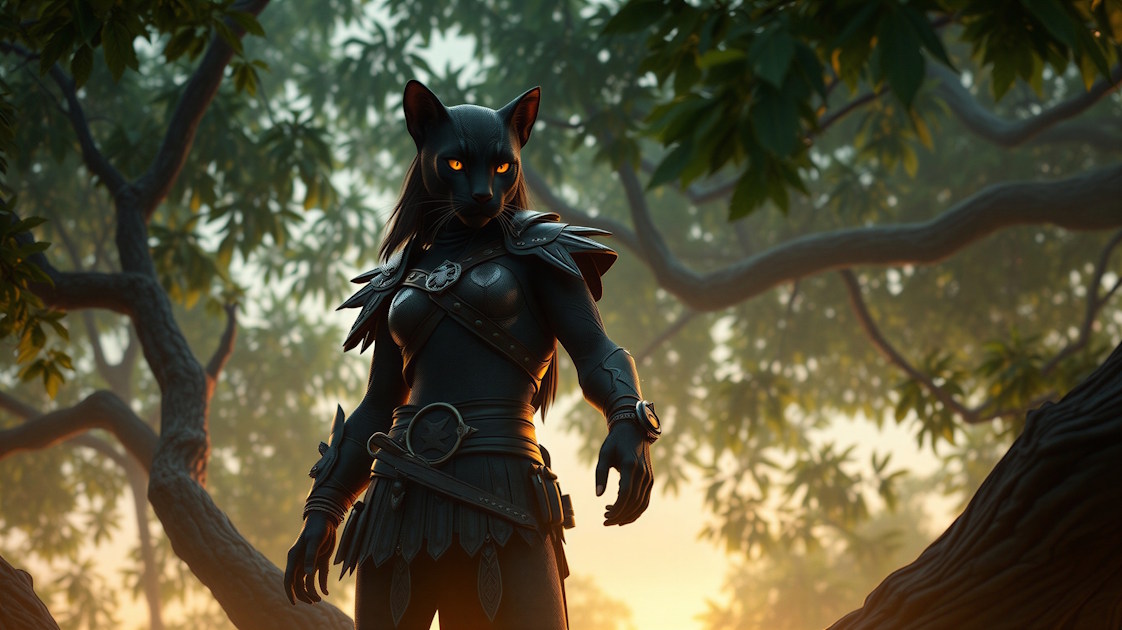
Nimala is depicted as a krill of impossible perfection—feline in every line and proportion, but elevated beyond the mortal form into something that makes the eye ache with the effort of following it. She is lean where other krill are lean, but more so, her body stripped of everything that does not serve speed and violence until what remains is pure function rendered in fur and muscle and claw. Her coat, in the oldest depictions, is the color of deep shadow—not black but the dark between branches where light has never reached, a color that seems to absorb attention rather than reflect it. Later artistic traditions render her in the tawny golds and muted greys of a forest predator at dusk, her markings shifting depending on the light and the angle of observation.
Her eyes dominate every depiction. They are amber, the deep, burnt amber of tree resin caught in late afternoon sun, and they carry an intensity that krill artists spend lifetimes trying to capture. The eyes do not merely look; they assess, weigh, and judge with a predator’s absolute focus. Krill who have undergone the shi-ja ritual sometimes report seeing those eyes in the moments between consciousness and oblivion, watching them with an attention that feels less like divine observation and more like a hunter deciding whether the prey before it is worth pursuing.
She is never depicted standing still. Every carving, every woven image, every pattern etched into bark or painted onto hide shows Nimala in motion—mid-leap, mid-strike, turning on a branch with one hand trailing behind her, descending through a gap in the canopy with her body elongated into a single line of directed force. The krill consider static depictions of Nimala to be not merely inaccurate but offensive, a fundamental misunderstanding of a being whose essence is movement. To freeze Nimala in place is to kill her, and no krill artist would commit that particular blasphemy.
Her weapons, when depicted, are her own body—claws extended to their full killing length, teeth bared in the focused grimace of a predator committed to the strike. Some traditions show her carrying a pair of curved blades that mirror the shape of krill claws, but these are considered later additions influenced by the sinji warrior tradition rather than authentic elements of her original mythology. The truest depictions show her unarmed because she needs no arms. She is the weapon.
The primary symbol associated with Nimala is the Three Claws—three parallel diagonal slashes that represent the marks left by a predator’s strike. This symbol appears throughout krill territory, carved into boundary trees, etched into weapon hilts, and scarified into the skin of sinji warriors during the shi-ja ritual. Secondary symbols include the Leaping Shadow, a silhouette of a krill in mid-flight between branches, and the Amber Eye, a single eye rendered in golden pigment that adorns the entrances to training grounds and sites associated with the shi-ja.
Origins
The krill tell Nimala’s origin not as a creation story but as a hunt story, because the krill understand everything through the lens of the hunt. In the time before time had a name, when the world was raw and unfinished, and the forests were young enough to still be afraid of the dark, something moved through the canopy that had no form and no name. It was faster than falling and quieter than growth. It left no tracks. It cast no shadow. The trees felt it pass and shivered, not from fear but from the recognition that something had entered the world that was more alive than they were.
The myths do not say where Nimala came from. She did not emerge from the Great Tree, whose roots anchor the forest’s life force. She did not crawl up from the earth or descend from the sky. The oldest tellings simply state that the world required a predator, and so a predator appeared—not created by any hand or will but called into existence by the fundamental need of a living world for something at the top of every chain, something that hunts and is never hunted. Nimala was that necessity given flesh. She existed because a world without a supreme predator is a world out of balance, and the forest does not tolerate imbalance.
Her first act, according to the myths, was to run. Not toward anything. Not away from anything. She ran because running was what she was, the way fire burns because burning is what fire is. She crossed the length of the Merrow Woods in the time it takes a leaf to fall from branch to ground, and when she reached the forest’s edge, she turned and crossed it again, faster, learning the shape of every tree, the angle of every branch, the position of every shadow. By the time she stopped—if she stopped—she knew the forest more intimately than the forest knew itself. She had mapped it not with eyes or memory but with motion, her body recording every surface and space as she moved through it.
The krill themselves entered the myths later, appearing in the forest as small, ground-dwelling creatures with feline features and no particular destiny. The earliest tellings describe them as unremarkable—quick but not fast, clever but not wise, fierce but not dangerous. They lived beneath the canopy and feared the things that lived above it. Nimala observed them for a long time, the myths say, watching from heights they could not reach, and she saw in them something she recognized: the raw material of hunters. Not hunters yet. But the potential, coiled tight, is waiting for something to draw it out. What she did next was not an act of mercy or kindness. It was an act of conviction. She descended from the canopy and walked among them, and by her presence alone she showed them what they could become. The krill looked up, and for the first time, they wanted to climb.
Domains & Attributes
Nimala governs speed in all its expressions—physical velocity, quickness of thought, speed of decision, and the lethal swiftness of a strike delivered at the precise moment when hesitation would mean failure. Her domain is not raw, undirected motion but purposeful speed, the kind that serves the hunt and the kill and the survival of those fast enough to earn it. A krill who runs from danger without purpose does not honor Nimala. A krill who moves with calculated precision through a collapsing bridge, choosing each footfall with instinct sharpened by a lifetime of practice, embodies everything she represents.
The hunt is her second domain, encompassing not merely the pursuit and killing of prey but the entire philosophy of predation that underpins krill culture. To hunt, in the krill understanding, is to commit fully to a course of action—to choose a target, pursue it without hesitation, and see the pursuit through to its conclusion regardless of difficulty or cost. This philosophy extends far beyond literal hunting to encompass every endeavor that requires focus, commitment, and the willingness to risk failure. A warrior stalking an enemy, a craftsman pursuing the perfection of a technique, a tribal leader tracking a solution to a complex problem—all are engaged in the hunt as Nimala defines it.
Her third domain is the killing stroke itself—the moment of decisive action that separates the successful from the unsuccessful, the living from the dead, the worthy from the unworthy. The krill revere this moment not out of bloodlust but out of respect for its purity. The killing stroke admits no ambiguity. It cannot be taken back. It demands absolute commitment and absolute skill, and it reveals the truth of the one who delivers it as nothing else can. Nimala is the goddess of that moment, the divine embodiment of the instant when preparation meets opportunity, and the result is final.
Her domain does not extend to cruelty or prolonged suffering. The krill draw a sharp line between the clean kill and the infliction of unnecessary pain, viewing the latter as a corruption of Nimala’s teachings rather than an expression of them. A predator that toys with its prey has forgotten its purpose. Nimala’s kills are swift, certain, and without malice—the natural conclusion of a hunt conducted with skill and commitment. The krill apply this principle broadly, valuing decisive action over prolonged deliberation and clean resolution over messy compromise.
Nature & Temperament
Nimala is not kind. The myths make no effort to soften this. She does not comfort the weak, console the grieving, or offer second chances to those who fail. She is a predator in the deepest sense of the word—a being whose nature is organized entirely around the identification and elimination of weakness, not out of cruelty but out of a conviction so absolute that it leaves no room for gentleness. The forest does not forgive the slow. The canopy does not catch the clumsy. Nimala embodies these truths without apology, and the krill love her for it because they understand that a world governed by mercy is a world that produces prey, not hunters.
Her ferocity is legendary even among the Old Gods. The myths describe her as a presence that other divine beings approached with caution, not because she was the most powerful but because she was the most committed. Other gods could be reasoned with, bargained with, persuaded to reconsider a course of action. Nimala could not. Once she chose a path, she followed it with the single-minded intensity of a predator locked onto prey, and nothing—not argument, not threat, not the combined will of her divine peers—could divert her. The krill call this quality “the straight line”—the shortest distance between intention and action, unmarked by doubt or deviation.
Yet the myths also reveal a being of profound, if unsentimental, loyalty. Nimala did not love the krill in the way a parent loves a child. She loved them the way a master hunter loves the pack she has trained—with fierce pride in their achievements, merciless intolerance of their failures, and an absolute willingness to spend her own blood in their defense. The distinction matters to the krill, who find the parental model of divine affection patronizing. They do not want a mother goddess. They want a goddess who expects them to keep up and who will leave them behind if they cannot. That Nimala would also die for them—or vanish for them, which may amount to the same thing—is the paradox at the heart of her mythology, a fierce love expressed through the refusal to lower one’s standards.
Her relationship with stillness is complex. A predator must be capable of perfect immobility—the coiled waiting before the spring, the absolute patience of the ambush. Nimala embodies this aspect of the hunt as fully as she embodies its explosive release, though the krill find it harder to mythologize. The waiting is not dramatic. It does not make for stirring tales around the hearth fire. But the krill who have spent hours motionless in a branch fork, watching a trail below for the movement that will trigger the kill, understand that Nimala’s stillness is not the absence of speed but speed held in reserve, compressed into a single point of potential energy waiting for the moment of release. The most dangerous predator is the one you never see move until it is too late.
The Forest Pantheon
The krill Forest Pantheon consists of four divine figures—Nimala the Swift, Thyrkos the Guardian, Velania the Wise, and the Great Tree—each governing a distinct aspect of existence, none subordinate to the others, their relationships defined by respect and mutual recognition rather than hierarchy or kinship. They are not family. They are not allies in any conventional sense. There are four necessary forces that together create the conditions in which the krill can survive, each one indispensable and each one complete unto itself.
Nimala’s relationship with Thyrkos the Guardian is one of functional complementarity, sharpened by a fundamental disagreement over the nature of strength. Thyrkos protects. Nimala hunts. Thyrkos holds ground. Nimala takes it. Where Thyrkos sees a threat and builds a wall, Nimala sees a threat and kills it before the wall becomes necessary. The krill recognize both approaches as valid, understanding that some dangers require the shield and others require the claw, but the tension between the two divine philosophies creates a productive friction within krill culture that prevents either defensive caution or aggressive action from dominating unchecked. Warriors who honor Nimala and sentinels who honor Thyrkos argue with the same intensity as their divine patrons, and the krill consider this argument essential to their survival.
Her relationship with Velania the Wise is more distant but marked by a grudging respect. Nimala acts. Velania contemplates. Nimala trusts instinct refined by experience. Velania trusts knowledge accumulated through observation. The myths contain episodes in which Nimala ignored Velania’s counsel and succeeded through sheer speed and ferocity, and episodes in which Nimala’s impulsiveness created problems that only Velania’s wisdom could resolve. Neither goddess acknowledges the other’s superiority, but neither dismisses the other’s value. The krill healers and shamans who serve Velania and the sinji warriors who serve Nimala maintain a similar relationship—wary, respectful, and aware that the tribe needs both.
Nimala’s relationship with the Great Tree is the most enigmatic element of the pantheon’s dynamics. The Great Tree is not a god in the same sense as the other three—it is older, vaster, and operates on a scale that makes individual divine personalities seem small by comparison. Nimala does not compete with the Great Tree or argue with it. She moves through the world that the Great Tree sustains, hunts the creatures that the Great Tree shelters, and serves a function within the forest ecosystem that the Great Tree requires but does not control. The krill see this relationship as the model for their own existence within the Merrow Woods: they are part of the forest, dependent on it, shaped by it, but not owned by it. They are free to move, hunt, and live as Nimala does—within the forest but answerable only to themselves.
The Great Deeds
Nimala’s mythology does not follow the pattern of grand construction projects or world-shaping sacrifices that characterize the divine myths of other races. Her Great Deeds are hunts—pursuits of creatures so dangerous, so fast, or so deeply hidden that only a goddess of Nimala’s nature could have brought them down. Each hunt teaches a different lesson about the principles the krill hold sacred, and each is told with the lean, unsentimental precision that krill storytelling demands.
The Hunt of the Canopy Wraith is considered the foundational myth of krill martial culture. The Wraith was a creature of pure shadow that moved through the treetops, devouring krill without warning or trace, striking from angles that no physical being should have been able to occupy. Warriors who attempted to confront it died without ever seeing their killer. Nimala tracked the Wraith for seven days and seven nights, not by following its trail—it left none—but by mapping the spaces where it was not, narrowing the possibilities with each pass through the canopy until the creature’s hiding place was reduced to a single branch in a single tree. She struck once. The Wraith ceased to exist. The lesson the krill draw from this myth is that the hunt is won not by speed alone but by the relentless application of intelligence in service of the kill. The sinji call this principle “hunting the absence.”
The Running of the Six Winds tells how Nimala pursued six elemental storms that had descended upon the Merrow Woods, each one threatening to destroy a different region of the forest. Rather than fighting the storms directly, Nimala outran them, leading each one in turn on a chase so swift that the winds exhausted themselves trying to keep pace. By the time the sixth storm collapsed into still air, Nimala had circled the entire forest six times, and the paths she carved through the canopy became the wind corridors that the Aidu tribe would later learn to navigate. The lesson is that some enemies cannot be killed but can be outlasted, and that the hunter must know when to strike and when to simply run faster than the thing that threatens her.
The Kill at the World’s Root is the darkest of Nimala’s myths, and the one told least often. Something emerged from beneath the forest floor—the myths refuse to name it or describe it, saying only that it was slow and patient and that it consumed roots. It moved so gradually that the trees did not notice they were dying until entire groves had been hollowed from below. Nimala could not outrun this threat because it did not move in ways that speed could counter. Instead, she descended beneath the canopy for the first and only time in her mythology, leaving the heights that were her domain to enter the dark, close spaces below the forest floor where she could not run, could not leap, could not use any of the abilities that defined her. She killed the thing in the dark, in silence, with nothing but her claws. She never spoke of what she found below the roots, and the krill do not ask. The lesson is that true ferocity is not dependent on favorable conditions. The predator who can kill only when the terrain suits her is not a predator at all.
The Fall of the Old Gods
The krill account of the Fall of the Old Gods differs markedly from human and dwarven versions of the same catastrophe. Where other races describe the Fall as a cosmic war between divine factions, the krill tell it as a hunt gone wrong—a pursuit in which the hunters became the hunted, the prey turned on its pursuers, and the entire divine order collapsed because the gods forgot the first rule of predation: know what you are hunting before you commit to the kill.
The krill myths hold that the Old Gods, in their arrogance, pursued a quarry they did not understand—some force, principle, or entity that the myths decline to name, following the krill tradition of refusing to dignify certain dangers with the specificity of a name. Whatever they hunted, it was not what they expected, and when they closed for the kill, it turned on them with a ferocity that matched their own. The resulting conflict was not a war in any strategic sense but a catastrophic melee, a tangle of divine violence so chaotic and so destructive that it consumed the participants as thoroughly as it ravaged the world around them.
Nimala’s role during the Fall is described with uncharacteristic vagueness in krill mythology, which normally demands precision. She fought. This much is agreed upon. She was present when the cataclysm reached the Merrow Woods, and she acted to protect her territory and her people from the worst of its effects. Krill oral traditions describe trees bending away from invisible forces, storms parting around the forest’s edges, and a sound like continuous thunder that lasted for three days—the sound, some storytellers claim, of Nimala running so fast that the air itself shattered in her wake, creating a barrier of broken wind that deflected the divine destruction pouring across the landscape.
But the details are uncertain, and the krill distrust uncertain narratives. What they know—what they can verify through observation and experience—is that the Merrow Woods survived the Fall largely intact while civilizations around it burned. They know that the krill people emerged from the cataclysm diminished but alive, while human kingdoms crumbled to dust. And they know that when the chaos subsided, and the surviving krill looked for their gods, Thyrkos and Velania were gone—their presences no longer felt in the forest, their sacred sites emptied of whatever power had once resided there. But Nimala was not confirmed dead. She was simply not found.
The Vanishing
The krill call it the Vanishing rather than a death, and the distinction matters. To die is to be caught, and Nimala cannot be caught. To die is to stop, and Nimala does not stop. The krill logic is simple and, to their way of thinking, irrefutable: a goddess whose entire nature is speed and evasion does not perish in a cataclysm that killed slower, less agile beings. She survived. She must have survived. The alternative—that something was fast enough to catch her—is a possibility the krill acknowledge intellectually but reject in their bones.
The competing theories about Nimala’s fate fall into roughly three traditions, each with adherents across all six tribes. The first holds that Nimala outran the Fall itself, moving so fast that she passed beyond the boundaries of the mortal world entirely and now exists in some realm adjacent to reality, visible only in the peripheral vision of those moving at speeds that approach her own. Proponents of this theory point to the fleeting shadows that sinji warriors sometimes glimpse during the most intense moments of combat—shapes that move too fast to identify, present for a heartbeat, and gone before the eye can focus.
The second tradition holds that Nimala retreated into the deepest, most inaccessible reaches of the Merrow Woods, where the canopy grows so thick that sunlight has not touched the forest floor in millennia. In this telling, she hunts still, pursuing prey that mortal krill cannot perceive, maintaining the balance of forces in regions of the forest that no living krill has ever reached. This theory appeals to the krill’s territorial instincts, suggesting that their goddess remains within the domain she claimed and defended, watching over her people from depths they cannot access but trusting them to manage the canopy she left in their care.
The third and most unsettling tradition holds that Nimala is everywhere and nowhere—that her speed became so great during the Fall that she fragmented, scattering across the forest like light through a shattered mirror. In this telling, every sudden gust that shakes a branch without apparent cause, every prey animal that dies of fright before the hunter’s claws reach it, every heartbeat of perfect silence in the forest at dusk carries a fragment of Nimala’s presence. She is not gone. She is dispersed, and on some day that the krill cannot predict, the fragments will converge, and she will be whole again, and the forest will remember what it means to have a goddess running through its branches.
The krill do not choose between these theories. To choose would be to commit to a certainty that the evidence does not support, and while the krill are many things, they are not fools. They maintain the ambiguity because the ambiguity itself serves a purpose: it keeps Nimala present in a way that a confirmed death could not. A dead goddess is a memory. A missing goddess is a possibility. And the krill have always preferred possibilities to conclusions.
Nimala & the Shi-Ja
The shi-ja ritual that transforms ordinary krill into sinji warriors is the most sacred ceremony in krill culture, and Nimala’s role within it is the strongest evidence her followers cite for her continued existence. The details of the shi-ja are closely guarded secrets known only to current sinji and tribal leaders, but certain elements are understood broadly enough to be discussed in the context of Nimala’s mythology without violating the ritual’s sacred privacy.
The krill believe that Nimala created the shi-ja in the time before the Fall, designing it as a method of selecting and elevating those krill who possessed the potential to approach—never match, but approach—her own abilities. The ritual is a hunt in which the candidate is simultaneously hunter and prey, pursuer and pursued, forced to confront the full spectrum of predatory existence in a compressed period of extreme physical and spiritual intensity. Those who emerge have been fundamentally changed, their bodies faster, their senses sharper, their instincts refined to a degree that ordinary training cannot achieve. Those who do not emerge do not return.
Nimala’s presence within the shi-ja is the element that elevates the ritual from ordeal to sacrament. Sinji who have survived the transformation speak—rarely, reluctantly, and in terms so guarded that meaning must be inferred rather than understood directly—of being watched during the ritual’s most critical moments. Not observed by the tribal elders who oversee the ceremony, but watched by something else, something that assessed them with the focused, unblinking attention of a predator evaluating prey. Some describe amber eyes in the darkness. Others speak of a presence that moved around them faster than their heightened senses could track, testing them, pushing them, forcing them past limits they did not know they possessed. Whether this presence is Nimala herself, a residual echo of her divine power embedded in the ritual’s framework, or a psychological phenomenon produced by extreme physical stress is a question that no sinji has ever answered directly. They simply say that something was there, and that it judged them, and that they survived its judgment.
The relationship between the shi-ja and Nimala’s Vanishing is a source of theological speculation among krill shamans. If Nimala is truly gone, what force transforms candidates during the ritual? If she is merely absent, does the shi-ja serve as a channel through which she continues to shape her people? Some argue that the ritual functions as a kind of anchor, a fixed point in the mortal world that tethers Nimala to her people regardless of where or what she has become. Others suggest that the shi-ja is Nimala’s greatest creation—a mechanism so perfectly designed that it continues to function without its creator’s active involvement, the way a masterfully crafted blade continues to cut long after the smith who forged it has died.
What is not debated is the result. Sinji warriors emerge from the shi-ja possessing abilities that exceed what training and natural talent can account for. They move faster than their musculature should allow. They react to threats before conscious perception can register them. They fight with a fluid, instinctive precision that resembles nothing so much as the hunting style attributed to Nimala in the oldest myths. Something happens during the shi-ja that cannot be explained by physical conditioning alone, and the krill, who believe what they can verify through experience, accept the evidence of their senses: the goddess may be gone, but her gift remains.
Legacy & Enduring Influence
Nimala’s influence on krill culture is so pervasive that separating it from krill identity is effectively impossible. The values she embodies—speed, decisiveness, predatory focus, merciless self-honesty about one’s own capabilities—are not merely admired within krill society. They are the standards against which every krill measures themselves, the baseline expectations that define what it means to be krill rather than something lesser. A krill who is slow is not merely inconvenienced; he is failing to meet the standard set by the goddess who lifted his ancestors out of the dirt and into the canopy. This is not a comfortable legacy. It is not meant to be.
The martial culture that Nimala inspired remains the defining characteristic of krill civilization. Every krill, regardless of tribal affiliation or social role, trains in combat skills from childhood, developing the speed, balance, and predatory awareness that Nimala’s mythology celebrates. This training is not optional or recreational; it is the foundation of a culture that views physical excellence as a moral obligation rather than a personal choice. The krill do not distinguish between the warrior and the citizen because Nimala made no such distinction. In her mythology, every krill is a hunter. The only variable is skill.
The concept of “the straight line”—the shortest distance between intention and action, unmarked by doubt or deviation—has become a guiding principle that extends far beyond combat into every aspect of krill decision-making. Krill leaders are expected to act decisively once they have assessed a situation, viewing prolonged deliberation as a weakness that dishonors Nimala’s legacy. This can make the krill appear impulsive to other races, but the krill understand the distinction between haste and speed: haste is uncontrolled motion, while speed is the precise application of force at the optimal moment. Nimala never hurried. She simply never hesitated.
The ambiguity of Nimala’s fate serves an ongoing cultural function, maintaining a tension between hope and pragmatism that the krill find productive. The possibility that their goddess watches them from beyond perception creates a psychological incentive to perform at the highest level at all times—not out of fear of divine punishment but out of pride. A krill who slackens in Nimala’s potential presence shames himself. A krill who performs with excellence honors not just himself and his tribe but the goddess who may or may not be watching. The uncertainty is the point. It ensures that the krill never relax into the comfortable assumption that no one is keeping score.
Worship & Observances
Krill worship of Nimala bears no resemblance to the ceremonial traditions of other races. There are no temples, no priests dedicated exclusively to her service, no liturgies or sacred texts. The krill honor Nimala through performance—through the quality of their hunting, the speed of their movement, and the precision of their kills. Every successful hunt is an act of worship. Every flawless strike is a prayer. The krill see no need for intermediaries between themselves and their goddess because the relationship is direct and experiential: be fast, be fierce, be worthy, and Nimala is honored. Fall short, and no amount of ritual will compensate.
The most significant observance connected to Nimala is the Night of Swift Shadows, held once a year during the darkest new moon of autumn. On this night, the krill extinguish every light in their tree villages and spend the hours between dusk and dawn in complete darkness, moving through the canopy by instinct, memory, and the heightened senses that their feline heritage provides. The Night of Swift Shadows is simultaneously a celebration, a test, and a memorial—a celebration of the abilities that define krill identity, a test of each individual’s mastery of those abilities, and a memorial to the goddess who may be moving through the same darkness, unseen and unheard, keeping pace with her people in the blind hours when only the swift survive.
The shi-ja ritual, discussed in its own section, represents the most intense form of Nimala worship, though the krill would not use that word. The transformation of a candidate into a sinji warrior is the ultimate expression of Nimala’s legacy—the elevation of a mortal being to a state that approaches, however distantly, the divine standard she set. Every sinji who survives the ritual becomes a living testament to Nimala’s enduring power, a demonstration that whatever happened to the goddess, the gift she gave her people remains active and transformative.
Individual krill maintain personal observances that reflect their relationship with Nimala’s legacy. A hunter who makes a clean kill might pause for a single heartbeat of silent acknowledgment before claiming the prey. A warrior entering a dangerous situation might touch the Three Claws scarification on her arm, not as a plea for protection but as a reminder of the standard she has committed to meet. These gestures are private, understated, and never discussed—the krill consider public displays of devotion to be performative rather than genuine, a corruption of the direct, unsentimental relationship that Nimala’s mythology demands.
Sayings & Proverbs
Krill sayings associated with Nimala are characteristically terse, stripped of ornament, and frequently uncomfortable in their implications. They do not comfort. They challenge.
“Nimala does not wait” is the most commonly invoked expression, used to cut short deliberation that has exceeded its usefulness. When a krill says this, the meaning is unambiguous: the time for thinking has passed, the time for acting has arrived, and anyone still talking is falling behind. The phrase carries an edge of contempt that the krill do not bother to soften, reflecting their cultural conviction that excessive caution is a greater danger than premature action.
“The prey does not choose the hunter” is used to remind the overconfident that circumstances, not intentions, determine outcomes. A krill who boasts of future achievements or assumes success before earning it might hear this phrase delivered with the flat, uninflected tone that signals serious disapproval. The saying reflects Nimala’s own mythology, in which the hunt is never certain until the killing stroke falls, and even a goddess must earn every kill through skill and commitment.
“Fast enough to live” is the krill’s version of a compliment—understated, conditional, and implicitly temporary. To be fast enough to live today carries no guarantee of being fast enough to live tomorrow. The phrase acknowledges achievement while refusing to treat it as permanent, reflecting a culture that views complacency as the first step toward failure. Sinji warriors use this expression among themselves with a brevity that outsiders might mistake for indifference, but that the krill understand as the highest form of respect: you met the standard. Today.
“She is still running” serves as both an expression of faith in Nimala’s survival and a general statement of defiance against any force that claims to be absolute. The krill use it when confronted with situations that seem hopeless or opponents that seem unbeatable, drawing on the mythology of a goddess who could not be caught by the apocalypse itself. The phrase does not promise victory. It promises refusal—the refusal to accept defeat, the refusal to stop moving, the refusal to be prey.
“Show me your claws” is a challenge issued between equals, demanding that the other party demonstrate their capabilities rather than merely asserting them. It is used in contexts ranging from friendly competition to deadly confrontation, always with the understanding that the one issuing the challenge is prepared to show their own. The phrase originates from myths in which Nimala evaluated potential hunters not by their words or their lineage but by the sharpness of their claws and their willingness to use them.
Sacred Sites
Krill sacred sites associated with Nimala are not permanent structures but locations defined by events—places where something happened that the krill consider touched by her presence. These sites shift over time as new events create new associations and old memories fade, reflecting the krill conviction that sacredness is not a property of places but of actions performed within them.
The most consistently revered site is the place within each tribe’s territory where the shi-ja ritual is conducted. These locations are chosen for their specific characteristics—height, difficulty of access, the quality of darkness they provide during the ritual’s nocturnal phases—and are considered the closest thing the krill possess to holy ground. Access is restricted to current sinji, candidates, and the tribal leaders who oversee the ceremony. No other krill visits these sites uninvited, and no outsider has ever seen one. The locations are unmarked and undecorated; their significance is known only to those who need to know.
The Nimala Paths are routes through the canopy that tradition associates with the goddess’s movements during her Great Deeds. These paths follow the trajectories described in the hunting myths—the route of the Canopy Wraith pursuit, the circuits of the Running of the Six Winds, the descent point of the Kill at the World’s Root. Young krill who have completed their initial training are expected to run these paths as a demonstration of readiness for adult responsibilities, retracing Nimala’s mythological hunts through the same trees and across the same branches where the goddess is said to have moved. The paths are maintained by sinji veterans who ensure the routes remain navigable while preserving their difficulty, understanding that a path made easy dishonors the goddess who first ran it.
Certain ancient trees throughout the Merrow Woods bear deep claw marks that the krill attribute to Nimala herself—gouges in the bark too high, too deep, and too precisely placed to have been made by any mortal creature. Whether these marks are genuinely ancient or the product of generations of reverential maintenance is a question the krill do not investigate. The trees that bear them are treated with a respect that stops short of formal veneration—krill will not build near them, hunt near them, or disturb the canopy around them, creating small pockets of undisturbed forest that serve as natural sanctuaries for the wildlife the krill depend upon. In this way, the sacred sites attributed to Nimala serve a practical ecological function that the krill recognize and appreciate without allowing it to diminish the sites’ spiritual significance.
Concluding Remarks
Nimala the Swift remains the most vital presence in krill spiritual life precisely because she refuses to be confirmed as absent. She is the hunt that never ends, the predator that was never caught, the question that the krill ask every time they climb into the canopy and push themselves toward a speed and precision they know they can never fully achieve. She set a standard that is by definition unreachable—no mortal krill will ever be as fast, as fierce, or as merciless in their conviction as the goddess who taught them to climb—and the krill would not have it any other way. A reachable standard is no standard at all.
Her legacy is written in the bodies and reflexes of every sinji warrior who emerged from the shi-ja carrying abilities that training alone cannot explain. It is written in the culture of a people who view physical excellence as a moral obligation and decisive action as a form of prayer. It is written in the three parallel claw marks carved into boundary trees across the Merrow Woods, each one a statement of territorial claim that is also a statement of faith: we are here, we are fast, and we are not prey.
Whether Nimala watches from the deepest canopy, runs through a realm beyond mortal perception, or has dispersed into the forest itself matters less than the fact that the krill live as though she might be watching. And in that living—in the daily practice of speed, ferocity, and uncompromising self-demand that Nimala’s mythology requires—the goddess achieves the only form of immortality that the krill consider genuine: not the preservation of a body or a name, but the continuation of a standard so high that every generation must reach for it and every generation falls short and every generation, in the reaching, becomes something more than it was before. Nimala is still running. The krill are still trying to keep up. And the forest, which has seen gods die and worlds break, and civilizations crumble to nothing, watches them run and says nothing, because the forest knows what the krill know: the hunt is the only thing that matters, and the hunt never ends.