OSLO, ISLE OF THE KING
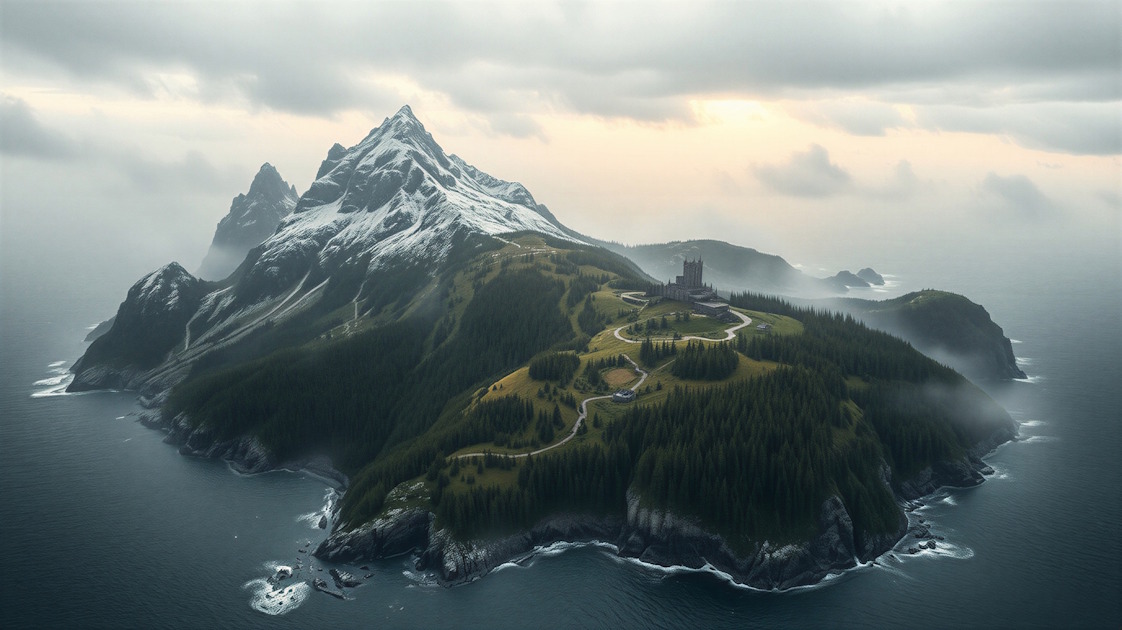
Oslo, the Isle of the King, remains the most potent symbol of humanity's lost glory—a vast, mountainous island shrouded in ancient forest and five centuries of silence. Once the seat of power for the Kingdom of Darshavon, from which the kings of the One Kingdom governed a realm stretching from the Alzion Mountains to the Ugull Mountains, Oslo now lies abandoned and forbidden, its empty harbors and silent halls preserved by the fear and superstition that have kept all comers at bay since the catastrophic Fall of the Old Gods.
Situated in the Barrens Ocean west of modern-day Seacea and south of Anolga, separated from the mainland by the Eriatic Channel, Oslo occupies a position of extraordinary strategic and symbolic significance. The island was chosen as the seat of royal power precisely because of its central accessibility—reachable from every coastal province yet beholden to none, an island capital that embodied the king's role as sovereign of the entire realm rather than champion of any single region. From the magnificent Sarradin Keep, nestled within the dense Thornwall Forest with the bustling harbor city of Sarradin grown up around it, the kings of Darshavon presided over generations of unprecedented prosperity, unity, and achievement.
The Fall of the Old Gods in Year 0 brought an abrupt and devastating end to Oslo's role as the heart of human civilization. The king perished alongside the gods in the cataclysm of the Third Great War, and in the chaos that followed, the island's population fled to the mainland, abandoning their homes, their livelihoods, and the institutions that had sustained them. What they left behind has remained untouched for over five centuries. No one who has attempted to reclaim Oslo has returned to report what they found, and the island's reputation as a haunted, forbidden place has only deepened with each failed expedition. Sailors who pass through the Eriatic Channel speak of strange lights glimpsed through the treeline, of sounds carried across the water that might be wind through empty buildings or might be something else entirely, and of an oppressive stillness that settles over vessels that drift too close to shore.
Today, Oslo exists as both a physical place and a political abstraction—an uninhabited island whose empty throne represents the ultimate prize for any ruler ambitious enough to claim the mantle of the One Kingdom. The Eriatic Channel that separates the island from the mainland falls under Seacean naval authority, making the kingdom of Seacea the de facto gatekeeper to humanity's most sacred and most dangerous piece of real estate. King Classus Thelindor IV of Kallendor's recent proclamation of himself as king has renewed interest in Oslo and the legitimacy it represents, though no one has yet been bold or foolish enough to attempt a landing on its shores.
Historical Periods
The Age of the Old Gods (Before Year 0)
Oslo's origins as a seat of power predate formal record-keeping, reaching back to the era when the scattered principalities and domains of the mainland were first drawn together under a single crown. The island's selection as the royal capital was a masterstroke of political symbolism—an offshore seat of governance that belonged to no province and was therefore equally accessible to all, reinforcing the king's identity as sovereign of a unified realm rather than a regional power. The natural harbor on the island's southern coast provided excellent anchorage for the royal fleet and merchant vessels, while the mountainous interior and dense forests offered both defensive advantages and the timber, game, and fresh water necessary to support a substantial population.
Sarradin Keep rose at the heart of the island, a fortress of extraordinary scale and craftsmanship positioned within the vast Thornwall Forest that covered much of Oslo's interior. The keep served as the king's residence, the seat of the King's Council, and the administrative center from which the affairs of a continental kingdom were managed. Around the keep, the harbor city of Sarradin grew into a thriving metropolis—home to the royal court, the administrative bureaucracy, military garrisons, and the merchants, artisans, and laborers who supported them. At its height, Sarradin was among the great cities of the One Kingdom, its docks crowded with vessels from every coastal province and its streets alive with the commerce and culture of a civilization at its zenith.
Beyond Sarradin, the island supported several other communities that served specialized roles within the kingdom's infrastructure. The town of Vael Morin, on Oslo's northeastern coast where the Eriatic Channel narrowed, served as a naval waystation and customs post, its watchtowers monitoring all maritime traffic between the island and the mainland. Vael Morin's shipwrights maintained and repaired vessels of the royal fleet, while its warehouses stored goods in transit between the provinces, making it an essential node in the kingdom's commercial network.
On the island's western shore, the fishing community of Dunmere occupied a sheltered cove beneath the Greycloak Mountains, Oslo's central mountain range whose mist-shrouded peaks gave the island its characteristic silhouette when viewed from the mainland. Dunmere's fishermen supplied much of the island's fresh seafood, while its position facing the open Barrens Ocean made it a staging point for the exploratory voyages that pushed the boundaries of human maritime knowledge. The community also served as a retreat for scholars and temple functionaries seeking solitude away from the bustle of Sarradin, and several small monasteries and study houses were established in the hills above the town during the kingdom's golden age.
The temples on Oslo were among the kingdom's most magnificent, befitting the island's status as the center of royal and divine authority. The Great Temple of Sarradin, situated on elevated ground overlooking the harbor city, served as the primary site for royal ceremonies, state religious functions, and the elaborate festivals that marked the sacred calendar. Scholar-priests from across the realm competed for positions at Oslo's temples, renowned for their libraries, astronomical observations, and the quality of their scholarly discourse.
During this golden age, Oslo represented everything Darshavon aspired to be—a place where the authority of the crown, the wisdom of the temples, and the industry of the people combined to create a civilization of remarkable sophistication and stability. The island's population swelled during major festivals and council sessions, when lords from every region of the kingdom gathered at Sarradin Keep to participate in governance, settle disputes, and renew the bonds of loyalty that held the One Kingdom together. Ships from every province filled the harbor, their cargoes reflecting the diversity of a realm that stretched from sea to mountain, from forest to grassland.
The Age of Resilience (Year 0 to 100)
The Fall of the Old Gods struck Oslo with devastation as much spiritual and political as physical. The king's death in the cataclysm of the Third Great War removed the keystone of the entire Darshavonian system in a single, irreversible moment. Without the king, the King's Council had no authority. Without divine sanction, the temples had no purpose. Without central governance, the administrative machinery that had coordinated a continent's affairs ground to a halt.
The immediate aftermath in Oslo was one of confusion, grief, and mounting terror. With the king dead and the Old Gods destroyed, the institutions that had sustained the island's population collapsed virtually overnight. The royal court dissolved as nobles and officials scrambled to secure their own positions on the mainland, where their estates and military forces provided some measure of security. The temple scholar-priests, their divine patrons annihilated, abandoned their posts in bewilderment and despair. Merchants and artisans, recognizing that an island capital without a kingdom to serve had no economic future, booked passage on whatever vessels remained in the harbor.
The evacuation of Oslo was not a single, organized event but a gradual hemorrhaging of population that accelerated as conditions deteriorated. The first to leave were those with the means and connections to secure positions on the mainland—nobles, wealthy merchants, senior officials. The military garrisons departed next, their officers recognizing that their services would be desperately needed in the provinces where goblin raids and territorial disputes were already erupting. The common people followed as best they could, crowding onto fishing boats and merchant vessels, many heading for the Seacean coast where the proximity of the Eriatic Channel made the crossing shortest.
Within months of the Fall, Oslo was effectively empty. The last residents—caretakers, a handful of stubborn fishermen in Dunmere, and the occasional scavenger stripping valuable materials from the abandoned temples—departed before the first winter. What they left behind was a functioning city frozen in the moment of its abandonment: doors standing open, goods left on shelves, ships still moored in the harbor. The Thornwall Forest, no longer managed by the foresters who had maintained its trails and boundaries, began its slow reclamation of the island's cultivated spaces.
During the chaotic century that followed, Oslo's abandonment became permanent as the mainland's population was consumed by the struggle for survival. The noble houses that had once gathered at Sarradin Keep were now carving out independent territories from the ruins of the One Kingdom, their energies devoted to defense, agriculture, and establishing the regional powers that would become the Four Fiefdoms. Oslo, an island without resources to exploit or populations to govern, held no practical value for leaders focused on immediate survival. The place's emotional and symbolic weight—the grief tied to the king's death, the unsettling emptiness of a once-great capital—made it something people preferred to avoid rather than reclaim.
During this period, the first stories of Oslo's haunting began to circulate. Fishermen who ventured too close to the island's shores reported unnatural fogs that materialized without warning, sounds that carried across the water from deep within the forest, and a pervasive sense of dread that intensified the nearer one approached. A handful of expeditions attempted to land on the island during the later decades of this century, driven by rumors of treasure left behind in the abandoned temples and royal vaults. None returned. Whether they perished from natural causes—the deteriorating harbor infrastructure, wild animals that had moved into the abandoned settlements, the treacherous mountain terrain—or from something more sinister became a matter of speculation that only deepened the island's fearsome reputation.
The Age of Change (Year 101 to 450)
As the Four Fiefdoms took shape during the Age of Change, Oslo's significance shifted from practical to symbolic. The island that had once served as the administrative heart of a continent became a political abstraction instead—the empty throne that every ambitious ruler dreamed of claiming and none dared approach. The abandoned Sarradin Keep, its halls presumably still containing the regalia and records of the Darshavonian monarchy, represented the ultimate source of political legitimacy in a world of competing fiefdoms.
Multiple rulers during this period declared their intention to reclaim Oslo and restore the One Kingdom, using the island as the centerpiece of reunification rhetoric that appealed to nostalgia for Darshavon's golden age. Each attempt failed, though the nature of those failures varied. Some ambitious dukes found their plans thwarted by the opposition of rival fiefdoms unwilling to accept any one ruler's claim to supremacy. Others actually dispatched expeditions to the island, only to see their forces vanish without a trace into the fog-shrouded forests. The pattern of these disappearances—consistent across centuries, regardless of the size or preparation of the expeditions—cemented Oslo's reputation as a place that actively resisted human return.
The establishment of Seacean naval dominance over the Eriatic Channel during this period added a practical barrier to any attempt on Oslo. As the Seacean kingdom consolidated its control over the southern coastal waters, it gained effective authority over all maritime approaches to the island. While Seacea never formally claimed sovereignty over Oslo—such a claim would have provoked immediate war with every other fiefdom—its navy could and did regulate who approached the island's waters. This control served Seacea's interests in several ways: it prevented rival kingdoms from establishing a foothold on the island, maintained Seacea's position as gatekeeper to humanity's most potent political symbol, and provided a convenient excuse to expand naval patrols throughout the Eriatic Channel and surrounding waters.
Throughout this era, the Thornwall Forest continued its slow consumption of Oslo's abandoned settlements. The cultivated lands that had once fed the island's population reverted to woodland, while the buildings of Sarradin, Vael Morin, and Dunmere deteriorated under the assault of weather, vegetation, and time. Sailors passing through the Eriatic Channel reported seeing the forest canopy growing denser with each passing decade, gradually swallowing structures that had once risen proudly above the treeline. The Greycloak Mountains, their peaks still visible from the mainland, became the only reliable landmark on an island that was slowly disappearing beneath a blanket of green.
The Age of Advancement (Year 451 to Present Day - 539)
The current age has brought renewed interest in Oslo, driven by both technological advancement and political ambition. King Classus Thelindor IV of Kallendor's proclamation of himself as king—the first ruler since the Fall to formally claim the title—has forced the other fiefdoms to confront questions about Oslo's significance that they had long left dormant. If Classus claims to be the rightful successor to the kings of Darshavon, does that claim extend to the throne in Sarradin Keep? And if so, what would it mean for the balance of power among the fiefdoms if one kingdom succeeded in reclaiming the island that had once governed them all?
The development of Kallendorian airship technology has added a new dimension to these calculations. For the first time since the Fall, it is theoretically possible to reach Oslo without passing through the Eriatic Channel and Seacean naval patrols. An airship approach would bypass the maritime chokepoint that has served as the island's primary physical barrier for five centuries, potentially rendering Seacea's gatekeeper role irrelevant. Neither Kallendor nor Seacea has missed this possibility, and tensions over the implications of airship technology for Oslo's status have become an undercurrent in diplomatic relations.
Despite these strategic considerations, no serious attempt to reclaim Oslo has been mounted during the current age. The island's fearsome reputation continues to deter all but the most reckless adventurers, and the practical challenges of establishing a foothold on an island abandoned for over five centuries remain daunting, even with modern technology. The harbor infrastructure at Sarradin has presumably deteriorated beyond use, the settlements are buried beneath generations of forest growth, and whatever dangers have claimed previous expeditions remain entirely unknown and therefore impossible to plan against.
Seacea has responded to the changing political landscape by strengthening its naval presence in the Eriatic Channel, citing the need to protect shipping from Anolgan raiders while quietly ensuring that its ability to control access to Oslo remains unchallenged. The kingdom's position on the island's status is carefully ambiguous—Seacea neither claims Oslo for itself nor acknowledges any other fiefdom's right to claim it, preferring to maintain the status quo that keeps the island empty and its own strategic advantage intact.
For now, Oslo remains as it has been for over five centuries: an uninhabited island visible from the mainland, its forests growing thicker, its buildings crumbling beneath the canopy, and its mysteries preserved by the silence that has settled over the Isle of the King like a shroud. The throne in Sarradin Keep stands empty, waiting for a claimant who may never come—or who may already be planning an approach that would reshape the political landscape of the Four Fiefdoms forever.
Geography and Key Locations
The Island
Oslo is a vast, mountainous island situated in the Barrens Ocean, separated from the mainland by the Eriatic Channel. The island lies roughly west of modern-day Seacea and south of Anolga, with a position that provides roughly equal maritime access from every coastal region of what was once the unified Kingdom of Darshavon. The Eriatic Channel, which varies in width along its length, is the primary navigable waterway between the island and the mainland, with currents, tides, and weather patterns that present navigational challenges requiring skilled seamanship even under favorable conditions.
The island's terrain is dominated by the Greycloak Mountains, a central range whose peaks frequently disappear into cloud cover, giving the mountains their name and the island its characteristic silhouette when viewed from the mainland. The Greycloaks are not excessively tall by continental standards, but their steep slopes and narrow valleys make the terrain difficult to traverse, particularly for those unfamiliar with the island's geography. The mountains divide Oslo into roughly distinct coastal regions—the more sheltered southern and eastern shores facing the Eriatic Channel, and the exposed western coast facing the open Barrens Ocean.
The Thornwall Forest blankets most of the island's surface, covering the mountain slopes, filling the valleys, and extending to the edges of the coastal cliffs and beaches. In the five centuries since the island's abandonment, the forest has reclaimed virtually all cultivated and developed land that once supported Oslo's population, growing over roads, through buildings, and around the walls of settlements never designed to withstand an arboreal siege. The forest's name, which predates the kingdom itself, refers to a particularly dense species of thorned undergrowth that makes passage through the woods without established trails extremely difficult.
Sarradin Keep and Sarradin City
Sarradin Keep served as the seat of royal power for the kings of Darshavon, a fortress of extraordinary scale and craftsmanship situated within the Thornwall Forest on elevated ground above the island's primary natural harbor. The keep was designed to combine defensive strength with the grandeur appropriate to the ruler of a continental kingdom, its walls and towers commanding views of both the surrounding forest and the harbor below. The king's throne room, council chambers, royal archives, and private apartments were all housed within the keep's walls, along with quarters for the royal guard and the administrative staff necessary to govern a vast realm.
The harbor city of Sarradin grew up around the keep over generations, spreading down the slopes toward the waterfront and along the coastline in both directions. At its height, the city housed tens of thousands of residents and served as the administrative, commercial, and ceremonial heart of the One Kingdom. The harbor itself was a marvel of engineering, with stone-built quays, warehouses, and drydock facilities capable of servicing the royal fleet and the merchant vessels that connected Oslo to every coastal province of the realm. The Great Temple of Sarradin stood between the keep and the harbor, its domes and towers visible to approaching ships as a landmark announcing their arrival at the center of human civilization.
In the present day, Sarradin Keep and its surrounding city presumably stand in whatever state five centuries of abandonment and forest encroachment have left them in. No living person has seen the keep since the evacuation after the Fall, and whether its structures still stand beneath the Thornwall canopy or have collapsed into ruin is entirely unknown. The harbor, exposed to the tides and storms of the Barrens Ocean without maintenance, has almost certainly deteriorated beyond recognition.
Vael Morin
Vael Morin occupied a position on Oslo's northeastern coast where the Eriatic Channel narrowed, making it the island's closest point to the mainland. The town served as a naval waystation and customs post, its watchtowers monitoring all maritime traffic passing between Oslo and the coastal territories of what would later become Seacea and Anolga. The town's shipwrights maintained and repaired vessels of the royal fleet, while its warehouses stored goods in transit between the provinces.
The town's strategic position made it the natural point of arrival and departure for most visitors to Oslo, and its facilities were designed to handle the substantial volume of official and commercial traffic that flowed through the island capital. Vael Morin's watchtowers, positioned on headlands overlooking the channel, provided early warning of approaching vessels and served as navigation aids for ships making the crossing in poor visibility. The town maintained signal fire stations that could communicate with corresponding positions on the mainland, providing a rudimentary but effective long-distance communication system.
Vael Morin's proximity to the mainland makes it theoretically the most accessible point on the island for any modern expedition, though the condition of its harbor facilities and the state of whatever defenses or dangers the island now harbors remain entirely unknown.
Dunmere
Dunmere occupied a sheltered cove on Oslo's western coast, beneath the slopes of the Greycloak Mountains, where they descended toward the open Barrens Ocean. The community began as a fishing village whose inhabitants supplied fresh seafood to the island's population, but over time it developed a secondary identity as a scholarly retreat and place of contemplation. The town's relative isolation from the bustle of Sarradin, combined with its dramatic coastal setting, attracted temple scholars and functionaries seeking solitude for study and reflection. Several small monasteries and study houses were established in the hills above the town during the kingdom's golden age, and their libraries and workshops contributed to the realm's intellectual life, even at a remove from the capital's political intensity.
Dunmere also served as a staging point for exploratory voyages into the western reaches of the Barrens Ocean, with its harbor providing anchorage for vessels outfitting for long-distance journeys beyond the established coastal trade routes. The knowledge accumulated by Dunmere's mariners regarding ocean currents, weather patterns, and distant landfalls represented a valuable body of navigational expertise that was largely lost following the island's abandonment.
The Greycloak Mountains
The Greycloak Mountains form the spine of Oslo, running roughly north to south through the island's interior and creating the elevated terrain that defines much of its geography. The range takes its name from the persistent cloud cover that shrouds the upper peaks, giving the mountains a grey, cloaked appearance visible from the mainland and serving as a navigational landmark for sailors in the Eriatic Channel for as long as humans have traversed those waters.
The mountains are not exceptionally high, but their steep slopes and the dense Thornwall Forest that covers them make overland travel across the island's interior extremely challenging. Mountain streams and rivers flow down from the Greycloaks in all directions, providing the fresh water that sustained the island's population and feeding the harbor at Sarradin through a system of channels and reservoirs that were among the infrastructure achievements of the Darshavonian era.
Political Significance
Oslo's political significance far outweighs its practical value as an uninhabited island, a paradox that has shaped the diplomacy of the Four Fiefdoms for centuries. The empty throne in Sarradin Keep represents the ultimate source of political legitimacy in a world where every fiefdom traces its authority to the fractured remnants of a kingdom that was governed from that very seat. To reclaim Oslo would be to claim the mantle of the One Kingdom itself—a prize so consequential that no fiefdom can allow another to seize it, yet so fraught with danger and political risk that none has dared to try.
Seacea's control of the Eriatic Channel places the kingdom in a uniquely powerful position regarding Oslo's future. Any conventional maritime approach to the island must pass through waters patrolled by the Seacean navy, giving Seacea effective veto power over any expedition it considers threatening to its interests. This control has been a primary stabilizing factor in inter-fiefdom politics—as long as Seacea maintains naval dominance, no single kingdom can unilaterally claim Oslo without first securing Seacean cooperation or overcoming Seacean opposition.
The Seacean position on Oslo is one of calculated ambiguity. The kingdom neither claims the island nor acknowledges any other fiefdom's right to claim it, maintaining a status quo that preserves Seacean strategic advantage while avoiding the provocation of asserting sovereignty over a place every fiefdom considers part of its shared heritage. This balancing act requires diplomatic skill, as any perception that Seacea is using its control of the channel to assert proprietary rights over Oslo would likely provoke a coalition of the other fiefdoms against it.
King Classus Thelindor IV's proclamation of himself as king has introduced new urgency into these calculations. By claiming the royal title, Classus has implicitly asserted a connection to the throne in Sarradin Keep that the other fiefdoms cannot ignore. While Classus has not yet moved toward Oslo itself, the logical extension of his claim points to the island as the ultimate validation of his royal authority. The development of airship technology in Kallendor, which could potentially bypass the Eriatic Channel entirely, has made this theoretical threat feel increasingly tangible to Seacea and the other fiefdoms.
Anolga's position adds another dimension to the island's political significance. The western kingdom's coastline lies south of Oslo, and Anolgan sea lords have long maintained that their maritime traditions give them as much right to the waters around the island as Seacea's naval patrols. Anolgan raiders have occasionally probed the approaches to Oslo, testing Seacean responses and gathering intelligence about channel defenses, though whether these incursions represent genuine interest in the island or simply Anolgan opportunism is difficult to determine.
Vranna, the most cautious and pragmatic of the fiefdoms, has generally avoided direct involvement in Oslo's politics, preferring to use its agricultural leverage to discourage any unilateral action by other kingdoms. Vrannan diplomats have consistently argued that any attempt to reclaim Oslo should be a joint enterprise of all four fiefdoms, a position that effectively prevents any single kingdom from gaining advantage while preserving the appearance of cooperative intent.
The Forbidden Island
The nature of Oslo's haunting—if haunting it is—remains one of the known world's great unsolved mysteries. The consistent pattern of expeditions that venture to the island and never return has persisted across five centuries, encompassing parties of varying size, preparation, and purpose. Military expeditions, scholarly investigations, treasure-seeking adventurers, and even accidental landings by storm-blown vessels have all ended in the same result: silence. No survivor has returned to describe what they encountered, and no physical evidence—wreckage, remains, messages—has ever washed ashore to provide clues about the fate of those who ventured onto the island.
Theories about what befalls those who land in Oslo are as numerous as they are unverifiable. The most common folk belief holds that the spirits of the Old Gods, destroyed in their final battle, linger on the island in some diminished but still dangerous form, striking down any mortal who intrudes upon what was once their sacred domain. Others suggest that the king's spirit guards Sarradin Keep, refusing to allow anyone to claim the throne until a worthy successor appears. More pragmatic observers point to the natural dangers of an island abandoned for five centuries—collapsed structures, predatory animals, and treacherous terrain worsened by forest overgrowth—as sufficient explanation for the disappearance of small, unprepared parties.
Sailors who traverse the Eriatic Channel regularly report phenomena that reinforce the island's fearsome reputation, though the reliability of these accounts varies considerably. Fog banks that materialize unnaturally fast, lights that appear in the forest at night where no fires should burn, sounds that carry across the water in ways that defy natural acoustics—these reports are common enough to maintain a baseline of dread among mariners but inconsistent enough to resist systematic analysis. Whether these phenomena represent genuine supernatural activity, natural effects amplified by expectation and fear, or simply the exaggerations of superstitious sailors remains an open question.
What is beyond dispute is the practical effect of Oslo's reputation. The island is avoided by all but the most reckless or desperate, its shores unvisited, its forests unexplored, and its secrets preserved by a barrier of fear that has proven more effective than any wall or garrison. The Forbidden Island of the King keeps its own counsel, and the world has learned, through five centuries of costly lessons, to respect its silence.
Current Challenges and Tensions
Oslo's current significance lies not in what the island is, but in what it represents and the tensions it creates among the Four Fiefdoms. The island serves as a focal point for the unresolved questions that have defined inter-fiefdom politics since the fall of Darshavon: Who has the right to rule? Can the One Kingdom be restored? And what would it mean for the balance of power if one fiefdom succeeded in claiming the ultimate symbol of royal authority?
King Classus Thelindor IV's adoption of the royal title has transformed Oslo from a historical curiosity into an active political concern. The other fiefdoms view Classus's claim with suspicion and alarm, recognizing that the logical culmination of his ambition points toward the island and the throne it contains. The massing of troops at borders after his proclamation reflects not just anxiety about Kallendorian expansionism but deeper fears about what a successful claim to Oslo would mean for the independence each fiefdom has maintained since the fall of the One Kingdom.
Kallendorian airship technology represents the most significant change in the strategic calculus surrounding Oslo since Seacea first established naval control of the Eriatic Channel. The ability to approach the island by air would render five centuries of Seacean gatekeeper strategy obsolete, potentially allowing Kallendor to reach Oslo without Seacean knowledge or consent. This possibility has driven Seacea to invest heavily in anti-airship capabilities and intelligence networks to detect aerial approaches to the island, while simultaneously pursuing diplomatic channels to establish international agreements restricting airship flights over the Eriatic Channel.
The island itself remains the greatest unknown in all of these calculations. Whatever dangers have claimed every expedition to Oslo's shores for five centuries show no sign of diminishing, and no amount of political ambition or technological innovation can address a threat that remains entirely uncharacterized. Until someone successfully lands on Oslo and returns to report what they found, the island will continue to exist in the political imagination as simultaneously the most desirable and most terrifying place in the known world—an empty throne surrounded by five centuries of silence, waiting for a claimant who has not yet proven worthy or fortunate enough to survive the attempt.