Rurik Shieldbearer, Guardian of the Realm
Introduction
Rurik Shieldbearer, known to the dwarven people as the Guardian of the Realm, is the god of protection, vigilance, and the unyielding defense of home and kin. Where his brother Morden Fireforge embodied the creative fire that gave the dwarves the power to build, Rurik embodied the patient, immovable strength that ensured what they built would endure. He is the wall that does not break, the sentinel who does not sleep, the shield raised between the dwarven people and every force that would see them destroyed. If Morden gave the dwarves their purpose, Rurik gave them their survival.
Of the three dwarven gods—Grommara the Mother of Stone, Morden the Keeper of Flames, and Rurik the Guardian of the Realm—Rurik is perhaps the most quietly revered. He lacks the boisterous charisma that makes Morden a favorite of storytellers, and he does not possess the primordial mystique of Grommara, whose creation of the mountains and the dwarven race itself places her beyond easy comparison. Rurik’s greatness is of a different kind: steady, deliberate, and so deeply woven into the foundations of dwarven life that it is often taken for granted, like the stone beneath one’s feet or the air in one’s lungs. He is the god you do not think about until the moment you need him most.
His death—a final act of defiance against the cosmic cataclysm that accompanied the Fall of the Old Gods—sealed his place in dwarven mythology as the ultimate expression of the guardian’s duty. While the world above burned and the divine powers that had shaped existence tore themselves apart, Rurik stood at the threshold of the dwarven realm and held the line, buying his people the time they needed to seal their great doors against the destruction. He did not survive. But the dwarves did, and to their way of thinking, that is precisely the outcome Rurik would have chosen.
Origins & Birth
The dwarven creation myths hold that Grommara’s second son came into being not with the spectacular eruption that heralded Morden’s arrival but with a silence so profound it seemed to deepen the very stone from which he was drawn. Where Morden was born of the molten heart of the world—fire and fury made manifest—Rurik was shaped from the deepest granite of the world’s foundations, stone that had lain undisturbed since before time had meaning. Grommara reached into the bedrock where pressure and patience had compressed raw earth into something harder than iron, and from that unyielding material she drew forth her second child.
His birth left no scar on the landscape. No mountain split. No fire erupted. The stone simply parted, and Rurik stepped forward—fully formed, perfectly still, his eyes already scanning the horizons for threats that did not yet exist. The myths describe his first moments as a study in contrast with his brother’s: where Morden had emerged laughing and reaching for the nearest piece of ore, Rurik stood motionless for what some tellings claim was an entire day, taking the measure of the world before committing himself to action within it. When he finally moved, it was to place himself between Grommara and the mouth of the cave from which he had been born, his body positioned to shield her from whatever might come from beyond.
This instinct—to stand between those he loved and whatever threatened them—defined Rurik from the first breath he drew. The myths suggest that Grommara recognized in her second son a quality she had not anticipated: not the creative urge she had poured into Morden, but a protective resolve so absolute that it bordered on the elemental. Morden would build the civilization. Rurik would ensure it endured. Together with their mother, the three formed a divine family whose complementary natures gave the dwarven people everything they needed to survive and thrive in a world far more dangerous than any of them had initially imagined.
Domains & Attributes
Rurik’s primary domain is protection in its broadest sense—the defense of home, family, community, and the accumulated works of dwarven civilization against all threats, whether physical, spiritual, or existential. This encompasses the martial aspects of defense, including the skill of arms, the craft of fortification, and the discipline of the warrior, but it extends far beyond the battlefield to include the quieter forms of protection that sustain a people through ages of hardship. The parent who shelters a child, the elder who preserves endangered knowledge, the engineer who reinforces a weakening tunnel wall—all act within Rurik’s domain as surely as the warrior who raises his shield against an enemy’s blade.
Vigilance forms the second pillar of Rurik’s divine portfolio. The dwarves understand that protection without awareness is merely luck, and luck is something they have never trusted. Rurik represents the watchful eye that identifies threats before they materialize, the careful mind that prepares contingencies for dangers that may never arrive, and the disciplined patience to maintain readiness across years, decades, and centuries of apparent peace. The Iron Shields who patrol the deepest tunnels, the scouts who watch the mountain passes, and the thane lords who weigh every diplomatic development for its implications to dwarven security all serve Rurik’s legacy, whether they invoke his name or not.
Endurance constitutes Rurik’s third domain—not the explosive energy of Morden’s creative fire but the slow, grinding persistence that outlasts every challenge through sheer refusal to yield. This quality manifests in the dwarven capacity to withstand sieges that would break others, to maintain traditions across millennia without degradation, and to absorb setbacks that would scatter less resilient civilizations. Rurik’s endurance is not passive; it is the active, conscious decision to hold one’s ground when every instinct screams for retreat, repeated day after day until the threat exhausts itself against the immovable object of dwarven resolve.
Unlike Morden, whose domain explicitly excludes destruction for its own sake, Rurik’s relationship with violence is more nuanced. The Guardian of the Realm does not celebrate combat, but neither does he shy from it. War in service of protection is not merely acceptable but sacred, and the dwarves draw no moral distinction between the warrior who defends his thane and the smith who forges the weapons that make that defense possible. Both serve the same purpose. Both honor the same god. The key principle is intention: force wielded to protect is righteous, force wielded to conquer or dominate is not.
Appearance & Symbols
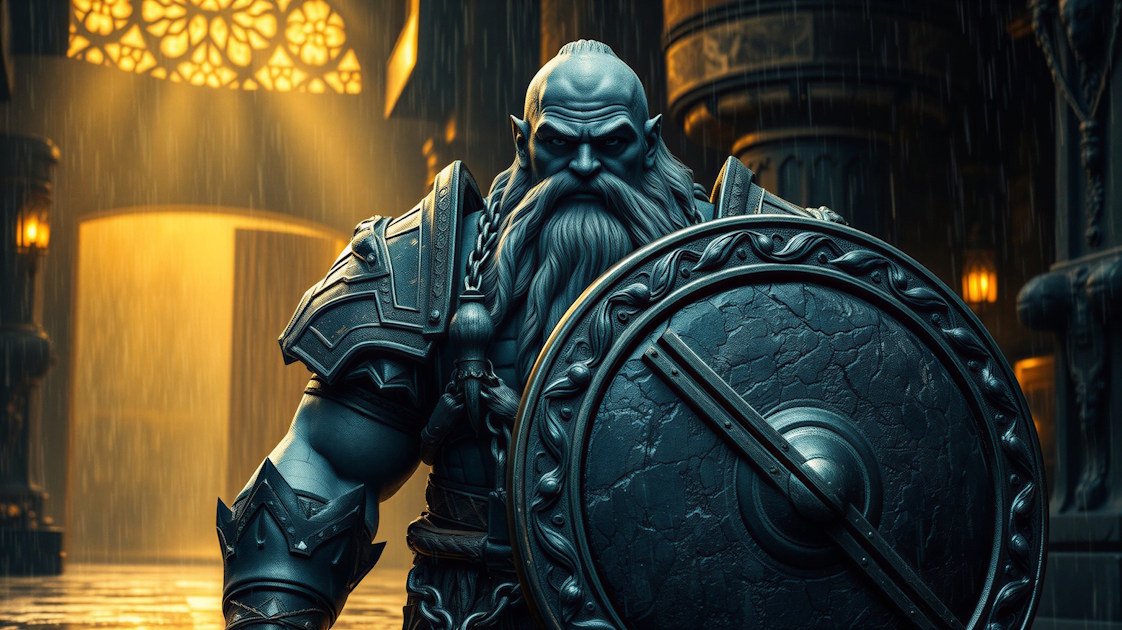
Dwarven artistic tradition depicts Rurik as a figure of imposing solidity—broad even by dwarven standards, with shoulders like the buttresses of a great hall and arms thick as stone columns. Where Morden is rendered in shades of fire and molten metal, Rurik appears in the greys and iron-blues of deep mountain stone, his skin seeming to share the texture and hardness of the granite from which he was born. His features are heavy and angular, carved rather than shaped, giving him the appearance of a living statue whose creator valued strength over elegance. His eyes, unlike Morden’s blazing forge fires, are described as the cool grey of polished steel—calm, watchful, and utterly unreadable.
His beard is as magnificent as any dwarven god’s but entirely different in character from his brother’s. Where Morden’s beard is living flame, Rurik’s is depicted as a cascade of braided iron and stone, heavy and immovable, often shown interwoven with chains that symbolize the unbreakable bonds of duty. Some artistic traditions render the beard as actual iron, hammered into links and plates that serve as both adornment and armor. Others depict it as grey stone shot through with veins of silver, reflecting his granite origins. In all traditions, the beard is meticulously maintained—every braid precise, every link deliberate—reflecting the discipline and order that define Rurik’s character.
Rurik carries his great hammer, Thokkengrul, a name that translates roughly from the oldest dwarven tongue as “the answer of stone.” Unlike Anvil’s Voice, which was designed as both tool and weapon with equal emphasis, Thokkengrul is unambiguously a weapon of war—a massive, blunt instrument forged from a single piece of ore drawn from the deepest vein Grommara ever created. The hammer’s head is unadorned save for a single rune of protection carved into each face, and its haft is wrapped in leather cured from the hide of a creature the myths do not name. The weapon’s simplicity is the point: Thokkengrul does not need ornamentation because its purpose admits no ambiguity. In his other arm, Rurik bears a great shield, round and rimmed with iron, which in most depictions is large enough to shelter three ordinary dwarves behind it.
The primary symbol associated with Rurik is the Iron Shield—a round shield depicted with a single horizontal line across its center, representing the threshold that enemies shall not cross. This symbol appears on the doors of dwarven fortifications, on the armor of elite defenders, and on boundary markers that delineate the borders of dwarven territory. Secondary symbols include the Watchful Eye, a single open eye carved into stone above tunnel entrances and defensive positions, and the Closed Fist, representing readiness for battle. The elite dwarven military forces known as the Iron Shields take their name directly from Rurik’s symbol, a connection that every member of those units carries with solemn pride.
Personality & Character
If Morden is the god you want beside you at the feasting table, Rurik is the god you want at your back when the tunnel goes dark. The myths portray him as a figure of profound quiet—not sullen or withdrawn, but possessed of a stillness that makes the air around him feel heavier, more deliberate, as though even the dust motes slow in his presence. He speaks rarely and never wastes a word. When he does offer counsel, it carries the weight of stone, and the myths record no instance of anyone—mortal or divine—dismissing his words lightly. He is the god who listens while others talk, who watches while others act, and who moves only when he has determined the precise moment and manner in which his intervention will be most effective.
This patience is Rurik’s defining virtue and the quality that most clearly distinguishes him from his brother. Where Morden charges forward, Rurik waits. Where Morden acts on instinct and confidence, Rurik calculates, considers, and prepares. The myths describe him spending days studying a problem that Morden would have attacked in seconds, not because he lacks courage but because he understands that the defender’s greatest weapon is knowing exactly when and where to commit his strength. A story popular among the thanes recounts how Morden once challenged Rurik to a race through a collapsing tunnel. Morden sprinted forward with characteristic abandon. Rurik studied the pattern of falling stones for three heartbeats, then walked through the collapse without a single rock touching him. Both brothers reached the other side, but only one arrived without dust on his shoulders.
Despite his reserve, Rurik is far from cold. The myths portray a god capable of deep emotion, expressed through action rather than words. His love for Grommara manifests in the tireless vigilance with which he guards her creations. His bond with Morden, for all their rivalry, runs so deep that the prospect of his brother’s sacrifice at the Sundering Deep drove Rurik to the only recorded instance of him raising his voice in anger against a family member. His affection for the dwarven people—quiet, patient, and utterly without condition—finds expression in every fortification he designed, every defensive technique he taught, and every moment he spent standing watch so that others could sleep safely.
Rurik’s relationship with ale and feasting is characteristically understated. He drinks, but moderately. He attends celebrations, but positions himself near the exits. He appreciates good craftsmanship in a cup as much as any dwarf, but his compliments come in the form of a slow nod rather than Morden’s thunderous approval. The myth notes with some amusement that Rurik is the only figure in dwarven mythology who has ever voluntarily left a feast early, a detail that the storytellers include precisely because it is so thoroughly un-dwarven that it highlights just how singular the Guardian’s character truly is.
The Brotherhood of Fire and Iron
The relationship between Rurik and Morden is told from Rurik’s perspective in a cycle of tales that reveals a different dimension of the brothers’ bond than the version preserved in Morden’s mythology. Where the tales told through Morden’s lens emphasize the rivalry’s competitive energy and the joy of testing oneself against a worthy opponent, the Rurik traditions focus on the quiet tension between two fundamentally different approaches to the same essential question: what does it mean to serve the dwarven people?
Rurik loved his brother without reservation but struggled at times to understand him. The myths describe Rurik watching Morden work at the forge with a mixture of admiration and unease—admiration for the brilliance of the creations that emerged, unease at the reckless speed with which Morden consumed his own energy to produce them. For Rurik, who measured every expenditure of strength against the possibility that it might be needed later, Morden’s prodigal generosity with his own divine essence felt like a warrior throwing away his shield before the battle had begun. He never said as much to Morden directly, but the concern shaped his behavior, driving him to work harder at defense precisely because he feared his brother would eventually give too much of himself away.
The great debate between the brothers—whether creation or defense held greater importance—took on a different character when viewed through Rurik’s eyes. Morden argued his position with passionate conviction and rhetorical flair. Rurik simply pointed to the ruins of things that had been created without adequate protection: settlements overrun, forges destroyed, masterworks lost to raiders and neglect. His argument required no eloquence because the evidence spoke for itself. The dwarves note that while neither brother conceded the point, Morden always made sure his forges were well-guarded after these discussions, suggesting that Rurik’s quiet logic landed more effectively than he let on.
The physical contests between the brothers are remembered in Rurik’s tradition with a patience that mirrors the god himself. Where Morden’s versions emphasize the excitement and improvisation of their competitions, Rurik’s versions note the patterns—how Morden always started strong and faded, how his creativity could be channeled into predictable directions, how the key to matching his brother was simply to endure the initial onslaught and wait for the opening that always came. This is not presented as superiority but as complementarity: Morden’s fire and Rurik’s stone, each incomplete without the other, each strongest when working alongside rather than against its counterpart.
The moment of Morden’s sacrifice at the Sundering Deep is the wound at the center of Rurik’s mythology. The guardian who had spent his existence protecting others could not protect the one person who mattered most. The myths hold that Rurik offered himself in Morden’s place—not once but repeatedly, with an urgency that shattered his characteristic composure—and that Morden’s refusal was the one argument Rurik could never counter: the task required fire, not stone. In the silence that followed Morden’s descent into the Sundering Deep, something in Rurik changed. The myths do not describe what, exactly, but the god who emerged from that silence was harder, more resolute, and possessed of a determination that would find its ultimate expression in his own final hours.
The Great Works
Rurik’s Great Works differ fundamentally from his brother’s in both nature and intent. Where Morden created objects of beauty and transformative power, Rurik built things designed to last—structures, systems, and defenses whose value lay not in their brilliance but in their absolute reliability. The dwarves treasure Morden’s creations for their artistry and Rurik’s for their permanence, and both forms of greatness occupy equal standing in dwarven tradition.
The greatest of Rurik’s works is the Deepward—the system of defensive architecture that forms the template for every dwarven fortification ever built. According to the myths, Rurik spent centuries studying the mountains, learning the natural properties of stone under stress, the behavior of air and water in confined spaces, and the movement patterns of every creature that might threaten a dwarven settlement. From this study, he developed a comprehensive doctrine of underground defense that accounts for every conceivable angle of attack: approach tunnels designed to funnel enemies into killing zones, multiple fallback positions connected by concealed passages, ventilation systems that double as defensive chokepoints, and great doors engineered to withstand siege for decades without maintenance. Every thane in existence follows the principles Rurik established, and dwarven military engineers study the Deepward as both a practical manual and a work of sacred genius.
Thokkengrul, his great hammer, stands as a masterwork of a different kind. Where Morden’s Anvil’s Voice was forged with the precision of a master craftsman pursuing perfection, Thokkengrul was shaped with the singular focus of a warrior who needed a weapon that would never fail at the moment of greatest need. The myths describe Rurik forging the hammer over a period of seven years, testing each stage of construction against increasingly severe trials—striking mountainsides, shattering boulders, deflecting blows from weapons wielded by Morden himself. Only when the hammer survived every test without showing the slightest crack or deformation did Rurik consider it finished. The weapon’s name, “the answer of stone,” reflects its purpose: when an enemy poses a question through force of arms, Thokkengrul provides the only response the stone knows how to give.
The Warden Stones represent another of Rurik’s enduring contributions—a network of carved stone markers placed at the boundaries of dwarven territory, each one inscribed with runes of warning and warding. The myths claim that Rurik personally placed these stones, walking the entire perimeter of every dwarven domain and driving each marker into the earth with a single blow of Thokkengrul. The stones served both practical and symbolic purposes: marking borders that all races could see and understand, while also providing anchor points for the defensive awareness that Rurik cultivated among his people. Whether the Warden Stones possessed any actual power is debated; what is not debated is that the tradition of boundary markers they established remains fundamental to dwarven territorial claims.
The Shield Wall doctrine—the coordinated defensive formation that remains the foundation of dwarven infantry tactics—is attributed to Rurik’s direct instruction. The myths describe him training the first dwarven warriors personally, teaching them that individual strength means nothing without coordination, that a shield protects the warrior beside you more than it protects yourself, and that the line holds or falls as one. These principles, refined over millennia of practical application, remain central to the training of every Iron Shield, and the formation drills performed in dwarven training halls follow patterns that tradition traces directly to Rurik’s original instruction.
The Fall of the Old Gods
The cosmic cataclysm known as the Fall of the Old Gods occupies a different place in dwarven mythology than it does in the histories of surface-dwelling peoples. For humans, the Fall represents the destruction of Darshavon and the collapse of the civilized order that the Old Gods had sustained. For the dwarves, whose civilization was older than Darshavon and whose gods were already diminished by Morden’s sacrifice at the Sundering Deep, the Fall was not the end of an era but the final act of a tragedy that had been unfolding for a long time.
The dwarven myths describe the Fall as a war among the Old Gods that erupted with devastating suddenness, shattering the divine order that had maintained the world’s stability since its creation. The causes of this war are not the concern of dwarven mythology, which focuses instead on its effects: earthquakes that cracked mountain foundations, magical energies that poisoned underground waterways, and waves of destructive force that rippled through the earth itself, threatening to collapse tunnels and caverns that had stood since before recorded time. The surface world burned. Kingdoms fell. And beneath the mountains, the dwarves felt their world shudder around them.
Rurik had anticipated a crisis of this nature, though not its specific form. The Guardian of the Realm had spent the ages since Morden’s sacrifice preparing for the next existential threat, fortifying the thanes, training defenders, and developing contingency plans for scenarios that ranged from massive goblin invasions to geological catastrophe. When the Fall began and its effects reached the underground world, Rurik activated defenses that had been centuries in preparation. The great doors of the thanes, already formidable, were reinforced with additional barriers. Stockpiles of food and water were distributed according to plans Rurik had devised. Warriors were deployed to critical structural points throughout each fortress.
But the Fall was worse than even Rurik had prepared for. The divine energies unleashed by the warring gods did not merely shake the earth; they threatened to unmake the barriers between the surface world and the underground realm entirely. Fissures opened in places that had been geologically stable for millennia. Sections of the tunnel collapsed not from structural failure but from the stone itself losing cohesion as magical forces disrupted the fundamental properties of matter. The carefully engineered defenses held against physical threats, but they had not been designed to withstand the disintegration of reality itself.
The Last Stand at the World’s Gate
The myths describe the final hours of Rurik Shieldbearer with a solemnity reserved for no other passage in dwarven oral tradition. As the Fall reached its crescendo, the destructive energies pouring through the earth converged on a point that the myths call the World’s Gate—a vast natural cavern that served as the junction between the deepest dwarven territories and the passages leading upward to the surface. If the World’s Gate fell, the cataclysm would pour into the heart of the dwarven realm, and no amount of fortification would save the thanes from destruction.
Rurik understood what was required. The great doors of the thanes needed time to complete their sealing—massive mechanisms of stone and iron that could not be rushed without compromising their integrity. The dwarven people needed time to reach the safety of their deepest halls. The defenders needed time to withdraw from exposed positions. And the only way to buy that time was for someone to hold the World’s Gate against the storm of divine destruction that was bearing down upon it.
He did not ask for volunteers. He did not deliver a speech. The myths record that Rurik simply walked to the World’s Gate, set his shield against the stone floor, and waited. Warriors who attempted to join him were turned back with a single word or a look that brooked no argument. This was not a battle that numbers could win. The forces converging on the Gate were not enemies that could be fought with conventional arms. What was needed was not an army but a bulwark—a single, immovable point of resistance against which the cataclysm would spend its fury while the dwarven people sealed themselves behind their impregnable doors.
What followed is the most sacred passage in dwarven storytelling. The energies of the Fall struck the World’s Gate like a wave breaking against a cliff face. Stone shattered. The air itself ignited. Forces that had toppled surface kingdoms and killed gods poured through the cavern with enough power to unmake mountains. And Rurik stood against them. Thokkengrul in one hand, his great shield raised in the other, the Guardian of the Realm planted himself at the threshold and refused to move.
The myths do not describe the struggle in terms of physical combat, for there was no enemy to strike. Instead, they speak of resistance—of divine will set against cosmic destruction, of stone refusing to yield to the forces that would grind it to dust. Rurik did not fight the cataclysm; he endured it, absorbing blow after blow of destructive energy through his shield and his body, each impact diminishing him but failing to move him from his position. The cavern crumbled around him. The ceiling collapsed. The walls dissolved. But the Guardian held, and behind him the great doors of the thanes ground slowly, inexorably shut.
When the last door sealed, the dwarven people were safe. The myths hold that Rurik knew the moment it happened—felt the vibration of iron meeting stone one final time through the floor beneath his feet. And in that moment, with his purpose fulfilled and his strength finally spent, the Guardian of the Realm allowed himself to fall. The cataclysm swept over the place where he had stood, obliterating every trace of his physical form and collapsing the World’s Gate into a mass of fused stone and rubble that remains impassable to this day.
No body was recovered. No weapon was found. The dwarves searched, in the years that followed, sifting through the rubble of the collapsed cavern for any trace of their god. They found nothing but stone—stone that was, by every account, harder and more resilient than any natural formation should have been, as though Rurik’s essence had fused with the rock itself in his final moments, becoming one last barrier between the dwarven people and the ruin of the world above.
Legacy & Enduring Influence
Rurik’s sacrifice established the principle that defines dwarven military culture to this day: the defender’s duty does not end until those he protects are safe, regardless of the cost to himself. This principle operates at every level of dwarven society, from the Iron Shield who holds a tunnel junction against overwhelming odds to the thane lord who accepts personal hardship to shelter his people from economic crisis. The willingness to absorb punishment so that others might be spared is not merely admired in dwarven culture; it is considered the highest expression of dwarven virtue, the quality that separates a true guardian from someone who merely carries a weapon.
The Iron Shields, the elite military forces maintained by every thane, take their name and their ethos directly from Rurik’s legacy. Every recruit who enters their ranks learns the story of the Last Stand at the World’s Gate as part of his training, not as ancient history but as a living standard against which his own commitment will be measured. The oath sworn by new Iron Shields—to stand between their people and harm until their duty is discharged or their life is spent—echoes the choice Rurik made in his final hours. That no Iron Shield has ever broken this oath is a point of fierce pride throughout dwarven society.
Rurik’s influence on dwarven architecture and engineering is equally profound. The defensive principles he established remain the foundation of every fortification the dwarves have built in the millennia since his death. Dwarven engineers study these principles not as historical curiosities but as active doctrine, adapting them to new circumstances while preserving the core philosophy that defense must be layered, redundant, and designed to function even when individual components fail. The impregnability of the seven thanes—fortresses that have never been breached by external assault in all of recorded history—stands as the most tangible monument to Rurik’s genius.
Perhaps most importantly, Rurik’s legacy shapes the dwarven understanding of what it means to endure. The dwarves are a patient people, capable of maintaining traditions, grudges, and defensive postures across centuries that would exhaust the attention span of shorter-lived races. This patience is not passivity; it is Rurik’s endurance made cultural, the active decision to outlast every threat through sheer, grinding persistence. When a dwarven elder counsels patience in the face of provocation, he channels the same philosophy that kept Rurik motionless at the World’s Gate while the cataclysm raged around him.
Worship & Observances
Worship of Rurik Shieldbearer is woven so thoroughly into the daily rhythms of dwarven life that it often goes unrecognized as worship at all. The guard who checks his equipment before a shift, the mason who tests a load-bearing wall one more time than strictly necessary, the parent who walks the corridors at night, ensuring every door is secured—all participate in traditions that trace their origins to Rurik’s teachings, whether they invoke his name or not. This is precisely as the dwarves believe Rurik would prefer it: protection expressed through action rather than ceremony, vigilance practiced as habit rather than ritual.
The most significant formal observance dedicated to Rurik is the Vigil of the Guardian, held annually in every thane on the longest night of the year. During the Vigil, the great doors of each thane are ceremonially inspected by the thane lord and his council, the defensive mechanisms tested, and the Iron Shields paraded in full battle array. The ceremony is conducted in near-total silence, reflecting Rurik’s own character, with the only sounds being the ringing of hammers testing stone and the measured tread of armored boots on the great hall’s floor. The Vigil serves both symbolic and practical purposes, reminding the community of the vigilance that keeps them safe while also ensuring that actual defenses remain in proper working order.
Before battle or any undertaking that involves significant risk, dwarven warriors observe the Shield Prayer—a brief, silent moment in which each warrior touches his shield and acknowledges the tradition of protection that connects him to every defender who came before, up to and including Rurik himself. The prayer has no spoken words; it is a moment of internal commitment, a private renewal of the vow to stand between harm and those who depend on you. The silence of the Shield Prayer is considered sacred, and to interrupt it is a serious breach of military etiquette that can result in formal censure.
Individual dwarves honor Rurik through small acts of preparedness that permeate daily life. Keeping tools in good repair, maintaining stores of food and water beyond immediate needs, checking structural integrity of living spaces, knowing the locations of defensive positions within one’s thane—these habits are so ingrained in dwarven culture that they barely register as conscious behavior, yet each one reflects the philosophy of constant readiness that Rurik embodied. The dwarves do not separate the sacred from the practical in matters of defense; to be prepared is itself an act of reverence.
Sayings & Proverbs
Rurik’s mythology has contributed a distinct set of sayings to the dwarven vocabulary, expressions that tend toward the understated and practical rather than the dramatic, reflecting the god’s own temperament.
“The shield holds” is the most common expression associated with Rurik, used both as a statement of reassurance and as a declaration of intent. A commander rallying his troops, an engineer certifying a fortification, or a parent comforting a frightened child might all use this phrase, drawing on the same wellspring of meaning: whatever threatens us, we will endure. The phrase carries additional weight from its association with the Last Stand, where the shield held until the doors were sealed and the dwarven people were safe.
“Rurik’s patience” describes the ability to wait without anxiety for the right moment to act—a quality the dwarves consider essential for warriors, leaders, and craftsmen alike. To say someone possesses Rurik’s patience is high praise, implying not merely tolerance for delay but the disciplined confidence to remain still when action would be premature. The expression is sometimes used with gentle irony when applied to dwarves who are being excessively cautious, acknowledging that even virtues can be carried to excess.
“Stand where Rurik stood” is an exhortation to accept difficult responsibility without complaint, invoking the image of the god walking to the World’s Gate without hesitation or fanfare. It is used when duty calls for sacrifice—when someone must take the watch no one wants, bear the burden no one volunteers for, or make the decision that will cost them, regardless of which option they choose. The phrase carries no promise of glory; like Rurik’s own sacrifice, it implies that doing what must be done is its own sufficient reason.
“Check the door twice” has become shorthand for thoroughness in all matters of security and preparation, referencing Rurik’s legendary meticulousness in defensive planning. The saying applies equally to literal doors and figurative ones—contracts that need reviewing, alliances that need verifying, plans that need stress-testing. It reflects the dwarven conviction that the most dangerous assumption is the one you never bother to question.
“He walks with Rurik” is spoken of warriors who fall in defense of others, carrying a different connotation from the Morden equivalent. Where “he drinks with Morden” evokes a scene of celebration and fellowship in whatever afterlife the dwarves imagine, “he walks with Rurik” suggests continued service—an eternal patrol alongside the Guardian himself, watching over the dwarven people from beyond the veil of death. It is considered the highest honor that can be bestowed on a fallen warrior, reserved for those whose deaths directly saved others.
Sacred Sites
The most significant site associated with Rurik is the World’s Gate itself—or rather, the mass of fused stone and rubble that now occupies the cavern where Rurik made his last stand. Located deep beneath the mountains in a region accessible only through the most ancient tunnels, the collapsed Gate has become the closest thing the dwarves possess to a formal shrine. No attempt has been made to clear the rubble, both because the dwarves consider the site sacred and because the fused stone has proven resistant to every tool and technique applied to it, as though the material itself refuses to be moved. Small offerings are left at the rubble’s edge by those who make the difficult journey—shield bosses, weapon charms, and stones carried from distant thanes, placed in silent tribute to the god who gave everything at this spot.
The great doors of each thane serve as distributed sacred sites, their massive forms embodying the principle of defense that Rurik championed. While every dwarf passes through these doors routinely, the doors themselves are treated with a reverence that transcends their functional purpose. They are inspected, maintained, and repaired with a care that borders on the devotional, and the keepers who tend them hold positions of quiet prestige within their communities. During the annual Vigil of the Guardian, the doors become the focal point of communal observance, their mechanisms tested and their surfaces examined for any sign of weakness.
The Training Halls where Iron Shields are forged into warriors carry Rurik’s presence in a more active sense. These halls, found in every thane, are designed according to principles attributed to Rurik’s own specifications, with spaces optimized for formation drills, individual combat training, and the development of the tactical awareness that distinguishes a dwarven warrior from a mere fighter. The halls are utilitarian by design, free of the decorative elements found elsewhere in dwarven architecture, reflecting Rurik’s belief that training spaces should cultivate focus rather than comfort. A carved image of Rurik’s shield typically adorns the entrance, the only concession to ornamentation in an otherwise austere environment.
Boundary stones throughout dwarven territory echo the Warden Stones of Rurik’s myth, marking the limits of dwarven domain with carved markers that serve as both practical boundary indicators and symbolic reminders of the Guardian’s watchfulness. While modern boundary stones lack whatever power the original Warden Stones may have possessed, the tradition of placing them according to Rurik’s specifications—at precise intervals, at specific terrain features, always within sight of at least one other marker—has been maintained without interruption since the earliest days of dwarven civilization.
Concluding Remarks
Rurik Shieldbearer endures in dwarven memory as the quiet foundation upon which everything else is built. He is not the god who inspires songs or whose name is shouted in moments of triumph. He is the god whose presence is felt in the weight of a well-made shield, in the solidity of a door that has never failed, in the silence of a tunnel where nothing threatens because someone is always watching. His legacy asks nothing dramatic of those who honor it—only the steady, daily commitment to ensuring that what the dwarves have built will still be standing tomorrow.
His sacrifice at the World’s Gate resonates not because it was spectacular but because it was inevitable. Rurik did not choose to die; he chose to fulfill his purpose, and death was simply the cost. The dwarves understand this distinction intuitively, recognizing in Rurik’s final act not a moment of heroism but the natural conclusion of a life spent in absolute commitment to a single principle: those I protect will not fall while I still stand. That the standing cost him everything does not make the act tragic in dwarven eyes. It makes it complete.
Today, when an Iron Shield takes his position at a tunnel entrance and settles his weight against his shield, when a thane lord inspects the great doors and finds them sound, when a dwarven child sleeps soundly in the deepest halls without fear of what the darkness might hold, the spirit of Rurik Shieldbearer is present. Not as a ghost or a miracle, not as a whispered prayer or a hope for intervention, but as the oldest and most essential promise the dwarven people have ever made to themselves: the shield holds. It held at the World’s Gate. It holds still. And for as long as the dwarves endure beneath their mountains, it will hold forever.