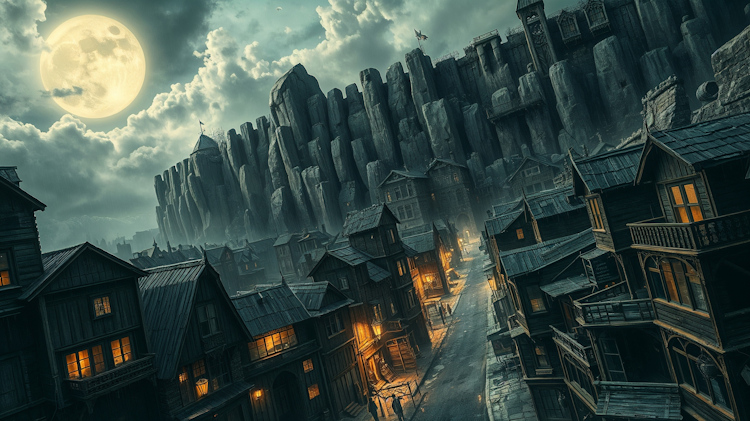
There are places in the World of Uhl that time has forgotten. Shantytown is not one of them. Time remembers Shantytown perfectly well. It simply stopped caring.
The border town sits at the edge of the known world, wedged between the Four Fiefdoms at its back and the Blasted Zone before it — that vast, desolate scar where the Old Gods fought their final battle and annihilated one another in a cataclysm that ended the Age of the Old Gods and shattered the Kingdom of Darshavon forever. Beyond the Blasted Zone, where the chaos magic thins and the land remembers how to grow again, lie the Freelands. Shantytown belongs to neither. It exists as an independent entity, answerable to no fiefdom, no duke, and no council — not because it chose independence, but because no one has considered it worth claiming in a very long time.
It was not always so. In the final years of Darshavon, when the Three Great Wars between the Old Gods threatened to consume the world, the kingdom's war wizards raised Shantywall — a bastion of ensorcelled granite rising a hundred feet above the ground and thick enough to withstand the most devastating magical assault ever conceived. The wall was a masterwork of divine-era engineering, infused with protective enchantments so powerful that when the gods themselves turned the surrounding landscape into a wasteland of raw chaos, Shantywall held. The settlement that grew in its shadow was a garrison town of strategic importance, the last outpost of civilization before the frontier, staffed by soldiers and war mages who understood that what lay beyond the wall was not merely dangerous but fundamentally wrong — a place where the fabric of reality had been torn and never properly mended.
When the Old Gods destroyed one another and Darshavon collapsed, the garrison abandoned its post. The soldiers left. The war mages followed. The supply lines that had sustained the outpost dried up as the emerging Four Fiefdoms turned their attention inward, consumed by the business of building new nations from the wreckage of the old. But the wall remained, and people — the kind of people who had nowhere better to go — remained with it. Refugees, deserters, outcasts, and those fleeing debts or enemies or crimes settled in the shadow of the great wall because it was there, and because nothing else was. Shantytown grew not by design but by accumulation, its ramshackle buildings leaning against the ancient fortification like beggars against a rich man's gate.
Centuries have passed since anyone considered Shantytown important. Everything about the place is old now — its history, its foundations, its people. The tenements and shops that crowd its narrow streets crumble at the corners, their walls dark with age and neglect. The air carries the scent of damp earth and decay, a smell that seeps into clothing and hair and memory and never quite washes out. The Singing Sword, the town's only tavern of note, leaks conversation and lamplight from its open door while its proprietor tosses drunks onto the cobblestones with the regularity of a clock striking the hour. Below the tavern, in spaces never meant for habitation, people make homes in makeshift apartments accessed by moss-slick stairs, paying what rent they can for the privilege of a roof and a locked door.
And above it all, Shantywall endures. The enchantments have faded but not vanished entirely. The granite has weathered but not fallen. The gatehouse crumbles at the edges, its ironwork rusted and its portcullis frozen in a half-raised position that suggests the last person to operate it didn't expect anyone to follow. Beyond the gate lies open country, and beyond that, the Blasted Zone — miles of scorched and twisted earth where chaos magic still pools in hollows and crackles along ridgelines, warping whatever is unfortunate enough to wander through. Few travel that road by choice. Those who do are either desperate enough to risk the crossing or dangerous enough that the Zone's hazards are the least of their concerns.
Shantytown attracts both kinds. The border town has become a waypoint for those moving between the Four Fiefdoms and the Freelands by the overland route — a path no sane person takes when alternatives exist, which means the people who pass through Shantytown are rarely sane by conventional standards. Fugitives, witches, hunters, and those being hunted all find their way to the town's narrow streets, staying long enough to gather supplies, trade information, or hide from whatever pursues them before moving on. Nobody comes to Shantytown to stay. They come because they have to, and they leave as soon as they can.
The town has no formal governance, no guard, and no law beyond the unwritten kind that develops in places where everyone has something to hide and no one wants authorities asking questions. Disputes are settled privately. Strangers are watched but not challenged — unless they give reason to be. The residents who remain year after year have learned to mind their own business with a discipline that borders on art. If screams echo through the alleyways at night, doors stay locked. If a stranger asks about a woman and a child, nobody remembers seeing them. Shantytown protects its own, not out of loyalty or kindness, but because in a place where everyone is running from something, silence is the only currency that never loses its value.
Once, Shantytown guarded the border between civilization and oblivion. Now it squats in the ruins of that purpose, a town built around a wall that protects nothing, at the edge of a wasteland that threatens no one who has the sense to avoid it. The Old Gods are dead. The garrison is gone. The enchantments flicker like candle flames in a drafty room, holding on through habit rather than necessity. But the wall still stands, and the town still breathes, and the people who drift through its streets still find shelter in its shadow — the same shadow that has sheltered the desperate and the damned for over five hundred years. Shantytown endures, not because it matters, but because no one has bothered to put it out of its misery. In the end, that may be the most honest form of survival there is.