SILAS
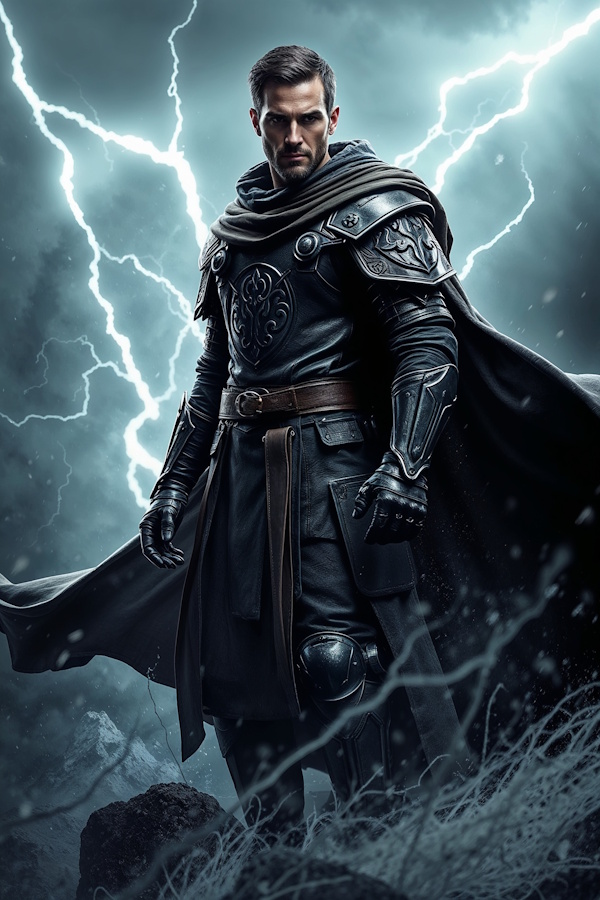
No one knows the true name of Silas’s god. The other Old Gods bore titles and epithets, names shouted in temples and carved into altars across the breadth of Uhl. Silas’s deity had none of that. Its followers called it the Voiceless One—an Old God of martial discipline and the mastery of arms who never spoke directly but whose will pressed through the spaces between things: the shudder of wind against tent canvas, the groan of old timber, the half-formed images that surfaced in dreams and faded before a sleeper could pin them down. Most scholars assume it perished alongside the rest of the pantheon in the cataclysm that ended the age of the Immortals. Silas disagrees. He believes the Voiceless One endures, diminished but aware, waiting in the margins of the world for those patient enough to listen.
He spent his youth in a hidden temple deep in the Freelands, raised among the last of the Voiceless One’s faithful—a dwindling congregation of warrior-priests who had withdrawn from the wider world rather than abandon their devotion. The temple’s location was a closely guarded secret, known to no outsider, and the handful of clerics who maintained it lived austere, regimented lives divided between prayer and combat training. Silas grew up in that rhythm, learning the forms of the broadsword and the short sword before he could read the ancient texts that lined the temple’s modest library. His days followed a pattern as old as the faith itself: physical discipline at dawn, study and meditation through the afternoon, and long vigils at night spent trying to decipher his god’s cryptic whispers in the rustle of leaves, the low moan of wind through the temple’s stone corridors, and in the fragmentary visions that visited his dreams.
The Voiceless One had been a god of warfare, but not in the crude sense of bloodlust and conquest. Its domain was the art of combat—the precision of a blade drawn at the right instant, the geometry of footwork, the discipline that separated a trained warrior from a thug with a sword. Its priests embraced the way of the warrior as fully as they did their spiritual calling, and Silas proved an apt student of both. He trained in hand-to-hand combat until his body answered by reflex rather than thought, and he drilled with broadsword and short sword until switching between them mid-fight became as natural as breathing. Where other clerics of the Old Gods carried staffs or wore ceremonial robes, the warrior-priests of the Voiceless One armored themselves in dark leather and swept cloaks across their shoulders, indistinguishable from soldiers or sellswords to anyone who didn’t know better.
But the temple was a cloister, and Silas grew restless within its walls. The other priests contented themselves with preserving what remained—guarding the old texts, maintaining the old forms, waiting for a sign that might never come. Silas wanted more. He believed his god’s purpose could not be served by a handful of aging faithful hidden away in the wilderness, and he became convinced that the path to restoring the Voiceless One’s place in the world lay not in prayer alone but in action. Ancient texts spoke of relics once wielded by the gods and their most devoted followers—weapons, shields, sacred instruments of war imbued with divine purpose. If even one such relic could be recovered, Silas reasoned, it might serve as proof that the old faith still held power, a tangible anchor for belief in an age that had abandoned it. Guided by those same texts, he left the temple and ventured into the wider world to seek them.
He has found none to date.
Years of searching across the Freelands and beyond turned up fragments of legend and dead ends but no relics. The quest did not break his faith, but it reshaped it. Stripped of the temple’s certainties and forced to survive on his own terms, Silas discovered that the practical application of his training—his skill with a blade, his knowledge of field medicine, his ability to steady frightened people with a word or a hand on the shoulder—mattered more to the living than any relic of the dead gods ever could. His reputation grew in mercenary circles: a warrior-priest who fought with the discipline of a monk and the ferocity of a veteran, who could stitch a wound as competently as he could open one, and whose calm, measured presence settled nerves before a battle in ways that had nothing to do with divine magic and everything to do with conviction.
That reputation caught the attention of Captain Madilyn Oakthorn. The Mavens needed fighters—they always needed fighters—but Oakthorn recognized in Silas something rarer than a strong sword arm. A mercenary company held together through lean times and long marches not by pay alone but by the belief that the person standing beside you cared whether you lived or died. Silas carried that quality the way other men carried weapons: openly, without apology, and ready to put it to use. She offered him a place, and he accepted, because every good cause needs money to survive and because the Mavens’ work took them into the forgotten places of Uhl where ancient relics might still lie buried beneath the ruins of older civilizations.
Within the company, Silas occupies a role no one else can fill. He fights in the front line with broadsword and shield, stepping forward with Captain Oakthorn when the situation demands it, and carries a short sword at his hip for close work. His war cries sound more like prayers to those who fight alongside him, and in the chaos of battle, his voice cuts through the din with a steadiness that keeps others from breaking. Off the field, his tent draws a quiet stream of visitors—Mavens seeking counsel, or a listening ear, or the reassurance that someone in the company gives a damn about more than the next contract. Silas listens, advises, and offers what comfort he can, drawing on the wisdom of a faith most people consider dead. He does not preach. He does not lecture. He meets each person where they stand and offers what the moment requires, whether that means practical guidance, a steady hand, or the silence of someone willing to sit with another’s grief without trying to fix it.
He moves with the quiet efficiency of a man trained from childhood to leave no trace—a habit of the hidden temple that never left him. On the expedition into the Grimmere, his ability to slip through the swamp’s shadows unsettled even seasoned members of the company, and his perimeter reports arrived with a brevity that wasted no one’s time. He carries himself with a watchfulness that never quite relaxes, scanning his surroundings the way a man of deep habit does without conscious thought.
Those who mock his devotion to a dead god rarely do so twice. Not because Silas threatens or postures, but because watching him fight tends to end the conversation. The Voiceless One’s priests trained to embody their deity’s domain, and Silas embodies it with an economy of movement and a controlled ferocity that makes the connection between faith and warfare difficult to dismiss. Whether or not a god listens when he prays, the discipline his faith instilled is as real and as sharp as the blades he carries.
He does not know if the Voiceless One still exists. He believes it does, the way a man believes in something he cannot prove but refuses to surrender—not out of stubbornness but because the alternative offers nothing worth building on. His search for the ancient relics continues, driven by the same quiet conviction that carried him out of the temple and into the wider world. Until he finds one, or until the last whisper fades into silence, Silas serves the Mavens, guards the living, and keeps faith with a god the rest of Uhl has forgotten.