STALKERS
Few creatures in all of Uhl inspire the particular brand of dread reserved for the stalkers. They are the dark inverse of the patrollers — where the patrollers stand watch over the great forests and frontier holds, the stalkers slip past their cordons unseen; where the patrollers protect the innocent, the stalkers prey upon them; where the patrollers hold to a code of duty and shared sacrifice, the stalkers answer only to the warlords who bid them hunt. Drawn almost entirely from haurek stock and forged in the lightless depths of the Underland, they represent everything the patrollers are not — deceitful, sadistic, patient beyond reason, and unmatched at the lonely arts of pursuit and silent kill.
Deep Hollow
Stalkers are not born so much as broken and remade, and the place where that remaking happens is Deep Hollow. Buried in the depthless dark of the Underland, well beneath the surface fortresses of Greth and the high mountain warrens claimed by other goblin clans, Deep Hollow is a labyrinth of natural caverns and carved passages where no torch is ever struck and no natural light has ever fallen. Generations of hunters have shaped it into something between a refuge and a forge, a place where the most promising young of the goblin races — overwhelmingly haurek, by ancient custom and inclination — are sent to learn an art that other goblins lack the patience or temperament to master.
The chambers of Deep Hollow form a closed world, complete in themselves. Initiates eat there, sleep there, fight there, and die there if they prove unworthy of the calling. Eyes adapt to absolute darkness within a year. Other senses sharpen to compensate. The masters who govern the place are themselves veterans of legendary hunts, grizzled survivors whose own exploits have entered goblin folklore, and they tolerate no weakness in their charges. What emerges from Deep Hollow is no longer quite the creature that entered. The stalker who returns to the surface world has been hollowed out and refilled with patience, silence, and purpose.
Training & Discipline
The training in Deep Hollow is brutal by any reasonable measure, and it is meant to be. Recruits endure years of sensory deprivation, learning to navigate by touch, scent, and hearing alone, until they can move through unfamiliar tunnels in pitch darkness without striking a single wall. They study the language of disturbed dust, bent grass, and the faintest traces of body heat left on stone. They are taught to read the stories that prey leaves behind without intending to leave anything at all.
Above all, they learn patience. A stalker must be capable of remaining motionless for hours and, when the hunt demands it, for days at a stretch. Wild creatures forget such a hunter is there. Sentries grow careless beneath his unmoving gaze. By the time the moment for action arrives, the stalker has watched his quarry so long that he knows their habits as intimately as his own. The masters consider this discipline the foundation of every other skill; a stalker who cannot wait cannot hunt, and a stalker who cannot hunt is no stalker at all.
Combat training emphasizes silence and economy over brute force. The recruits learn the curved dagger and the throwing star, the garrotte and the whipcord, the short bow drawn from cover and the boot-knife drawn from nowhere. They are taught to kill cleanly and quickly when death is required, to capture intact when capture serves better, and never to waste motion on display. Most of all, they are trained to think like their prey — to anticipate where a frightened mind will run, what it will trust, what it will fail to notice. A stalker who understands his quarry's psychology rarely needs to chase it. He simply waits where it has already decided to go.
Methods of the Hunt
What makes a stalker terrifying is not the kill itself but everything that precedes it. A stalker rarely strikes the moment he has the opportunity. He prefers to circle, to learn, to apply pressure in measured doses until his target makes the mistake he has been waiting for. He moves ahead of his quarry as often as he follows behind, loosing arrows from impossible angles, mimicking voices he has overheard during long surveillance, planting evidence of himself in places his target believes safe. Fear, isolation, and exhaustion are weapons in his arsenal as surely as any blade.
Patrollers who have studied the stalker arts at second hand describe these tactics as psychological warfare, and the term is apt. A stalker reads his prey's emotional state the way a tracker reads a footprint, and he manipulates that state with the same care. Hasty prey makes hasty mistakes. Lonely prey trusts the wrong voice in the dark. Desperate prey runs in straight lines toward exactly the kill zone the stalker has prepared. The hunt becomes a cruel pedagogy in which the target is taught, lesson by lesson, the precise shape of his own destruction. By the time the killing stroke comes, many of the stalker's victims welcome it.
This is not cruelty for its own sake, though some stalkers undeniably take pleasure in the work. It is method. A target who breaks before the end provides better intelligence, makes worse decisions, and dies more conveniently than one who holds his composure. The stalker's patience is the patience of a predator that has all the time in the world and an absolute conviction that it will eat.
A stalker's gear is selected for efficiency rather than display. The traditional arsenal includes throwing stars balanced and sharpened to surgical precision, capable of killing silently at considerable distances; curved daggers designed for quick thrusts and silent throat work; the garrotte, which strangles without a sound; and the dreaded whipcord, which can snap a neck from a dozen paces or coil around a throat in the same motion that pulls the wielder into close quarters. Many stalkers carry the short bow as well, favored for ambush along narrow trails and ravines.
Beyond steel and cord, the stalker's pack contains alchemical compounds developed in the laboratories of Deep Hollow over generations. Powders that eliminate scent trails. Vapors that induce unconsciousness. Smokes and flashes that create diversions when stealth alone proves insufficient. The leathers and furs they wear are dyed in muted browns and grays, oiled to make no sound, fitted close to allow silent movement through brush and over rock. They carry no insignia. They wear no trophy or ornament that might catch the light. The only mark a stalker leaves behind is the body of his target, and frequently not even that.
In Service
Stalkers do not roam the surface world for sport, though many would gladly do so given the chance. They serve. The masters of Deep Hollow assign their finished hunters to the warlords and chieftains of goblin society, where their particular gifts command considerable price. Lord Gral of Greth maintains the largest standing complement of stalkers in service to any single warlord, and his finest hunters — figures such as Skarth the Relentless — have become legends in their own right, deployed against rival goblin leaders, fleeing traitors, and the patroller halls that stand between Greth and its ambitions.
The work itself takes many forms. A stalker may be sent to eliminate a rival warlord whose elimination would be politically inconvenient if openly attributed. He may be tasked with mapping the defenses of a patroller hall, returning weeks or months later with intelligence that no other agent could have gathered. He may be loosed against a single target and instructed to take as long as he requires, so long as the matter ends with the target's death and no evidence of foul play. The most accomplished among them — those who, like Skave, can pass through guarded territory at will — become irreplaceable instruments of their lord's strategy.
Stalkers operate alone more often than in pairs, and almost never in larger groups. The work demands a degree of independence that does not survive the friction of company. They are intelligent enough to operate without supervision, skilled enough to handle nearly any target, and disciplined enough to follow orders without question or personal agenda. The best of them are professional craftsmen of a brutal trade, taking neither trophies nor signatures, content with the satisfaction of a hunt cleanly concluded. The worst — the arrogant, the vindictive, the ones whose tongues run ahead of their judgment — give the profession its evil reputation among those who survive long enough to spread word of it.
Reputation & Legacy
Among the patrollers of the three Halls — Alzion, Simmaron, and Merrow — the stalker is regarded as the single most dangerous adversary the goblin races can field. A patroller may stand against a dozen haurek regulars and acquit himself well. He may face gaugaths and grekkels and the assorted horrors of the Underland with reasonable hope of victory. Against a stalker working his trade in earnest, even the most seasoned ranger relies as much on luck as on skill. The recruits at the Halls study what little is known of stalker methods, less in the hope of defeating one in open combat than of recognizing the signs of being hunted in time to do something about it.
To the surface peoples of the Four Fiefdoms, the stalker is a half-believed terror, the sort of creature that figures in cautionary tales told by frontier mothers to wayward children. Most surface dwellers who encounter one never know it. They simply vanish, or die in some accident that bears no obvious mark of foul play, or are found in their beds with a single small wound and no other sign of struggle. The stalkers prefer it this way. A reputation is useful, but anonymity is more useful still, and a victim who knows what is hunting him is a victim who may yet escape.
For all their menace, the stalkers serve a purpose in the wider patterns of the world. They are the goblin races' answer to the patrollers, and so long as the warlords of the Underland nurse their ambitions against the surface kingdoms, the stalkers will continue to slip from the deep places of Uhl on errands their masters cannot otherwise accomplish. Their existence is part of the reason the patroller halls remain as vigilant as they do — and part of the reason the frontier between the two worlds, however quiet it may sometimes appear, is never truly at peace.
Characters
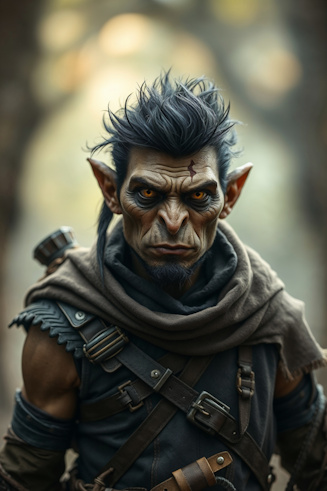 SkaveHaurek stalker in the service of Lord Gral.