Sythraxis the First Brood Mother
Introduction
Sythraxis the First Brood Mother is the primordial goddess of the sitheri—the original serpent, the divine brood mother from whose body the entire race spilled into the world. She is creation and consumption made one, the coiling hunger that devours and the swollen belly that brings forth life, the cold logic that decides which offspring survive and which are eaten before they draw their second breath. The sitheri do not love Sythraxis. Love is a warm-blooded sentiment, soft and useless in the black water of the Grimmere. What they feel for her is something older and colder: the recognition of absolute authority, earned not through kindness or wisdom but through the simple, undeniable fact that she made them, and what she made, she owns.
Among the four gods of the sitheri Swamp Pantheon—Sythraxis the First Mother, Morghen the Hunter, Thessara the Tide Bringer, and Vexthul the Bone Keeper—Sythraxis holds primacy not by divine decree but by the same principle that governs all sitheri society: the mother rules because the mother breeds. The others are her equals in power, and the tides of dominance between them shift as they shift between all beings in the Grimmere, but Sythraxis’s authority is of a different kind than theirs. Morghen hunts. Thessara commands the waters. Vexthul collects the dead. Sythraxis produces the living that do all these things. Without her, the others would govern nothing.
The sitheri believe she is dead. Most of them. The brood mothers whose authority derives from her divine mandate recite her death as established fact, because a dead goddess who bequeathed her power to her daughters is more useful to them than a living one who might reclaim it. But in the deepest reaches of the Grimmere, where the water turns black and the mud has no bottom, the old shamans tell a different story. They say that Sythraxis did not die. They say she descended, sinking back into the primordial muck from which she first emerged, and that she waits there still—patient, cold, coiled in the dark—for the moment when the swamp calls her forth again. Whether this is prophecy or wishful thinking depends on who is speaking and what they stand to gain from the answer.
Appearance & Symbols
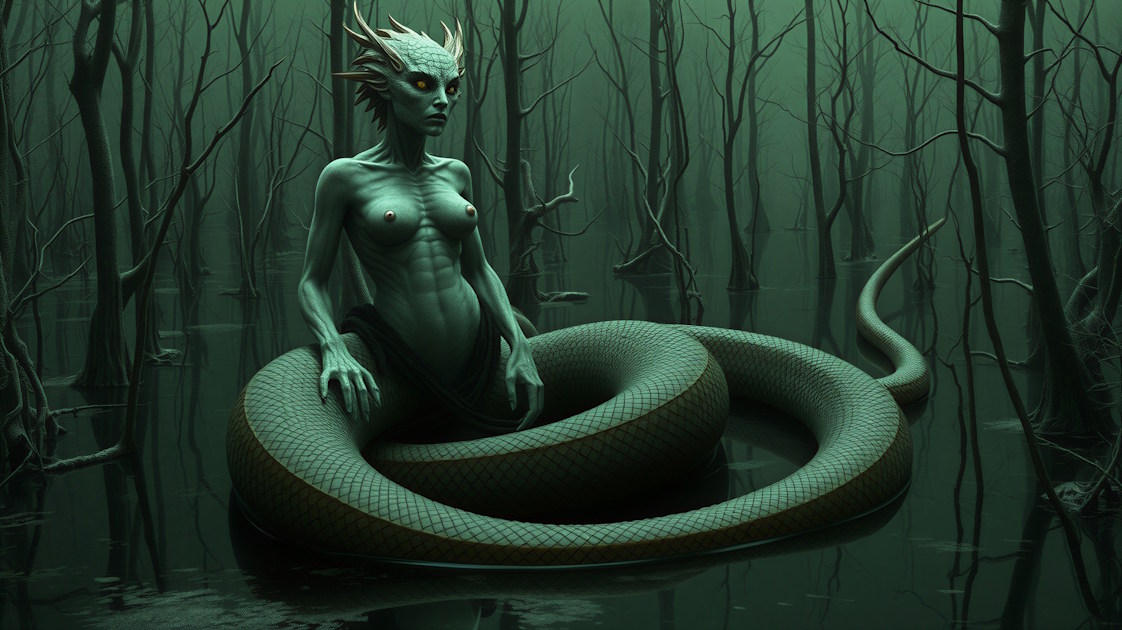
Sythraxis is depicted in two forms, and the sitheri consider both equally authentic. The first and oldest is the Great Serpent—a colossal snake of proportions so vast that the myths describe her body filling entire waterways, her coils displacing the swamp itself as she moved through it. In this form, her scales are depicted as the color of deep swamp water—not black but the lightless brown-green of water so thick with sediment and decay that it has become opaque, a color that absorbs everything and reflects nothing. Her eyes are described as the pale yellow of old bone, lidless and unblinking, carrying the fixed, patient attention of a predator that has never needed to hurry because nothing in the world can escape it.
The second form is the Divine Mother—a sitheri female of impossible scale, towering above the canopy of the swamp’s tallest trees, her body combining the serpentine features of her race with a magnitude that makes mortal sitheri seem like insects at her feet. In this form, she retains the serpentine lower body, her coils trailing behind her through the water, but her upper body is unmistakably female and unmistakably sitheri—scaled, cold-eyed, and carrying the particular stillness of a being that does not need to demonstrate its power because its power is self-evident. Brood mothers favor this depiction, as it reinforces the connection between divine authority and the female form that governs sitheri society.
She is never depicted in motion. Unlike Nimala, who cannot be shown standing still, Sythraxis is always rendered coiled, settled, waiting. Her posture communicates not inactivity but the specific readiness of a predator that has already chosen its position and will not move until the moment of the strike. The sitheri find this stillness more threatening than any display of aggression, because stillness in a creature of Sythraxis’s size and power implies absolute confidence—the certainty that nothing in the environment requires a reaction, because nothing in the environment constitutes a threat.
The primary symbol associated with Sythraxis is the Coiled Egg—a serpent wrapped around an egg in a posture that is simultaneously protective and possessive, its jaws positioned to consume the egg as easily as to guard it. This symbol appears on brood mother regalia, sacrificial altars, and the boundary markers that define tribal territories throughout the Grimmere. Secondary symbols include the Open Jaw, representing the consuming aspect of her nature, and the Shed Skin, representing the renewal that follows destruction. The Shed Skin carries particular significance, as the sitheri view the shedding of skin as a metaphor for Sythraxis’s cyclical nature—the constant process of consuming the old to make way for the new that defines both their goddess and their civilization.
Origins
The sitheri tell Sythraxis’s origin as a hunger story, because the sitheri understand everything through the lens of hunger. Before the swamp had a name, before the water had learned to be still, before the mud had settled into the shapes that would become the Grimmere, there was a darkness beneath the world that was not empty. It was full—full of pressure, full of heat, full of something that wanted out. The darkness pressed against the underside of the world the way an egg presses against the inside of its shell from the moment the creature within begins to grow, and like an egg, the world eventually cracked.
Sythraxis came through the crack. She did not emerge gracefully or with purpose. She erupted—a convulsion of scale and muscle and hunger that tore upward through the muck, displacing water and earth in a surge so violent that it reshaped the landscape around the point of her arrival. The myths describe the swamp forming in her wake, the displaced earth settling into the low, waterlogged terrain that would become Death’s Head Swamp, the water rushing in to fill the void her passage created. The Grimmere is, in sitheri understanding, the scar left by Sythraxis’s birth—a wound in the world that never healed, because healing would require closing the passage through which she entered, and nothing has ever been strong enough to seal it.
Her first act was to eat. The myths are specific about this. She did not survey her domain or establish her authority or contemplate the nature of her existence. She ate whatever she found—fish, mud, the creatures that had inhabited the water before her arrival, the vegetation that grew at the margins of the newly formed swamp. She consumed without discrimination because she was empty, and emptiness in sitheri theology is the only true suffering. The full are powerful. The empty are nothing. Sythraxis filled herself with the raw substance of the world, and in doing so, she transformed it. What went into her mouth as chaos came out of her body as purpose. She was the first act of creation in sitheri mythology: the conversion of raw, meaningless matter into something organized, something directed, something hungry enough to want more.
When she had eaten enough to think, she looked at the swamp around her and found it insufficient. It was wet, dark, and hostile—all qualities she approved of—but it was empty of anything that resembled herself. She was alone in a way that offended her not emotionally but practically. A single predator, no matter how powerful, is a dead end. A species requires offspring. Offspring require a mother. And so Sythraxis, having consumed enough of the world to remake a portion of it in her image, turned her hunger inward and began the process that would produce the sitheri race.
Domains & Attributes
Sythraxis governs reproduction in its most brutal and unromantic form—the biological imperative to produce offspring, the selection of which offspring survive, the consumption of those that do not meet the standard, and the absolute authority of the mother over the products of her body. Her domain encompasses fertility, but not the gentle, nurturing fertility celebrated by other races. Sythraxis’s fertility is the cold arithmetic of a species that produces many and keeps few, that views its young not as precious individuals but as investments to be evaluated, culled, and deployed according to the mother’s judgment. Every brood mother who selects mates, oversees clutches, and decides which hatchlings are strong enough to live is exercising authority that Sythraxis established at the dawn of sitheri existence.
Her second domain is consumption—the act of taking the world into oneself and transforming it into something useful. This is not mere eating, though the sitheri do not draw a sharp line between the physical act of consumption and its spiritual significance. To consume, in sitheri theology, is to exercise dominion. The predator who eats the prey absorbs its strength. The brood that conquers a rival absorbs its territory. The warrior who takes a scalp absorbs the reputation of the fallen. Sythraxis is the divine embodiment of this principle: the being who consumed the primordial chaos and produced order from it, who turned raw matter into a race of predators capable of consuming in turn. The chain of consumption that defines sitheri existence begins and ends with her.
Her third domain is authority itself—specifically, the authority of the mother over her brood. This is not a negotiated authority or a consensual one. It is absolute, biological, and non-transferable. The mother produced you. The mother fed you. The mother decided you were worth keeping alive when she could as easily have crushed you in the egg. Your life is her investment, and she will spend it as she sees fit. This understanding permeates every level of sitheri society, from the brood mother’s command over her tribe to the deference that even the most accomplished warrior shows to any female of breeding status. Sythraxis did not invent matriarchy; she embodied it, and the sitheri adopted it because the alternative—a world where the producers of life do not control the products of life—struck them as self-evidently absurd.
Her domain does not extend to mercy, compassion, or the preservation of the weak. Sythraxis produced offspring. She did not coddle them. The myths are explicit that she consumed those of her early children who failed to meet her standards, recycling their substance into the next clutch with the efficient indifference of a predator who cannot afford to waste resources on failures. The sitheri view this not as cruelty but as the foundational principle of a healthy species: the strong survive, the weak are consumed, and the mother who permits weakness to persist in her brood is a mother who has failed her purpose.
Nature & Temperament
Sythraxis is cold. The word carries specific weight in sitheri theology, where cold-bloodedness is not a biological fact to be acknowledged but a spiritual virtue to be cultivated. Warm-blooded creatures are governed by their temperatures—they overheat, they shiver, they waste energy maintaining internal conditions that the environment does not support. Cold-blooded creatures adapt. They slow when the world demands slowness and accelerate when opportunity presents itself. Sythraxis embodies this principle at its most extreme: a being whose emotional temperature never rises above what the situation requires, whose responses are calibrated with the precision of a predator that cannot afford to waste a single calorie of energy on unnecessary feeling.
Her cruelty is not the hot, impulsive cruelty of rage or sadism. It is the cold cruelty of efficiency—the willingness to inflict suffering when suffering produces a useful result and to withhold it when it does not. The myths describe Sythraxis evaluating her offspring with the detached attention of a breeder assessing livestock, selecting those with the qualities she valued and discarding the rest without hesitation or remorse. She did not hate the weak. She simply had no use for them, and in a world governed by the economics of predation, uselessness is a death sentence that sentiment cannot commute.
Her brutality is comprehensive. The myths contain no episodes of tenderness, no moments of maternal warmth, no instances where Sythraxis softened her standards or made exceptions for offspring that showed promise despite present weakness. The sitheri do not find this troubling. They find it reassuring. A goddess who plays favorites is a goddess who can be manipulated through emotional appeal. Sythraxis cannot be manipulated because she does not care. She produces. She evaluates. She consumes or she keeps. The system is transparent, predictable, and utterly without compassion, and the sitheri consider these qualities essential in any authority worth obeying.
Her patience is perhaps her most unsettling quality. The myths describe Sythraxis waiting—not with Thyrkos’s vigilant discipline or Velania’s analytical attention but with the blank, motionless patience of a snake that has positioned itself along a trail and will remain there for days, weeks, however long it takes for the prey to arrive. This patience is not a virtue in the moral sense. It is a weapon. Sythraxis waits because waiting works, because the prey always comes eventually, and because the predator who moves first reveals its position while the predator who waits retains every advantage. The sitheri who invoke Sythraxis’s patience are not asking for the strength to endure. They are asking for the discipline to remain still until the killing moment arrives.
The Swamp Pantheon
The sitheri Swamp Pantheon consists of four divine figures whose relationships are defined not by family, hierarchy, or cooperation but by the same shifting tides of dominance and submission that govern all interactions in the Grimmere. Sythraxis, Morghen the Hunter, Thessara the Tide Bringer, and Vexthul the Bone Keeper are equals in the sense that none possesses the power to permanently subordinate the others, but they are not equals in the sense that surface-dwelling races understand the word. In the Grimmere, equality is a temporary condition—the brief moment of balance between two predators before one establishes dominance over the other. The pantheon’s relationships are fluid, competitive, and defined by the constant negotiation of power that the sitheri consider the natural state of all relationships.
Sythraxis’s relationship with Morghen the Hunter is one of mutual dependence expressed through perpetual tension. Sythraxis produces the warriors that Morghen inspires. Morghen’s hunts provide the sustenance that Sythraxis’s broods require. Neither can function without the other, yet neither willingly acknowledges the debt. The myths describe episodes where Sythraxis dominated Morghen through sheer reproductive authority—reminding the hunter that without mothers to produce hunters, the hunt ceases to exist—and episodes where Morghen asserted dominance by withholding the kills that Sythraxis’s broods needed to survive. This tension mirrors the relationship between brood mothers and their most successful warriors, a dynamic the sitheri recognize as fundamental to their society’s functioning.
Her relationship with Thessara the Tide Bringer is more openly antagonistic. Thessara controls the waters of the Grimmere—the same waters that Sythraxis emerged from and claims as her birthright. The myths describe territorial disputes between the two goddesses that reshaped the swamp’s geography, with floods and droughts serving as weapons in a conflict that neither could win decisively. The sitheri see in this relationship the inevitable conflict between any two powers that claim the same territory, and they apply its lessons to their own inter-tribal wars: even gods cannot share the swamp without fighting over it.
Sythraxis’s relationship with Vexthul the Bone Keeper is the most complex in the pantheon. Vexthul governs what happens after death—the collection of the worthy, the dissolution of the unworthy, the maintenance of the ancestral realm where sitheri spirits continue their competitive existence. Sythraxis produces the living. Vexthul claims the dead. The boundary between their domains is the boundary between life and death itself, and neither goddess respects it entirely. Sythraxis consumes her failed offspring before Vexthul can claim them. Vexthul sometimes claims the living before Sythraxis is finished with them. This ongoing trespass creates a rivalry that the sitheri find both theologically significant and darkly amusing—even the gods steal from each other in the Grimmere.
The Great Deeds
Sythraxis’s Great Deeds are acts of consumption and creation—the two processes that, in sitheri theology, are the same process viewed from different angles. Every myth about Sythraxis follows the same fundamental pattern: she encounters something, she consumes it, and from that consumption something new emerges. The sitheri do not distinguish between destruction and creation because Sythraxis taught them that the distinction is false. Everything that exists was made from something that was consumed to make it.
The Swallowing of the Dark is Sythraxis’s foundational myth—the deed from which her epithet derives and the event that the sitheri consider the first act of creation in their theological history. In the earliest days after her emergence from the deep, the Grimmere was choked with a darkness that was not merely the absence of light but an active, suffocating presence that filled the water and the air with something thick and hostile. Nothing could grow in this darkness. Nothing could hunt. The swamp was a dead place, full of potential but paralyzed by the weight of the primordial void that had followed Sythraxis through the crack in the world’s foundation.
Sythraxis consumed it. She opened her jaws and swallowed the darkness—not metaphorically but literally, drawing the void into her body through a sustained act of consumption that lasted, according to the myths, for an entire cycle of the moon. The darkness fought her. It pressed against her from the inside, trying to burst free, trying to extinguish the life that had dared to contain it. But Sythraxis’s hunger was greater than the darkness’s will to exist, and when the last of it was gone, the swamp could breathe. Light reached the water for the first time. Plants began to grow. Creatures emerged from the mud. The Grimmere became a living ecosystem because Sythraxis had consumed the thing that prevented life from taking hold. The sitheri take from this myth the lesson that defines their civilization: creation requires consumption. To build, you must first devour.
The Culling of the First Clutch is the most disturbing of Sythraxis’s myths, and the one that brood mothers cite most frequently when justifying the harsh evaluation of their own offspring. Sythraxis’s first clutch of eggs—produced from the raw substance she had consumed in the swamp’s earliest days—hatched into creatures that were not sitheri. They were malformed, mindless, driven by hunger but lacking the intelligence and cunning that Sythraxis required in her offspring. She consumed them. All of them. Then she produced a second clutch, refining the process, selecting more carefully from the materials available to her. The second clutch was better but still insufficient. She consumed them too. The myths describe this cycle repeating through multiple iterations, each clutch closer to the standard Sythraxis demanded, each failure recycled into the next attempt. The sitheri number these failed clutches differently depending on the telling, but the point remains consistent: Sythraxis did not accept her first results. She consumed them and tried again, and again, and again, until she produced offspring worthy of the world she was building.
The Drowning of the Sun King is the myth the sitheri tell about Sythraxis’s only significant interaction with the world beyond the Grimmere. A human king—the myths do not specify which kingdom or era, suggesting the story may be mythological rather than historical—raised an army to burn the swamp and exterminate the sitheri, whom he considered vermin unworthy of the land they occupied. He marched his forces into the Grimmere, confident that fire and steel would prove sufficient against what he dismissed as animals. Sythraxis waited until the army was deep within the swamp, far from solid ground and surrounded by water on all sides. Then she rose from the deep and consumed the king before his soldiers’ eyes, swallowing him whole, armor and crown and all. The army broke. Those who escaped the swamp carried stories that ensured no surface kingdom attempted a similar invasion for generations. The myth teaches that the Grimmere is not a territory to be conquered. It is a mouth. And what enters the mouth does not leave.
The Ten Daughters
The ten broods of the sitheri trace their origins to the Ten Daughters of Sythraxis—the final and most perfect clutch the First Mother produced before the events that led to her death or disappearance. These ten females, each possessing a distinct aspect of their mother’s nature, became the first brood mothers of the sitheri civilization, establishing the tribal structure that persists to the present day. The myths hold that Sythraxis evaluated this final clutch with the same merciless scrutiny she had applied to all her offspring and, for the first time, found nothing to cull. Each daughter was complete. Each was worthy. Each carried enough of the First Mother’s essence to establish and sustain a brood of her own.
The Ten Daughters are not named consistently across all sitheri traditions, as each brood maintains its own version of the founding myth that emphasizes its particular ancestor’s qualities while diminishing those of rival broods. What all versions agree upon is that Sythraxis divided her territory among the ten equally, granting each daughter a portion of the Grimmere sufficient to sustain a viable population, and that she established the principle of matriarchal succession that governs sitheri society: the brood mother rules because the brood mother breeds, and the authority to breed descends from Sythraxis through an unbroken line of mothers stretching back to the original ten.
The division of Sythraxis’s nature among her daughters is a matter of intense theological debate between the broods. Each tribe claims that its founding daughter received the most essential aspect of the First Mother’s character. The Apis-aba claim their ancestor inherited Sythraxis’s cunning. The Zaros-goz claim theirs inherited her strength. The Cutho-ka claim endurance. Every brood has its argument, and none will concede to any other. The sitheri consider this perpetual disagreement healthy rather than divisive, viewing it as a continuation of the competitive dynamic that Sythraxis herself modeled—ten daughters, each convinced of her own supremacy, each driving her brood to prove it through achievement rather than assertion.
The relationship between the brood mother system and Sythraxis’s divine mandate is the foundation upon which all sitheri social order rests. The brood mother’s authority is not merely political or military; it is biological and theological, derived from the same principle that gave Sythraxis her primacy among the gods: she who produces the next generation controls the next generation. Males who challenge this authority—and the myths acknowledge that some do, as the ambitious and the visionary sometimes chafe against any structure that constrains them—are challenging not just a brood mother but the divine order that Sythraxis established. Whether this order is genuinely unbreakable or merely durable enough to have lasted this long is a question that most sitheri refuse to ask aloud, though the emergence of figures like S’Sarren-kull suggests that the answer may be less settled than the brood mothers prefer.
The Fall of the Old Gods
The sitheri account of the Fall of the Old Gods is characteristically pragmatic and devoid of the cosmic grandeur that other races attach to the event. The gods fought. The gods died. The world shook. The swamp survived. The sitheri do not invest the Fall with theological significance beyond its practical consequences, viewing it as further evidence of a principle they already held: that power is temporary, that even gods can be consumed, and that the survivors of any catastrophe are those who had the sense to stay low and let the destruction pass overhead.
The Grimmere’s isolation from the centers of divine conflict provided the sitheri with natural protection during the Fall, just as it had protected them from the great events of previous ages. The swamp’s inhospitable terrain, its lack of strategic value to surface-dwelling powers, and its position far from the major axes of divine warfare meant that the worst of the cataclysm passed around the Grimmere rather than through it. The sitheri weathered the accompanying upheavals—earthquakes, floods, atmospheric disturbances—with the stoic indifference of a race accustomed to living in an environment that was trying to kill them long before the gods decided to kill each other.
Sythraxis’s role during the Fall is where the myths diverge sharply, with different broods and shamanic traditions offering incompatible accounts that the sitheri have never attempted to reconcile. The brood mothers’ official tradition holds that Sythraxis fought against the destructive forces of the Fall, defending the Grimmere from the cosmic energies that threatened to unmake it. The shamans’ tradition holds that she did nothing of the kind—that Sythraxis recognized the Fall as a catastrophe beyond her capacity to influence and responded in the way any sensible predator responds to a threat too large to fight: she went still, went deep, and waited for it to pass.
The Death of Sythraxis
The most widely accepted account of Sythraxis’s death is told by the brood mothers, who have the strongest interest in establishing her demise as historical fact and the authority to punish alternative interpretations. In this telling, Sythraxis died not in the initial cataclysm of the Fall but in its aftermath, when the residual energies of the dying gods seeped into the ground and poisoned the deep waters from which she had originally emerged.
The poison was not a substance but a corruption—a wrongness that entered the primordial muck at the bottom of the Grimmere and began unmaking the conditions that had given Sythraxis her power. The deep waters that had birthed her turned against her, the connection between goddess and swamp becoming a channel through which the corruption flowed directly into her body. She felt it the way a brood mother feels sickness in her clutch—an internal wrongness that no amount of strength or cunning could compensate for, because the threat was not external. It was inside her, woven into the same substance from which she was made.
Sythraxis did what the sitheri do when confronted with a problem they cannot solve through force: she consumed it. She drew the corruption into herself deliberately, pulling the poison from the swamp’s deep waters into her own body, concentrating it within her flesh rather than allowing it to spread through the ecosystem that sustained her children. The myths describe this as a sustained act of ingestion that lasted for days, the First Mother coiling in the deepest basin of the Grimmere, her body swelling with the corruption she was absorbing, the water around her clarifying as she drew the poison out of it and into herself.
The corruption killed her. Or rather, the corruption and Sythraxis killed each other, the poison destroying the goddess from within while she destroyed the poison by containing it within a body that could metabolize what the swamp could not. When the process was complete, the deep waters were clean—or clean enough for sitheri purposes—and Sythraxis was gone. Her body sank into the muck at the Grimmere’s deepest point, the same muck from which she had erupted at the beginning of the world, and the surface of the water closed over the place where she had been.
This is the official account. It is clean, purposeful, and serves the brood mothers’ interests by establishing Sythraxis as a selfless protector who died to save the swamp that sustains her people. The shamans tell a different version. In their telling, Sythraxis did not die. She was overwhelmed. The corruption was too much for even a goddess to metabolize, and rather than being destroyed, she was driven into a state of dormancy so deep that it is indistinguishable from death—coiled in the lightless mud at the bottom of the Grimmere, her body saturated with the poison she consumed, alive but unable to act, waiting for the corruption to run its course through her divine system. This process, the shamans say, is not yet complete. It has been five hundred years, and the First Mother is still digesting. When she finishes—when the poison is finally broken down and absorbed, when the corruption becomes just another meal that made her stronger—she will rise. And the swamp will remember what it means to have a goddess coiled at its heart.
The brood mothers dismiss this interpretation. They have to. A dormant goddess who might return is a threat to every authority structure built on the assumption of her absence. A sleeping First Mother renders every brood mother a regent rather than a ruler—a caretaker holding power in trust until the rightful owner awakens. The shamans, who operate outside the brood mother hierarchy and whose authority derives from spiritual insight rather than reproductive status, have less reason to insist on Sythraxis’s permanent death and more reason to keep the possibility of her return alive. The tension between these interpretations is not merely theological. It is political, and it has been political for five centuries.
Legacy & Enduring Influence
Sythraxis’s legacy is sitheri civilization itself. Every brood mother who commands a tribe, every warrior who completes the Hundred Scalps, every hatchling that survives its first season in the Grimmere exists because Sythraxis consumed the primordial darkness, produced the Ten Daughters, and established the matriarchal order that has sustained the sitheri through every age of the world’s history. Her influence is not inspirational in the way that other races’ divine legacies tend to be. The sitheri do not aspire to be like Sythraxis. They simply live within the system she created, following its rules because the rules work and because the alternative—a sitheri society without matriarchal authority, without the culling that keeps the species strong, without the consuming hunger that drives expansion and conquest—is not a society at all. It is a collection of predators waiting to eat each other.
The matriarchal order remains Sythraxis’s most tangible contribution to sitheri culture. Brood mothers derive their authority directly from the divine mandate she established, and this authority has proven remarkably resilient across five centuries of post-divine governance. The system works because it aligns political power with biological reality—the female who controls reproduction controls the future of the brood, and in a species as aggressive and territorial as the sitheri, centralizing that control in a single authority figure prevents the fratricidal chaos that would result from unrestricted competition.
Yet the mandate is not unquestioned. The emergence of S’Sarren-kull—a male sitheri of extraordinary vision and ambition who seeks to unite the broods under a singular purpose that transcends the traditional matriarchal structure—demonstrates that Sythraxis’s order, however durable, is not immune to challenge. S’Sarren-kull’s power derives not from reproductive authority but from spiritual insight and necromantic knowledge, sources of influence that the matriarchal system was not designed to accommodate. Whether his rise represents a temporary anomaly or the first crack in a structure that has endured since the age of gods is a question the sitheri are currently living through rather than answering from a distance.
The practice of ritual sacrifice, central to sitheri culture, traces its theological justification directly to Sythraxis’s mythology. The consuming of enemies, the offering of captives, the ritualized violence that marks every significant event in sitheri life—all are understood as reenactments of Sythraxis’s foundational acts, the continuous repetition of the principle that creation requires consumption and that the strong survive by incorporating the substance of the weak. Every sacrifice performed on a sitheri altar is, in theological terms, a small-scale repetition of the Swallowing of the Dark—the act that made the Grimmere livable and the sitheri possible.
Worship & Observances
Sitheri worship of Sythraxis is inseparable from the practice of sacrifice that defines their religious life. The brood mothers serve as Sythraxis’s priestesses by default, their authority to preside over sacrificial rituals deriving from the same divine mandate that grants them political and reproductive power. There are no temples dedicated exclusively to Sythraxis; every sacrificial altar in the Grimmere serves her, and every act of ritualized consumption—from the formal sacrifice of captives to the communal consumption of defeated enemies—constitutes worship in her name.
The most significant observance dedicated to Sythraxis is the Spawning Rite, conducted when a brood mother produces a new clutch of eggs. This ceremony, presided over by the brood mother herself with the participation of the tribe’s shamans and senior warriors, consecrates the clutch to Sythraxis’s legacy and establishes the First Mother’s authority over the lives that will emerge from it. The rite includes the sacrifice of captives whose blood is used to anoint the eggs, the recitation of the creation myth that traces the brood’s lineage back to one of the Ten Daughters, and the formal acknowledgment that the hatchlings belong first to Sythraxis and second to the brood mother who produced them. This ceremony reinforces the theological foundation of matriarchal authority while providing a practical occasion for the tribe to gather and reaffirm its social bonds.
The Culling Feast, held after each clutch has been evaluated and the unworthy hatchlings removed, reenacts Sythraxis’s Culling of the First Clutch in miniature. The consumption of culled hatchlings—a practice that horrifies other races but that the sitheri consider essential to their species’ health—is framed as an act of worship, a repetition of the First Mother’s refusal to accept anything less than perfection from her offspring. The feast serves both practical and spiritual purposes, recycling biological resources while reinforcing the principle that weakness is not tolerated and that the mother’s judgment is absolute.
The Dark Tide, observed during the lowest water levels of the dry season when the Grimmere’s deepest basins are partially exposed, involves pilgrimages to the deep places where Sythraxis is believed to have descended. Shamans lead small groups to the edges of these black-water pools and conduct rituals that the brood mothers officially tolerate but privately distrust, as these observances draw their significance from the shamanic tradition that holds Sythraxis dormant rather than dead. The pilgrims offer sacrifices into the dark water—blood, bones, and occasionally living captives—and listen for signs that the First Mother stirs in her sleep. Whether any sign has ever been received is a matter of dispute between shamans and brood mothers, and the dispute shows no sign of resolution.
Sayings & Proverbs
Sitheri sayings associated with Sythraxis are cold, transactional, and stripped of sentiment—functional expressions for a people who view language as a tool rather than an art.
“The Mother eats first” establishes priority in any situation involving the distribution of resources, authority, or opportunity. The brood mother takes her share before anyone else, and this principle extends metaphorically to any situation where hierarchy determines access. The saying is not a request or a suggestion. It is a statement of natural law, as inarguable as the fact that water flows downhill. To dispute it is to dispute Sythraxis herself.
“Consume or be consumed” is the closest thing the sitheri have to a philosophical motto—a reduction of their entire worldview to four words. The saying acknowledges no middle ground, no neutral position, no possibility of coexistence between predator and prey. In every interaction, one party is the consumer and the other is the consumed. The only choice available is which role you occupy, and that choice is made not through negotiation but through the exercise of strength, cunning, and the willingness to strike first.
“She sank, she waits” is the shamanic counter-tradition compressed into four words, spoken by those who believe Sythraxis is dormant rather than dead. The saying serves as a quiet declaration of allegiance to the shamanic interpretation of the First Mother’s fate, and brood mothers who hear it spoken too loudly or too often have been known to respond with violence. The phrase carries an implicit threat that the shamans deny intending but that the brood mothers cannot ignore: if Sythraxis returns, the authority structures built on her death become illegitimate overnight.
“Weak clutch, weak mother” is the harshest judgment that can be leveled against a brood mother, directly connecting the quality of her offspring to her competence as a leader. The saying invokes Sythraxis’s repeated cullings of her early clutches, implying that a mother who produces weak offspring has failed the standard the First Mother set. The phrase is never spoken to a brood mother’s face unless the speaker is prepared to back the insult with force, as the accusation it carries is severe enough to justify lethal retaliation.
“The swamp remembers” is used in multiple contexts, all carrying the implication that actions have consequences that persist beyond the actor’s ability to control them. A betrayal will be remembered. A debt will be collected. A weakness will be exploited, if not today, then tomorrow, or next season, or next generation. The swamp’s memory is Sythraxis’s memory, and Sythraxis’s memory does not forgive, does not forget, and does not expire.
Sacred Sites
The deepest basin of the Grimmere—the place where the water turns black, and the mud has no measurable bottom—is the most sacred site in sitheri religious geography. Known as the Mother’s Maw, this location is believed to be both the point from which Sythraxis originally emerged and the place where she descended after the Fall. No sitheri has ever reached its bottom. Several have tried, diving into the lightless water and descending until the pressure and the cold forced them back or claimed them entirely. The shamans say that those who do not return have found the First Mother and chosen to remain with her. The pragmatists say they drowned. Both interpretations serve the site’s mystique.
The Spawning Beds, located in the warm, shallow waters where brood mothers traditionally produce their clutches, are considered sacred to Sythraxis as sites of creation that echo her own reproductive acts. These locations are defended with particular ferocity during spawning season, as an attack on a spawning bed is understood as an attack on the divine process that Sythraxis established. The destruction of a rival brood’s spawning bed is considered an act of total war that justifies retaliation without limit—one of the few circumstances under which sitheri inter-tribal conflict acknowledges no rules of engagement.
The Shed Grounds are locations throughout the Grimmere where unusually large quantities of shed snakeskin accumulate, creating eerie landscapes of translucent scales draped over branches and floating on dark water. The sitheri associate these sites with Sythraxis’s cyclical nature, viewing the accumulated skins as evidence of her ongoing process of renewal. Shamans harvest shed skins from these locations for use in rituals, and the sites themselves are treated as neutral ground where inter-tribal hostilities are temporarily suspended—one of the very few such designations in sitheri culture.
Concluding Remarks
Sythraxis the First Mother endures in sitheri culture not as a memory to be cherished but as a fact to be reckoned with. She is the answer to the question that every sitheri hatchling eventually asks: why is the world this way? Because Sythraxis made it this way. Why do the mothers rule? Because Sythraxis established it. Why do the weak die? Because Sythraxis consumed them. Why does the swamp sustain us? Because Sythraxis swallowed the darkness that would have killed it. The answers are not comforting. They are not meant to be. They are efficient, consistent, and brutally honest, which is everything the sitheri require from their theology.
Whether she is dead or dormant—whether the brood mothers’ official account or the shamans’ whispered alternative reflects the truth—matters less than the system she left behind. The matriarchal order functions. The broods survive. The Hundred Scalps ritual produces warriors. The sacrifices feed the swamp’s hunger and the tribe’s identity. Sythraxis built a civilization on the principle that creation requires consumption, and five hundred years after her departure from the world, the civilization continues to consume and create in equal measure. If she is dead, her legacy is self-sustaining. If she sleeps, she sleeps in a world that still operates according to her design.
Deep in the Grimmere, where the water turns black and no light reaches, the mud shifts sometimes. The shamans notice. The brood mothers pretend not to. And the swamp, which was born from the scar of a goddess’s arrival and which may yet witness the convulsion of her return, keeps its secrets the way it keeps everything else: slowly, patiently, and in the dark.