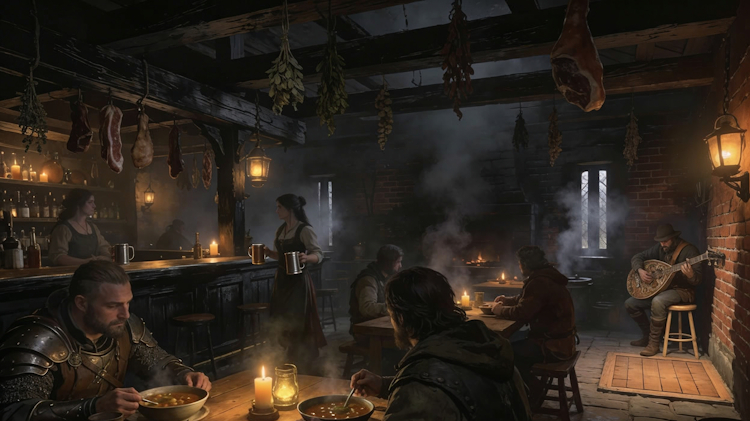
In a city where lordlings wage war over territory, and mercenaries flock to whoever pays best, a man needs somewhere to eat, drink, and keep his head down. The Bottom of the Barrel has served that purpose in High Holt for nearly thirty years, offering honest food, strong drink, and the kind of anonymity that keeps a person breathing in a place where asking the wrong question can get a blade slipped between one's ribs.
The tavern sits along one of High Holt's main interior lanes, deep enough within the city walls to avoid the worst of the sprawl that spills beyond the outer fortifications. A wooden sign swings over the door, painted with the image of a barrel tipped on its side, the last drops of ale spilling from the bunghole. The name was meant as a joke by its founder, Garren Thatch, a former salt hauler who spent twenty years moving heavy loads between High Holt's mines in the Alzion foothills and the city's trade depots. When his knees finally gave out, and he used his savings to buy a run-down alehouse, a friend remarked that Garren had scraped the bottom of the barrel with his purchase. Garren liked that well enough to hang it over the door, and the name stuck.
Garren never set out to build anything grand. He wanted a place where working men could get a decent meal without worrying about the lordlings' latest feud or which mercenary company had taken offense at which slight. What he built instead was something High Holt quietly needed: a neutral ground. The salt trade brought men from every corner of the Freelands and beyond—Seacean merchants negotiating contracts, caravan guards between jobs, miners spending their wages before the next haul. They needed somewhere to conduct business without pledging loyalty to one faction or another, and The Bottom of the Barrel became that place almost by accident.
The building itself is unremarkable by High Holt's standards, which is precisely the point. Brick walls darkened by years of cook smoke rise two stories, topped by a slate roof that leaks in exactly two places that Garren has never bothered to fix, claiming they keep the air circulating. The ground floor houses the main room, the kitchen, and a small storeroom. Garren's quarters occupy the upper floor, along with two rooms he occasionally lets to travelers willing to pay a fair rate and who do not look like they will cause trouble in the night.
Inside, the place is warm and perpetually smoky, the air carrying the mingled scents of whatever the kitchen has going and the cheap tallow candles that provide most of the light. Low wooden beams cross the ceiling, hung with dried herbs and the occasional cured ham, giving the room a close, sheltering feel that shuts out the cold and fog that creep in from the Blackwood Forest most evenings. The bar is a heavy slab of blackwood oak—one of the few genuinely impressive things in the establishment—salvaged from a fallen tree outside the city walls and planed smooth by a carpenter who owed Garren a favor. It has survived brawls, spilled drinks, and one incident involving a thrown axe that left a gouge Garren refuses to sand out, claiming it adds character.
The seating is a mixture of long communal tables near the center and smaller tables along the walls, with a few corner spots prized by those who prefer to watch the room while keeping their backs to solid stone. One such corner, close enough to whatever entertainment is playing to muffle quiet conversation, offers clear sightlines to both the front door and the kitchen passage. Regulars know this table is favored by men who have reason to be cautious, and they leave it open out of habit rather than any formal arrangement.
Garren runs the kitchen himself and takes genuine pride in his cooking, which is simple, filling, and better than it has any right to be given the prices he charges. His pork stew has earned something of a reputation—thick with root vegetables and seasoned with herbs he grows in a small plot behind the building, served with loaves of dark bread and butter. The recipe came from his mother, a miner's wife who understood that a working man needed substance over sophistication. He rotates through a handful of other dishes depending on what is available at market: mutton pies, roasted chicken, sausages with fried onions, and a fish soup he makes when the traders bring freshwater catch in from the rivers east of the city. The portions are generous, and the cost is fair—copper buys a meal, and silver gets a meal with drink and enough left over for a second round.
The drink selection is practical rather than extensive. Garren keeps three or four ales on tap, sourced from a local brewer who operates out of a cellar two streets over, along with a serviceable red wine imported from the Seacean lowlands and a rougher spirit distilled somewhere in the Freelands that he sells to those who want warmth more than flavor. He has never stocked anything fashionable or expensive, reasoning that a man who wants fine wine can find a lordling's hall to drink in.
Entertainment at The Bottom of the Barrel changes with the week and the season. Garren has no house musician and cannot afford to keep one on retainer, but High Holt's transient population ensures there is usually someone willing to play for a meal, a bed, or a few coins passed around in a hat. Flute players, fiddlers, lute strummers, and the occasional storyteller have all taken the small corner stool near the hearth, where a bit of open floor provides space for dancing when the mood strikes—though most evenings the mood does not strike, and the cleared space sits empty while patrons nurse their drinks and talk in low voices. The quality of the entertainment varies wildly, from genuinely talented musicians passing through on their way to or from the Four Fiefdoms to performers so poor that Garren has been known to offer them a free meal just to stop playing.
The barmaids—currently three women who rotate shifts throughout the week—are efficient, no-nonsense, and capable of handling trouble without calling for Garren's help. He hires from the city's working families, pays fairly by Freelander standards, and expects his staff to keep the drinks flowing and the peace intact. They know the regulars by name and by preference, remembering who tips well and who starts fights after his third cup. A familiar face walking through the door might earn a wave toward any open table and a promise to stop by in a minute, which passes for warmth in a place where excessive friendliness is treated with suspicion.
The tavern's clientele reflects High Holt's character as a fortress-city where power is earned rather than inherited. Tradesmen make up the backbone of the regular crowd—salt haulers, carpenters, smiths, and laborers who work the city's walls and keep its infrastructure from crumbling while the lordlings argue over who rules what. Mercenaries are the other constant presence, their companies flowing in and out of the city with the tides of conflict. They gather at the communal tables in groups defined by company allegiance, talking contracts and coin while sizing up the competition. Garren tolerates mercenaries because their money is good and they drink heavily, but he has made it clear through hard experience that company rivalries stay outside his door. The one time a dispute between sellswords turned violent inside the tavern, Garren settled it with a cudgel he keeps behind the bar—a short, iron-banded length of blackwood he calls "the Negotiator"—and banned both men for a season.
Garren himself is a broad-shouldered man in his late fifties, his hands scarred from years of hauling salt barrels and his knees testimony to the same. He keeps his grey hair cropped short, wears a leather apron stained beyond redemption, and speaks with the blunt directness common to Freelanders who have never seen the point in dressing up their words. He has no interest in politics, no loyalty to any lordling, and no patience for anyone who brings factional disputes into his establishment. This stubborn neutrality has served him well. Both sides of High Holt's current power struggle leave The Bottom of the Barrel alone, partly because Garren has never given either cause for grievance and partly because even soldiers need somewhere to eat that is not aligned with their rivals.
The tavern's reputation for neutrality has made it a quiet gathering point for those conducting business that requires discretion without the cloak-and-dagger atmosphere of seedier establishments. Salt merchants close deals over bowls of stew. Mercenary lieutenants sound out potential recruits away from the pressures of their camps. Travelers seeking guides for expeditions into the surrounding wilderness—the Blackwood Forest, the Hollow Hills, or, for the particularly desperate or foolish, the Grimmere—come here to make inquiries without attracting too much attention. Garren does not involve himself in his patrons' affairs, but he listens, and a man who has run a tavern in High Holt for three decades has heard enough to know when trouble is walking through his door. He will not warn a patron away from a bad decision—that is not his business—but he has been known to pour a free drink for someone about to embark on something dangerous, which is as close to sentiment as he allows himself.
The Bottom of the Barrel makes no pretense of being anything other than what it is: a working tavern in a hard city, built by a man who spent his youth breaking his body for someone else's profit and decided to spend his remaining years on his own terms. It lacks the history of establishments that have stood for generations, the refinement of taverns that cater to the wealthy, and the intrigue of places where assassins and spies conduct their shadowy business. What it offers instead is reliability—a hot meal, a strong drink, a seat by the fire, and the assurance that whatever is happening outside, inside these walls, a man can eat in peace. In the Freelands, where loyalty shifts like sand and today's ally may be tomorrow's enemy, that kind of constancy is worth more than most people realize.